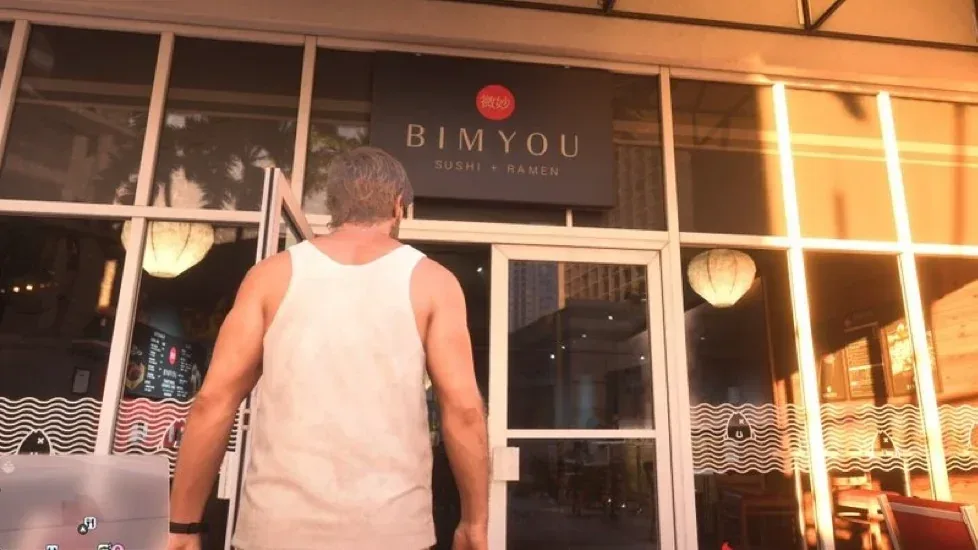
Grand Theft Auto VI has found one of its sharpest small-scale Vice City gags in an unlikely place: a café storefront. Bimyou looks, at first glance, like a Japanese restaurant. Its sign promises sushi and ramen. Step inside, however, and the business is a coffee shop, while “sushi” and “ramen” turn out to be labels for bread rather than the meals a visitor might reasonably expect.
The joke has landed especially well with Japanese players, for whom the name supplies the key punchline. Bimyou translates as “mediocre,” making the café’s apparent attempts at sophisticated Japanese-inspired branding feel deliberately deflated from the outset. It is a knowingly unimpressive name for a venue whose exterior imitates eateries that present Japanese cuisine as a premium, elevated experience.
That setup alone is a neat bit of environmental comedy: the sign sells one idea, the interior changes the premise, and the business name admits that the whole operation is not nearly as grand as it wants to appear. But the gag has another detail that makes it more than a simple joke at the expense of bad restaurant branding. One of Bimyou’s bread varieties is Coppepan, a Japanese bread that resembles a hot dog bun while having a distinct taste. So the café does have a real Japanese culinary connection—just not in the form its sign initially suggests.
A storefront built around misdirection
Environmental storytelling is the practice of communicating character, tone, or a joke through a game world’s objects and spaces rather than through a cutscene or an explicit explanation. Bimyou is a compact example. Players do not need a quest marker, a lengthy conversation, or a formal reveal to understand the joke. The storefront provides the first assumption: sushi and ramen mean restaurant. The coffee-shop interior overturns it. The bread labels extend the absurdity. Then the name supplies a final, sarcastic verdict.
That structure matters because it rewards attention. A player rushing through Vice City might register Bimyou as another fictional business. Someone who enters discovers the menu switch. Someone who understands the name gets a further layer. And someone who recognizes Coppepan finds that the game has tucked a sincere cultural reference inside an otherwise pointed parody.
It is a good fit for a series built around fictional commercial worlds. A made-up brand can do more than fill a street corner; it can compress an attitude toward marketing, consumer expectation, and cultural shorthand into a few signs and products. Bimyou’s humor does not depend on presenting an elaborate fictional company history. The deliberately odd mismatch between its advertising and its actual offering does the work.
Why Japanese players are responding to it
Discussion around Bimyou has focused on the familiar experience of seeing Japanese words used outside Japan as atmosphere rather than language. Players responding to the café joke have pointed to real-world businesses that frame ordinary Japanese terms as if they express an expansive lifestyle philosophy, or select words primarily because they sound Japanese without fully considering the meaning.
That is why “Bimyou” is more precise than a random invented name. Its meaning turns the premise into self-parody. The establishment is not merely using Japanese language as decoration; it is using a word that undercuts its own polished presentation. For Japanese players, the contrast is recognizable enough to be funny: a venue performing authenticity and refinement while effectively calling itself mediocre.
Related coverage includes GTA 6's 'Bimyou' Café Has Japanese Players Laughing at a Sharp Restaurant Joke.
The conversation also touches on food. Some of the players enjoying the gag noted that Japanese-themed restaurants can offer food that bears little resemblance to what people would encounter in Japan, while also charging far more for the experience. GTA VI’s café does not need to establish a one-to-one target for its satire. Instead, it plays with the broad tension between a restaurant’s image and what it actually delivers.
That distinction is important. The comedy is not simply “Japanese restaurant bad.” Bimyou works because the game gives the business a contradictory identity: it advertises recognizable dishes, operates as a coffee shop, names bread after those dishes, and puts a bluntly modest Japanese word above the door. The target is performative branding and the confidence of a place selling an idea that does not quite line up with the product.
Coppepan keeps the joke from being purely superficial
The Coppepan reference is the detail that gives Bimyou a little more texture. Coppepan is described as a Japanese bread reminiscent of a hot dog bun but different in taste. Its presence means the café’s connection to Japan is not wholly fabricated. The location is not serving sushi or ramen as the sign initially leads players to believe, yet it does sell an item connected to Japanese bread culture.
That does not cancel the bait-and-switch. It makes the switch more playful. A player can reasonably think, “This is not a Japanese restaurant,” and then discover that the café has included a specifically Japanese bread anyway. In other words, Bimyou is not exactly what it pretends to be, but it is not entirely disconnected from its branding either.
There is also a practical lesson for players who enjoy GTA VI’s smaller details: interiors and product labels can be worth inspecting even when they are not tied to a mission. The game’s city spaces can hide jokes that unfold across a sign, a menu, and an item description rather than a single obvious punchline. Players looking for other discoveries across Leonida may also want to consult this guide to the Exotic Animals Front parrot cash stash.
A familiar kind of GTA commercial satire
Bimyou is not presented as the first time the series has used a Japanese-flavored business name for a joke. Players discussing the café have recalled a store named Nutsaki in an earlier entry. That comparison places Bimyou within a longer pattern of exaggerated fictional commerce, where the joke is often embedded in a brand name before a player even walks through the door.
Still, Bimyou appears more layered than a name alone. “Nutsaki,” as remembered by players, is a quick verbal gag. Bimyou couples wordplay to a physical space and menu concept. The false promise of sushi and ramen is readable to anyone who sees the signage. The coffee-shop reveal changes the context. The name rewards Japanese-language knowledge. Coppepan then adds an unexpected point of specificity.
That combination explains why a humble café has attracted attention amid broader conversations around GTA VI. Massive open-world games are often discussed through their headline-scale elements: map size, story developments, major systems, or controversies. Yet a small location can sometimes show the most concentrated version of a game’s voice. Bimyou is a side detail, but it is a complete comic sketch told through design.
What Bimyou says about reading game-world details
There is an easy temptation to treat fictional signage as background texture. In GTA VI, Bimyou demonstrates why it can be worth reading it literally and then questioning it. The sushi-and-ramen claim is technically not what it seems; the business is selling bread with those names. The name itself is not a lofty slogan, either. It is the opposite of one.
For players who do not speak Japanese, the café can still be funny as a deliberately confusing restaurant concept. For players who do, “Bimyou” adds a more direct sarcastic edge. And for those who notice the Coppepan offering, the location becomes a joke with a carefully placed exception. Each level is self-contained, rather than requiring a player to understand every reference to appreciate any of it.
That is effective satire in miniature. It does not lecture the player about restaurant authenticity or branding. It lets a coffee shop advertise sushi and ramen, sells bread instead, and labels itself mediocre. The rest follows from paying attention.
Vice City is full of places designed to catch the eye. Bimyou stands out because, once players stop and look, it makes a modest storefront carry several jokes at once. The Japanese response suggests the word choice was not incidental. It transformed an already amusing menu fake-out into a pointed parody of how language, cuisine, and prestige can be packaged together—and occasionally packaged very badly.