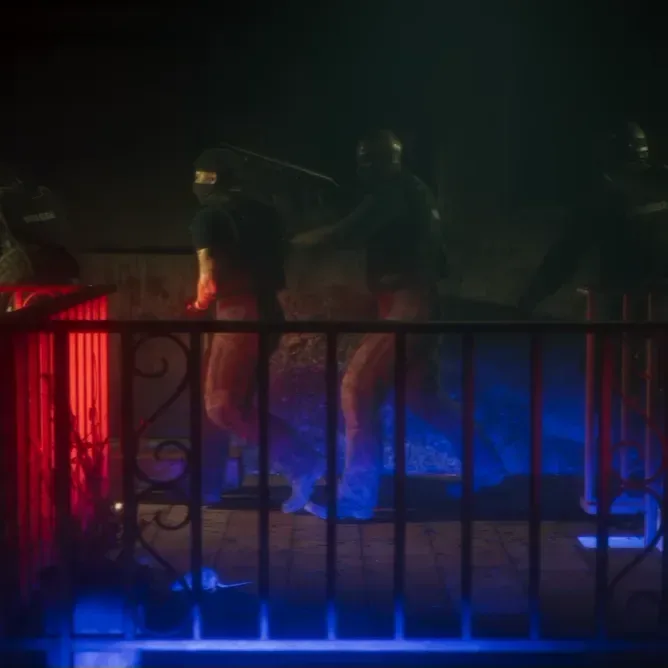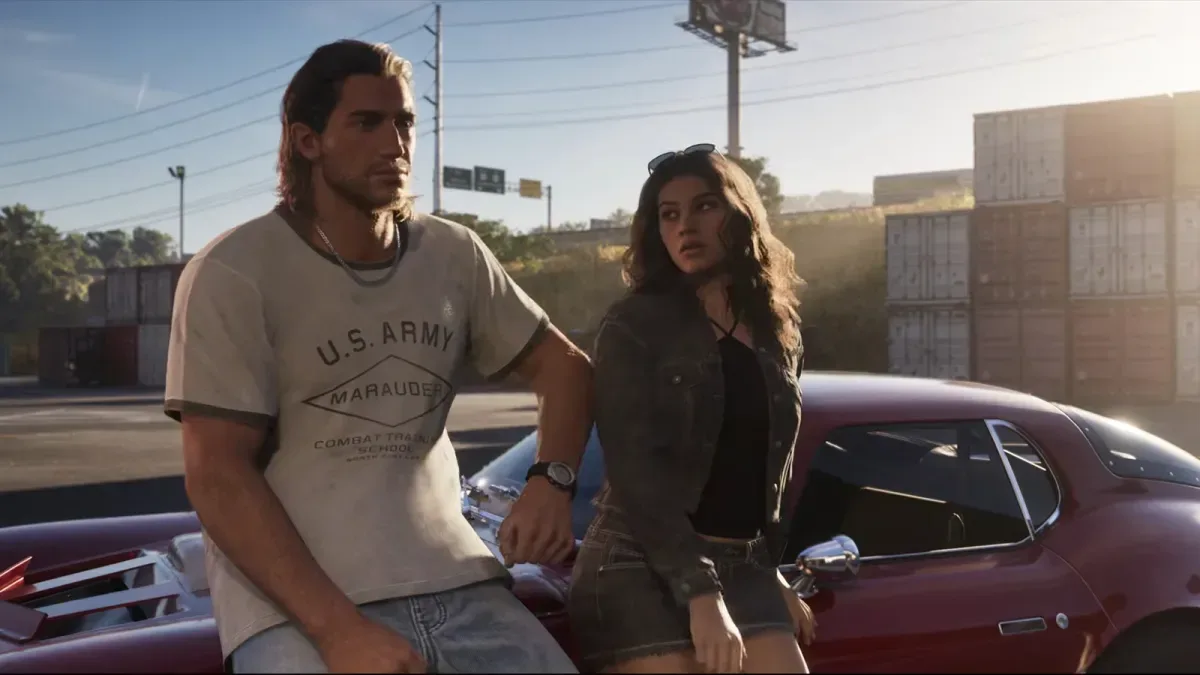
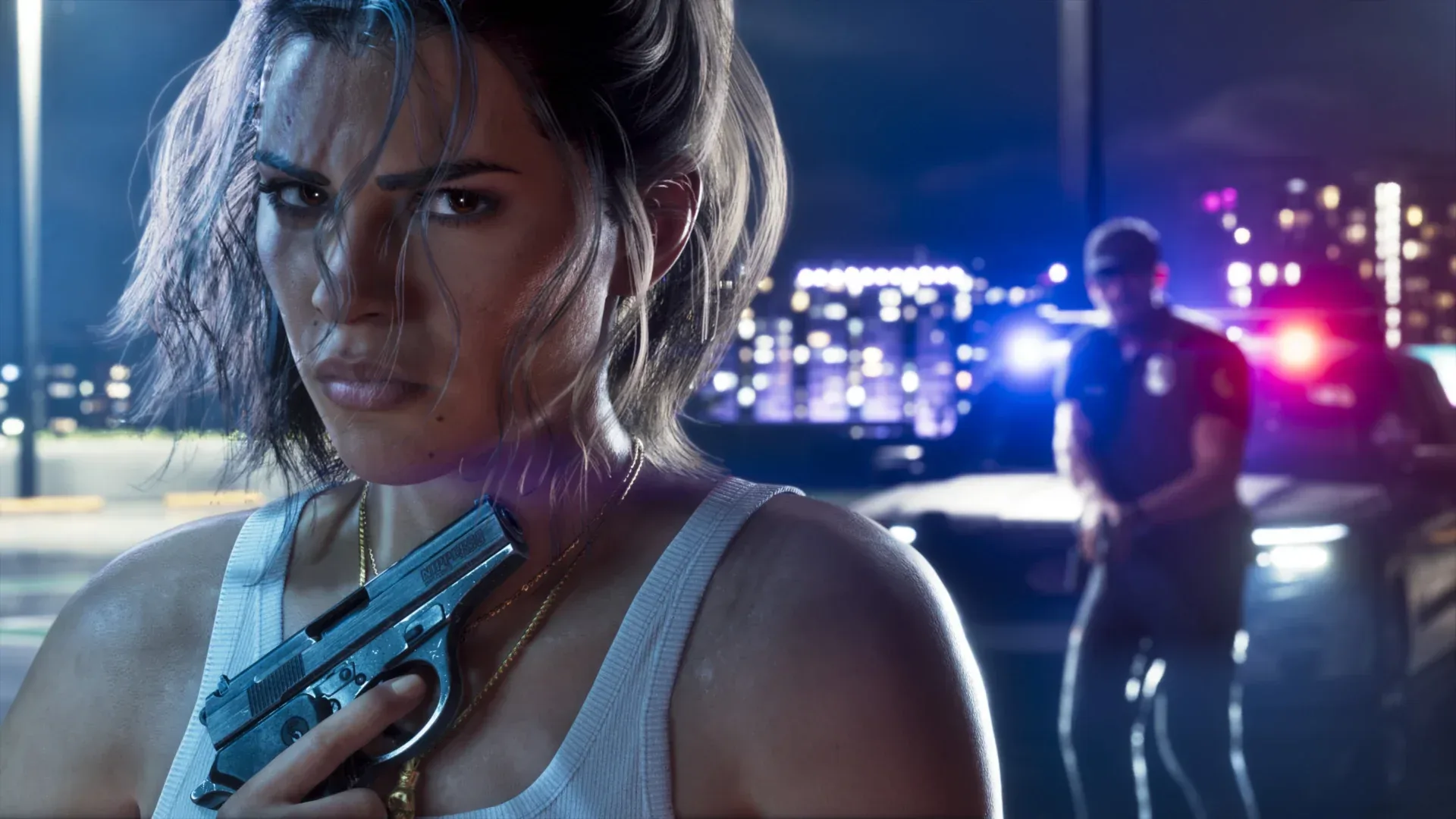
For most of Grand Theft Auto history, police radio chatter has occupied that comfortable, strange space between game interface and world detail. Commit a crime, trigger a response, and dispatch begins describing the player’s actions. It is an instantly recognizable part of the series’ pursuit scenes, present since the first mainline game, but traditionally it has not needed an explanation. The player could hear it because the game wanted the player to know what was happening.
Grand Theft Auto 6 changes that arrangement. Early in the game, Jason’s friend Cal takes Jason’s phone and installs a custom, homebrew police-radio scanner application. The small story beat establishes that Jason can hear police reports because he has a scanner. When the game later allows free roaming as Lucia, she also has the scanner app, although the installation itself is not shown.
It is a modest piece of exposition, but it does more than tidy up an old videogame convention. By putting the scanner on the protagonists’ phones, GTA 6 makes dispatch audio information that exists for Jason and Lucia as well as for the person holding the controller. During pursuits, they can respond to reports that police have identified their vehicle or noticed their clothing. That turns a familiar audio cue into shared knowledge inside the fiction.
A classic GTA signal now has a clear owner
Police chatter has long been useful because it translates a complicated chase into understandable information. A player does not necessarily need to see every responding officer or infer every escalation from the map. Dispatch dialogue can tell them that authorities are looking for a suspect, pursuing a particular vehicle, or reacting to a recent offense.
Before GTA 6, that information could be read as a purely player-facing layer. Characters such as CJ or Tommy Vercetti did not need a visible radio receiver for the mechanic to work. Like respawning after failure or protagonists remaining the same age through enormous amounts of activity, it was a convention audiences could accept without demanding a literal answer.
The scanner app gives the feature an in-world explanation. In game-design terms, that means a mechanic is accounted for by the setting and its characters rather than existing solely outside the story. Jason does not merely benefit from the player hearing dispatch; he has access to dispatch traffic through the phone Cal modifies. Lucia’s matching access means the two playable leads are operating with the same kind of awareness once the game shifts to her free-roam play.
That distinction may sound narrow, but it affects how a chase is understood. If a report says law enforcement has spotted the protagonists’ car, the line is no longer just a prompt for the player to reconsider a route. Jason and Lucia have heard it, too. Their dialogue during escapes reinforces this point: they comment on the reports as information relevant to their own decisions.
Why the explanation matters to gameplay
The key practical effect is clarity. GTA 6’s scanner reports can communicate whether police attention has settled on more than the protagonists themselves. The supplied details indicate that dispatch may identify their car or report their clothing. Those are materially different forms of recognition in a pursuit: a vehicle report points attention toward what they are driving, while a clothing report identifies aspects of their appearance.
Related coverage includes GTA 6 Gives a Long-Running Police Radio Feature an In-World Explanation.
The game’s framing means players should treat the chatter as more than mood-setting audio. It is part of the characters’ situational awareness. When Jason or Lucia reacts verbally, the scene connects three things that games often keep separate: the system tracking police attention, the sound conveying that status, and the characters inhabiting the world.
What is confirmed: Cal installs a homemade police scanner program on Jason’s phone early in GTA 6; Jason can subsequently hear police reports concerning his actions, crimes, and location; Lucia has the same app once she becomes available for free roaming; and the protagonists acknowledge dispatch reports during chases, including reports concerning a vehicle or clothing.
What should not be assumed: the available details do not establish every condition that changes police reporting, whether the app can be upgraded or disabled, or exactly how any particular report changes pursuit systems. It would be easy to turn the concept into an elaborate theory about disguise, vehicle switching, or wanted-level rules, but those specific mechanics are not established here. The safer reading is that the radio chatter supplies meaningful context during escapes and that GTA 6 makes the characters consciously privy to it.
Cal’s app is a compact piece of character work
The setup also uses an ordinary object—the phone—as the bridge between a legacy game mechanic and the story. Cal is described as Jason’s hacker friend and stoner buddy, making a custom scanner program a natural favor for him to perform. The scene does not need a lengthy technical explanation about radio frequencies, police networks, or mobile software. Its job is simply to establish why Jason has access to traffic that previous protagonists heard without comment.
That restraint matters. A police scanner, in the broad sense, is a receiver or program used to monitor radio communications. GTA 6’s homebrew version is not presented in the available information as a detailed simulation of real-world communications technology. It is a narrative device that validates the audio feed players already recognize. Cal’s involvement provides a credible-enough connection without making the game pause for a lesson in communications infrastructure.
Lucia’s installation happens off-screen, if it happens as a discrete scene at all. Rather than presenting that absence as a contradiction, it reads as an economical handoff. The important point is that she has the same access when free-roam control shifts to her. The game can therefore retain the same familiar police-report language across both protagonists while maintaining the idea that each can actually hear it.
From invisible interface to diegetic information
A useful technical term here is diegetic. In narrative media, something diegetic belongs to the story’s world: characters can plausibly perceive it. Non-diegetic elements are for the audience alone, such as a traditional score that characters cannot hear or a menu that exists outside the fiction.
Police chatter in older GTA games could reasonably be treated as non-diegetic gameplay feedback. It helped the player understand police behavior, even if nobody on screen appeared to be listening. GTA 6 moves it toward diegetic information by making the scanner app part of Jason’s and Lucia’s equipment and having them discuss what dispatch says.
That is not necessarily a claim that every GTA system must now receive a lore explanation. The series has always made room for abstraction. Players accept unusual recovery, mission restarts, and other conveniences because games need readable rules. The appealing part of GTA 6’s decision is precisely that it addresses one recurring oddity without pretending it has solved every gap between simulation and gameplay.
It also demonstrates an efficient design principle: an explanation has more value when it supports behavior. If the app only existed as a throwaway joke, it might be a neat reference with little effect. Instead, the protagonists use the reports while attempting to escape, so the premise earns its place in scenes where players are likely listening closely.
A small detail with larger implications for GTA 6’s chases
The police scanner does not suddenly make GTA’s chases realistic in a literal sense, nor does it need to. Its contribution is coherence. Players receive the useful dispatch information the series is known for, while Jason and Lucia gain a believable reason to make decisions based on the same information.
That shared awareness can make pursuit dialogue feel more grounded. When a character reacts to a report about a car or clothing, the response is connected to a fact the player has just heard rather than to knowledge that appeared from nowhere. It is a simple technique, yet it reduces the gap between what the player knows and what the protagonist seems to know.
The detail sits alongside other GTA 6 features that emphasize Vice City as a place players can continue to inhabit; the game’s broader post-finale exploration setup is covered in our look at how GTA 6 keeps Vice City open after the finale. Here, though, the focus is much smaller and more immediate: dispatch chatter is no longer floating above the action as an unexplained convenience.
There is humor in the fact that a feature present since the original game has finally received such a direct explanation. GTA has never required every part of its world to stand up to forensic scrutiny. Yet the scanner app is a smart answer because it preserves the old mechanic exactly where it is most useful while allowing Jason and Lucia to participate in it.
For players, the takeaway is straightforward. Listen to the chatter during pursuits. GTA 6 presents it not just as background noise or a detached system notification, but as intelligence the protagonists can hear and discuss. Cal’s improvised phone software turns an old series convention into a piece of character equipment—and gives one of GTA’s most familiar sounds a place in the world at last.