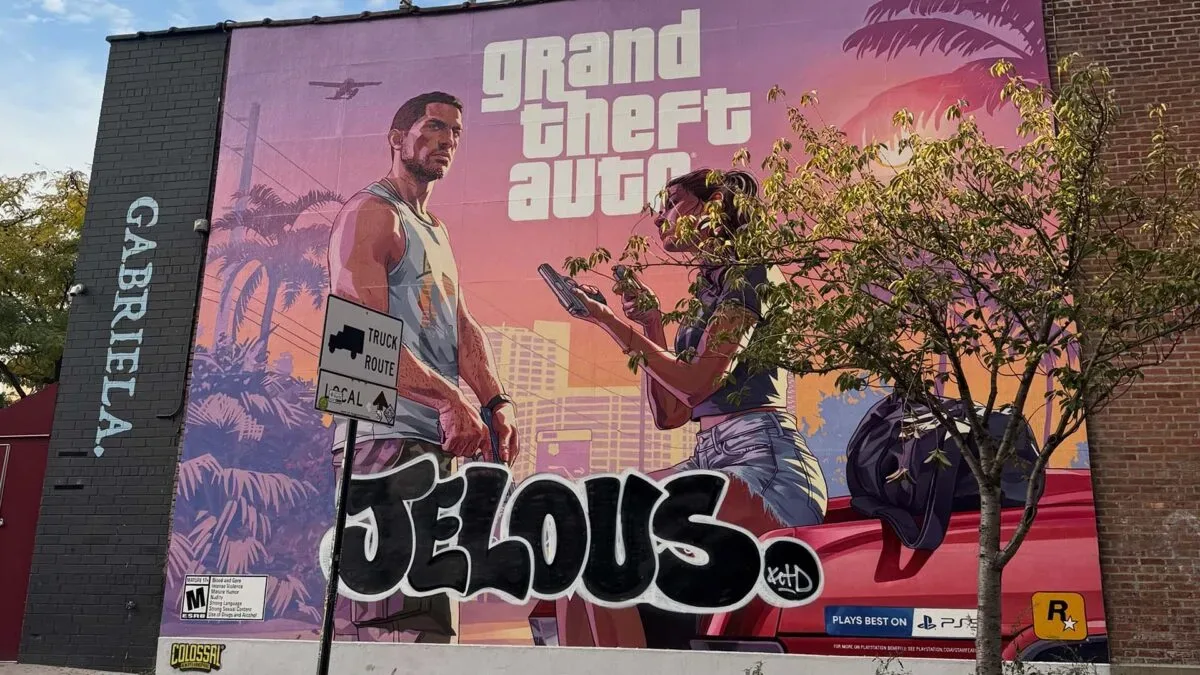
A large Grand Theft Auto 6 mural in Brooklyn has become the latest battleground in an argument that is much bigger than a single black-and-white name mark. The mural, commissioned by Rockstar Games and painted by hired artists in early October, depicts GTA 6 protagonists Jason and Lucia. After roughly a week of work, it became a visible marker of the game’s public marketing campaign—and a point of excitement for fans who had followed the painting’s progress.
Late Tuesday, graffiti artist Jelous added a tag to the lower half of the work and later documented it on Instagram. The response has been sharply divided in the broadest sense, but the loudest fan reaction has been negative. Many viewers see an elaborate, hand-painted mural that required planning, time and professional skill being overwritten by a comparatively simple tag. Others argue that a major corporate advertisement placed in public space is not entitled to special protection from the city’s visual conversation.
That split is precisely why this has traveled beyond a routine piece of GTA 6 promotional news. It is a disagreement about who gets to claim public-facing art, whether the identity of the commissioner changes the ethics of painting over it, and how a game built around lawbreaking and urban satire inevitably complicates the reaction.
What happened to the GTA 6 mural
Rockstar Games hired artists to create the large Brooklyn mural in early October. It features Jason and Lucia, the central characters associated with GTA 6, and took approximately a week to finish. Fans watched its development and celebrated the completed image, treating it as a conspicuous sign that the game’s marketing was becoming more visible in the physical world.
Jelous then placed a basic black-and-white logo bearing the artist’s name across part of the mural’s bottom half. The act was documented on Instagram, where the post quickly became one of Jelous’s most popular posts. In practical terms, that result explains why a high-profile surface can be attractive: visibility is part of what a tag seeks to achieve. A work attached to one of gaming’s most anticipated releases brings an existing audience, a recognisable image and an immediate online reaction.
That attention has not translated into broad approval. Comments on Instagram included brief condemnations such as “Ruined” and “Not cool.” Discussion elsewhere was harsher, with GTA fans calling the act vandalism or criticizing its execution. Some commenters’ objection was not only that the mural was altered, but that the added design was minimal relative to the scale and detail of the painting beneath it.
A tag is not the same thing as a mural
It helps to be clear about the terms being debated. A tag is generally a stylised written name or signature, often made quickly. It is a way for an artist to establish presence and recognition. A mural, by contrast, is a large-scale painted image. In this case, it was a commissioned promotional artwork with characters, composition and a substantial production period behind it.
Those different forms can serve different purposes, and the distinction is central to the backlash. The GTA 6 mural was designed to be legible to passers-by as a polished campaign image. Jelous’s mark was designed to identify Jelous. The two visual languages are therefore in direct tension: one is a controlled brand presentation, while the other asserts an individual artist’s name over that presentation.
Related coverage includes GTA 6 Brooklyn Mural Draws Backlash After Overnight Tagging.
Calling the latter “just graffiti” does not settle the question, either. Graffiti encompasses a broad range of practices and opinions, rather than one universal rulebook. Still, one commenter who identified themselves as an Italian graffiti artist argued that painting over the GTA 6 image was disrespectful even within graffiti culture. Their point was not that commissioned work becomes untouchable merely because it is commercial. Instead, they stressed that the people who physically made the mural invested time, effort and skill, and that this labour should matter.
“Graffiti is about expression, but it’s also about respect,” the commenter wrote, arguing that commercial status alone does not automatically make a painted work fair game to destroy.
That view captures a key part of the negative response. The complaint is not simply a defence of Rockstar’s advertising budget. It is also a defence of the artists who painted the mural. For critics of the tag, the immediate visual target may be a huge game publisher, but the surface that was changed is nonetheless the result of other artists’ work.
Why the corporate-ad argument persists
The counterargument has force because the mural is not a neutral public artwork: it is promotional material funded by a corporation. It was made to generate interest in a forthcoming entertainment product. From that perspective, treating the wall as a protected cultural object can look like granting a brand an exception that ordinary street art does not receive.
Supporters of Jelous have made a version of exactly that case, describing the mural as a giant advertisement and therefore a fair target for a tag. The logic is straightforward. An enormous commercial image occupies public view, benefits from a recognisable location and asks people to engage with a company’s message. A response that disrupts the message can be understood as an assertion that the space does not belong exclusively to the advertiser.
But “corporate-funded” and “artistically worthless” are not interchangeable descriptions. The GTA 6 mural can be both an advertisement and a labour-intensive painting. That is why the debate resists an easy answer. One side focuses on the power and visibility of the company behind the campaign; the other focuses on the labour and visual work that has been painted over. Both observations can be true at once.
The weak point for people defending the tag may be the gap between the act’s possible statement and its visible result. Critics have argued that if an artist chooses to go over a large mural, the new work should offer a comparably compelling image, technical display or pointed message. Jelous’s simple name mark has instead left opponents seeing the move as opportunistic: it has gained enormous attention by attaching itself to a far more elaborate and already famous piece.
The GTA irony is real, but it is not a verdict
There is an obvious layer of irony in all this. Grand Theft Auto is a series closely associated with crime, disruption and satire of consumer culture. A graffiti artist tagging a giant GTA 6 promotion sounds, on paper, like an act that belongs in the franchise’s own visual universe. The contradiction between an outlaw-flavoured game campaign and a real-world unsanctioned tag is naturally part of why the story has drawn so much interest.
Yet that irony does not decide whether the alteration was respectful, effective or artistically successful. GTA’s fictional world makes space for reckless behaviour because it is a game world designed around it. The Brooklyn mural is a real physical work made by real people, and its audience is not obligated to admire an intervention just because it resembles something a GTA character might do.
In fact, the franchise connection may have intensified the reaction. Fans had been tracking the mural while it was being made, so they did not encounter it merely as a polished campaign asset that appeared overnight. They saw its creation as an event. By the time it was tagged, the mural had become a small shared landmark for people anticipating GTA 6. Altering it thus registered not only as a challenge to Rockstar’s marketing, but as a change to something fans had already invested attention in.
Attention was the immediate outcome
Whatever one thinks of the tag, the immediate visibility goal worked. Jelous’s Instagram documentation became one of the artist’s most popular posts, and the mural itself received another burst of discussion. The attention economy around street art and social media is relevant here: an action on a highly recognizable work can move rapidly from a local wall to a wider gaming audience once it is photographed and shared.
That does not mean notoriety equals endorsement. The high engagement has largely come alongside criticism, and the incident has made the artist’s name more widely known while also attaching it to a dispute over the treatment of another group of artists’ work. Visibility can be valuable, but it is not the same as consensus about the quality or ethics of the act.
It also illustrates how contemporary game marketing can become participatory in unexpected ways. A physical campaign piece is no longer just a one-way ad once passers-by photograph it, fans track its creation, and another artist alters it. The mural becomes a live object of argument. Social platforms amplify each stage: the build, the completion, the tag and the backlash. For a related look at how Instagram is continuing to expand tools aimed at creators, see Instagram’s Edits update for Mac.
What the argument is really about
The dispute is unlikely to produce a rule that satisfies everyone. A corporate mural is still an advertisement, and people will reasonably question why commercial imagery should be treated as above intervention. At the same time, the fact that a company commissioned it does not erase the work of the artists who spent a week producing the image.
The response to Jelous’s tag shows that many GTA fans and some graffiti-minded commenters place value on that distinction. For them, respect for artistic effort is not cancelled out by the Rockstar logo or by the mural’s marketing function. For defenders, the mural’s commercial purpose is exactly what makes it a legitimate surface for an unsanctioned reply.
There is no evidence here of a resolution, restoration or official response. What is clear is that the tag has done more than alter a painted wall. It has turned a GTA 6 promotion into a debate over authorship, public space, artistic etiquette and the difference between being noticed and being appreciated.