Grand Theft Auto 6’s version of Vice City is proving that a living open world does not need every memorable encounter to begin with a chase, a gunfight, or a stolen vehicle. A run of circulating clips puts animals at the center of the game’s smallest and strangest moments: Jason pets cats and dogs, sits behind a dog apparently steering a jet ski, runs afoul of an aggressive cat during a car theft, and becomes an alligator’s very unfortunate lakeside visitor.
It is a mix that feels appropriately chaotic for GTA. Animals are not presented as one-note scenery. Some are companions or harmless neighborhood color. Others abruptly turn a routine player action into a problem. There is also a pet snake feeding sequence, complete with dead mice, and footage of a giant crab. The common thread is not simply that wildlife exists in the world; it is that the clips depict animals reacting within it.
That distinction matters. Background wildlife can make a map appear busy, but interactive wildlife can change the rhythm of play. A player who stops to pet a cat has made a voluntary detour. A player who meets an alligator in the water has discovered an environmental hazard. A cat hidden in a target vehicle, meanwhile, can turn a familiar crime-game impulse into a surprise interruption. The clips suggest that GTA 6 is getting considerable mileage out of encounters that are small in scale but highly shareable.
A dog with goggles may be Vice City’s most responsible boater
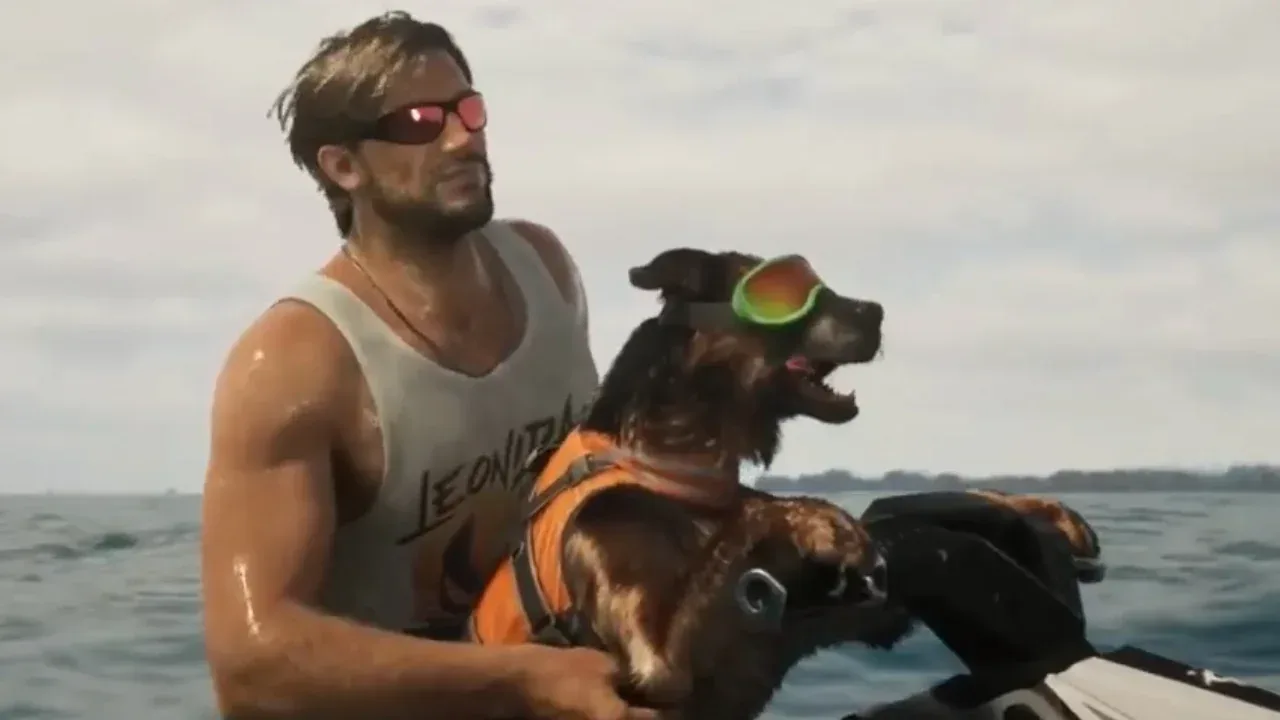
The breakout image is hard to beat: Jason rides on the back of a jet ski while a goggle-wearing dog occupies the front position, paws on the handlebars. Whether the scene is a carefully arranged piece of player-driven nonsense or a more authored interaction, the visual communicates something valuable about the game’s tone. GTA has always accommodated absurdity, and this is the kind of unscripted-looking absurdity that players are inclined to pass around immediately.
It also reframes the jet ski from pure transport into a miniature character scene. Rather than merely using a vehicle to cross water, Jason shares the moment with a dog that appears to be in charge. That is the entire joke, and it is enough. Games with big maps frequently depend on travel, so a small interaction that makes travel feel less mechanical can have an outsized effect on how players remember a place.
The dog clip is especially effective because it does not need mission context to land. Anyone can understand it in seconds: dog, goggles, jet ski, apparent pilot credentials. That makes it ideal short-form material while still pointing toward a larger question about the game’s systems—how often can residents, vehicles, watercraft, and animals create these odd little scenes when they overlap?
Petting is charming—until an ordinary action goes wrong
The gentler side of the footage is straightforward. Jason can pet a puppy, and another clip shows him petting a cat. These are modest interactions, but their appeal should not be dismissed simply because they are mundane. Petting an animal is an optional action with no obvious criminal objective. It asks the player to pause and acknowledge a creature in the environment rather than treat everything on the street as an obstacle, a target, or a prop.
One clip also points to the fragility of those pleasant moments. A puppy-petting scene can change dramatically if a car door is opened badly. That is a useful example of emergent interaction: a result created by multiple systems meeting rather than a result that is necessarily staged as a fixed mission beat. In this case, a character interaction, vehicle movement, and an animal’s presence may collide into an outcome that is funny, uncomfortable, or both.
Related coverage includes GTA 6 Animal Clips Show Vice City's Cute, Chaotic and Dangerous Side.
Emergent interaction is a broad term, and it is worth keeping the claim narrow. The clips do not establish every rule governing animals, vehicles, or player choices across GTA 6. They do show the potential of ordinary systems to produce unexpected consequences. For a series built around player freedom, that potential is more meaningful than a single isolated novelty animation. A petting prompt is cute. A petting prompt that exists in a world where nearby traffic and doors can complicate the moment makes that world feel less sealed off.
Not every animal encounter is an invitation to be nice
The animal footage does not stay wholesome for long. In one clip, Jason attempts to steal a car and discovers that a cat is in the back. The cat responds aggressively. It is a sharp reversal of expectations: the would-be thief is not initially stopped by law enforcement, an armed owner, or a locked door, but by a furious feline passenger.
The scene works because it turns a familiar GTA action into a local, specific inconvenience. Vehicle theft is a central open-world activity; the cat changes the texture of it. The game does not need to make every animal encounter consequential for it to matter. Even a brief interruption can make a vehicle feel like it belongs to somebody and is being used as a real space, rather than functioning solely as a convenient object for the player to acquire.
Then there is the alligator. Jason approaches one in a lake and is attacked, making the danger considerably less theoretical. The animal is a reminder that the Florida-inspired setting is not just a collection of beaches, roads, and neon-soaked urban jokes. Water and wetlands can carry risk. A player who moves through those spaces may need to consider more than routes, police attention, and rival NPCs.
The practical implication is simple: players may want to treat animal encounters as situational rather than decorative. Friendly-looking pets invite interaction, but wildlife—particularly a large predator in its habitat—can demand distance. The clips do not provide a complete survival guide or establish exact behavior rules, so it would be premature to declare a universal strategy. Still, the alligator footage makes one lesson abundantly clear: stomping around in its lake is not a reliable way to make friends.
The snake and the crab push the simulation toward the bizarre
A pet snake sequence adds another layer to the animal mix. The footage shows a snake being fed dead mice and constricting them. Unlike a passing cat or dog, a snake kept as a pet implies a more persistent relationship between a character and an animal. At minimum, it depicts an interaction with a specific feeding behavior rather than a simple pat or ambient animation.
That is important because it broadens the kinds of animal moments visible in the game. Cats and dogs make a city feel inhabited. Predators such as alligators make its natural spaces dangerous. A snake-feeding scene is closer to a domestic simulation, focused on care, feeding, and an animal behaving in a way that some players will find fascinating and others will find unpleasant. GTA 6’s animal ecosystem, as glimpsed here, is not confined to a single emotional register.
And then there is the giant crab. Its appearance is a fittingly odd punctuation mark for a batch of clips already swinging from adorable to alarming. There is not enough in the footage described here to define its gameplay role, size category, or broader significance. What it does establish is that players should not assume the animal roster is limited to familiar pets and the expected Florida-coded threat of an alligator.
Why small animal systems can make a huge map feel more convincing
Large game worlds face a persistent challenge: size alone does not create a sense of place. A map can contain enormous distances and still feel repetitive if the player’s actions produce the same results everywhere. Animals are one way to break that pattern. They can occupy homes, vehicles, shorelines, lakes, and streets, creating different kinds of attention depending on where the player is and what they are doing.
The clips make Vice City look less like a sequence of activity icons and more like a setting with distractions, hazards, and moments that do not obviously exist to advance a mission. A cat is not necessarily there to provide loot. A puppy is not necessarily a quest marker. The alligator is not a conventional boss fight. Their value is in the possibility that a player will encounter them while doing something else, then react.
That reaction is often the real content. Players laugh at the dog operating the jet ski, recoil at the snake feeding, sympathize with the pettable animals, and learn not to trespass in an alligator’s water. A short clip can spread because it captures a distinct emotional beat without requiring the viewer to understand the larger plot. That is why the animal footage has become such a useful early showcase for the game’s world detail.
It also illustrates an appealing contrast at the heart of GTA 6. Jason and Lucia occupy a game built around crime and disorder, yet some of the most memorable scenes currently circulating are about stopping to pet a cat or seeing a dog dressed for aquatic success. The violence and threat remain close at hand—the aggressive cat and alligator prove that—but the world is given room for silliness and tenderness too.
For more on the wider soundscape expected around Vice City, see the reported hip-hop tracks connected to GTA VI’s radio. The animal clips, however, make their point without a soundtrack: whether players are boating with a dog, approaching a lake, or opening a car door near a puppy, Vice City appears determined to keep them guessing.