GitHub briefly put an unusually volatile gaming topic front and center: PlayStation 5 emulation, Grand Theft Auto 6, and the question of whether moving a game to a different place to run crosses a legal boundary.
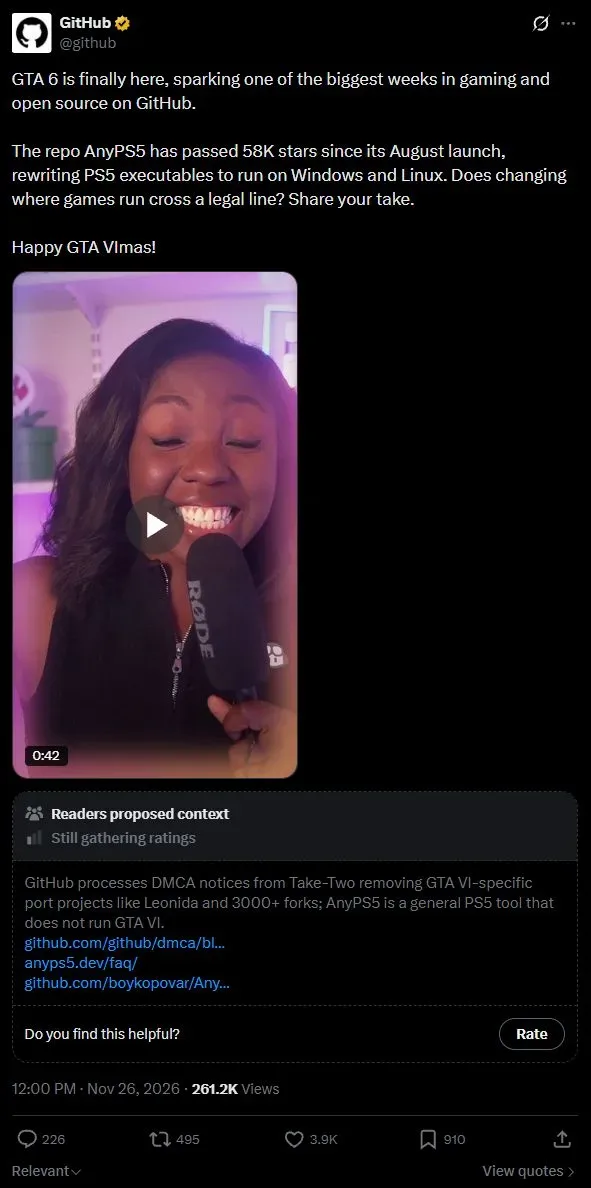
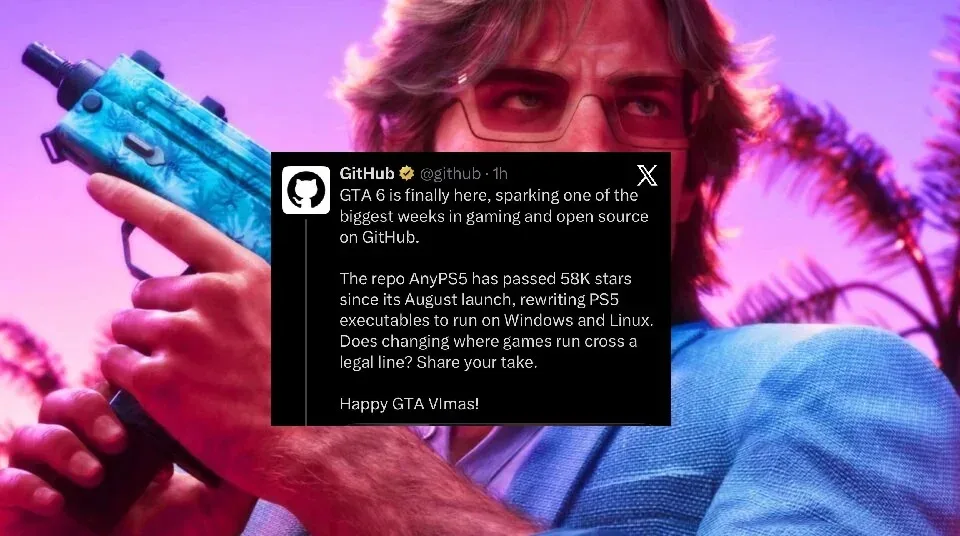
The Microsoft-owned code-hosting platform published a post on X that celebrated the rise of AnyPS5, a PS5 emulator project, saying it had reached 58,000 stars after launching in August. The post framed the release of GTA 6 as a major catalyst for gaming and open-source activity on GitHub, and included the pointed question: “Does changing where games run cross a legal line?” The post was subsequently deleted.
That sequence is remarkable less because it settles anything than because it emphatically does not. A social-media post cannot resolve the legal status of an emulator, a game port, or software developed around a newly released commercial game. But putting that deliberately provocative question alongside a celebration of interest in a PS5 emulator, as GTA 6 arrived, made it easy to read the post as wading into a dispute with enormous commercial stakes.
For the immediate release context, see our November 26 games release roundup.
What GitHub’s deleted post actually connected
The post did not merely note that an emulator existed. Its opening tied GTA 6’s arrival to an exceptionally busy week for gaming and open source on the service. A video included with the post also highlighted a message attributed to an AnyPS5 contributor urging others to get developers working with three days remaining before GTA 6.
That matters because the conversation was not an abstract discussion of preservation, compatibility research, or old hardware. The social post connected attention around a current, high-profile release directly to the project’s visibility and development energy.
GitHub’s “star” figure also needs a little context. On GitHub, a star is a user signal that a repository is interesting, useful, or worth following. It can be an indicator of attention and community enthusiasm. It is not, by itself, proof that the software works with a particular game, that someone has downloaded it, or that it is legally authorized to run anything. A rapid increase in stars is therefore meaningful as a measure of public interest, not a clean measurement of compatibility or use.
The available information says AnyPS5 passed 58,000 stars since its August launch. It does not establish whether GTA 6 runs on the project, whether an individual contributor’s urgency resulted in a working build, or what technical state the emulator was in at the time. Those are important distinctions when the headline subject is a game whose name can generate immediate assumptions.
Emulation, porting, and “where games run” are not interchangeable terms
The deleted post’s wording compressed several different technical and legal ideas into one short question. They should be separated.
Emulation
An emulator is software designed to reproduce enough behavior of one computing environment on another device or operating system that software written for the original environment can run. In this case, the relevant target environment is a PlayStation 5. The broad concept is not the same thing as a copy of any individual game.
But the practical path from an emulator project to a commercial game can involve many additional components, data files, technical protections, or distribution decisions. The facts supplied here do not describe AnyPS5’s implementation, its compatibility, or what material users may require. It would be irresponsible to fill those gaps with assumptions.
Porting
A port generally means adapting software to run natively on a different platform. Rather than recreating a console environment, a port changes or rebuilds the game so it is intended to execute on another target, such as PC. The supplied reporting says Take-Two has been taking down GitHub repositories described as attempts to “vibe-code” a GTA 6 PC port during the past week.
“Vibe coding” is informal shorthand for leaning heavily on AI-assisted prompts and iterative generation to make software. It does not confer any special legal status on a project. Nor does calling something a port, an experiment, or a proof of concept answer questions about what code, assets, files, or protected material it uses.
Compatibility and copying
The phrase “changing where games run” sounds simple, but it leaves out the details that normally matter most. Is the work independently written? Does it distribute game content? Does it use material taken from a commercial release? Does it bypass technical safeguards? Is the work being shared publicly? Is it being marketed around a game that is still actively sold and supported?
No general yes-or-no answer can be responsibly extracted from GitHub’s post. The question presented there was rhetorically neat, but the practical and legal issues around emulation and ports are usually fact-specific. A platform’s deletion of repositories and a publisher’s objection to particular projects also do not automatically establish a comprehensive rule for every emulator or every compatibility effort.
Why GitHub’s ownership made the post more conspicuous
GitHub has been owned by Microsoft since 2018, when Microsoft acquired the platform in a $7.5 billion all-stock transaction. That corporate relationship is central to why the post drew attention. Microsoft is a major platform holder in games, while Sony is the company behind PlayStation 5. A GitHub account celebrating momentum around a PS5 emulator and inviting a legal-line debate can readily look like platform rivalry, even if the post was intended as a conversation about open-source development.
That is precisely the kind of impression an official social account must anticipate. Corporate ownership does not make every GitHub message an Xbox statement, and there is no supplied evidence that Microsoft directed or approved the post. Still, audiences do not encounter brand messages in a vacuum. They see a Microsoft-owned service, a PlayStation emulator, the week of GTA 6’s release, and a question that sounds as though it is testing the limits of copyright and platform control.
Deleting the post removes it from the account’s live feed, but it does not erase the editorial judgment it displayed. Its framing was unusually combustible because it appeared to turn a sensitive dispute into a cheeky engagement prompt.
The GTA 6 angle is bigger than an attention spike
GTA 6 is not incidental in this episode. The game was placed in the opening line of GitHub’s post, and the included video reportedly used a contributor message that framed development effort around the game’s imminent release. At the same time, Take-Two has reportedly been acting against repositories trying to create a PC port of GTA 6.
Those facts create a clear practical backdrop: a blockbuster launch attracts technical curiosity, ambitious hobby projects, publicity-seeking repositories, and efforts that rights holders may regard as unauthorized. The closer a project’s public identity is tied to a specific new game, the less it can be treated as a vague theoretical debate about computing environments. It becomes a matter of named software, active rights management, and the potential for rapid confusion among players about what is real, supported, or safe.
That does not mean every user who follows an emulator repository is attempting to access GTA 6 outside of its intended platform. A star is not evidence of conduct, and interest in emulation has many possible motivations. It does mean GitHub’s own presentation invited readers to see the project’s momentum through the lens of GTA 6.
What is known, and what remains unconfirmed
- GitHub published an X post that said AnyPS5 had exceeded 58,000 stars since an August launch.
- The post explicitly connected the moment to GTA 6’s release and asked whether changing where games run crosses a legal line.
- The included video highlighted a contributor comment urging work ahead of GTA 6.
- The post was deleted.
- Take-Two has reportedly pursued takedowns of GitHub repositories attempting to create a GTA 6 PC port.
Equally important are the boundaries of what is not established by those points. There is no supplied evidence that AnyPS5 runs GTA 6. There is no supplied explanation from GitHub for publishing or deleting the post. There is no supplied statement from Microsoft, Sony, Take-Two, or the AnyPS5 project addressing the post. And the material does not provide a judicial ruling or legal analysis that would determine the status of any particular emulator or repository.
A social-media lesson hiding in plain sight
The post’s deletion was likely the sensible operational move, but the larger lesson is about precision. GitHub is a platform where developers share code and where intellectual-property disputes can be highly consequential. When a corporate account comments on a live controversy, it needs to distinguish community metrics from product claims, technical terms from legal conclusions, and playful provocation from language that appears to endorse a potentially unauthorized project.
Here, the trouble was not simply that the post mentioned emulation. It combined a popular PS5 emulator’s growth, an enormous new game, developer urgency, and a question about legality into one promotional package. That framing left too much room for readers to interpret the message as taunting Sony, dismissing a publisher’s concerns, or celebrating a route to running GTA 6 beyond its intended hardware.
For players, developers, and observers, the clearest response is to resist the shortcut implied by the viral framing. A repository’s stars are not a compatibility guarantee. An emulator is not synonymous with a native port. A takedown is not a full legal treatise. And an official account’s rhetorical question is not legal guidance. GitHub’s now-removed post made those distinctions more urgent, even as it blurred them.