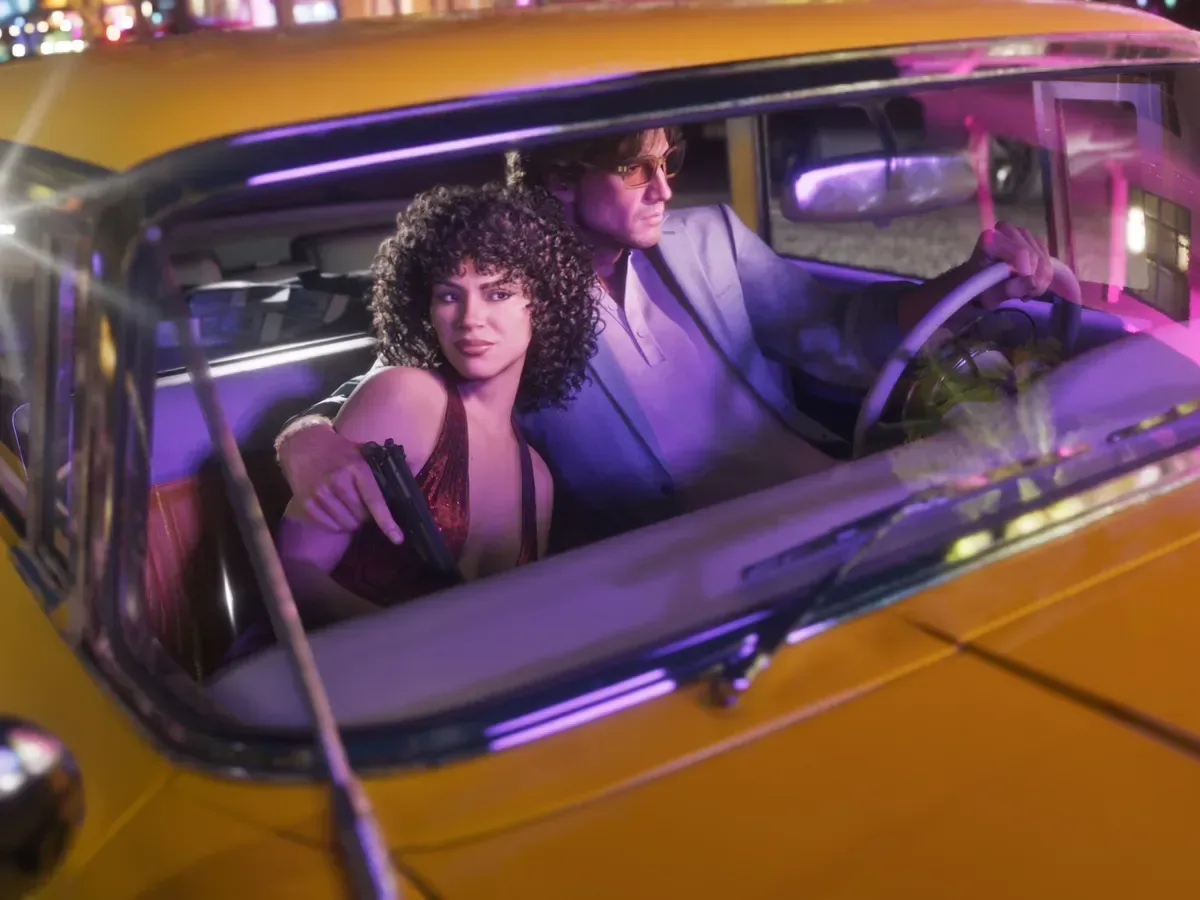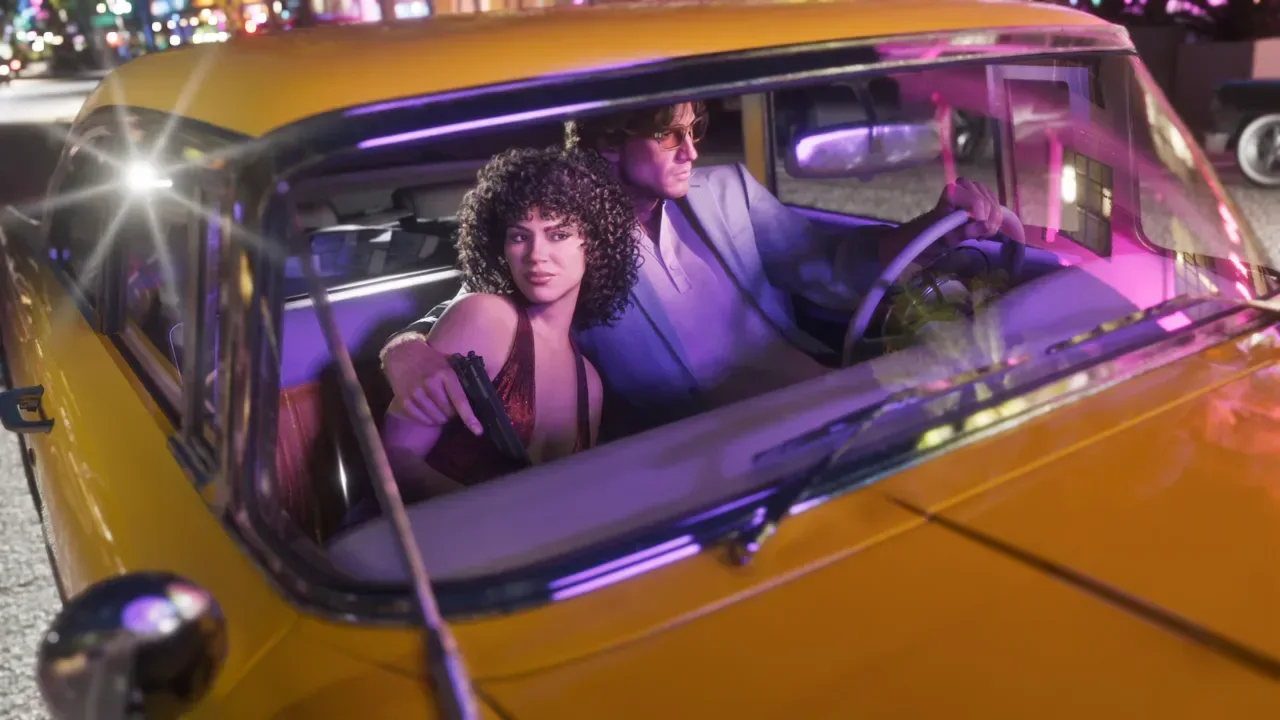
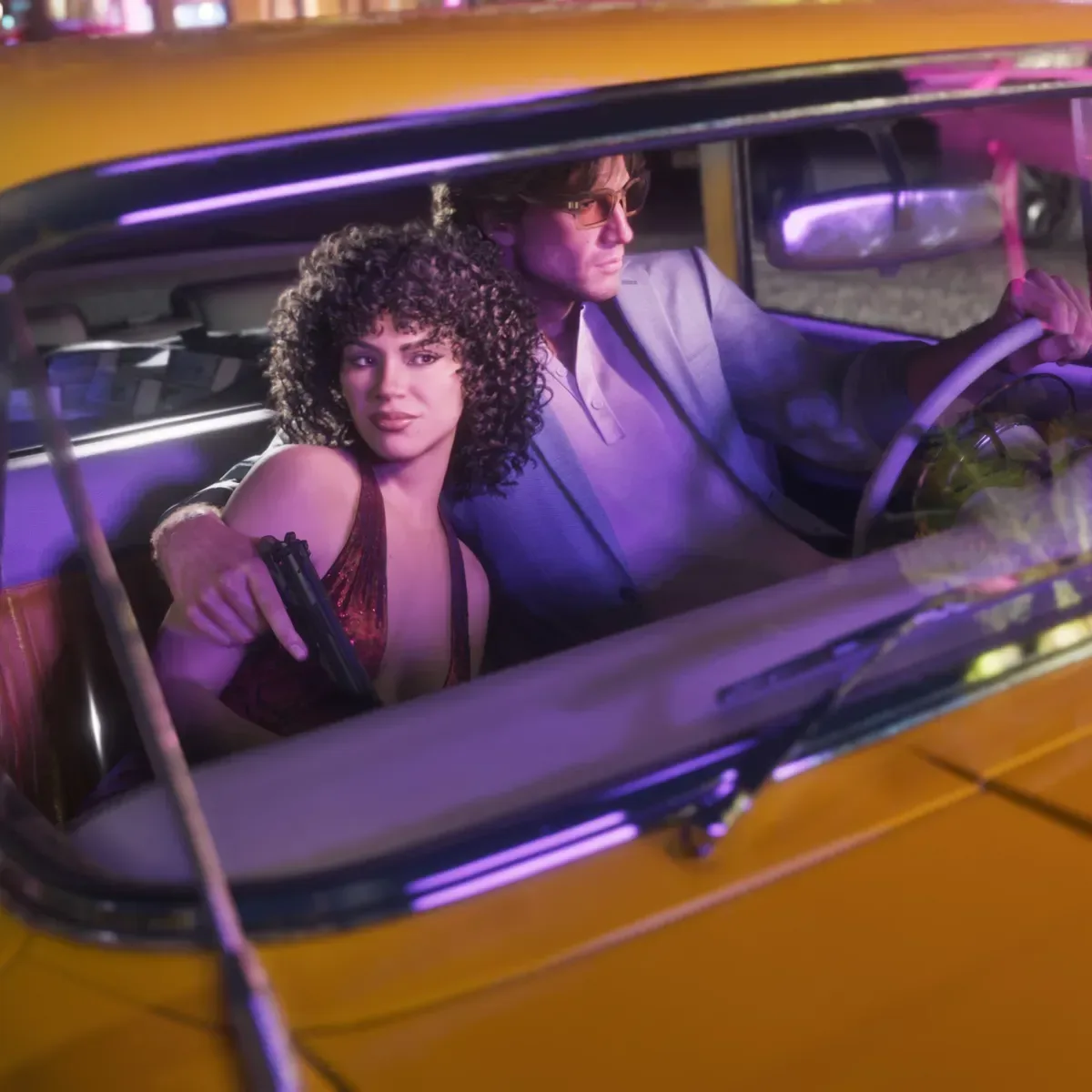
Grand Theft Auto 6’s cars are not all intended to behave alike, and the story behind Jason’s starter pickup helps explain why. Lewis Bentley, a former Gran Turismo World Series competitor, is listed in the game’s credits as a developer in the physics department. Bentley previously said in a since-deleted video that he worked on GTA 6 for around three years, as part of the team responsible for vehicle physics.
That is a meaningful detail for a series in which driving is not merely transport. A car can be a getaway tool, a weapon, an open-world shortcut, or the entire point of an impromptu race. GTA 6’s approach appears to put more emphasis on differences between vehicles rather than making every car feel like a slightly altered version of the same machine.
The early example getting attention is the Ganado, Jason’s starting vehicle. Players have found the small pickup awkward or unruly, especially when its rear end starts to step out. That behavior tracks with the vehicle’s apparent real-world inspiration: the Ford Ranchero, a North American rear-wheel-drive vehicle produced from 1957 to 1979.
Why the Ganado can feel difficult to control
Rear-wheel drive means the engine’s power is sent to the back wheels. In practical driving terms, that can make a vehicle more willing to rotate when the driver applies throttle through a turn, particularly if grip is limited or the vehicle is unsettled. The rear tires are being asked to push the vehicle forward while also helping it remain planted. If they lose traction, the tail can swing outward.
That is the broad principle behind the Ganado’s tendency to feel loose at the back. It does not necessarily mean the pickup is unusable or badly tuned; it means the vehicle asks more of the driver than something designed to feel neutral and forgiving. A player who brakes, turns, and accelerates abruptly may provoke a slide. A smoother approach—slowing before the corner, steering progressively, and being patient with the throttle on exit—should make the same trait easier to manage.
In a game built around sudden turns, traffic, pursuits, and improvised escapes, this distinction matters. A truck that squirms under power creates a different kind of decision from a stable, predictable road car. The latter may be easier to place through traffic, while the former could be entertaining in the right hands but costly when the objective is simply to leave a crime scene without meeting a lamp post at a highly personal velocity.
Handling model: what that term means
A handling model is the collection of rules that determines how a virtual vehicle responds to steering, braking, acceleration, surface changes, weight transfer, and traction loss. It is not just top speed or how quickly a car reaches that speed. It is the personality a player feels when entering a corner too quickly, clipping a curb, or putting power down while the wheels are still turned.
The available information does not identify the exact systems used for GTA 6 or assign any single vehicle behavior to Bentley alone. Physics development is collaborative work, and Bentley himself praised the wider physics team. Still, his background in competitive Gran Turismo makes his credited involvement notable: he brings experience in a motorsport-oriented driving environment to a project where cars must serve both simulation-minded details and the unpredictable demands of a Grand Theft Auto sandbox.
Related coverage includes A former Gran Turismo competitor helped tune GTA 6’s driving physics.
Bentley is known for qualifying for the final of the GT Sport World Tour event held alongside the Nürburgring 24 Hours in 2018. In his deleted video, he summarized the ambition with the line, “We put the auto in the Grand Theft Auto.” It is a neat slogan, but the more useful reading is that GTA 6’s driving team appears to have treated vehicle behavior as a major part of the game’s identity rather than a background feature.
Recognizable inspirations, unlicensed names
GTA 6 does not use licensed real-world vehicles. Instead, its cars are visually recognizable interpretations of real-life counterparts, altered enough to remain distinct. The Ganado’s connection to the Ford Ranchero is an example of that design language: the inspiration can be apparent without the in-game vehicle becoming a formally branded Ford.
The potentially more ambitious part is that the resemblance may extend beyond silhouette and styling. When a car inspired by an older rear-wheel-drive pickup feels comparatively tail-happy, the reference is doing more than furnishing the art department with a shape. It informs how that vehicle occupies the road.
That does not mean every fictional car needs to be a strict mechanical replica of its inspiration. GTA’s vehicles still need to work within the game’s own rules and missions. But varied behavior can make the vehicle roster more legible. Players may begin to choose a car based on what they need it to do, not only how fast it looks or whether it has already survived three unfortunate encounters with concrete barriers.
- Rear-wheel-drive vehicles may reward careful throttle use and can be more prone to oversteer.
- Oversteer describes a slide in which the rear of the vehicle loses grip and rotates outward.
- Traction is the available tire grip that allows a vehicle to accelerate, brake, and turn.
- Weight transfer is the shift in load across a vehicle during braking, acceleration, and cornering, affecting which tires have the most grip.
A racing-minded culture behind the scenes
Bentley was not the only person around the project with an interest in racing. Rockstar North has an in-house racing team that won a team-based 24-hour Nürburgring event in 2022. Winning an endurance event does not automatically reveal how a particular GTA 6 car was tuned, but it does offer useful context: people within the studio have hands-on competitive racing experience and an established interest in motorsport.
That context is especially relevant because GTA 6 includes Gellhorn International Raceway, a closed asphalt circuit. It is described as the first closed asphalt circuit in the series and combines recognizable corners and racing lines associated with famous real-world tracks into one fictional speedway.
A closed circuit changes what players can ask of the driving model. City roads are full of intersections, obstacles, traffic, and mission pressure. They are excellent at exposing whether a car can survive chaos, but they are not always ideal for learning a vehicle’s limits. A circuit offers repeatable corners and clearer braking points. That makes it easier to notice how a vehicle reacts when the player turns in too early, brakes too late, or gets on the accelerator before the car has finished rotating.
For enthusiasts, Gellhorn International Raceway could become a practical place to compare vehicles rather than relying entirely on impressions gathered during chases. A car that feels brilliant in a straight line might be unsettled through a sequence of bends; another that feels modest on the highway may be composed enough to carry more speed through a lap. Those are not confirmed performance outcomes for specific GTA 6 vehicles, but they are the kinds of differences a purpose-built circuit makes visible.
What players can reasonably take from this
The key takeaway is not that GTA 6 has suddenly become a pure racing simulation. Grand Theft Auto has its own priorities: accessibility, comedy, action, and the freedom to commandeer something with four wheels because it happens to be nearby. Instead, the evidence points to a deeper layer of vehicle character within that framework.
That has practical implications from the opening hours onward. If the Ganado’s rear end keeps catching a player out, treating it like a neutral, all-purpose starter car may be the wrong approach. Brake in a straight line where possible, avoid mashing the accelerator halfway through a turn, and make smaller steering corrections when the rear begins to move. The goal is not to eliminate the vehicle’s personality; it is to work with it.
It also suggests that swapping cars may be more consequential than simply upgrading appearance. A player who wants a less dramatic escape vehicle may prefer one that remains composed under sudden steering inputs. Someone looking to have fun on Gellhorn International Raceway may seek a machine whose behavior can be learned and exploited over multiple laps. GTA 6’s fictional brands and altered designs may still conceal a meaningful range of driving experiences.
For more GTA 6 context, the reported optional dialogue involving Lucia, Jason, and Mandy is covered in our look at the possible Jason and Mandy connection.
Bentley’s credited physics role, his reported three-year stint on the game, the studio’s racing pedigree, and the addition of a dedicated circuit all point in the same direction: GTA 6 wants its cars to be more than disposable scenery. The Ganado may be a slightly chaotic introduction to that philosophy, but it is also a fitting one. In Grand Theft Auto, learning to control the slide has always been at least half the joke.