Fortnite has spent years proving that virtually any fictional character can be placed on its island, handed the same baseline battle-ready posture, and sent sprinting toward a storm circle. This week, that all-purpose crossover machine is turning its attention to Kingdom Hearts, with Sora set to appear as part of Fortnite’s current Gaming Legends season. More characters from the series are expected later in the week.
On paper, this is exactly the kind of crossover that makes immediate commercial sense. Kingdom Hearts is a long-running series built from collisions between Square Enix role-playing traditions and Disney worlds; Fortnite is a long-running live-service game built to make fictional universes collide in a different, much more weaponized way. Sora has traveled through a remarkable number of settings already. Dropping him into a battle royale with harvesting tools, vehicles, emotes, and a constantly shrinking safe zone is not even close to the strangest itinerary on his passport.
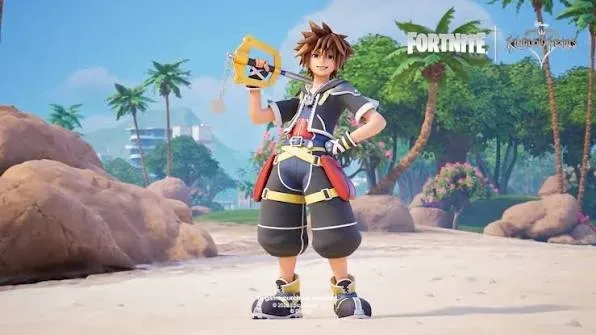
Yet the early image of Fortnite’s Sora has prompted a distinctly different reaction from the usual crossover excitement: he looks a bit unsettling. Not dramatically broken, not incomprehensible, and not necessarily a bad interpretation in technical terms. But there is a stiffness to the model’s face that makes the normally upbeat Keyblade wielder read less like an energetic hero and more like someone who has just been asked to agree to a very long terms-of-service update.
The Keyblade arrives with one conspicuous omission
The most amusingly awkward detail is the Keyblade. Sora’s signature weapon has traditionally carried an unmistakable Mickey Mouse charm at the end of its chain in the Disney and Final Fantasy crossover series. Fortnite’s version apparently does not retain that familiar icon. That absence is small in pure gameplay terms, but it is exactly the sort of visual footnote that fans notice immediately.
It also captures the strange reality of mega-crossover licensing. “Disney character appears in a game” may sound like a simple sentence, but individual designs, symbols, accessories, and brand elements can carry their own layers of approval and usage conditions. No specific explanation has been offered here for the missing charm, so it would be wrong to treat any licensing theory as confirmed. Still, the sight of Sora wielding a Keyblade without one of its best-known little flourishes is hard not to read as an unusually visible seam in an otherwise seamless corporate collaboration.
For a character whose visual language is so dependent on exuberant details—oversized shoes, impossible zippers, brightly shaped silhouettes, and a weapon that is equal parts fairy-tale key and sword—the missing charm has a bigger effect than its size suggests. It makes the Fortnite version feel just a fraction less like the Sora fans recognize and a fraction more like a highly regulated cousin who had to pass through three separate legal departments before leaving the house.
Why the face is doing the heavy lifting
The Keyblade issue is a fun piece of trivia. The face is the reason the skin has become uncanny. Sora is usually presented with a bright, open expression: he is sincere, emotionally direct, and often surrounded by characters dealing with cosmic sadness, memory loss, nobodies, heartless creatures, or whatever other metaphysical complication the series has selected for the day. His optimism is not a background detail. It is one of the character’s defining traits.
In the Fortnite presentation, however, that warmth seems reduced. The eyes and expression appear unusually fixed, giving the design a vacant quality that clashes with the character’s conventional energy. It is the sort of effect that can happen when a beloved stylized character is rebuilt for a different game’s rendering, animation, proportions, and cosmetics pipeline. A model may faithfully include the hair, colors, clothing, and weapon while still missing the specific spark that makes the original read correctly.
Related coverage includes Sora Joins Fortnite, and the Kingdom Hearts Crossover Looks Unsettlingly Different.
Fortnite skins often face a version of this problem because they must function within the game’s standardized character framework. The game needs cosmetics to work consistently in competitive action, and that means wildly different guests are adapted into a shared gameplay environment. The result can be funny, impressive, or occasionally disorienting. A character designed around one studio’s animation language may look different once they are posed, lit, and proportioned for Fortnite’s universal battlefield.
Sora may be a particularly sensitive case because Kingdom Hearts has always pushed its protagonists toward expressive, animated faces. The series can be absurd, melodramatic, tender, and wildly complicated, but its heroes tend to communicate their emotions loudly. A more neutral in-game look therefore does not feel neutral at all. It feels like the poor guy has stared directly into the void between worlds and received a push notification from it.
Crossovers are both Fortnite’s superpower and its weirdest habit
There is no escaping the larger context: Fortnite crossovers are no longer rare treats. They are a central feature of the game’s identity. For players who enjoy them, that is the appeal. The island functions like a living toy box where different fandoms can share the same virtual space, and the unexpected combinations are part of the joke. For players exhausted by franchise convergence, the same strategy can feel like every recognizable property has been rerouted into an endless promotional corridor.
The Kingdom Hearts arrival lands directly in that tension. It is a natural fit in the sense that Sora is no stranger to cross-media chaos. It can also feel like another reminder that Fortnite has become an exceptionally powerful place for recognizable characters to make a guest appearance. Whether that is delightful pop-culture play or an overstuffed synergy parade is mostly a matter of taste.
The industry conversation around what games prioritize is wider than any one cosmetic collaboration. As one recent discussion about immersive sims and blockbuster spending illustrates, there is ongoing debate over whether major game development is placing enough emphasis on the play experience itself rather than spectacle and scale. That debate over gameplay versus AAA presentation is not a direct verdict on Fortnite or Kingdom Hearts, but Fortnite’s crossover tempo makes the divide easy to see: the characters are an enormous part of the event, even before anyone considers what changes in play.
More Kingdom Hearts guests are still expected
Sora is not expected to be the whole story. Additional Kingdom Hearts characters are due later this week as part of the Gaming Legends season. That makes it worth withholding any sweeping judgment about the collaboration until the rest of the lineup is visible. A single model can create a strong first impression, especially when it is the series mascot, but a broader set of cosmetics could show how the crossover approaches other familiar designs.
It also leaves room for the simple possibility that many players will like it. Fortnite’s art style is intentionally its own thing, and adapting a character is not the same task as reproducing them in their home series. Some fans will focus on the thrill of seeing Sora take part in a game alongside Fortnite’s sprawling roster. Others will focus on the Keyblade’s missing Mickey charm, the unsettling eyes, or the broader fatigue that comes from seeing another cherished character converted into a skin.
Both responses make sense. Crossovers invite recognition, and recognition means people will spot every compromise. In Sora’s case, the compromise seems to have landed in the one place where it could not hide: his face. Kingdom Hearts has subjected its hero to tangled destinies, fragmented hearts, sleeping worlds, and enough existential drama to fill several journals. Fortnite’s version now gives him one more challenge: convincing everyone that he is still having a good time.