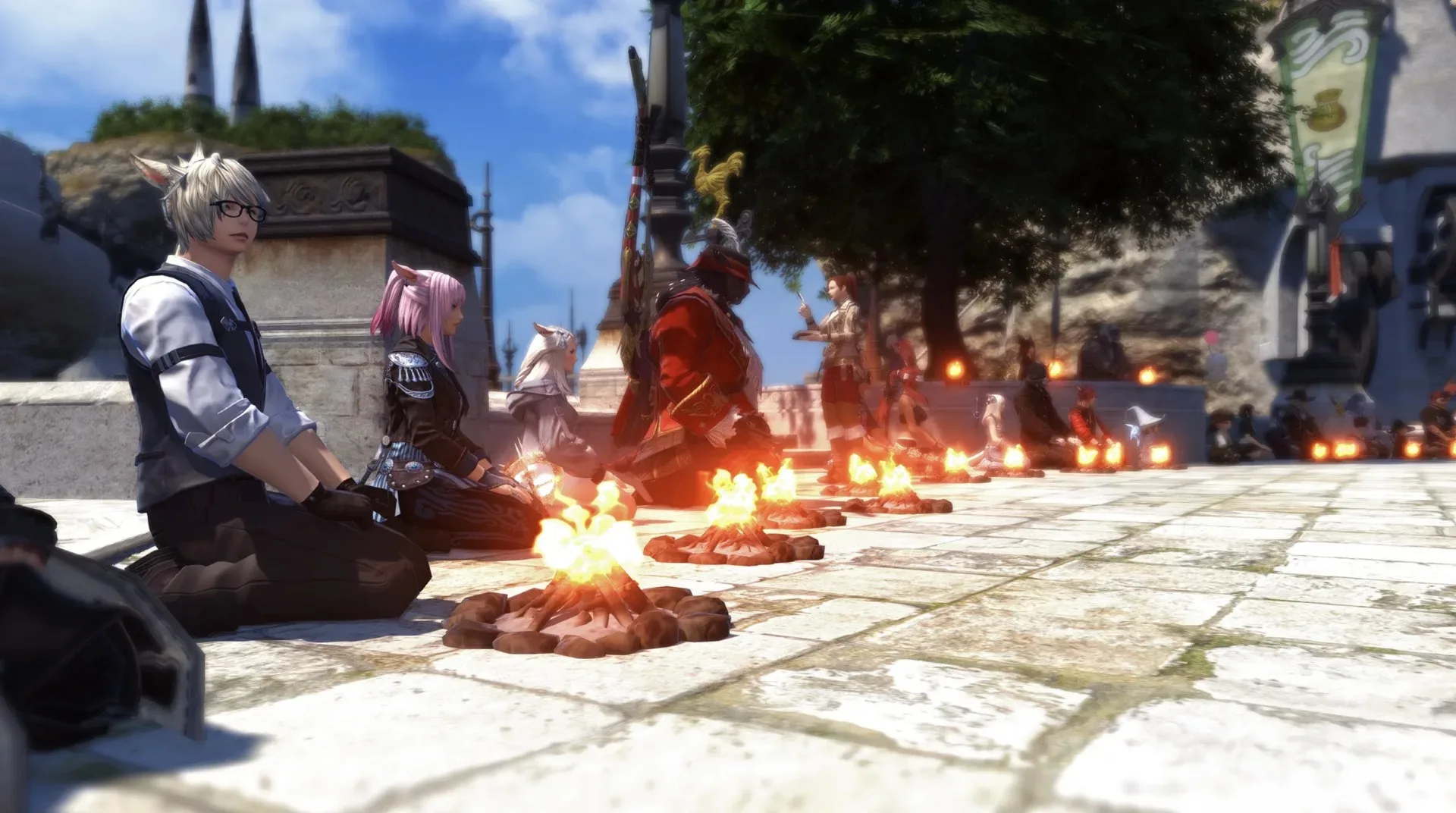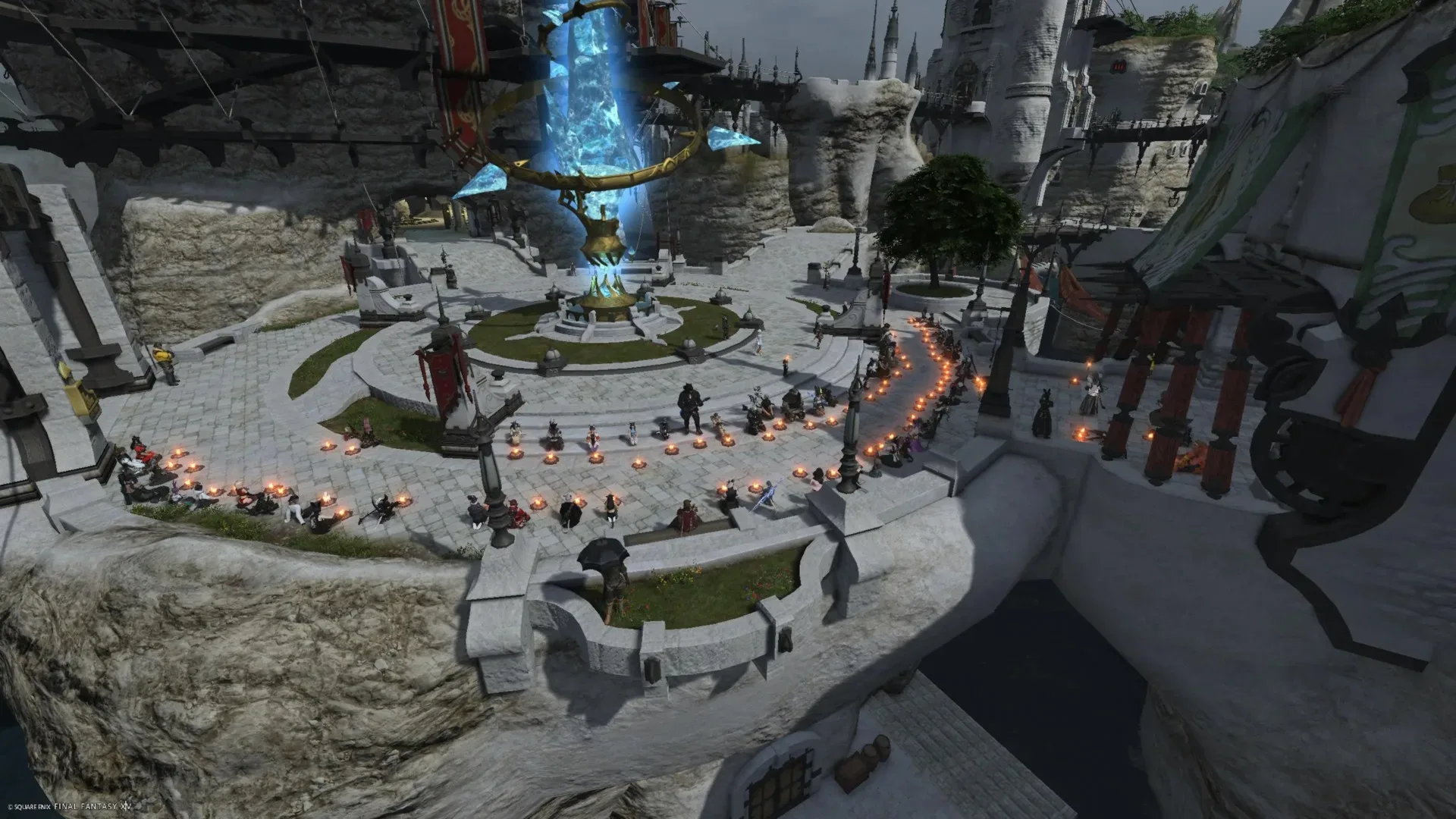
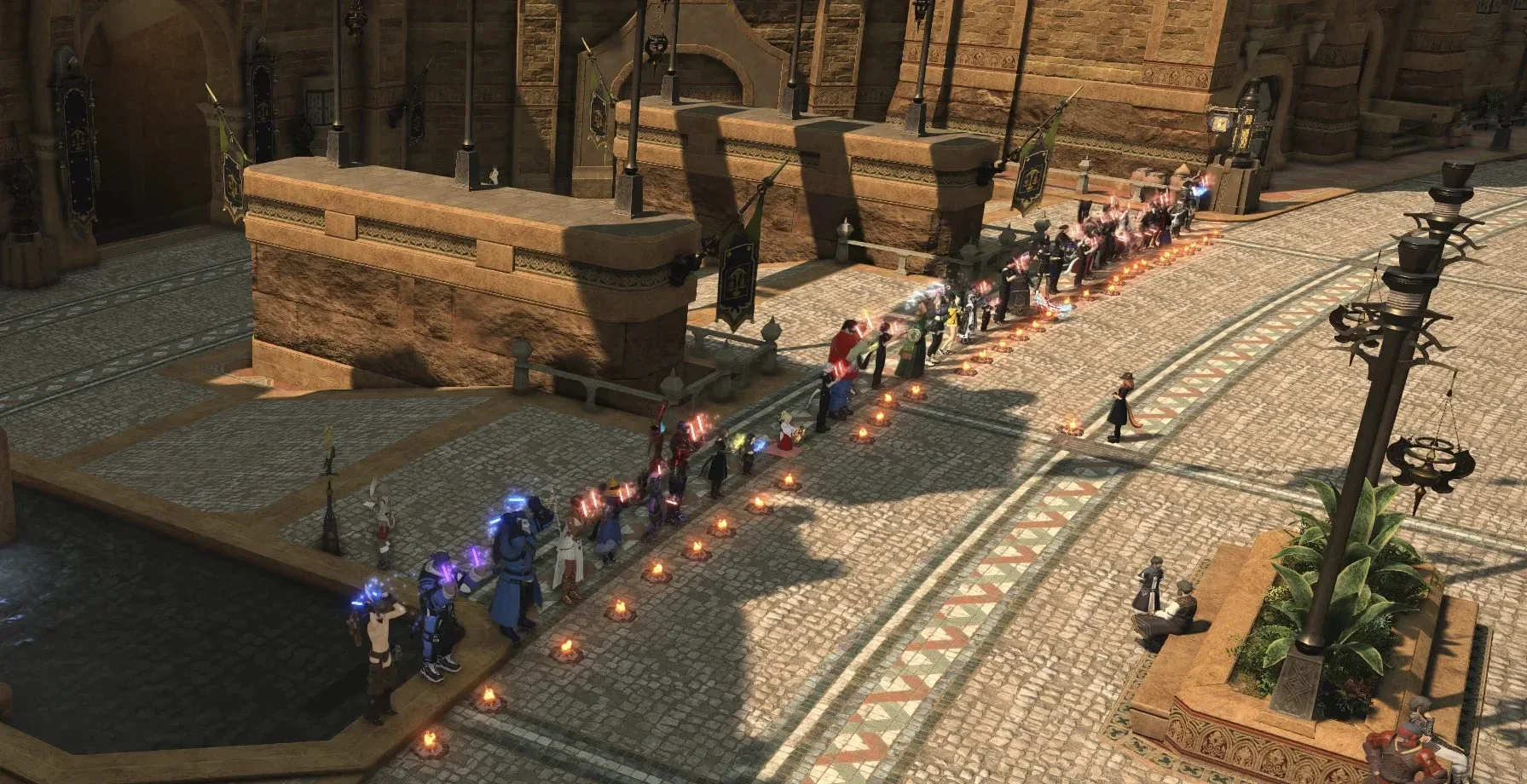
Final Fantasy XIV players are gathering across multiple servers to remember Eikichi Iwai, the bassist for The Primals, following confirmation of his sudden passing. Iwai was a member of the official Final Fantasy XIV band, whose rock performances have become a prominent part of the game’s musical identity and its worldwide Fan Festival events.
The news was shared through Square Enix and Final Fantasy XIV social accounts, which described Iwai’s death as sudden and expressed deep sadness. No further circumstances were provided in the announcement. In response, players have begun creating memorial gatherings inside the MMO, turning familiar virtual spaces into places for a community to grieve together.
Those gatherings are a fitting reflection of the unusual reach Final Fantasy XIV has built over time. An MMO is not simply a game people finish and set aside: it is a shared place, sustained by servers full of players who log in for raids, stories, role-playing, social events and quiet routines. When a musician’s work has accompanied those experiences, the connection can be intensely personal even among people who have never met.
The bassist behind a defining FFXIV sound
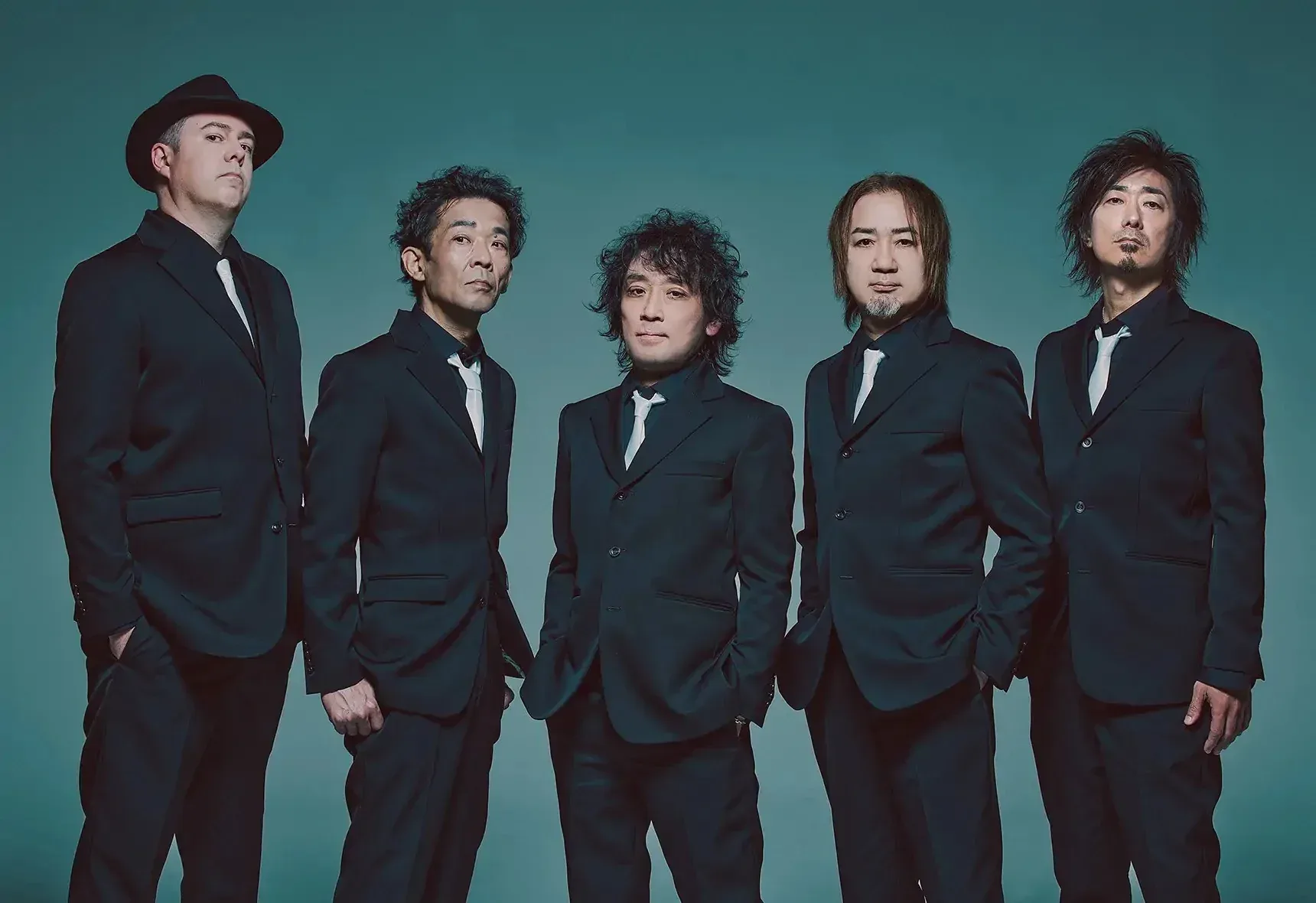
The Primals are led by Final Fantasy XIV composer Masayoshi Soken. Alongside Iwai on bass, the group includes Gunn on guitar, Tetsuya Tachibana on drums, and Michael-Christopher Koji Fox on vocals. Fox is also known for his work as an English localization and translation director on multiple Final Fantasy games.
For more context, explore Nintendo’s GitHub DMCA Sweep Targets Switch Emulator Forks and Mod-Chip Firmware.
The band is associated with rock arrangements and original music connected to the Final Fantasy XIV soundtrack. Their work exists at the intersection of game score, live-band performance and fan culture: songs first encountered during major narrative or gameplay moments can return in a more overtly concert-ready form, powered by guitars, drums and bass.
That format matters because a soundtrack arrangement does more than make a familiar track louder. A rock arrangement recasts a piece around the rhythm section. The bass is especially important in that process. It can reinforce the harmonic movement of a song, lock in with the drums to establish momentum, and provide the low-end foundation that makes a guitar-forward performance feel full rather than thin.
In practical listener terms, bass is often the part people feel before they can easily identify it. It gives weight to a chorus, drives a transition, and gives a fast or dramatic song its forward pull. It is also a connective instrument: where lead guitar may command attention and vocals carry lyrics, bass helps join melody and rhythm into a single groove.
Fans revisiting The Primals’ catalog in Iwai’s memory have specifically pointed to that contribution. “To the Edge,” for example, has drawn attention for its bass line, while the group’s repertoire also includes rock interpretations associated with tracks such as “Flow” and “Footfalls.” These songs carry different emotional tones, but each demonstrates why Final Fantasy XIV music can remain meaningful well outside the moment when a player first hears it in-game.
Why music can become part of an MMO community’s memory
Final Fantasy XIV’s story, activities and community traditions give its music repeated opportunities to become attached to milestones. A player may associate one piece with a difficult encounter, another with a pivotal narrative scene, and another with friends who were online at the same time. Live performances by The Primals add a further layer, translating music from the game into a shared event in front of an audience.
Square Enix’s Final Fantasy Fan Festivals, held in locations around the world, feature The Primals as a major attraction. Iwai’s last performance with the band took place at Fan Fest Japan earlier this month. For attendees, a performance in that setting is not merely an isolated concert. It is part of an event built around a game world that the crowd already shares, with songs that can evoke years of play and community history in minutes.
The connection also helps explain the response now emerging in-game. Memorials in online games can be temporary, player-organized spaces, but their significance does not depend on permanence. Players choose a location, arrive with their characters, stand together, use emotes, play music or simply remain present. The game’s usual systems—avatars, chat and common spaces—become a way to acknowledge loss collectively.
That does not erase the distance between an online memorial and the people who knew Iwai personally. It does, however, give a widely dispersed audience an appropriate way to express appreciation for a performer whose work reached them through a shared digital world. The scale of Final Fantasy XIV means those expressions can appear across servers rather than in one physical place.
Coverage of the player-organized gatherings has documented memorials appearing across the game’s worlds, underscoring how quickly communities can coordinate when news affects them. Reports on the in-game tributes describe players coming together to honor Iwai and the music he helped create.
A legacy heard in the arrangement
It is easy for instrumental contributions to be discussed in vague terms after a musician’s death. In Iwai’s case, fans have a concrete body of work to revisit: The Primals’ recorded songs and live performances. Listening again offers a more meaningful tribute than reducing a bassist’s role to a background function.
In a rock ensemble, the bassist’s choices affect the shape of the entire arrangement. A sustained note can make a section feel spacious and heavy. A more active line can add urgency beneath a melody. Syncing tightly with a drummer can turn a dramatic theme into something with a more physical, immediate pulse. These are not ornamental details. They are musical decisions that determine how a performance moves.
For game music, that work is amplified by context. A tune can already carry narrative associations for players, then gain new character through a band arrangement. The audience may recognize the opening phrase or vocal line immediately, but the rhythmic and harmonic details are what make the version land as a distinct performance rather than a simple replay of the original.
The Primals have occupied a notable place in that process for Final Fantasy XIV. Like The Black Mages, the band associated with composer Nobuo Uematsu, The Primals demonstrate how Final Fantasy music can live beyond its original game presentation through rock performance. The comparison is useful not because the groups are interchangeable, but because both illustrate a larger tradition of game compositions being treated as material for a stage, a band and an audience.
Iwai’s playing was part of how The Primals gave Final Fantasy XIV songs that second life. That legacy will remain accessible to listeners through the group’s existing music, even as the community now confronts a profound absence.
Players respond in the place they know best
One player response captured the immediate instinct many fans have expressed: keeping The Primals’ music on while playing. It is a simple act, but it reflects the way people often process the loss of an artist—by returning to the work and sharing it with others who understand why it matters.
For Final Fantasy XIV players, doing so inside the game adds another dimension. The music is heard in the same world where it gained much of its emotional power. A player can queue for content, visit a gathering, speak with friends or simply travel through a familiar area while the songs play. The tribute becomes intertwined with the routines that made the music important in the first place.
There is no single prescribed form for a community memorial, and players will likely remember Iwai in different ways: by attending a server gathering, revisiting a performance, listening to a favorite track, or sharing the bass lines and arrangements that stood out to them. What unites those responses is recognition of an artist whose playing helped give Final Fantasy XIV’s rock music its force.
The memorials appearing across servers are therefore not only expressions of sadness. They are also acknowledgements of contribution. Eikichi Iwai helped make music that has accompanied players through major game moments and real-world fan events alike. As the community gathers, the enduring sound of his bass remains one of the clearest ways to understand why so many people are paying tribute.