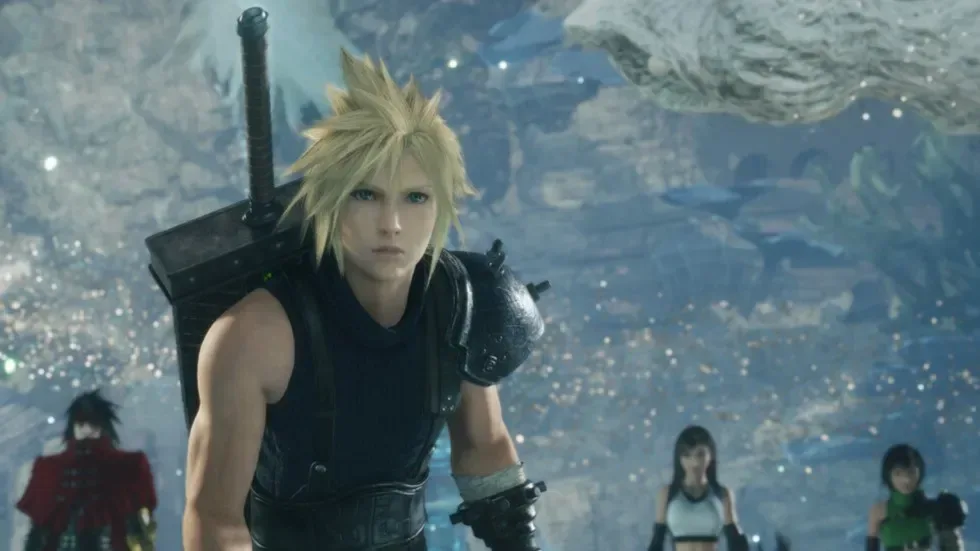
Physical-game collectors have heard a familiar, unwelcome startup sound around Final Fantasy VII Revelation: not the crystal chime of a save point, but the quiet whirr of a mandatory download. The concluding entry in the Final Fantasy VII remake trilogy is planned for a physical release on PlayStation 5 and Xbox Series X, yet the disc will not contain everything needed to play. An internet connection will be required to retrieve the remaining portions.
Director Naoki Hamaguchi has now explained the reasoning behind that decision. His answer is straightforward, even if it is unlikely to satisfy everyone who buys games specifically to avoid an online dependency: the development team believed a release built around disc capacity comparable to Final Fantasy VII Rebirth would force compromises to Revelation’s fidelity and quality. Rather than trim the game to fit, Square Enix chose a single-disc physical package supplemented by a digital download.
It is a decision that sits at the intersection of blockbuster game production, shrinking physical-media support, and the preservation concerns that have become increasingly prominent as console games lean on servers and patches. Revelation may arrive in a box, but the box alone is not the whole adventure.
One disc, plus an essential online step
The PlayStation 5 and Xbox Series X physical editions of Final Fantasy VII Revelation use one disc. Owners will need to go online to download additional parts of the game before playing. That distinguishes Revelation from the preceding two parts of the remake project, Final Fantasy VII Remake and Final Fantasy VII Rebirth, which each shipped on two discs: one used for installation and another used for gameplay.
Nintendo Switch 2 is taking a different route. Revelation is set to use a game-key card there, meaning the cartridge-style product functions as a key to download the game rather than serving as a fully self-contained copy. Across all of its announced console physical formats, then, players should not assume they can simply open the package, insert the media, and begin with no network access.
That detail naturally matters beyond initial inconvenience. Download sizes, connection speeds, data caps, rural internet access, travel, outages, future storefront status, and server availability all affect what “physical” means in practice. A boxed edition can still offer shelf presence, resale potential, and a tangible collectible, but it does not necessarily provide an offline fallback if crucial game data is absent from the included media.
Hamaguchi’s case: preserving the game as built
Hamaguchi acknowledged that players raised concerns after pre-orders began. He said the team initially discussed employing disc capacity in line with what it used for Rebirth. But doing so, in his view, would have required a trade-off in the finished game’s presentation and quality. The developers did not want to make that trade-off, leaving the hybrid physical-and-download structure as what he described as the realistic remaining option.
That explanation frames the choice as a collision between two valid expectations. On one side, a huge modern role-playing game is expected to push its visual detail, scale, audio, cinematics, environments, and performance as far as the target hardware will allow. On the other, consumers who purchase a disc reasonably expect it to contain a functional game, especially when earlier entries in the same trilogy made a more complete disc-based setup possible.
Related coverage includes Final Fantasy VII Revelation Director Addresses Physical Disc Download Requirement.
The word that does much of the work here is compromise. Hamaguchi’s position is not that physical discs are irrelevant; quite the opposite. He said he was pleased the game would still have a physical format at a time when the market is moving further toward disc-free hardware and distribution. But the team’s priority was ensuring that the game itself did not lose quality to meet the constraints of a conventional all-on-disc release.
For players who prize the game above all else, that argument may be persuasive. If the alternative truly involved a diminished version of Revelation, a download requirement can look like the less damaging concession. For preservation advocates, though, it does not resolve the core concern. A product can be technically physical while being incomplete as an archival object, and that distinction is the reason the reaction has been so sharp.
Why the reaction has been so intense
Criticism has focused on the idea that Revelation may not receive a fully playable physical version on any announced platform. The social-media account Does it play?, a prominent advocate for playable physical media and game preservation, argued that this is the central issue. Its objection is not merely about having to wait for a download on launch day. It is about whether a purchaser will retain meaningful access if digital infrastructure changes long after the game’s original release window.
This debate is particularly potent for Final Fantasy VII. The original game and the many projects connected to it occupy an enormous place in game history, and the remake trilogy is itself a high-profile reinterpretation of that legacy. Fans are not only anticipating the final chapter; some are thinking decades ahead, imagining what will remain on a shelf and what will still boot without external help.
There is also an obvious precedent within the trilogy. Remake and Rebirth established a physical expectation by shipping with two-disc solutions. Revelation’s one-disc-plus-download arrangement therefore does not emerge in a vacuum. Consumers can point to those earlier packages and ask why the finale cannot receive an equally robust physical treatment, even if the answer is that the newer game’s ambitions exceed that model.
The disagreement is not likely to disappear because both positions start from priorities that cannot be perfectly reconciled. Developers want to deliver their intended game without cuts. Physical-media supporters want the version sold on disc to stand on its own. The current plan favors the former while preserving a partial version of the latter.
A broader shift beyond one RPG
Revelation’s situation also reflects a wider industry transition. Digital storefronts, large patches, expandable games, and consoles sold without optical drives have steadily weakened the assumption that an optical disc is the complete product. Hamaguchi specifically referenced the broader shift toward discless gaming while defending the value of still offering a physical option.
For consumers, labels matter more than ever. “Physical edition” can describe several very different realities:
- A complete game that can install and play offline from its included media.
- A game that is playable from disc but benefits from optional patches.
- A partial installation that needs a required download for core content.
- A game-key product that provides a license or download path rather than the game data itself.
Those differences affect purchase decisions, particularly for collectors. They also matter for families with limited bandwidth and for anyone hoping to revisit a game years later. Revelation’s retail packaging may be an attractive collector item, but buyers who consider offline operation non-negotiable should understand that the announced PS5 and Xbox disc versions do not meet that standard.
Switch 2 owners face a related question with its game-key card format. The physical card may still hold value as a retail object or entitlement, yet it is not equivalent to a cartridge carrying the complete game. That distinction has become relevant across Nintendo’s new platform as players weigh convenience and retail ownership against long-term self-sufficiency. For another 2027 multi-platform release on the system, see Professor Layton and the Curious Village Remake’s announced platform plans.
What buyers can take from the announcement
There is no indication that Square Enix plans to change Revelation’s current physical distribution plan. Hamaguchi said he understands that some players will be unhappy, while also expressing satisfaction that the team retained a physical format at all. The company’s decision appears to be settled: one disc on PlayStation 5 and Xbox Series X, with required digital content; a game-key card on Switch 2.
That makes the practical advice unusually simple. Anyone planning to play digitally needs no adjustment beyond the standard expectation of a large modern download. Players considering the physical PlayStation or Xbox editions should plan for internet access and storage space before launch. Collectors should treat the disc as an incomplete version of the software rather than an autonomous preservation copy. And Switch 2 buyers should recognize that the game-key card carries the same basic online dependency in a different physical form.
Final Fantasy VII Revelation is scheduled for April 8, 2027, on PC, PlayStation 5, Xbox Series X|S, and Nintendo Switch 2. By then, the debate over its physical release may have broadened beyond this one finale. Revelation is becoming a notable example of the uncomfortable modern question behind a game box: are you buying the game itself, or a physical invitation to download it?