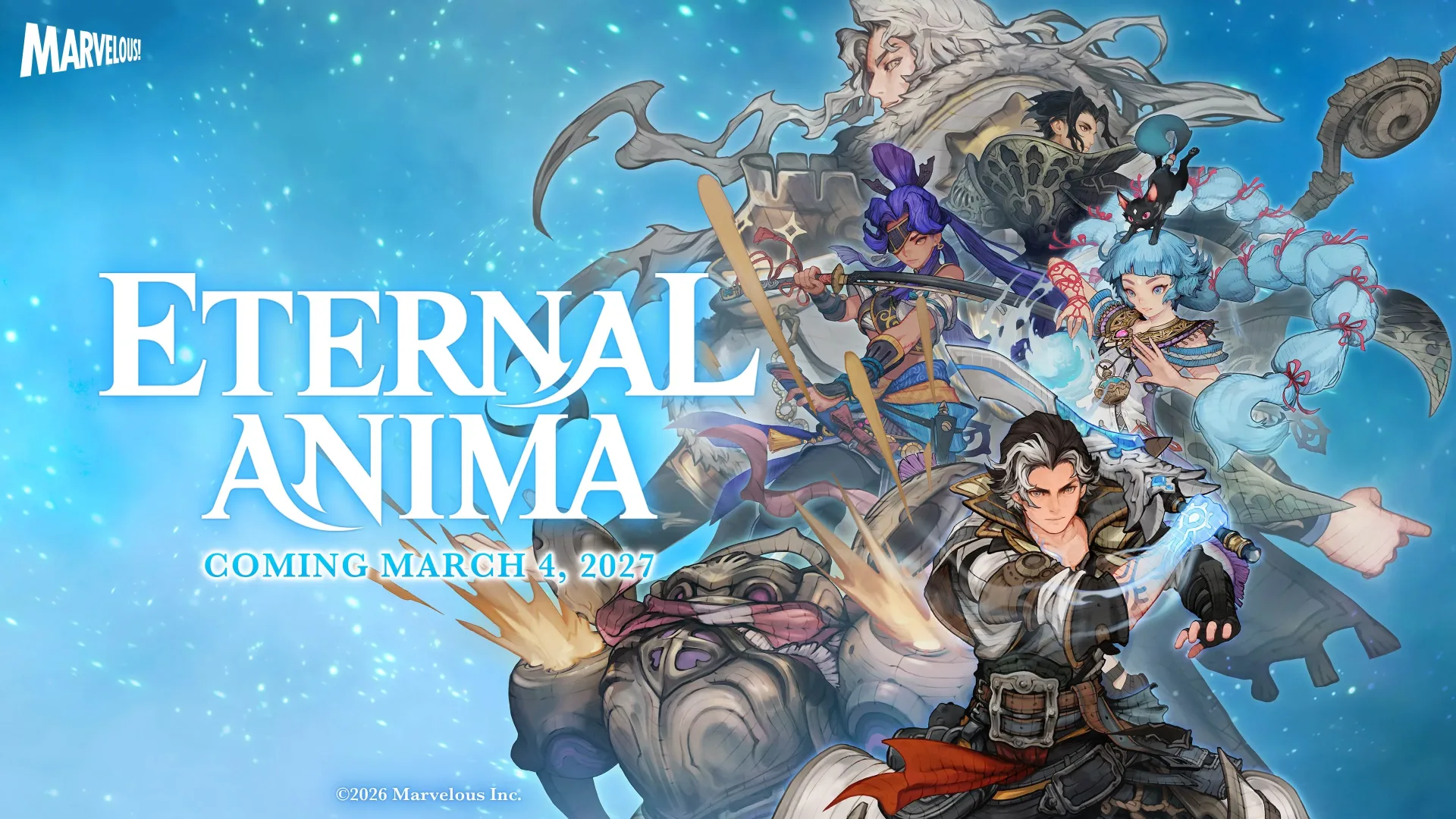
Eternal Anima is placing the idea of legacy at the center of both its story and its promotional campaign. A newly localized, English-subtitled Special Discussion video series brings members of the development team together with prominent Japanese game creators to talk through the thinking behind the upcoming JRPG, from time-travel storytelling to battle design and music.
The game is scheduled to launch globally on March 4, 2027 for Nintendo Switch 2, PlayStation 5, Xbox Series X|S and Windows PC via Steam. It is developed by Marvelous, with publishing handled by Marvelous USA in the Americas and Marvelous Europe in Europe and Australia. The ESRB has rated it T for Teen.
A conversation about legacy, not just a guest appearance
The opening episode pairs Katsuhisa Higuchi, Eternal Anima’s director, with Mistwalker’s Hironobu Sakaguchi. Their conversation is framed around the game’s central theme: the impact that people, choices and abilities leave across generations.
That theme is not confined to narrative decoration. Eternal Anima follows protagonist Wade as he travels across continents and works alongside ancestors and descendants from different points in time. The premise gives the team room to explore generational connections directly, rather than using time travel merely as a reason to visit alternate versions of the same setting.
Higuchi and Sakaguchi discuss approaches to JRPG design, including the kind of detail that can seem small in isolation but affects the texture of an adventure. Treasure chest contents are specifically among the subjects raised. For players, that is a useful signal of the team’s interest in how rewards are placed and contextualized, not simply how many chests appear on a map.
There is also a practical narrative challenge behind the premise. Stories that let characters move through time can easily create contradictions, often called paradoxes: a change in one era could theoretically erase the circumstances that made that change possible. The discussion addresses how Eternal Anima’s team approached its time-travel plot without producing those kinds of logical conflicts. It does not, however, reveal the game’s full rules for moving through time, so players should not assume specifics beyond the stated goal of making the narrative cohere.
Psychometry makes the past part of Wade’s progression
Eternal Anima’s most distinctive stated system is Psychometry. In the game’s terminology, Wade uses artifacts to decipher memories connected to them. Those recovered memories are not solely story material: they allow him to inherit abilities and classes from heroes of earlier eras.
A class system generally refers to a role or combat specialization that determines a character’s available skills and likely tactical strengths. Eternal Anima is connecting that familiar JRPG progression structure to its setting’s history. Rather than presenting a new skill as an abstract unlock, Psychometry ties character growth to an object, a memory and a hero from the past.
That creates a clear thematic overlap between plot and mechanics. Wade’s journey is about connections across generations, and his advancement is likewise built from what previous generations left behind. The final balance of the system, how widely classes can be mixed, and the exact conditions for gaining skills have not been detailed. Still, the basic idea points to an RPG where artifacts are meant to matter beyond their value as collectibles or quest keys.
Future Sight Battles aim to make prediction a combat tool
The game’s other headline mechanic is the Future Sight Battle system. It allows players to predict enemy actions and counter them, with the stated purpose of controlling the flow of combat.
In turn-based or command-driven RPG combat, knowing an opponent’s upcoming move can fundamentally change a decision. A player might prepare a defense against a heavy attack, use an interruption, direct healing toward a threatened ally, or choose a counterattack that takes advantage of an enemy’s expected behavior. Eternal Anima’s description indicates that this predictive layer is intended to be a recurring part of combat strategy rather than a rare cinematic flourish.
The important distinction is between predicting an action and merely reacting after it happens. Future Sight Battles promise an opportunity to make a plan before an enemy’s move resolves. Whether that information is always visible, requires a resource, applies only to particular encounters or takes another form remains unconfirmed. Until Marvelous shares more, the safest reading is that players will have some means to anticipate attacks and respond in ways that can shift momentum.
Psychometry and Future Sight Battles appear designed to reinforce one another conceptually. One system translates memories of the past into character abilities, while the other uses foreknowledge to influence the immediate future of battle. Along with the ancestor-and-descendant party premise, they give Eternal Anima a consistent vocabulary: the past supplies knowledge, and knowledge shapes what happens next.
Sakimoto and Uematsu discuss the score
The second Special Discussion installment turns from systems and story to music. Hitoshi Sakimoto of Basiscape, Eternal Anima’s music producer, speaks with guest composer Nobuo Uematsu about musical expression in JRPGs, their composing processes and the challenges that arise when writing for the genre.
The conversation also addresses how those ideas were carried into Eternal Anima’s soundtrack. This is notable because a score in a long-form RPG has to support many different kinds of moments: travel, conflict, revelations, quieter character scenes and repeated encounters. The developers have not provided a track list or further breakdown of the game’s music in the information available here, but the discussion series offers a focused look at the creative questions behind the soundtrack rather than treating music as an afterthought.
For players interested in owning music from the game, the announced Limited Edition includes a two-disc soundtrack. That is a physical-edition inclusion, not a confirmation that a separate soundtrack release or digital soundtrack will be offered.
Platforms, editions and what is still unknown
Eternal Anima is coming to four platform families: Nintendo Switch 2, PlayStation 5, Xbox Series X|S and PC through Steam. The game is already part of a busy 2027 release slate that includes projects such as Smalland 2: Lost Realms, though the two games target very different styles of play.
Physical pre-orders are available through participating retailers and the Marvelous USA online store for PS5 and Nintendo Switch 2. The standard physical edition is listed at $49.99 for PS5 and $59.99 for Switch 2.
- Standard physical edition: $49.99 on PS5; $59.99 on Nintendo Switch 2.
- Limited Edition: $79.99 on PS5; $89.99 on Nintendo Switch 2.
- Limited Edition contents: a copy of the game, a two-disc soundtrack, nine character art cards with a display stand, and an art book.
The announced physical offerings do not change the broader launch-platform list. Xbox Series X|S and Steam versions remain planned, but the provided information only specifies physical pre-orders for PS5 and Switch 2. Digital-edition details are expected later, so there is currently no supplied pricing or edition breakdown for digital purchases on any platform.
What the videos add before launch
Game trailers can establish a premise and showcase isolated moments, but a discussion format can be more useful for understanding design priorities. Eternal Anima’s first two episodes emphasize that its creators are thinking about continuity at several levels: continuity between generations in the story, between artifact memories and player growth, between visible enemy intent and battle decisions, and between musical process and emotional expression.
That does not answer every practical question about the JRPG. Details such as party size, exploration structure, the limits of class inheritance, and the precise operation of Future Sight Battles have yet to be outlined. But the series provides a clearer view of the principles guiding the project while keeping the focus on the people responsible for its narrative, systems and music.
With a March 4, 2027 release date set, Eternal Anima is now positioned as a cross-platform JRPG built around the consequences of history—and around giving players tools to turn that history into choices in the present.