The Ember Mug 3 sells a simple luxury with an unusually complicated delivery system: make a coffee or tea, get distracted for an hour or two, and come back to a drink that is still hot rather than a room-temperature disappointment. For slow sippers, desk workers and anyone whose beverage routinely loses a fight with a long meeting, that proposition has obvious appeal.
But Ember’s third-generation flagship also illustrates the hard part of smart home-style hardware. A heated mug is not just ceramic. It is a 14-ounce vessel containing a heating element, battery, controls and Bluetooth connection, plus a charging coaster and companion app. Those extra layers can create an impressively convenient experience when everything works. They can also turn the humble task of drinking coffee into another device-management chore.
At $150, the Mug 3 is an especially demanding purchase. It needs to be more than a novelty: it needs to feel dependable, pleasant to use and meaningfully better than reheating a drink. The reported experience suggests that it succeeds at the central trick—maintaining warmth—but has important caveats involving charging, controls, drink flavor and Android app reliability.
What the Ember Mug 3 is trying to do
The core feature is temperature maintenance. Rather than merely insulating a drink, the Mug 3 actively keeps it at a chosen heat level. That is distinct from a conventional travel tumbler, which slows cooling but cannot add heat back into the liquid.
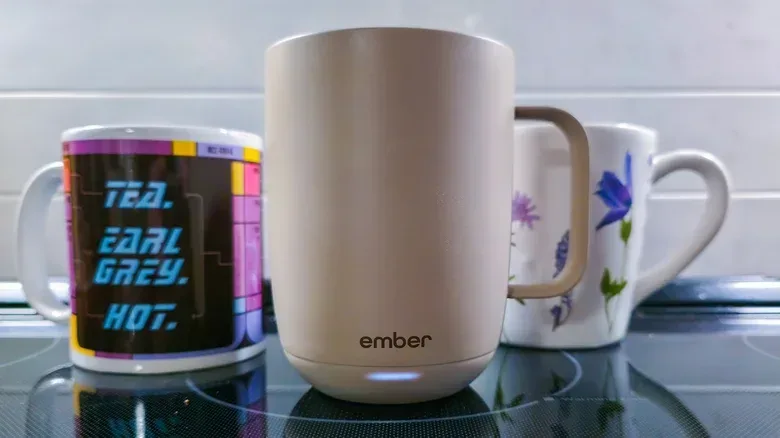
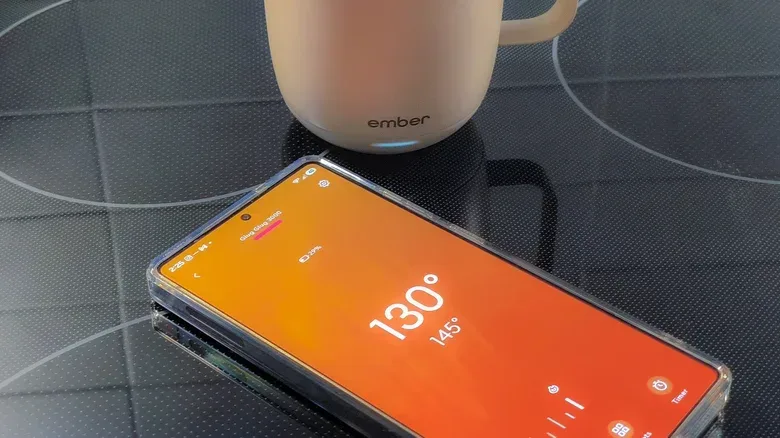
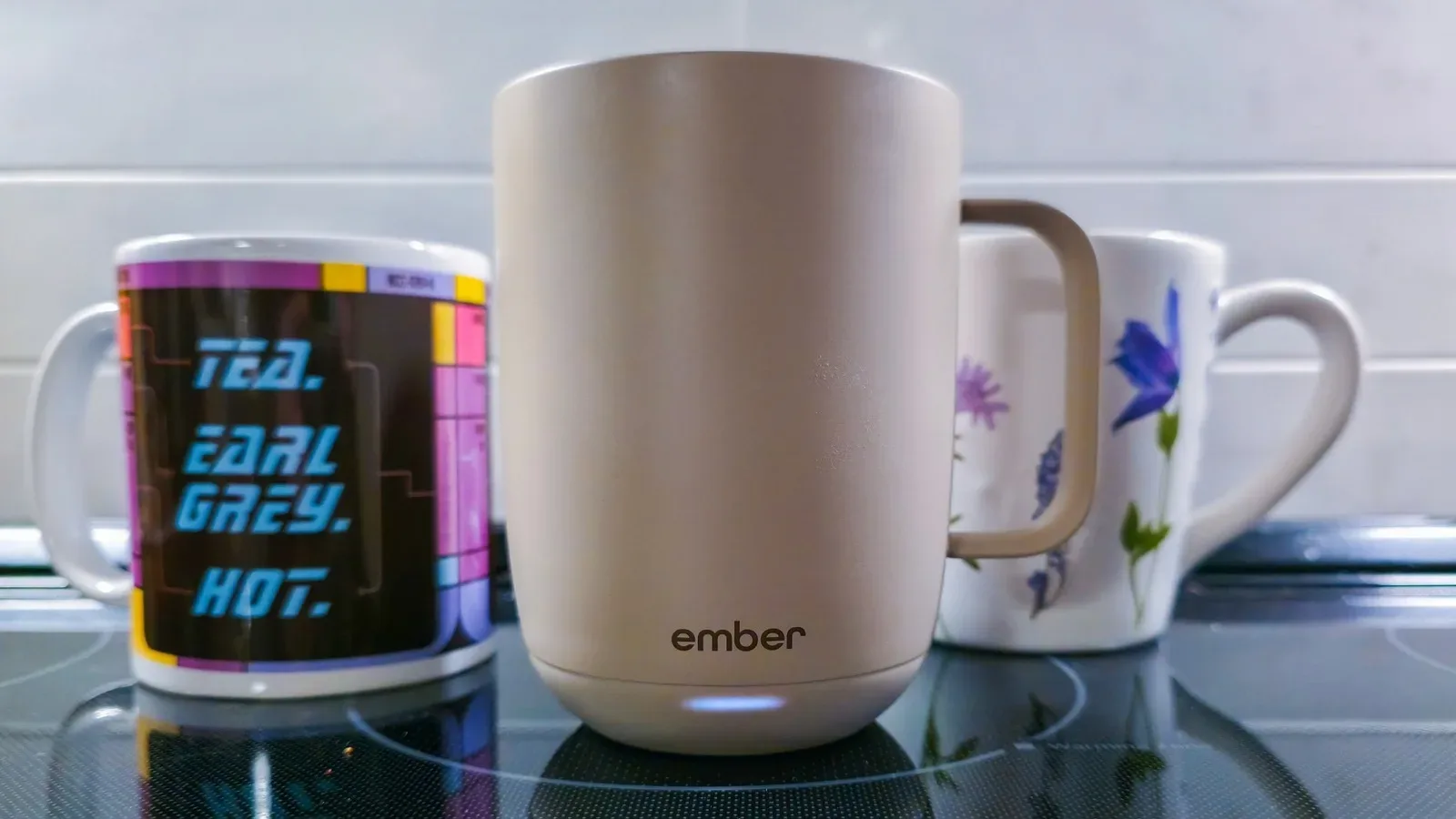
The supplied app can display a current temperature and allow users to set a target. The supported range reportedly tops out at 145 degrees Fahrenheit. An LED beneath the Ember logo offers a quick visual indication that the mug is active, while the included coaster doubles as its charger.
There is genuine charm in the result. A drink that remains hot long after it would ordinarily be tepid can make an extended work session feel more comfortable. It is a small convenience, but one that is immediately understandable—much like a warm desk lamp or a reliable pair of headphones. The problem is that the simple pleasure rests on several practical compromises.
Build, charging and the battery reality
The Mug 3 is described as sturdy, with a soft-feeling exterior and a metallic sound when tapped. It is also top-rack dishwasher safe, a meaningful convenience for an electronic drink vessel. Yet the added technology has a physical cost: it feels heavier than its 14-ounce capacity might suggest because the base houses the electronics and heating hardware.
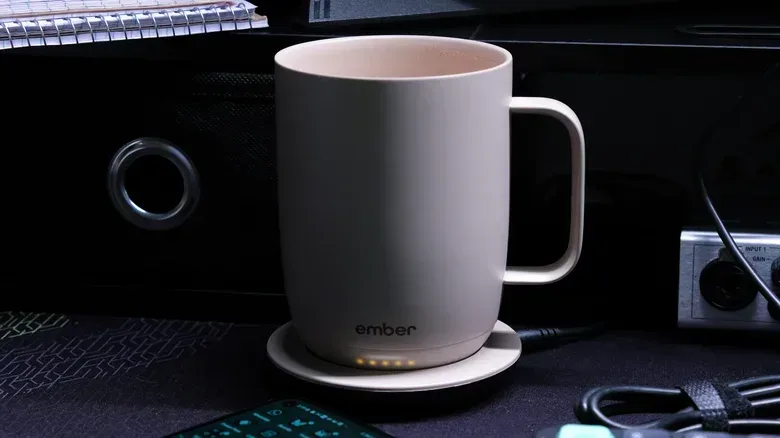
The charging coaster is an elegant idea in principle. Set the mug down where it belongs on a desk and it has access to power. In practice, it is not a carefree coaster. Because it is a charging pad, it is worth keeping spills away from it—the exact opposite of how ordinary coasters tend to be treated.
Battery performance appears heavily dependent on both the starting charge and selected temperature. In one reported use case, the mug was set to 145 degrees with roughly 30% battery remaining. It ran out of power within two hours, and the coaster’s charging pace was not enough to sustain that hotter setting. Beginning with a full battery produced more satisfying results, with beverages being finished before the battery was exhausted.
That distinction matters for buyers. A self-heating mug is not a bottomless reservoir of heat. Every degree maintained above room temperature requires energy, and a hotter target puts more demand on the battery. The included lid is marketed as providing up to three additional hours of life, but it does not contain extra power. Its benefit comes from trapping heat, meaning the mug has less work to do.
That is a useful, unglamorous piece of thermodynamics. Insulation reduces the rate at which heat escapes; active heating replaces heat that does escape. Combining a lid with the heater can extend practical use, but it does not erase the underlying power limits.
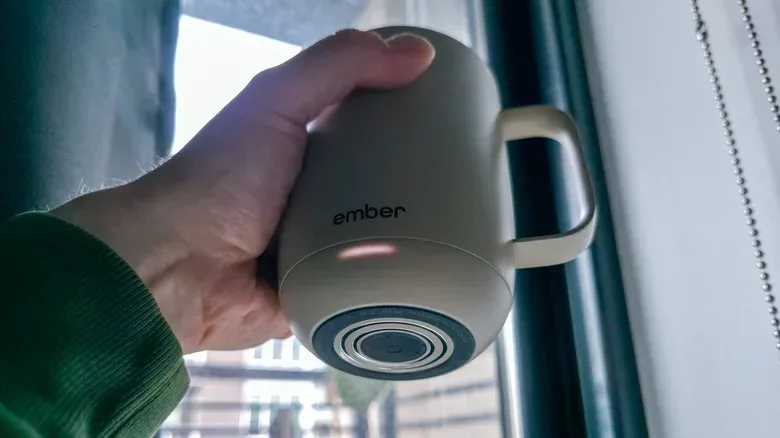
Two design choices may also frustrate people focused on long-term convenience. The charging approach uses two pogo pins—small spring-loaded electrical contacts—instead of Qi, the common wireless-charging standard. There may be thermal reasons for that choice, but it means the system is less universal than a Qi-equipped device. The coaster also uses a barrel connector for wall power rather than USB-C, which may make replacing a misplaced or damaged cable less straightforward.
The companion app is central—and that is the trouble
Ember’s app gives the Mug 3 much of its value. It enables more precise temperature adjustment than the mug alone and shows current heat status. Setup was reportedly easy, but later use on Android was inconsistent: temperature changes or power-off commands did not always stick, Bluetooth re-pairing was needed frequently, and the app sometimes displayed an error when opened.
Those issues are not a minor footnote because the app is the easiest way to tailor the experience. Without it, users are limited to a handful of preset temperatures through a single control on the underside of the mug. Placing that button at the bottom makes it awkward to reach, particularly when the mug contains hot liquid. It also means the hardware does not offer a convenient on-device alternative when the phone connection becomes unreliable.
Bluetooth pairing is the process that establishes a remembered wireless connection between a phone and accessory. In a product like this, reliable pairing is essential: the app cannot apply a precise target temperature or report the mug’s status if the connection is absent. Repeated pairing requests can turn an ambient, almost invisible product into one that regularly demands attention.
The available report specifically concerns Android and does not establish whether iOS users face the same behavior. Still, prospective buyers who use Android should treat app stability as a key consideration, not assume it is a solved problem because the initial setup is smooth.
For a broader reminder that a spec sheet rarely tells the whole story, PC buyers face a comparable lesson with hardware memory: VRAM is a graphics-card specification that can matter more than it first appears. The Mug 3 has its own equivalent. Its important number is not only the headline capacity or maximum temperature; it is how consistently its full system of battery, charger, controls and software works in everyday use.
High heat can change the drink, not just preserve it
The most interesting limitation is not electronic at all. Maintaining a beverage at a fixed high temperature can alter how it tastes. A pour-over made with freshly roasted Colombian medium-roast beans reportedly lost some fruit-forward notes and took on more bitterness after an hour at 140 degrees. Lowering the setting to 130 degrees and eventually 120 degrees produced a more preferable result in that use.
“Over-extracted” is a coffee term normally associated with brewing, where too much material is pulled from ground beans and bitterness can become dominant. Here it is being used to describe the taste result of holding brewed coffee hot over time. The practical point is straightforward: a hotter setting is not automatically a better setting. Preserving the feeling of warmth and preserving a coffee’s flavor are related but different goals.
Milk and espresso-based drinks appeared less temperamental in the reported use. A latte reportedly remained enjoyable after two hours. Black tea fared better at medium temperatures, while herbal tea was the strongest match: holding it at a comfortable sipping temperature seemed to suit both its use and flavor.
Individual results will vary with roast, brewing method, milk, sweeteners and personal taste. But the evidence supports a sensible approach for buyers: begin below the maximum temperature, particularly for black coffee, and adjust upward only if the drink is cooling faster than desired. The lid can help retain warmth without requiring the mug to work as aggressively.
Who the Mug 3 makes sense for
The Mug 3’s appeal is most obvious for someone with a consistent desk routine who habitually leaves drinks unfinished for long stretches. The ability to return to a still-warm tea or coffee can be more valuable than it sounds, and its physical build, dishwasher compatibility and compact charging arrangement support that role.
It is less compelling for people who finish a drink quickly, routinely carry drinks away from their desk, dislike companion apps, or expect maximum-temperature operation on a partial battery. It may also be a questionable choice for someone whose favorite coffee is especially sensitive to prolonged heat.
The price remains the largest obstacle. Ember’s original mug debuted at $80 in 2017; adjusted for inflation, that is about $108 in current dollars. The Mug 3’s $150 retail price therefore represents more than a simple inflation-driven increase. A less expensive alternative, the Ohm Ui Inkstone, is listed at roughly $40 less, although the available information does not establish a like-for-like feature comparison.
Ember mugs have also received steep Black Friday discounts in past years. For anyone attracted to the category but uneasy about paying flagship money for a product with app concerns, waiting for a sale is a practical option.
A brilliant basic idea that demands patience
The Ember Mug 3 gets the emotional part right. A hot drink that is still hot hours later feels unexpectedly magical, especially when work or life has pushed it out of mind. Its best use is not necessarily turning every cup into a 145-degree endurance test; it is quietly holding a suitable drink at a personal sweet spot.
Yet its shortcomings are hard to overlook at $150. The charging setup has limits, the on-mug controls are restrictive, and the reported Android app experience undermines the precision that justifies a connected mug in the first place. Add the risk of changing the character of delicate brewed coffee, and the Mug 3 feels less like a universal kitchen upgrade than a premium specialty tool.
For patient tea drinkers, latte fans and dedicated desk dwellers, that specialty may still be worthwhile. For everyone else, the smarter move may be to wait for a discount, compare lower-priced options, or keep using a normal mug before a second microwave round.