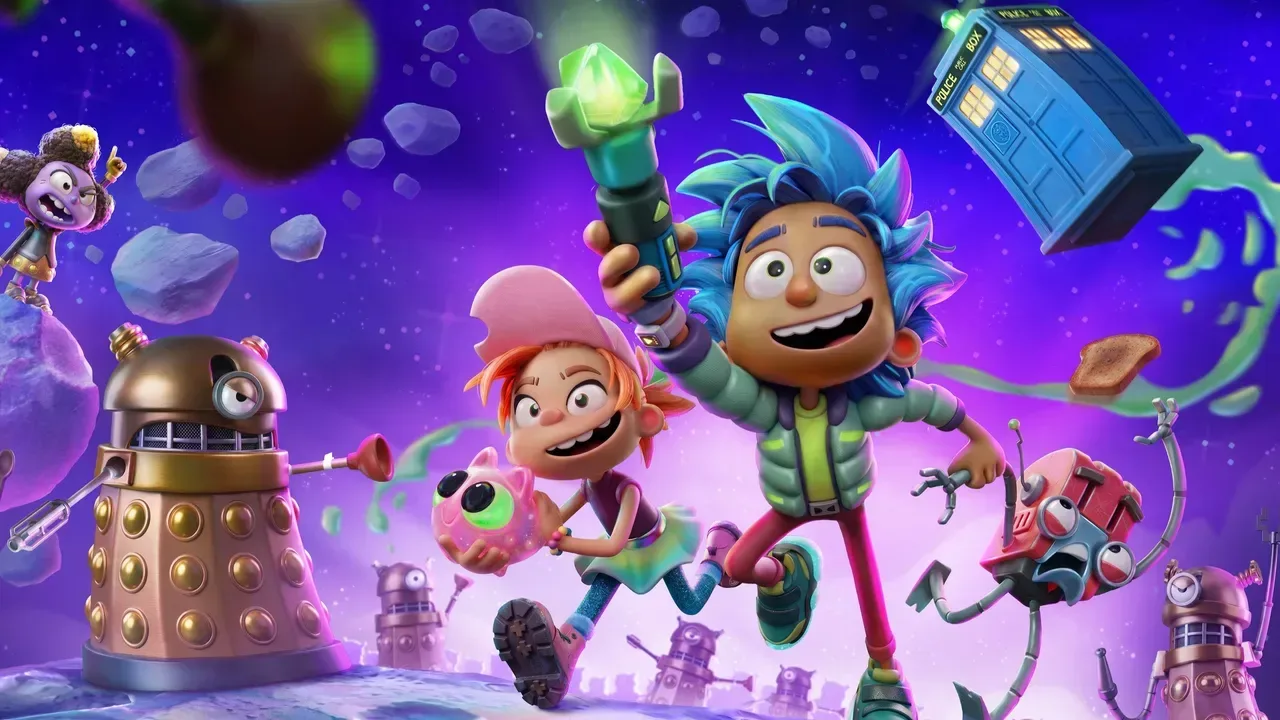
Doctor Who: TARDIS Crew is taking the long-running time-travel universe in a distinctly younger direction. The animated spin-off is being made for CBeebies viewers and will follow a young version of the Doctor travelling through time and space with Hannah, Beastie and a robot toaster companion named Toast-IE.
Official artwork establishes an immediately different visual identity for this Doctor: blue, spiky hair; a sonic screwdriver; and an animated design built for a preschool audience rather than an attempt to replicate any established live-action incarnation. The series is projected for a late-2027 or early-2028 launch, while the main Doctor Who programme is currently targeted to return to UK television roughly a year later.
Blue Zoo Animation Studio is producing the show. The London-based studio is behind Alphablocks and Numberblocks, which makes its involvement a useful signal of the intended audience and format. The commission covers 52 episodes at 11 minutes each, described as preschool-friendly stories.
A full preschool series, not a one-off detour
Fifty-two 11-minute instalments amount to a substantial order for a series aimed at younger children. Short episodes can give an adventure show a clear, repeatable rhythm: arrive somewhere unfamiliar, meet a creature or confront a problem, help the characters navigate it, and leave with the TARDIS ready for another destination. That is an inference from the episode length and child-focused remit, not a confirmed description of each episode’s structure, but it illustrates why the format fits Doctor Who unusually well.
For more context, explore Crossy Road Rush Is Set to Swerve Onto Apple Arcade on November 5.
The franchise’s central device has always been flexible: the TARDIS can take its occupants to almost any place or moment. For an animated programme, that premise makes room for changing settings, new creatures and self-contained stories without requiring a rigidly continuous plot. The official outline says the crew will encounter extraordinary creatures, discover worlds and meet legendary foes, including the Daleks.
Crucially, TARDIS Crew is not being framed merely as a simplified retelling of existing adventures. It has a new central version of the Doctor and a new group of travelling friends. Hannah appears in the artwork in a pink hat and is accompanied by a small pink alien pet. Toast-IE, meanwhile, is exactly what the name suggests: a robotic toaster sidekick. Those choices point to a companion group designed to be recognisable in silhouette and easy for young viewers to identify with before the TARDIS even takes off.
The Daleks are still here — with a wooden spoon
The Daleks remain one of Doctor Who’s most familiar threats, and they will appear in TARDIS Crew. Their presence is notable because it retains a foundational piece of Doctor Who imagery while giving the designers permission to reshape it for the series’ age range. The early art presents a more cuddly, cartoon-like Dalek design; one is fitted with a wooden spoon appendage.
That does not tell us how frightening, funny or threatening the Daleks will be in motion, nor does it reveal the plot role they will play. It does, however, show the programme balancing brand recognition with a gentler aesthetic. For a preschool production, iconic antagonists can introduce the basic idea of a recurring obstacle without automatically recreating the tone of the live-action programme.
The sonic screwdriver also survives the transition. In Doctor Who, the device is traditionally associated with investigating, operating or solving problems rather than simply acting as a weapon. Showing the young Doctor with one helps TARDIS Crew communicate its connection to the wider franchise at a glance, while also providing a natural storytelling tool for compact animated adventures.
What “young Doctor” does — and does not — confirm
The description calls the lead character a young Time Lord, but it does not establish where this Doctor sits in the larger continuity. No actor, voice cast, specific era or formal canon explanation has been detailed in the information available so far.
That ambiguity is likely to invite plenty of fan theorising. Doctor Who has a particularly expansive relationship with continuity: regeneration allows the Doctor to change appearance and identity, while time travel creates stories across eras and revisions to established ideas. The franchise has also explored the possibility of incarnations beyond the 16 main Doctors identified to date through the Timeless Child storyline.
Still, possibilities should not be mistaken for confirmation. TARDIS Crew could eventually be positioned before an already familiar Doctor, connected to a different part of the character’s history, or simply allowed to operate with broad independence as a preschool spin-off. At present, the confirmed facts are narrower: this is a young Doctor with new friends, travelling in the TARDIS, in an animated series that includes Daleks.
There is a practical upside to leaving the exact continuity slot undefined. The production would not need to anchor every story to a particular live-action companion, performer or period. That can make a show more approachable for children encountering Doctor Who for the first time, while avoiding the assumption that families must have followed decades of television to understand why the blue-haired Doctor is on screen.
Why the visual reset matters
Animation is doing more than changing the presentation. It creates room for a version of Doctor Who that can be instantly legible to its youngest intended viewers. The central group has strong visual shorthand: the Doctor’s blue hair, Hannah’s bright hat, a pink alien pet, a toaster robot and rounded Daleks. These are character-design choices that can make a busy science-fiction premise easier to read quickly.
That matters because the core concepts of Doctor Who can be big ones: aliens, time travel, strange worlds, threats and moral choices. A preschool adaptation does not need to eliminate imaginative scale. Instead, its challenge is to render that scale in a form that is inviting and emotionally understandable. The announced 11-minute length means each story has limited time to establish a setting and resolve its central problem, so immediately recognisable characters and clear visual cues are especially valuable.
Blue Zoo’s background on Alphablocks and Numberblocks also provides context for the approach, though it should not be read as a promise that TARDIS Crew will use the same educational structure. What is clear is that the studio has experience creating animation for young viewers. Doctor Who supplies the sci-fi playground; the production format and artwork suggest a programme designed to make that playground feel welcoming rather than daunting.
A new entry point to the TARDIS
TARDIS Crew arrives at a moment when the main Doctor Who series is on hiatus. Its planned release window places it ahead of the currently intended return of the main programme to UK screens. That timing gives the animated spin-off room to stand on its own rather than being only a companion piece airing alongside live-action episodes.
For families, the show may function as an entry point: a first encounter with the TARDIS, the sonic screwdriver and the Daleks in a format explicitly built for preschool viewers. For existing followers, its interest lies in seeing how the broad vocabulary of Doctor Who is translated into a new animation style and age bracket. Those are different audiences, and the newly revealed art is clearly trying to speak to both without requiring either group to do homework.
There are still major details to come. The revealed information does not include a specific premiere date, an episode list, voice casting or an explanation of Beastie beyond the character’s inclusion in the travelling group. It also does not settle whether the young Doctor will carry a firm continuity label. The announced window remains late 2027 or early 2028, rather than a locked date.
But the essentials are now unusually clear for an early reveal. Doctor Who: TARDIS Crew has a confirmed producer, a sizeable 52-episode order, a preschool audience, a blue-haired young Doctor, a fresh group of companions and Daleks redesigned for a more playful animated world. In a universe where the TARDIS can theoretically go anywhere, a toaster robot with a seat on the crew is hardly the strangest destination.