The Mowalola x Air Jordan 14 is nearly ready to move from runway reveal to retail release. Mowalola Ogunlesi’s first collaboration with Jordan Brand takes one of the line’s more immediately recognizable silhouettes and steers it away from the polished, performance-car-influenced presentation usually associated with the model.
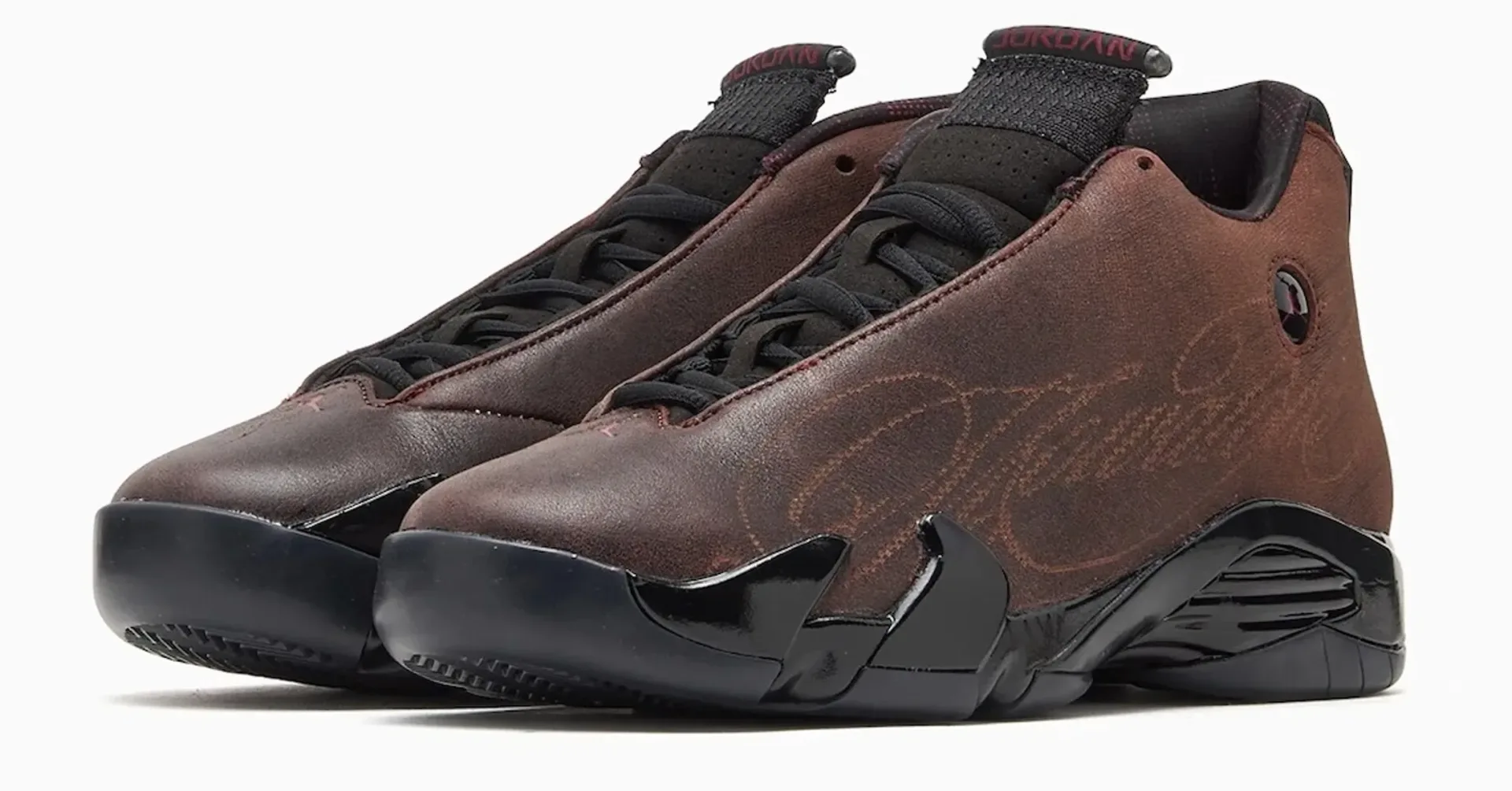
Instead, the partnership’s defining choice is a weathered brown leather upper. It replaces the Air Jordan 14’s more familiar suede treatment with a deliberately rougher surface, giving the shoe an aged, lived-in appearance from the start rather than asking wear to create that character over time.
The shoe is priced at $255 and carries style code IQ5708-001. It is scheduled to launch through Mowalola on September 19, followed by a wider global release on September 26. A matching open-back mule is also due alongside the sneaker, though it will be sold separately and no price for that version has been provided.
A familiar Air Jordan 14, but with its key cues interrupted
The Air Jordan 14 supplies a clear starting point: its form is associated with Ferrari-inspired design language. That makes Mowalola’s material and branding changes especially consequential. This is not simply a new color arrangement placed on an unchanged build; the collaboration uses the existing shape while selectively disrupting details that longtime Air Jordan 14 followers are likely to notice.
Most prominently, the conventional Ferrari-style window on the side panel has been replaced by a small circular Mowalola-branded element. A side-panel window is a cutout or inset detail that helps define the visual identity of a shoe’s upper. Changing it can alter the silhouette’s read even when the overall tooling, profile and name remain the same. Here, the replacement is small, but it shifts the side view from automotive reference toward designer identification.
Additional Mowalola branding appears along the side. Around the heel, a faded plaid pattern wraps the rear section and continues inside the shoe as a restrained red-on-black lining print. Black patent details finish the midsole and heel counter. Patent refers to a glossy finish, so those black sections should provide a visual contrast to the intentionally distressed-looking brown leather rather than blending into it.
That push and pull appears to be the project’s core visual idea. The leather gives the upper an uneven, worn presentation; the patent elements introduce a sharper sheen; and the muted plaid adds pattern without taking over the entire shoe. The result is a reinterpretation built around texture and finish, not merely a logo swap or a new palette.
Why the material choice matters
Leather and suede can suggest very different things before a wearer even puts a shoe on. Suede has a soft, brushed appearance, while the weathered leather described for this release is intended to look more rugged and pre-aged. In practical terms, the collaboration arrives with an aesthetic that may appeal to people who prefer footwear that looks expressive immediately rather than pristine or uniform.
It is important, though, to separate design intent from claims about durability or care. The available details establish the shoe’s brown, weathered leather appearance, but do not specify its construction, resistance to water, cleaning requirements or long-term wear characteristics. Prospective buyers should avoid assuming that an aged visual finish means the shoe needs no care, or that it will behave like a conventional smooth-leather pair.
For collectors and wearers, the appeal is likely to be less about preserving an untouched retro-style presentation and more about the fact that the shoe has been designed to look broken-in from day one. That does not make it less collectible; it simply changes the visual proposition. A scuff-resistant, immaculate-looking sneaker and a shoe made to communicate roughness can both be desirable, but they invite different expectations of ownership and display.
A runway concept moving into a retail release
Mowalola first showed the project at Paris Fashion Week earlier this summer. The presentation tied the collaboration to the label’s established rough, lived-in sensibility, and the retail imagery now clarifies how that approach has been carried onto the Air Jordan 14.
The collaboration also arrives as Jordan Brand continues to work with fashion designers as well as names rooted more directly in sneaker culture. Ogunlesi’s British-Nigerian design background brings another perspective into that wider approach. The distinguishing feature of this pair is not just that it has a fashion collaborator attached, but that its design direction visibly departs from a typical retro treatment through the aged upper and altered side panel.
That distinction is useful when assessing what the release is actually offering. A retro release often centers on restoring, recoloring or lightly revising a known model. This project instead retains the Air Jordan 14 as its base while making the material finish and branded side detail central to its identity. The underlying model remains recognizable, yet the collaboration does not appear interested in disguising its own intervention.
Jordan’s lifestyle-oriented experimentation has remained visible elsewhere as well. For more on another recent design framed around off-court use, see this look at the Jordan Vail’s lifestyle-first direction.
The companion mule broadens the collection’s idea
The separately priced open-back mule gives the collection a second format for the same design language. A mule is defined here by its open back, differentiating it from the enclosed sneaker format of the Air Jordan 14. The existence of both options suggests the project is being presented as a small footwear collection rather than a single isolated colorway.
Only limited information is available about the mule, so buyers should be careful not to project the Air Jordan 14’s exact specifications onto it. The confirmed connection is visual and conceptual: it accompanies the collaboration and is intended to offer another way to wear its design approach. Its separate price has not been stated.
That two-product structure also matters for anyone planning a purchase. The $255 figure applies to the Mowalola x Air Jordan 14, not automatically to the companion mule. Buyers interested in both should regard them as separate releases until further retail details establish otherwise.
Release details and what remains unconfirmed
Retailer imagery has surfaced ahead of launch, providing a closer look at the weathered brown leather, heel plaid, red-and-black inner lining, side branding, circular panel mark and black patent accents. Those images make the broad design easy to identify, while the release sequence establishes a clear early route and later wider availability.
- Product: Mowalola x Air Jordan 14
- Collaborator: Mowalola Ogunlesi
- Style code: IQ5708-001
- Price: $255
- First release: Through Mowalola on September 19
- Wider release: Global launch on September 26
- Companion item: A separately priced open-back mule
Information not established includes the mule’s price, a full retailer list, release quantities, regional allocations and any details concerning the footwear’s technical performance. Those gaps are worth keeping in mind, especially because a global release date does not necessarily answer how individual markets or retailers will handle the product.
Where this pair sits among current collaborations
The release lands during an active period for collaborative Air Jordan projects. CDG, APB and Jaide have Air Jordan 11 projects in progress, while Free the Youth has revealed an Air Jordan 16. Against that backdrop, Mowalola’s Air Jordan 14 distinguishes itself through its decision to make the shoe look intentionally aged and materially altered rather than treating a classic model as a clean canvas for branding.
There is no basis yet to judge demand, supply or resale outcomes, and those are not the most useful ways to read the release at this stage. The confirmed story is more direct: a first-time Jordan Brand collaborator has chosen an Air Jordan 14, retained its performance-car-informed profile, and changed enough of its surface and side-panel language to make the result immediately separate from a standard retro.
For people who follow the model closely, the circular replacement for the usual side-panel window may be the detail that signals the collaboration fastest. For everyone else, the brown leather, faded plaid and patent-black contrast will likely do the work. Either way, the release is built to look purposeful out of the box—and the September rollout leaves little time before that design reaches shelves.