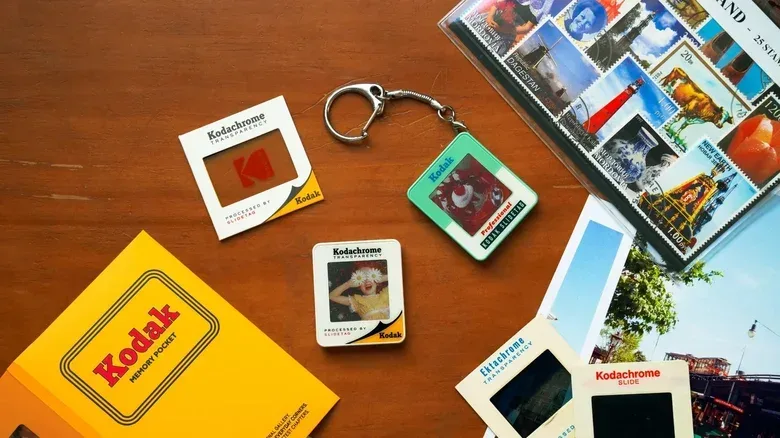
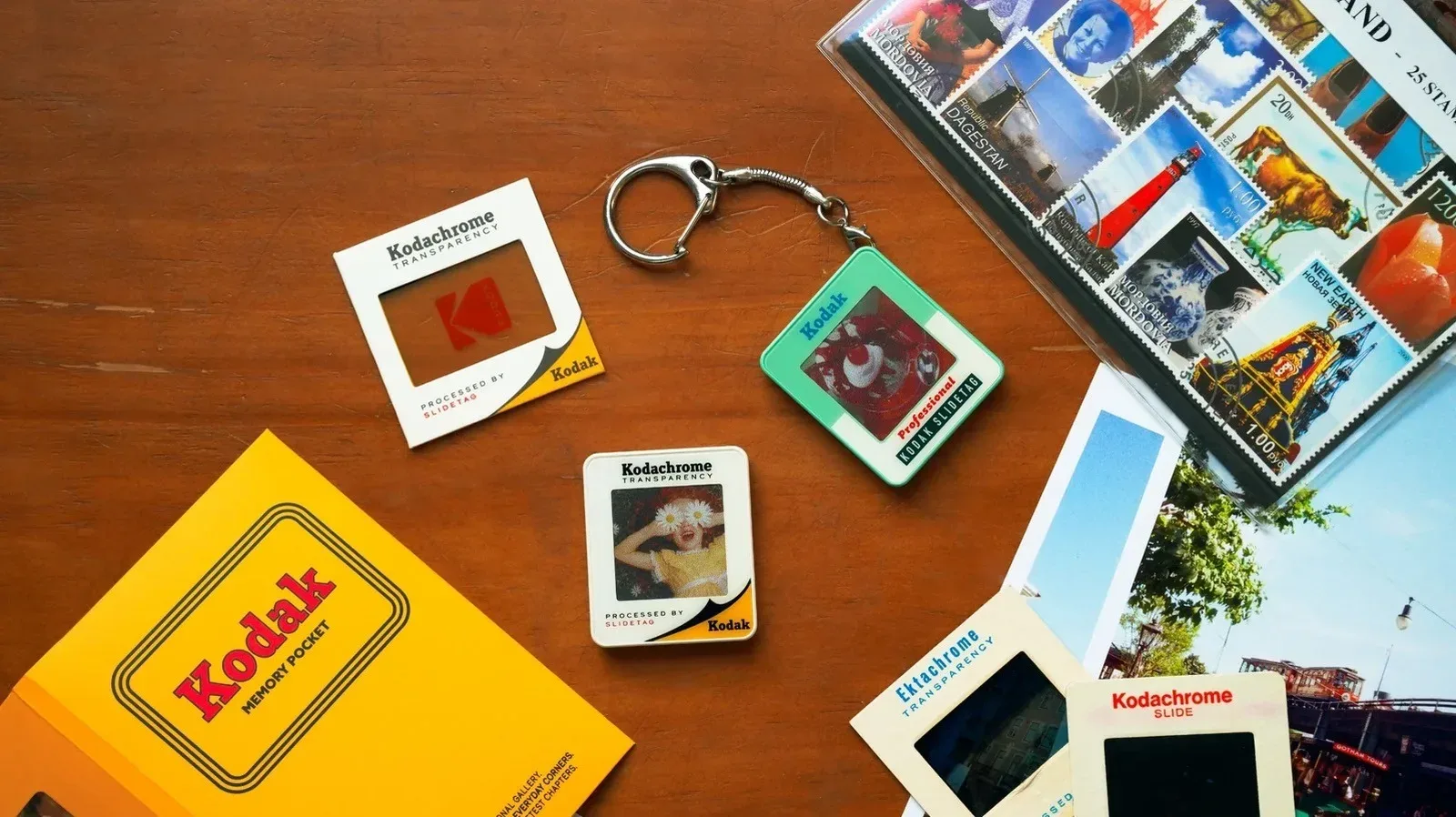
Kodak is taking the blind-box formula in a distinctly practical direction with the SlideTag, a small keychain device that combines a configurable e-ink display with item-tracking support. It is a deliberately compact, retro-styled object: part tiny photo frame, part personal label, part tracker, and part collectible whose exact exterior design is not always known at purchase.
The SlideTag draws its visual cue from Kodachrome slide mounts from the 1930s, the small frames used to present film photographs. Rather than putting a piece of film in that frame, Kodak has fitted the device with a 1.54-inch e-ink screen. Users can connect it to the Memory Link app to set photos, galleries, slideshows, a to-do list, calendar, timer, QR code, or name badge. It also supports both Apple’s Find My and Google’s Find Hub networks for locating attached belongings.
That collection of functions makes the SlideTag more interesting than a conventional novelty keychain. It is not positioned as a high-resolution digital photo frame or as a dedicated tracker in the mold of an AirTag. Instead, it is a lower-spec, characterful hybrid that makes the screen itself part of the point. For collectors, the blind-box packaging adds a second appeal: eight regular designs are available, alongside a secret edition listed with 1-in-64 odds.
A small screen built for persistent display
The SlideTag’s display measures 1.54 inches and has a 240-by-240 resolution, with support for six colors. Those specifications signal the kind of job it is intended to do. The display is small, square, and suited to presenting a single image or a simple piece of visual information on an object attached to keys, a bag, or another everyday item.
E-ink is the display technology associated with the product’s restrained, static-display approach. In this case, it makes sense for a device that may spend much of its time showing one favorite picture, an identifying QR code, or a brief reminder rather than continuously playing rich media. A slideshow and gallery are among the available modes, but the essential appeal is having a chosen image or utility panel visible on a physical object without turning that object into another tiny phone screen.
The six-color limitation is important context for anyone imagining a miniature photo frame. The SlideTag can display photos, but its screen is not presented as a substitute for a full-color, high-resolution display. Its appeal is closer to a stylized digital slide: an image treated as a small piece of personal visual design. The low-resolution, e-ink format can also complement the retro frame rather than work against it. The technical constraints are part of the product identity, not merely compromises hidden behind the design.
That gives the device a few different plausible roles. It can be a rotating photo keepsake, a label that makes one bag or set of keys recognizably yours, a simple badge for an event or group setting, or a scannable QR-code display. None of these uses needs the SlideTag to replace a larger display; they rely on its portability and its ability to make a small, persistent piece of information or imagery tangible.
Tracking is the utility layer, not an afterthought
The other half of the SlideTag is its tracking capability. Kodak lists Bluetooth 5.4 compatibility and support for Apple Find My and Google Find Hub. In plain terms, that means the device is designed to operate across the major Apple and Google location-finding ecosystems rather than restricting purchasers to only one of them.
For prospective buyers, that cross-network compatibility is one of the more consequential specifications. A photo-display keychain is a personal accessory; a tracker must fit the phone platform and finding network a person actually uses. By supporting both listed networks, the SlideTag is positioned to work for people in either ecosystem. The product’s usefulness when something goes missing still depends on setup and the relevant network, but its stated compatibility makes it broader in scope than a tracker aimed at a single mobile platform.
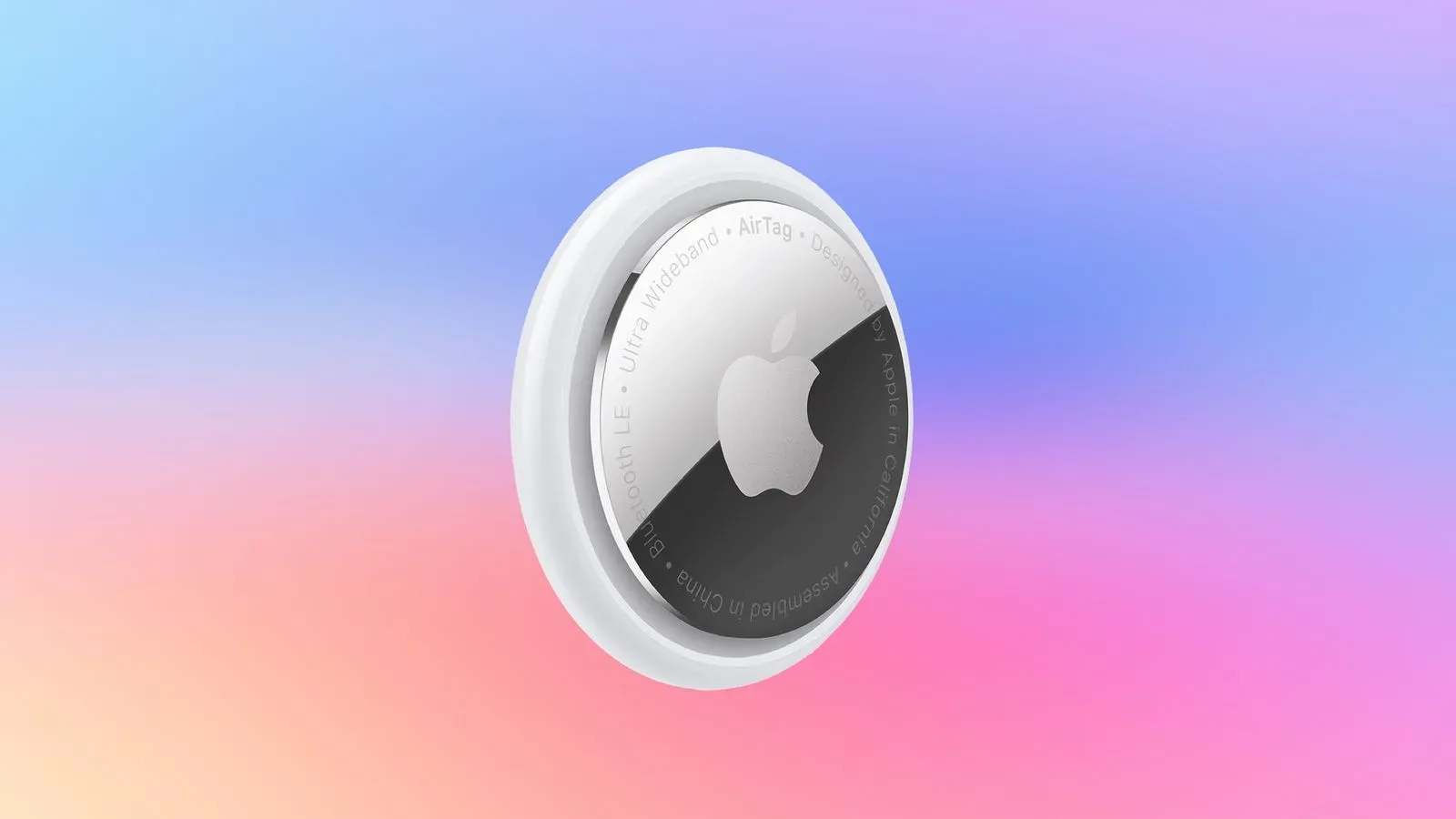
The SlideTag weighs 16.6 grams, making it somewhat heavier than an AirTag while remaining a small keychain object. It also uses a replaceable battery. The latter is especially relevant because the product is meant to sit among everyday belongings for an extended period: a replaceable power source avoids making the tracker-display combination inherently disposable once its battery is exhausted.
Kodak also lists an IP54 rating. This is a durability classification, but shoppers should read it as a stated rating rather than a blanket promise that a keychain device can withstand every condition. Its practical significance is that the SlideTag is intended as an item carried around with belongings, while sensible care remains warranted for a device with a display and replaceable battery.
The comparison with a conventional tracker is useful precisely because it clarifies what the SlideTag adds. An ordinary tracker answers the question of where an attached item may be. The SlideTag can additionally put a picture, name, schedule prompt, code, or timer on the outside of that item. Readers weighing dedicated trackers can also see how that category is changing on the value side; recent AirTag pricing provides useful context for comparing a purpose-built locator with a display-focused hybrid.
Memory Link makes the hardware more than a fixed novelty
The Memory Link app is central to the SlideTag’s versatility. Without app-based configuration, the product would be one small display with one predetermined function. With it, the owner can change the screen’s job over time. A travel photo can become a name badge; a name badge can become a QR code; the QR code can give way to a timer or a calendar view.
This does not mean every mode will be equally useful for every buyer. A 1.54-inch screen naturally favors information that is brief and legible. A to-do list may be best treated as a short prompt, while a QR code works because its job is functional rather than text-heavy. Similarly, a photo is likely to work best as a carefully selected image rather than an attempt to reproduce the experience of browsing an album on a larger device.
Still, the variety is meaningful. It allows the SlideTag to have a role beyond being a display for a single static image, and it helps explain why the retro physical design is paired with a companion app. The device is not simply nostalgic decoration. It is an accessory whose identity can change while its case design remains the same.
The blind-box question: utility meets a chase collectible
The SlideTag will be sold in blind boxes, continuing the approach used for Kodak’s Charmera mini camera. Buyers receive one of eight standard designs, while a secret design is considerably rarer, with stated odds of 1 in 64. That creates two distinct ways to approach the product: buy one for its functions and accept the design as part of the surprise, or buy with a specific collection goal in mind.
The difference matters because blind-box products turn packaging uncertainty into part of the purchase. Someone who simply wants a photo-and-tracker keychain may reasonably value the $35 single box as a one-off novelty. Someone trying to obtain a particular standard design or the secret edition is dealing with chance rather than a normal color or style selector. The rare edition’s listed odds should be viewed as odds for a blind-box pull, not as a guarantee that buying a certain number of boxes will yield that design.
Kodak lists a single blind box at $35 and an entire set at $280. Customer orders are currently capped at two blind boxes or one full set. The stated cap will matter to buyers who wish to collect multiple variants, particularly since the product is being framed as a collectible as well as an accessory. Yet the practical appeal should not be reduced to scarcity alone: every regular design retains the underlying e-ink display, app functions, replaceable battery, Bluetooth support, and tracking-network compatibility.
There is also an unusual tension here that may be the SlideTag’s strongest hook. Collectibles are often stored, displayed, or protected. Tracking tags are made to leave the house attached to things that could be misplaced. The SlideTag joins those impulses in one object. Its exterior can be collected, but its stated purpose encourages daily use. A chosen design can become part of a person’s keys or bag rather than remaining sealed in a box.
Who the SlideTag makes sense for
The SlideTag appears best suited to people who want a tracker to feel personal rather than invisible. It will likely appeal to photo-oriented gift buyers, blind-box collectors, and anyone who enjoys putting a small visual signature on the objects they carry. Its range of screen modes also gives it a practical angle for people who would rather display a scannable code, reminder, or identification label than another photo.
Conversely, buyers seeking the most straightforward possible locating accessory may prefer to compare the SlideTag’s $35 blind-box price with a dedicated tracker and decide whether the display, collectible casing, and app-driven customization justify the difference. The SlideTag’s value proposition is not that it eliminates trade-offs. It is that it combines features that are normally separate: a decorative photo object, a compact information display, and an item finder.
That combination is exactly why the product stands out. The SlideTag takes the visual language of a film slide, updates it with a small e-ink panel, and attaches modern tracking to a thing designed to dangle from everyday belongings. Whether its blind-box strategy proves more compelling to collectors or casual users, the central concept is easy to understand: make the tag that helps find your stuff look like a tiny piece of personal media.