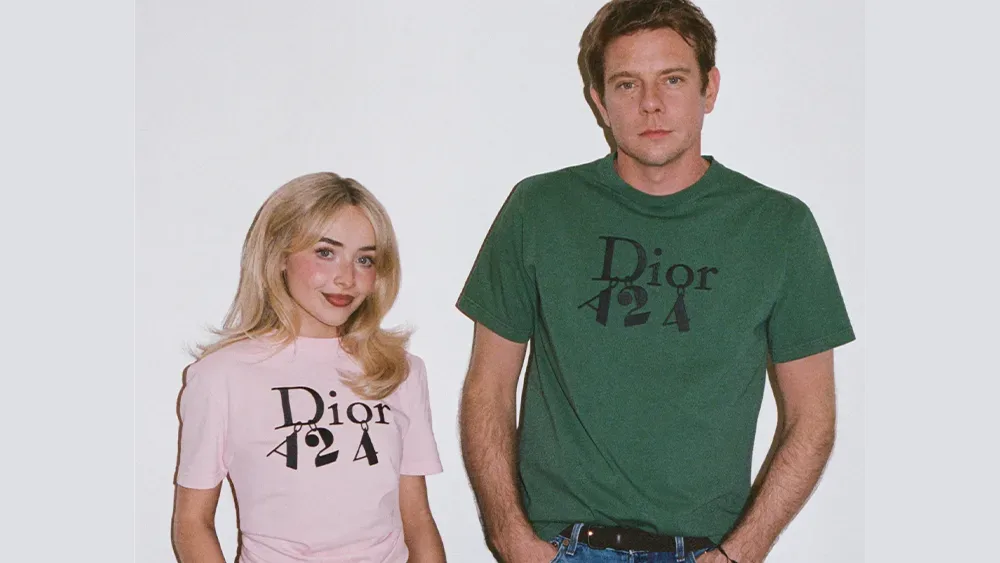
The Dior x A24 T-shirt has become an unusually visible piece of film-world merchandise precisely because it is not, at least for now, merchandise that ordinary fans can simply buy. Seen in light pink, navy and forest green and carrying both companies’ logos, the shirts have appeared on Robert Pattinson, Drew Starkey, Anya Taylor-Joy and Mia Goth. But Dior has indicated that there are currently no plans to offer the tees for public sale through Dior or A24.
That detail changes the object’s meaning. This is not a standard branded T-shirt with an intentionally broad customer base. It is a tightly distributed promotional garment tied to a newly announced two-year creative partnership between Dior and A24. The shirts were gifted in extremely limited quantities to A24 talent and to Sabrina Carpenter, who appears in the partnership’s launch campaign and has an established relationship with Dior creative director Jonathan Anderson.
For physical-media and movie-memorabilia collectors, the result is familiar: visibility has arrived before availability. The garments are already recognizable, but their provenance, production quantity, distribution list and long-term resale status remain unclear. That is enough to make the official tees desirable, while also making the online marketplace especially difficult to navigate.
What is officially known about the Dior x A24 tee
The known facts are relatively narrow but important. The shirt is connected to Dior and A24’s creative partnership, which covers film, fashion, theater and live programming over two years. A24’s Cherry Lane Theatre in New York is positioned as a central venue in that collaboration.
The launch campaign is a short film directed by Aidan Zamiri. It features Carpenter, Josh O’Connor, Drew Starkey, Camille Cottin and Sophie Wilde auditioning to play Anderson. More programming across film, theater and live events is expected during the life of the partnership.
Within that wider campaign, the co-branded tees function as a highly legible calling card: a simple item bearing two names that already carry strong cultural associations. Dior represents luxury fashion, while A24 is associated with independent film. The fact that recipients have worn the shirts publicly has made the apparel itself part of the campaign’s visual language.
What is not established is just as consequential. There is no public retail release currently planned. There is no confirmed retail price, stock count, size run or official consumer release date. There is also no announced authentication program, numbered edition or public registry identifying the recipients of genuine shirts.
Collectors should resist filling those gaps with assumptions. A shirt can be scarce without being a formally numbered limited edition. It can be authentic without having a documented chain of ownership available to the buyer. And a listing that uses the phrase “exclusive” does not by itself prove that it is an official recipient piece.
Why the tee is already appearing in resale conversations
Promotional apparel often occupies an awkward position between fashion, advertising material and memorabilia. The garment may be well made and highly sought after, but its original route into the world was gifting rather than retail. That means the conventional signals shoppers use to evaluate a clothing release—an official product page, a stated price, retail tags and a known release window—may be absent.
Listings said to be genuine have appeared on peer-to-peer marketplaces including Etsy and Depop, alongside a growing number of imitation designs. The existence of listings does not establish authenticity. It only demonstrates that sellers have recognized demand around the collaboration.
The official version is described as having Italian-sourced jersey and embroidered detailing, characteristics that may distinguish it from some imitations. But description alone is not a substitute for verification. Product materials, logo treatments and construction can be copied or represented inaccurately in a listing. Photos may also be incomplete, heavily edited or borrowed from elsewhere.
This is the central practical problem for anyone tempted by a resale purchase: scarcity does not automatically make every claimed example collectible, and a premium asking price is not evidence of legitimacy. With no public retail edition to compare against, buyers have fewer straightforward reference points than they would with a widely sold release.
Official tee, resale item or dupe: the terms matter
It is useful to separate three categories that can become blurred in search results.
- Official gifted tee: A garment distributed by Dior and A24 as part of the partnership’s limited gifting. This is the item collectors are usually seeking when they refer to the “real” shirt.
- Resale item: A shirt being sold by someone other than Dior or A24. A resale listing may be genuine, but resale status does not confirm that it is genuine.
- Dupe: A non-official garment made to reproduce, reference or approximate the look. A dupe may be an affordable styling alternative, but it should not be represented or purchased as official Dior x A24 partnership merchandise.
There is nothing inherently confusing about a dupe when it is labeled plainly. The issue arises when a seller uses ambiguous language—such as “inspired,” “rare,” “sample,” “promo” or “unreleased”—without providing enough information for a buyer to understand whether the item is official, custom-made or merely styled after the campaign.
That distinction also matters for future collecting. A buyer who wants the graphic and colors may reasonably choose a cheaper unofficial shirt, provided the listing is honest. A buyer who values production history, campaign association and scarcity is pursuing a different object entirely: a genuine gifted promotional piece. Those are separate goals and should carry separate expectations.
A cautious checklist for prospective buyers
Because the shirts were not offered through a normal public retail channel, collecting them calls for more patience than a typical fashion drop. The following checks cannot guarantee authenticity, but they can help a buyer assess a resale listing more carefully.
- Read the claim literally. Determine whether the seller actually says the shirt is official, or whether the listing only implies it through imagery, keywords or a high price.
- Ask for clear, current photographs. Request images of the exact garment, including the logo areas, interior labels, seams and embroidery. Avoid treating a single polished campaign-style image as sufficient documentation.
- Look for a credible ownership account. Given the limited gifting, a coherent explanation of how the seller acquired the garment is relevant. An explanation is not proof, but evasive or inconsistent answers are a reason to walk away.
- Compare details rather than relying on color. Pink, navy and forest green have been associated with the shirts, but a matching colorway by itself says very little. Examine the logo placement, textile presentation and finishing claimed in the listing.
- Preserve the listing record. Save the description, photographs and seller communications. For a collectible purchase, that documentation is useful for your own records even if the item later proves difficult to verify.
- Do not confuse uncertainty with a bargain. A low price may be tempting, but it does not resolve missing provenance. Conversely, an enormous price is not authentication.
For collectors who are new to apparel provenance, provenance means the documented history of an object: where it came from, who possessed it and how it reached its present owner. A direct gift recipient, a supporting photograph from the relevant event or correspondence connected to the item could all potentially strengthen a story of ownership. None should be treated as conclusive in isolation, especially when the overall documentation is thin.
Scarcity is part of the campaign, not proof of future value
The public visibility of the Dior x A24 tee gives it an immediate cultural appeal. It is connected to a collaboration that deliberately crosses entertainment and luxury fashion, and it has been worn by recognizable performers. Those factors may make it a compelling contemporary movie-fashion artifact.
They do not, however, establish a reliable future market value. There is no confirmed production number, no stated plan for continued gifting, and no public information indicating whether a retail version could emerge later. The collaboration still has additional programming ahead of it, so the shirt may ultimately become one item within a larger run of partnership material rather than a standalone centerpiece.
That uncertainty is not a flaw; it is simply the honest state of the item today. The strongest reason to pursue a verified example would be personal interest in Dior, A24, the campaign or its cast—not confidence that any particular listing will appreciate.
There is a broader collecting lesson here as well. Modern promotional objects can become culturally important before they are fully cataloged. The absence of formal documentation invites collectors to do more of their own archival work: retain screenshots, record the circumstances of purchase, photograph details upon arrival and distinguish confirmed facts from seller claims. That approach is valuable whether the object is fashion, a screening giveaway or another piece of entertainment ephemera.
What fans can realistically do now
Fans hoping for an official shirt have limited options at present. Dior has not indicated an intention to sell the tee publicly, so repeatedly checking the brands’ stores is unlikely to yield a confirmed retail listing under the current plan. A future change remains possible, but none has been announced.
Those who simply like the visual can choose an unofficial alternative, provided it is understood as such. That route avoids paying a collector premium for an unverified claim. Those who want an official garment are better served by waiting for detailed, convincing documentation rather than rushing toward the first marketplace result.
Meanwhile, the partnership itself is the bigger story. Its launch has already brought a short film and a conspicuous piece of apparel into the public eye, while its stated scope includes film, fashion, theater and live programming. The Cherry Lane Theatre’s role gives the collaboration a physical focal point beyond a logo exercise. For readers following A24’s screen work, the latest film coverage in pop culture offers another look at the wider conversation around movies and their audiences.
For now, the Dior x A24 shirt is best understood as restricted campaign apparel whose desirability is inseparable from its limited distribution. It is a genuine collectible target for the right buyer, but also a textbook case for restraint: know whether you want the look or the official artifact, and do not let the lack of a retail release turn an unverified listing into a certainty.