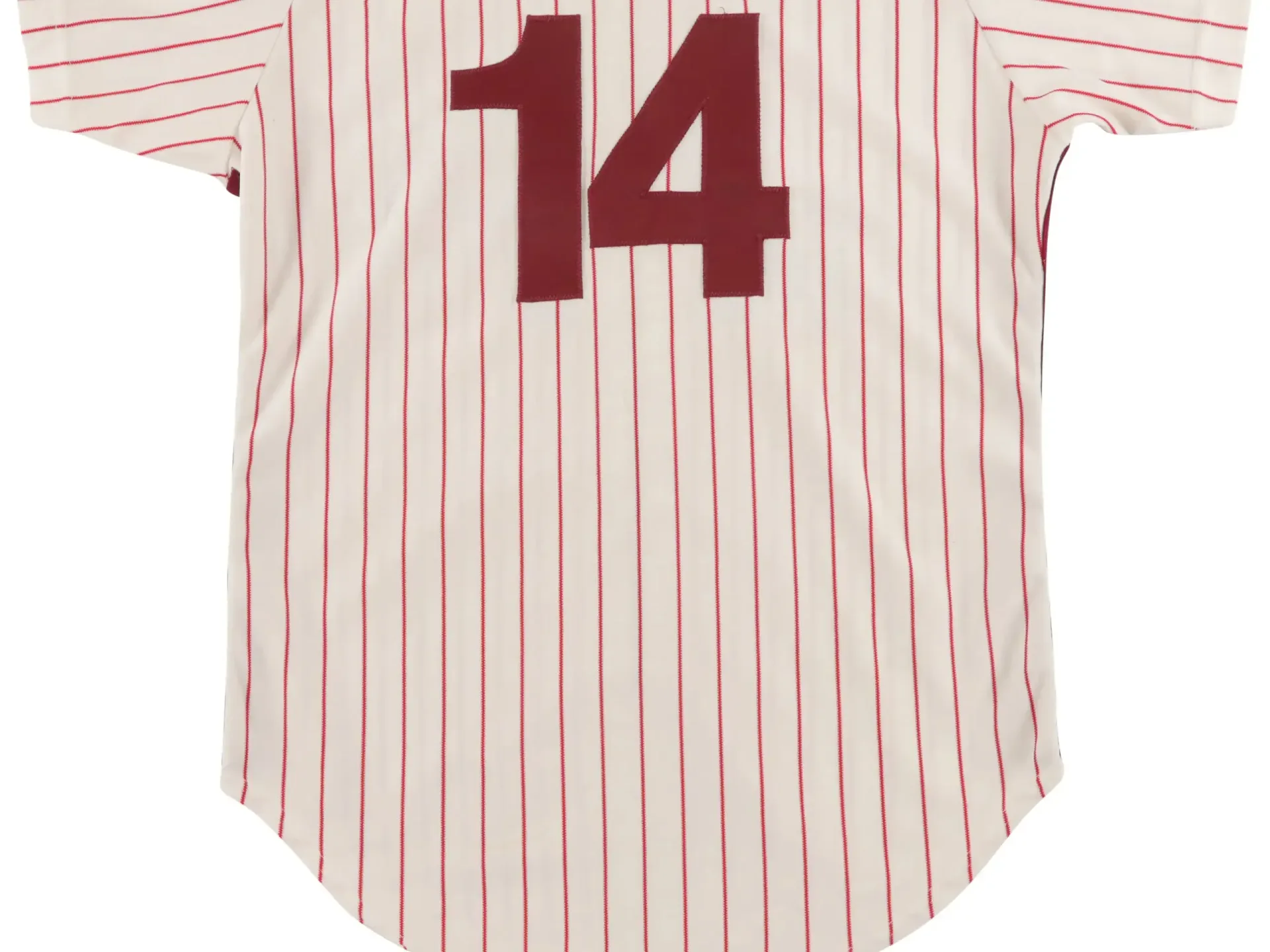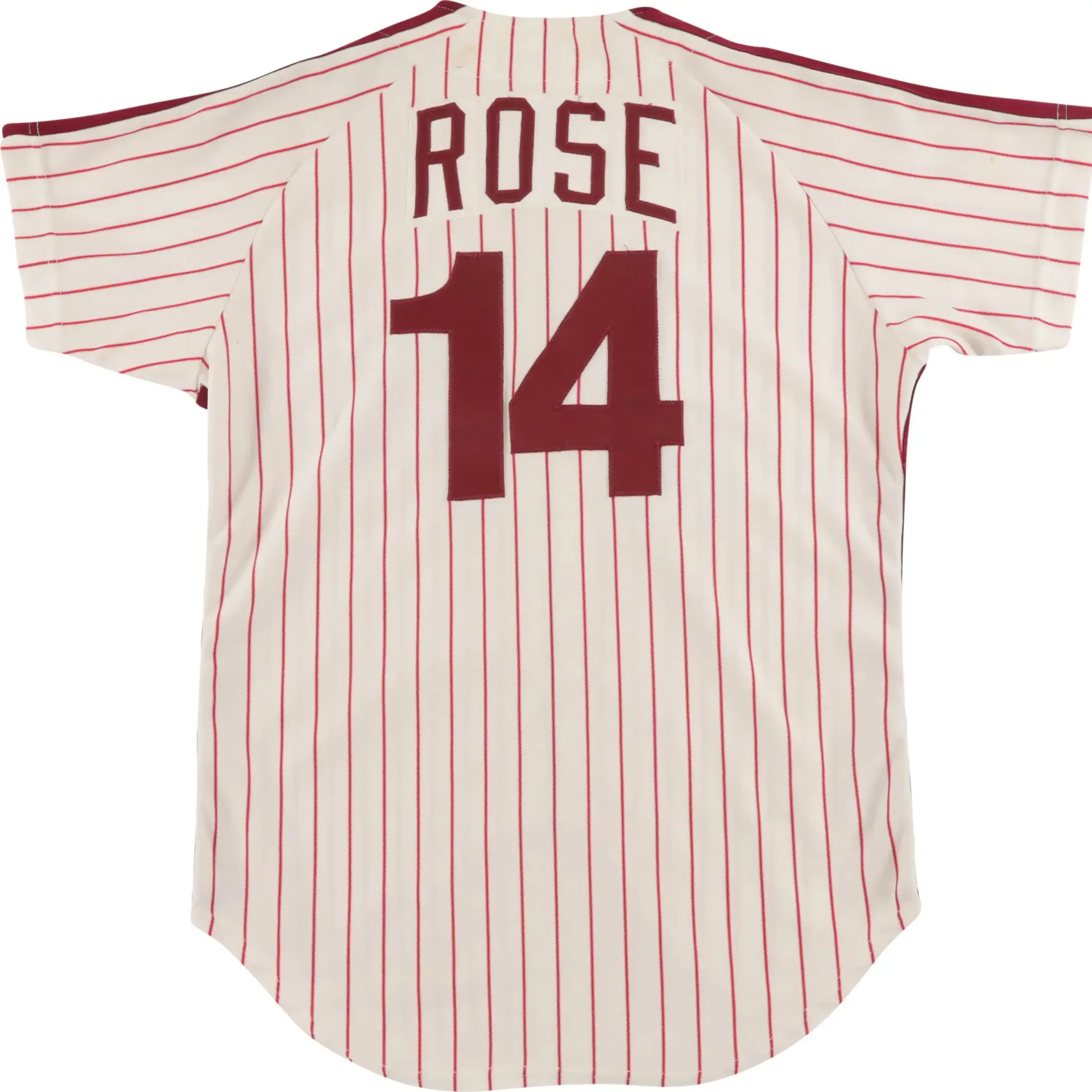
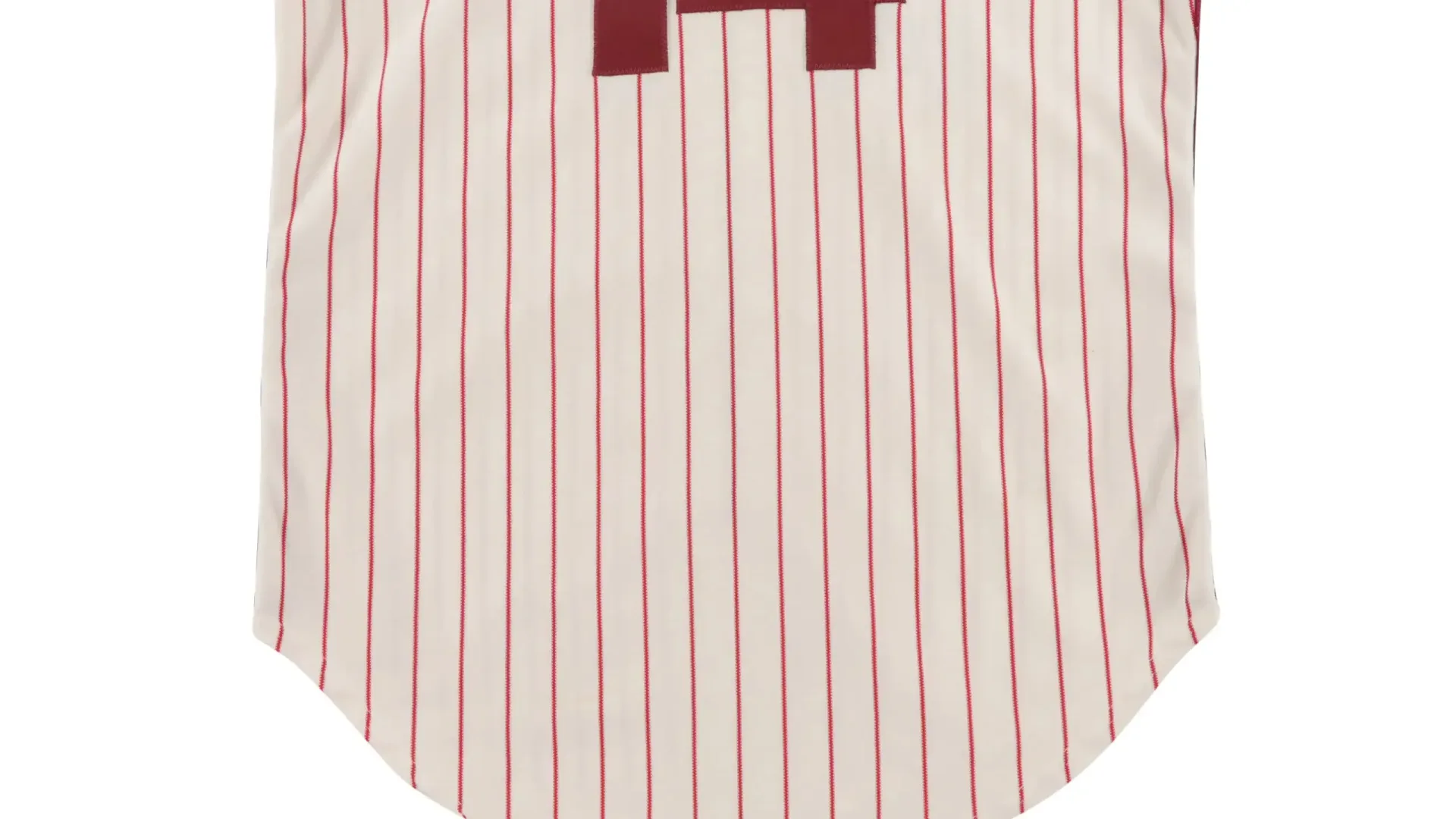
One of the defining pieces from the Philadelphia Phillies’ first World Series championship is headed to auction: Pete Rose’s game-worn jersey from Game 6 of the 1980 World Series. The photo-matched shirt is the headline lot in the 2026 Fall Classic Auction, which is scheduled to close on December 5.
The appeal is not simply that it is a Rose Phillies jersey. Its documented link to the clinching game gives the item a sharply specific place in baseball history. Rose played first base for Philadelphia, and the 1980 season saw him hit .282, score 95 runs and lead the league with 42 doubles as the club reached and won the World Series.
In the final moments of Game 6, Rose made a ninth-inning grab on a foul pop-up after the ball bounced out of catcher Bob Boone’s mitt. The jersey was later given by Rose to Bill Luzinski, the brother of Phillies teammate Greg Luzinski, in the postgame clubhouse. It has stayed in Bill Luzinski’s possession since then, providing a direct ownership trail from the championship celebration to the present.
MeiGray has photo-matched the jersey. For collectors, that term has a precise meaning: photographs are compared with details on the physical uniform—such as lettering placement, fabric characteristics, repairs, marks or other visual traits—to connect an item to its use in a particular game or period. It is distinct from a broad claim that an object was merely issued to, or associated with, a player.
That makes the Rose lot an especially useful example of why provenance and photo-matching matter in the game-worn market. The story combines a named player, a named game, a championship context, a postgame transfer and third-party photo-matching. Each element addresses a different question a bidder might ask: what is the item, when was it used, how did it leave the player, and what evidence supports its identification?
A championship artifact with a direct chain of custody
Rose joined the Phillies in 1978 after his long Cincinnati Reds career. By 1980, the 13-time All-Star and 1973 National League MVP was a key part of Philadelphia’s title run. Game 6 therefore carries more weight than a routine regular-season appearance: it was the game that delivered the franchise’s first World Series championship.
The Luzinski connection is important because it supplies more than a vague family recollection. The jersey is said to have been handed over in the clubhouse by Rose himself, then retained by the recipient. In collecting, a credible chain of custody is the sequence of ownership and possession from an item’s origin to its current seller. It does not replace authentication, but it can make an authentication conclusion more legible and more persuasive.
Potential bidders should still separate the supported details from assumptions. The available information identifies the jersey as game-worn and photo-matched to Game 6; it does not provide a presale estimate, bidding total, or a claim that this is Rose’s only surviving 1980 Phillies jersey. Its strength lies in the stated documentation, not in any need to inflate what has been disclosed.
Related coverage includes Pete Rose’s 1980 World Series Phillies Jersey Leads Lelands Fall Classic Auction.
Derek Jeter’s one-of-one brings the card side into focus
The auction is also built around a major modern-card centerpiece: a 1999 Metal Universe Derek Jeter Gem Masters 1/1, graded PSA 8. The “1/1” notation means this version was produced as a single copy, an intentional scarcity marker that differs from a normal base-card print run. The supplied auction details describe it as the only example made.
Its PSA 8 grade is a condition assessment, not a statement about rarity or player significance. In practical collecting terms, the one-of-one designation establishes supply, while the grade communicates the evaluator’s view of the individual card’s physical state. Both matter, but they answer different questions.
The Jeter card reportedly remained ungraded and out of public view for 27 years before grading at the 2026 National Sports Collectors Convention. That hobby-fresh status can be compelling because it describes a card that has not circulated through publicly visible grading or auction channels for much of its existence. But it should not be confused with a guarantee of a result: bidders ultimately decide what provenance, condition, player legacy and one-of-one scarcity are worth together.
The Metal Universe name also connects this sale to an era of sports cards known for bold visual design and chase-driven inserts. Modern collector interest is often shaped by the interaction of a card’s place within a release and the survival of a specific high-scarcity parallel or insert. The Jeter Gem Masters does not need an enormous population report to create scarcity; it is explicitly a lone produced copy.
Collectors who enjoy comparing eras of card design may also find a useful contrast in 1991 Impel Marvel Universe Series II’s cards, holograms and collector editions. The subjects and markets differ, but the release-level context is a reminder that inserts, presentation and edition structure can be central to how collectors understand a set.
Gehrig and Ruth material offers history in several forms
Another headline item is described as a newly discovered, dual-signed original Type 1 photo of Lou Gehrig and Babe Ruth. It was taken at Yankee Stadium on July 4, 1939, during Lou Gehrig Appreciation Day—the day Gehrig delivered his “luckiest man on the face of the earth” speech. The image shows the longtime Yankees teammates embracing and bears inscriptions from both men.
“Type 1” is a term collectors use for an original photograph made from the photographer’s negative around the time the image was taken. It concerns the photographic object itself, not just the scene depicted. That distinction is vital. A later print of a celebrated moment can still be desirable, but it is not the same category as a period original photo. In this case, the photo’s significance is layered: historic occasion, iconic subjects, original-format classification, and signatures on the image.
Gehrig is also represented by a 1934 Tour of Japan album. The album includes team signatures and original photographs, along with a circa-1923 Gehrig rookie photo by photographer Charles M. Conlon and dozens of images from the collection of Gehrig’s brother-in-law, Frank Twitchell Jr. It has PSA attribution in the auction description.
These two Gehrig lots demonstrate that “rarity” is not one uniform idea. A single original photograph signed by two legends is rare in one way; an album that preserves signatures, family-origin photographs and a particular touring context is rare in another. Serious bidders will likely evaluate them through different collecting frameworks, even though both are tied to the same player.
More than baseball: rings, uniforms, tickets and photos
While baseball anchors the offering, the broader catalog reaches across several sports and collecting formats. The personal collection of Green Bay Packers legend Willie Wood includes his Super Bowl II ring, his 1965 NFL Championship ring and his Pro Football Hall of Fame Gold Jacket. Championship rings are especially personal objects: unlike a team-issued program or retail collectible, they were presented to an individual connected to the accomplishment.
Football also appears through Pat Summerall’s 1952 Detroit Lions NFL World Championship ring, championship rings presented to Yankees general manager Cedric Tallis from 1977 and 1978, and a circa-1965 original Type I photo from Joe Namath’s Topps rookie-card photo shoot. The Namath image is identified as his first time wearing a Jets uniform, giving it a close connection to one of the sport’s most recognizable rookie cards.
Among basketball-related material are a signed 1970 Topps Basketball No. 123 Pete Maravich rookie card, authenticated by PSA with an Auto 10 designation, a 1957 Topps Basketball unopened pack from Bill Russell’s rookie year, and a program from Wilt Chamberlain’s 100-point game. The Maravich listing again illustrates the split between card authentication and autograph evaluation: PSA Authentic addresses the card’s authentication status, while Auto 10 is the stated autograph grade.
The baseball depth continues well beyond Rose, Jeter, Gehrig and Ruth. Listed highlights include a 1998 Metal Universe Ken Griffey Jr. Precious Metal Gems numbered to 50 and graded PSA 7; a full ticket from the clinching Game 5 of the 1907 World Series; a near-complete 97-of-100 M101-2 Sporting News Supplements set from 1909-13; and a 1971 Roberto Clemente Pirates game-worn cap attributed to the World Series. A PSA 3 full ticket from Clemente’s 3,000th hit is also included.
Other baseball lots span objects that capture very different kinds of history: a 1930s Honus Wagner professional-model barnstorming bat, Cy Young’s Hall of Fame presentational plaque, a late-1920s Babe Ruth single-signed baseball, a game-used ball from the final pitch of Nolan Ryan’s fourth no-hitter on June 1, 1975, and a Baseball Hall of Fame Gold Lifetime Pass presented to Ruth’s widow.
How to read the catalog language
The Fall Classic lineup is a concise lesson in the vocabulary collectors need when moving among cards, photos, uniforms and historic artifacts. Photo-matched identifies an object with period imagery. Game-worn means it was used by an athlete in competition, although the degree of game-specific documentation can vary from lot to lot. Attributed to, as used with the Clemente cap, signals an association described by the catalog and deserves close attention from bidders assessing the supporting evidence.
For cards, numerical grades such as PSA 8 or PSA 7 are condition assessments. “Authentic” can mean the item has been authenticated without a numerical card grade, while an autograph grade evaluates the signature. For photographs, Type I identifies an original period print. For unopened material, as with the 1957 Topps Basketball pack, the grade applies to the sealed pack itself rather than promising any particular card inside.
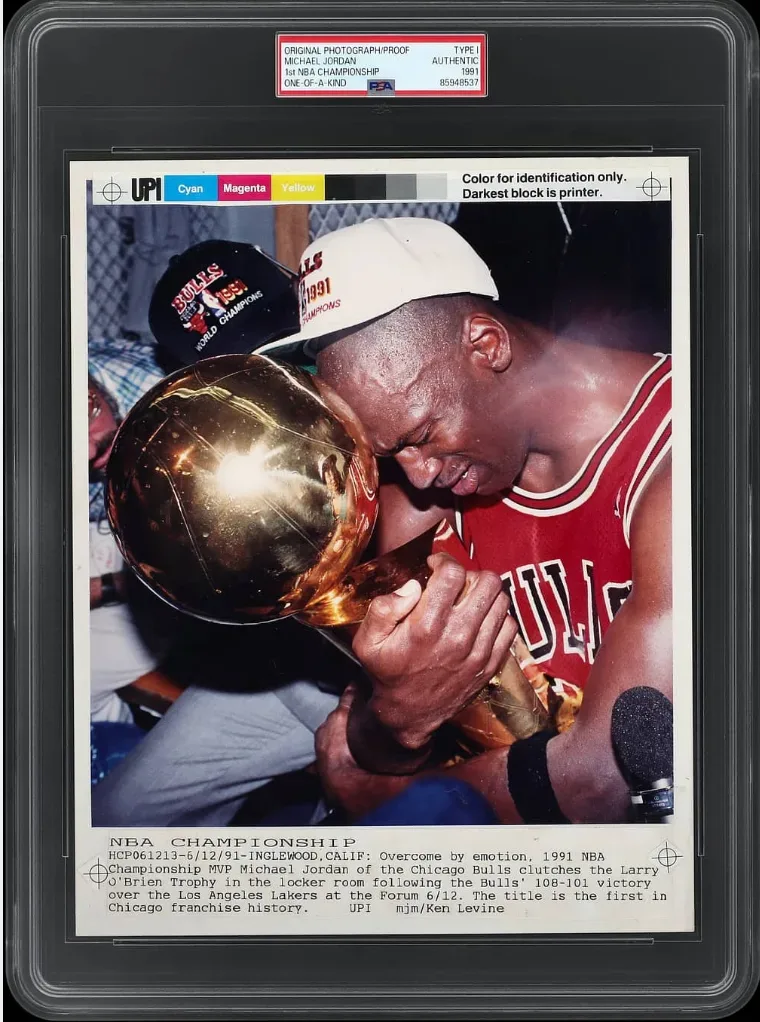
The remaining listings reinforce the auction’s range: a 1998 Yankees World Championship ring with its display box; Michael Jordan’s signed 1991 NBA All-Star Game professional-model jersey with a consignor letter of authenticity and PSA documentation; photo-matched gloves worn by Evander Holyfield in his November 10, 2006 fight with Fres Oquendo; and Richard Petty’s 1987 race-worn fire suit and photo-matched helmet.
For prospective bidders, the practical takeaway is straightforward: collect the evidence, not just the headline. Examine the exact wording of authentication and attribution, distinguish a production limitation from a condition grade, and recognize when a documented event connection turns a familiar object into a historically concentrated one. Rose’s Game 6 jersey has that concentration in abundance—Philadelphia’s first championship, a final-out moment, a postgame gift, a long-held provenance trail and photo-matching all gathered in one piece of flannel.