Anker’s SOLIX C200 DC Portable Power Station is listed at $130, reduced from $150. That is a $20 reduction, or roughly 13%, for a compact DC-only power station designed around USB charging rather than household AC outlets.
The distinction matters. At approximately 4.2 pounds and 3.9 by 4.3 by 7.3 inches, the C200 DC is positioned as a portable battery for phones, tablets, laptops, cameras and small accessories on the road, at campsites, or when an outage interrupts access to wall power. It is not presented as a replacement for a conventional AC-equipped backup generator. Its strengths are size, USB-C capability and an unusually broad port selection for its footprint.
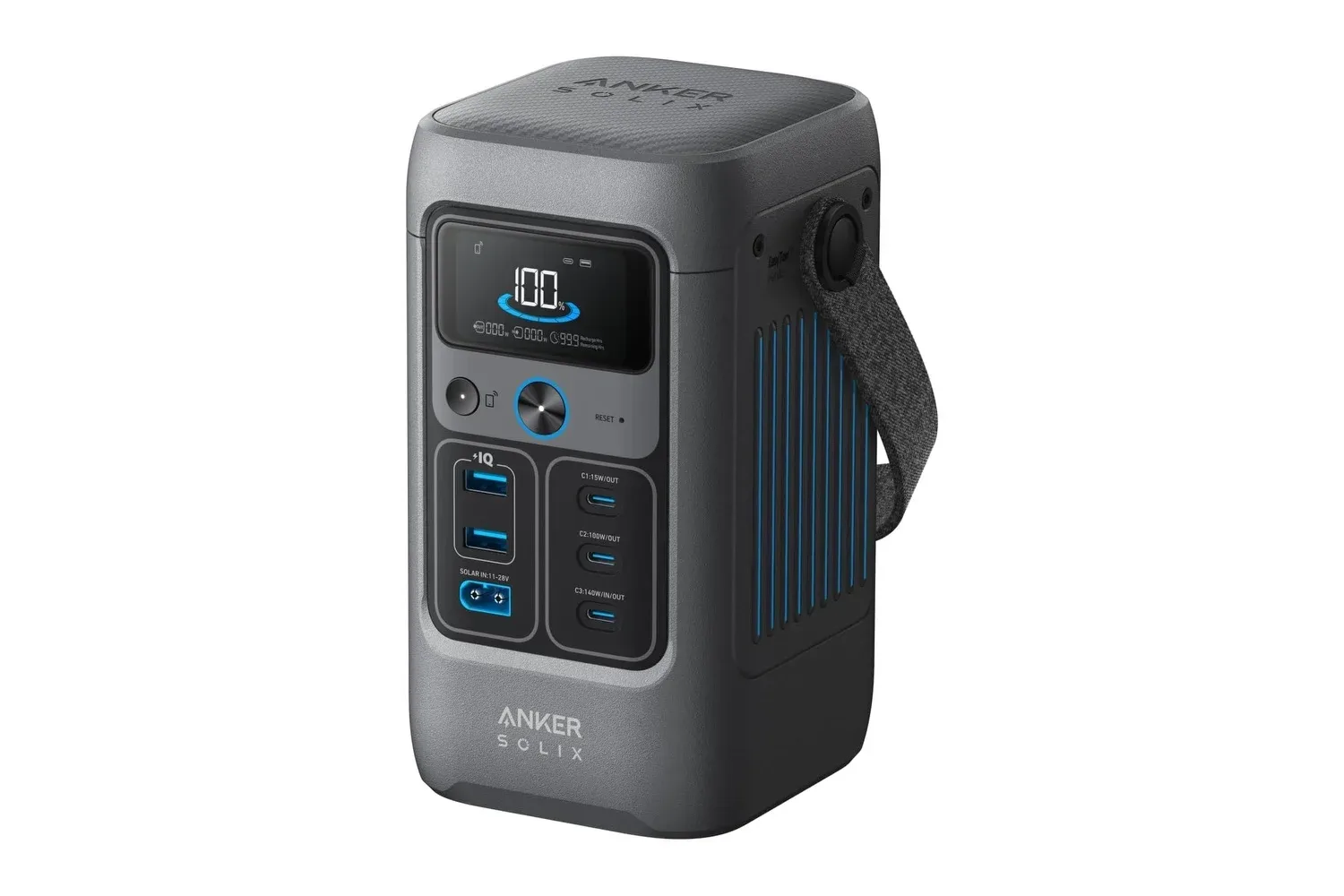
Its headline specification is a 192Wh LiFePO4 battery, described as roughly 60,000mAh. It offers 200W of total output across five ports: three USB-C and two USB-A. The port layout includes a 140W bidirectional USB-C connection, a second USB-C port rated up to 100W, a 15W USB-C port, and two USB-A ports rated at 12W each.
For people who already carry several power banks, this is a different sort of travel-power proposition: one battery with a display, high-power USB-C delivery, multiple simultaneous connections and the option to recharge from solar input. Its value depends less on its raw capacity alone than on whether those ports and recharge options suit the devices someone actually carries.
What the C200 DC’s specifications mean in practice
Wh, or watt-hours, measures stored energy. The stated 192Wh figure is the more useful capacity number when comparing devices that operate at different voltages. The approximately 60,000mAh figure is familiar to power-bank shoppers, but milliamp-hours are tied to voltage and therefore can make cross-device comparisons less clear.
That 192Wh capacity is intended for USB-powered equipment. Potential use cases include keeping a phone and tablet going during travel, topping up camera batteries in the field, or supporting a laptop and communication gear when a nearby outlet is unavailable. During an outage, the stated device examples include a cellphone, laptop and Wi-Fi router, all of which can be important for maintaining connectivity.
Capacity is only one half of the equation. Output describes how much power the station can deliver at a given moment. The C200 DC’s total output is rated at 200W, while its highest-rated individual USB-C port reaches 140W. This is why it can be relevant to larger laptops that can take advantage of high-wattage USB-C charging, rather than merely being a battery for phones and earbuds.
There is an important multi-device caveat. When both high-wattage USB-C ports are in use, the unit can provide up to 100W to either port. In plain terms, connecting a second demanding device changes the available power allocation. Buyers planning to charge more than one laptop at the same time should account for that shared-output behavior instead of assuming the 140W and 100W labels can always be reached concurrently.
Five ports, with USB-C doing the heavy lifting
The C200 DC’s port mix is heavily tilted toward USB-C, which is the practical choice for recent laptops, tablets, phones and many camera accessories. The 140W port supports USB Power Delivery 3.1, commonly abbreviated as PD 3.1. Power Delivery is a USB-C charging standard through which compatible devices and chargers negotiate an appropriate charging level. Here, the key point is that the 140W port is built to serve more demanding USB-C devices and to recharge the station itself.
- One 140W two-way USB-C port: for high-power charging and for recharging the C200 DC.
- One USB-C port up to 100W: another option for a laptop or other relatively demanding USB-C device.
- One 15W USB-C port: suited to lower-draw accessories.
- Two 12W USB-A ports: for older-cable devices and smaller accessories such as phones or earbuds.
“Two-way” is useful terminology here. A bidirectional port can send power to a connected device or accept power to refill the station. This reduces the need for a proprietary charging brick, although the C200 DC still needs a suitably capable USB-C wall charger to achieve its quoted rapid recharge figure.
The unit includes a USB-C-to-USB-C cable, but the 140W wall charger needed for the stated fast-charging result is not included. That is an essential practical consideration for anyone evaluating the $130 price: users without a high-output compatible wall charger should not assume every existing USB-C adapter will deliver the top recharge speed.
Recharge options: wall power and solar input
With a 140W USB-C wall charger, Anker says the C200 DC can reach 80% charge in about 1.3 hours. The company also lists an XT60 solar input with support for up to 100W of solar charging.
XT60 refers to the connector used for the solar input. It is separate from the USB-C ports, so prospective solar users should verify that their panel setup is compatible with the input arrangement and can provide the required connection. The quoted maximum solar-input figure is up to 100W, not a promise that every panel or weather condition will reach that level.
Solar capability has a straightforward appeal for camping and longer trips away from an outlet, where recharging the battery pack can be as important as the power it initially holds. It also creates a distinction between the C200 DC and a typical small power bank: the station has an explicitly stated solar-input path as well as its USB-C recharge route.
Still, the decision should start with a realistic charging plan. For a traveler who expects regular access to wall outlets, a USB-C wall charger may be the primary refill method. For someone assembling a camping or emergency kit, the solar input may be more central. In either case, the display is designed to show remaining battery level and power status, helping users watch consumption rather than discovering an empty pack after the fact.
Why the battery chemistry is worth noting
The SOLIX C200 DC uses a LiFePO4 battery, short for lithium iron phosphate. The stated advantage is longevity: the chemistry is intended to help the station remain useful over years of use as a portable or backup energy source.
That matters especially for a device that may spend long stretches stored in a car, backpack or emergency kit and then be expected to help when power is unavailable. A portable power station is not only a travel accessory; it can be a readiness tool for keeping essential low-power personal electronics charged. The three-year warranty adds a defined period of manufacturer coverage.
The compact dimensions and 4.2-pound weight also explain the product’s niche. A larger power station can offer more stored energy, but it becomes harder to treat as a backpack, carry-on or camera-bag companion. The C200 DC instead aims at mobility, with enough connection options to consolidate several USB charging jobs in one place.
Who should consider the $130 deal
The clearest audience is someone whose important devices charge through USB-C or USB-A and who needs more flexibility than a small, single-purpose power bank provides. Travelers may appreciate charging a laptop, phone and smaller accessories from one unit. Photographers can use its portable USB power access for camera batteries and related gear. Campers have both USB-C recharging and the option of solar input. Households can view it as a compact backup for phones, laptops and connectivity equipment during a power interruption.
It makes less sense to approach the C200 DC as an all-purpose appliance backup. The supplied specifications focus on USB output and make no claim of AC outlets. Before purchasing, users should list the connector type and charging requirements of their devices, consider whether simultaneous laptop charging is a real need, and check whether they already have—or are prepared to obtain—a 140W USB-C wall charger for the fastest stated recharge rate.
For another recent look at Anker charging hardware alongside an unusual collectible tie-in, see Anker’s Halloween sale coverage.
At $130, the SOLIX C200 DC’s appeal rests on a focused package: 192Wh of LiFePO4 storage, a 140W PD 3.1 USB-C port, five total ports, up to 100W solar input, a built-in status display and a portable 4.2-pound form factor. Shoppers should weigh those concrete capabilities against their device mix and charging setup, rather than treating the station as a substitute for every kind of backup-power product.
Shop the products
Check current price, model and availability at the retailer.