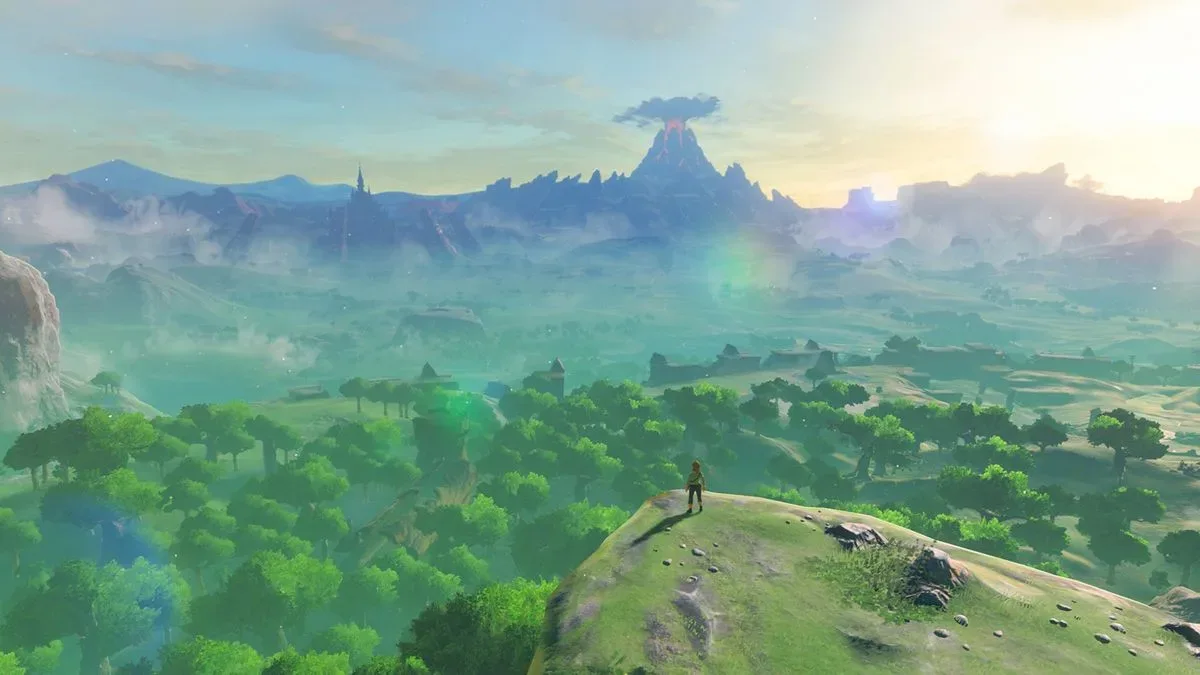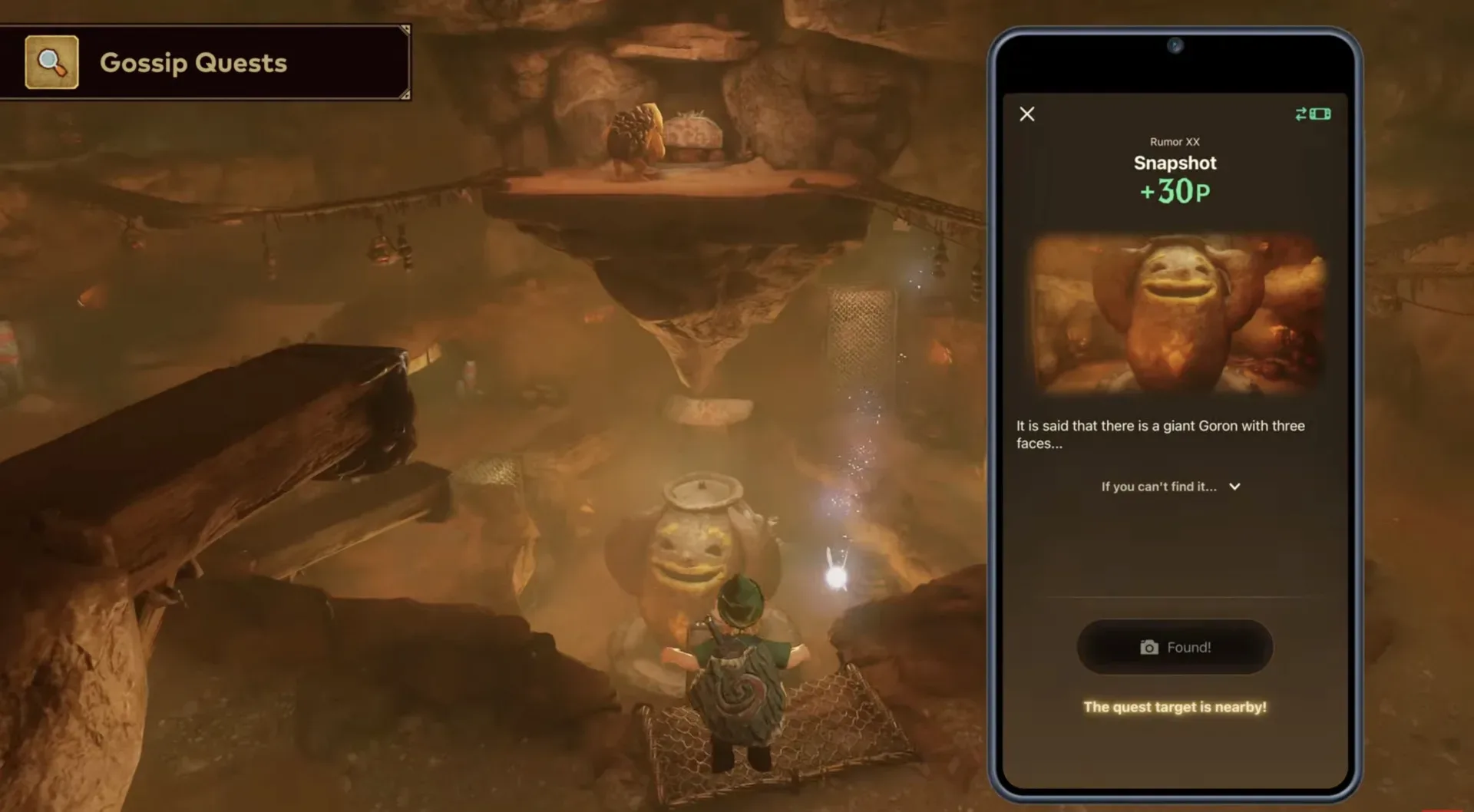
The Legend of Zelda: Tears of the Kingdom has an easy elevator pitch: it expands the Hyrule of Breath of the Wild. The hills, villages, ruins and roads return, now complemented by sky islands and a fresh set of abilities. That description is correct, but it misses the place where the sequel becomes strangest and most adventurous. The most daring part of this Hyrule is below it.
The Depths are not merely a second map designed to make the world bigger. They change the emotional contract between player and landscape. The surface often invites wandering with a reassuring readability: a mountain, a stable, a shrine, a plume of smoke, a person in need. The sky offers isolated challenges hovering in brilliant open air. Underground, much of that visual confidence is removed. The player descends through a chasm into darkness, finds uncertain footing, and has to make illumination rather than simply follow the next conspicuous landmark.
For a series that has repeatedly balanced discovery against careful construction, that is an unusually potent idea. The Depths make Hyrule feel less like a route through a curated adventure and more like a hazardous place that must be understood on its own terms.
From Zelda ritual to open-ended tools
Zelda has long been recognisable because it returns to familiar shapes: a green-clad hero, a princess, an ancient threat, puzzles, dungeons and a progression toward a climactic confrontation. Individual entries can be radically different, but they tend to preserve a sense that every barrier, item and room has been intentionally placed within a readable path.
Breath of the Wild disrupted that rhythm. Its Hyrule made Shrines a dominant form of challenge, spread exploration across a vast open world, and gave Link a small set of central abilities early. Rather than steadily handing out classic equipment such as a boomerang or hookshot, it encouraged players to combine systems, physics and environmental objects. Weapons could break, horses could be lost, and a destination could be approached by a route the player devised rather than one the game plainly prescribed.
Even its downloadable content delivered an especially unexpected image for the series: Link receiving a motorbike. The detail matters not because a motorbike defines the game, but because it demonstrates how far this version of Zelda had moved from older assumptions about what fits in Hyrule.
Tears of the Kingdom pushes that flexibility further with Ultrahand, Fuse and Ascend. Ultrahand turns loose materials into machines and improvised solutions. Fuse encourages experimentation with weapons and objects. Ascend lets Link move upward through overhead surfaces, a power that can make the world’s solid geometry feel surprisingly negotiable. These are not simply replacements for earlier tools. Together, they ask players to look at obstacles as editable problems.
That expressive approach is a major reason the sequel can revisit Hyrule without feeling entirely content to repeat it. Still, there is another answer to the question of how a sequel can build on a famously open game: create a space where openness no longer automatically provides comfort.
Related coverage includes Why The Depths Remain Tears of the Kingdom's Most Daring Zelda Idea.
The underworld refuses to be a sightseeing tour
The Depths lie beneath the familiar surface and are entered through red-rimmed chasms. They are enormous, dark and dangerous, marked by Gloom that damages Link’s hearts. Their relationship with the world above is meaningful, but the underground does not feel like a neat mirror map or a perfectly fitted puzzle-box alternate dimension. It has a rougher, more disorienting identity.
Earlier Zelda games have certainly explored parallel worlds and altered realms. A Link to the Past and Ocarina of Time, for instance, use their alternate states with great precision, tying locations and puzzles across clearly authored connections. The Depths work differently. They are linked to Hyrule, yet their darkness and scale keep the player from instantly converting those links into certainty. The point is less to admire a clever correspondence than to endure the unfamiliarity of being beneath everything one thought one knew.
That makes the underground unusually immediate. On the surface, long-distance views can constantly offer distractions: a tower, a shrine, a settlement, an unusual rock formation or a task that can be casually added to the mental list. In the Depths, the horizon frequently disappears. The ground becomes the urgent problem. Is there a drop ahead? Is that patch safe to cross? Are enemies waiting outside the limited circle of visibility? Is there enough equipment and food to keep pressing onward?
The environment takes on the role of an antagonist without ceasing to be an environment. It does not need a boss introduction to pressure the player; insufficient knowledge does the job. Darkness transforms ordinary movement into an act of caution.
Lightroots turn knowledge into progress
The central counterweight to the Depths’ obscurity is the Lightroot network. Activating a Lightroot creates a pool of visibility, reveals a portion of the map and establishes a fast-travel point. That familiar open-world loop—reach a marker, unveil information, extend one’s range—becomes much more satisfying when basic orientation is the prize.
A Lightroot is not just another icon checked off a map. In this setting, it represents a small recovered certainty. Before it is activated, a player may be navigating with only fragments of terrain and memory. Afterward, a little more of the underworld becomes legible. The reward is practical, but it also alters the mood: the player has created a foothold in a place built to make footholds feel temporary.
This is where the Depths offer a distinctive answer to a common open-world issue. Large maps can make exploration feel procedural when every point of interest is immediately visible or easily reached. The underground reverses that comfort. Discovery begins with a lack of information. Progress is measured not only in treasure or combat victories, but in the slow construction of a mental and literal map.
It is a useful contrast to the franchise’s more guided spaces, and to other Nintendo adventures where carefully designed movement can be the main pleasure. For another perspective on how Nintendo games frame traversal and player tolerance for friction, see this comparison of Super Mario Galaxy and Super Mario Sunshine. In the Depths, friction is not an unfortunate byproduct. Limited sight, uneven terrain and Gloom are fundamental to the intended tension.
Optional darkness, deliberate meaning
One of the most interesting things about the Depths is that much of their exploration is optional. The game still has a grand story on the surface, where Link helps people, investigates Hyrule’s troubles and faces an old evil. Those acts of kindness and restoration remain vital to the tone of Tears of the Kingdom. The underground does not erase them.
Instead, its optional status makes its presence more revealing. Players may choose the brighter routes, return to familiar settlements and focus on the main journey. But the hostile world beneath Hyrule remains there, waiting. It is a persistent suggestion that the kingdom’s beauty, order and rituals sit atop something unresolved.
This also lets the Depths avoid becoming a conventional mandatory dungeon sequence. A dungeon generally promises containment: a bounded challenge with a solution, a boss and a clear endpoint. The Depths can contain puzzles, resources and fights, but their larger purpose is to make the player feel uncontained. They are too broad, too dark and too easily entered from different places to become a tidy series of rooms.
That lack of tidiness is the feature. In a series celebrated for polish and exacting design, the Depths carry an impression of danger that is not fully domesticated by the player’s expectations. The surface Hyrule can often be read as a place where curiosity pays off quickly. The Depths demand that curiosity accept risk first.
A future-facing part of a familiar Hyrule
The sequel’s sky islands understandably provide its most instantly marketable image: Link above the clouds, surrounded by blue distance and floating fragments of land. But the Depths are the stronger counter-image. They are enclosed rather than expansive, obscured rather than picturesque, and uneasy rather than inviting.
That opposition helps explain why the underground leaves such a mark. Tears of the Kingdom is visibly connected to its predecessor, using the same broad Hyrule and retaining the Shrine-based structure. Yet underneath that continuity, it offers a place that refuses to behave like a comfortable revisitation. It gives the player remarkable building powers, then places them where improvisation can feel necessary rather than merely amusing.
The result is not an argument that every Zelda should be dark, sprawling or deliberately disorienting. Zelda’s history is richer because it contains focused dungeons, overworld riddles, playful gadgets and elegant progression. But the Depths show that the series can find new energy by allowing uncertainty to remain uncertainty for a while.
Lightroot by Lightroot, the player does not simply clear a map. They turn an unknowable space into somewhere they can survive. That is why the Depths stand as the most audacious part of Tears of the Kingdom: they make exploration feel dangerous again, and make understanding the world feel earned.