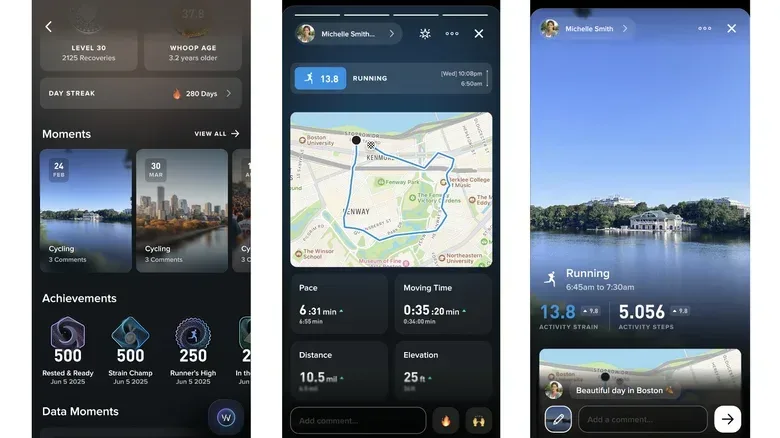
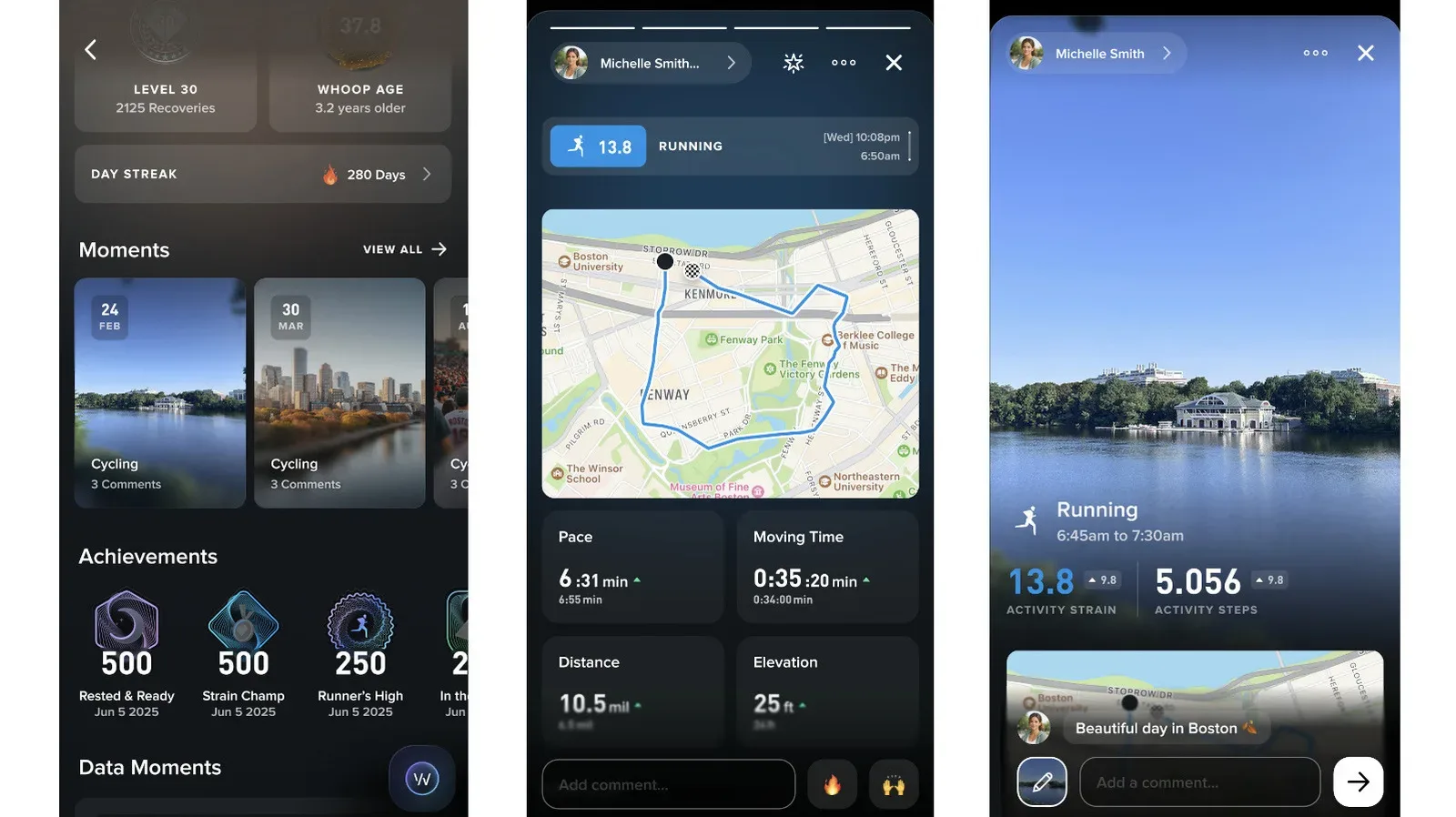
Fitness apps have long borrowed the language of games: streaks, goals, leaderboards, progress bars and the tiny dopamine ping of seeing a number move in the desired direction. Whoop is taking the next logical, and potentially much more personal, step. The company has launched Whoop Humans, a social network inside its app where members can share selected data gathered by their Whoop wearable.
The unusual pitch is not simply that people can post training updates. It is that the central information in those updates is intended to come directly from a wearable device. Members can share sleep, recovery, strain and activity information, while friends and family can follow one another, react and comment. Whoop calls this a more verifiably human kind of social network because its core posts are tied to real-world wearable data rather than conventional text alone.
That makes Whoop Humans less like a blank-status-box platform and more like a feed built around recorded performance and wellbeing signals. For people already invested in tracking their routines, that distinction could be the entire appeal. For everyone else, it may raise the equally important question: how much of somebody else’s sleep, exercise load or readiness do they actually want to see?
What Whoop Humans is designed to share
Whoop Humans is now available through the Whoop app. Its posts can include several categories of data produced by a Whoop wearable:
- Sleep: information related to a member’s sleep tracking.
- Recovery: a readiness-oriented measure that can indicate whether someone may need to ease off.
- Strain: a measure connected to physical exertion.
- Activities: workout and activity information captured through the wearable.
These categories matter because they turn a workout post into something broader than a photo of a gym floor or a line declaring that somebody “went hard.” A friend may see not only that a person exercised, but that they are recovering well, have taken on a demanding load or might be running low. Whoop’s envisioned use case is supportive accountability: congratulate someone hitting a goal, or suggest that a friend take it easier when their Recovery is low.
That is a different kind of social prompt from the familiar leaderboard. A leaderboard gives a group a shared ranking or target. A recovery update instead asks people to interpret context. High exertion is not automatically a win if it is paired with poor recovery, and a rest day need not look like failure. In theory, the feed can make fitness progress feel less like a one-dimensional score chase.
Wearable-verified does not mean automatic sharing
The most consequential practical detail is that wearing a Whoop does not automatically send all tracked information to the social network. Members choose which workout types or achievements appear, can adjust their sharing preferences at any time and can keep workout photos posted through the Moments feature private.
That separation is crucial. Health-adjacent data can feel intensely personal even when it is presented as a simple metric. A member may be happy to celebrate a particular workout, but not want every activity or achievement broadcast. Someone may want a close friend to know that their recovery is low, while preferring that the rest of their contacts never see it. Granular controls give the service a chance to support those different boundaries rather than treating all activity as content by default.
Related coverage includes Whoop Humans Turns Wearable Fitness Data Into a Social Feed.
Moments expands the feed beyond measurements by allowing workout photos. Yet the ability to keep those images private suggests that Whoop Humans is not necessarily asking users to turn every session into a public performance. It can serve as a personal record as well as a social post, depending on the choice the member makes.
A quick guide to the terms
Recovery is the term most likely to need interpretation. In the context of the new network, it is presented as data friends can use to understand when another person might need rest or a lighter day. It should not be confused with a public declaration of toughness or a clinical diagnosis; within this social feature, its role is a readiness signal that can add context to activity.
Strain refers to the exertion side of the equation. It gives a workout or set of activities a measurable shape, but the useful social value comes from reading it alongside recovery rather than treating it as an isolated badge of honor.
Moments is Whoop’s photo-sharing feature for workouts. Unlike the wearable-generated data at the heart of the network, a Moment is visual content a member can retain privately.
From Teams and leaderboards to a follower feed
Whoop already offers Teams, which brings people together through groups and leaderboards. Whoop Humans adds a more direct relationship model: members can follow friends and family, then comment on and react to their updates.
The distinction may sound small, but it changes the social dynamic. A team is organized around collective membership and comparison. A follower feed is organized around ongoing attention to particular people. The former can be great for a challenge or club. The latter is more suited to an accountability circle made up of training partners, relatives or friends with compatible fitness goals.
For gaming-minded users, the structure is immediately recognizable. Teams are the lobby and scoreboard; Whoop Humans is the activity feed where individual progress gets its own context. But the comparison has limits. Exercise and recovery are not simply match statistics. The data can encourage someone to push, but it can also provide a reason to back off. That is a meaningful difference from systems built only to maximize engagement, wins or ranking.
There is also a straightforward reason Whoop’s existing audience could find the network useful. People who use a wearable consistently have already accepted the habit of looking at their own patterns. Sharing selected patterns with a trusted set of people can make encouragement more specific. “Nice work” becomes “nice work reaching that goal,” while “take care” can be prompted by an observable low-recovery signal rather than a vague assumption.
The authenticity argument—and its limits
Whoop’s central message is that data produced by its wearables is harder to fabricate than an ordinary text post. That claim addresses a current social-media anxiety: feeds increasingly contain content whose origins are unclear, especially material that can be generated or altered with little effort. A recorded activity or wearable reading offers a different kind of post, rooted in an offline event captured by a device.
It is worth being precise about what that means. The feature’s authenticity claim applies to the source of the shareable fitness data: it comes from a Whoop wearable. It does not mean every social interaction around that data is automatically meaningful, nor does it remove the need for users to think carefully about what they reveal. A verified measurement can establish that a data point originated with the device; it cannot decide who should see it, how they will interpret it or whether posting it is beneficial for the individual.
That is why the opt-in controls may matter more day to day than the slogan. A social network based on wearable information works best if its members can decide what version of their activity they are comfortable presenting. The useful version of accountability is consent-based, selective and responsive to personal circumstances. The less useful version is pressure to make every workout legible to an audience.
Who is likely to get the most from it?
Whoop Humans is unlikely to convert people who have no interest in viewing fitness updates. The service’s value depends on a social graph where at least some people actively care about sleep, activity and recovery—not just calories, distance or the occasional workout selfie.
It is better suited to a few kinds of relationship:
- Friends pursuing goals together who want encouragement without needing to be in the same place.
- Families who use fitness data as a gentle check-in rather than a competition.
- Training partners who value the context of recovery as well as the fact that a session happened.
- Existing Whoop members who already use Teams but want more direct interaction with specific people.
The service may be less compelling for those who prefer their health data to remain entirely private, or who feel that public metrics can turn rest into something that needs defending. Neither position is wrong. The important point is that Whoop Humans is built around a type of information with higher stakes than a typical reaction-bait status update.
As with other connected services, the usefulness of an app can depend on both its social design and the reliability of the wider digital ecosystem it lives in. That broader dependency is apparent whenever major collaboration platforms have disruptions, as in this look at a recent Outlook, Teams and OneDrive outage. Whoop Humans is a different product, but its launch similarly reflects how much modern community and personal tracking happens through persistent app connections.
A social mechanic built around restraint
The interesting tension in Whoop Humans is that it aims to make fitness data more social without requiring users to make all of their fitness data public. That is a sensible foundation. The platform’s practical success will not be determined solely by whether activity cards look impressive in a feed; it will depend on whether people believe the controls let them share on their own terms.
Its strongest use case is not a giant crowd watching one person exercise. It is a smaller circle where data can make encouragement more informed. The combination of wearable-sourced posts, direct follows, reactions, comments, private Moments and adjustable preferences gives Whoop members a framework for that kind of exchange. Whether they use it for motivation, accountability or simply a few supportive check-ins is up to them.