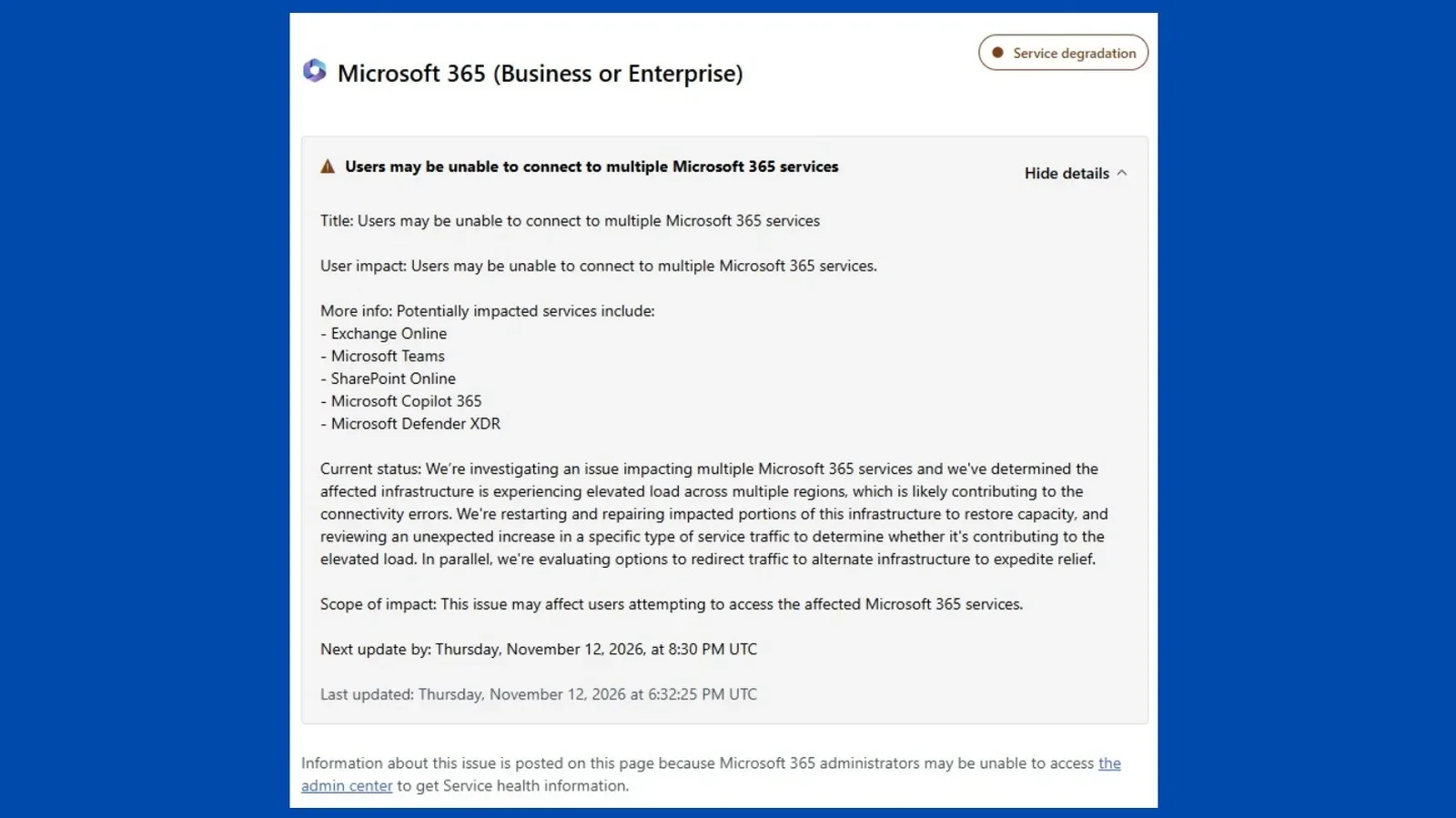

Microsoft has been working through a prolonged multi-service outage affecting Outlook, Teams, OneDrive and Office 365, with users around the world reporting trouble accessing email, messaging and documents for more than 12 hours. Copilot was affected as well, in a rare moment when an office interruption apparently extended to the tool that might otherwise volunteer to summarize the interruption in six bullet points.
The important gaming-specific point is reassuring, if qualified: Xbox services were not believed to be offline during the disruption. That does not make an outage across Microsoft’s work and cloud products insignificant—far from it—but it does mean players should not assume a problem with Outlook or Teams automatically means Xbox network services are down too.
Microsoft attributed the incident to server capacity pressure across several regions. Its explanation was not that traffic suddenly surged beyond expectations. Instead, the company said a number of servers had become unexpectedly unavailable, leaving remaining capacity to handle more work. A senior Microsoft executive also said there was no indication that malicious or cyber activity caused the event.
What Microsoft said went wrong
Microsoft described the condition as elevated load across multiple regions. In plain terms, online services run on fleets of servers rather than one mythical office PC beneath a blinking red light. When some of those servers stop being available, the requests they ordinarily handle—sign-ins, inbox refreshes, file retrieval, message delivery and document syncing—must be routed elsewhere.
That rerouting can increase the workload on the infrastructure still operating. If the remaining capacity cannot absorb the shifted demand cleanly, customers may see failures, slow responses, trouble authenticating, or services that work intermittently. Because Outlook, Teams, OneDrive and Office 365 are connected to work built around identity, communications and cloud-stored files, an issue at the underlying infrastructure layer can appear to users as several separate products failing at once.
Microsoft’s wording matters here. The company linked the disruption to unexpectedly unavailable servers and resulting capacity strain, rather than confirming a sudden rise in demand. That is a distinction between a system that has too much work arriving and a system that suddenly has too few healthy machines available to do its ordinary work. Either situation can produce the same frustrating result on a user’s screen, but they call for different recovery steps behind it.
Early changes did not restore service as expected
The incident also stood out because Microsoft acknowledged that its initial repairs were not producing the intended results. The company said it had monitored changes intended to improve serviceability and confirmed that they were “not taking as expected.” It then said it was looking at alternate workstreams to increase capacity amid sustained traffic-management imbalances.
Traffic management is the process of directing user requests to available infrastructure. Think of it less as a single queue and more as a series of route choices: which server, service cluster or region should answer a given request? A traffic-management imbalance means those routes are not distributing demand in a way that is keeping the platform stable. If a portion of infrastructure becomes unavailable, directing traffic away from it may be necessary, but doing so can overload the destinations receiving the diverted requests.
The phrase “not taking as expected” does not itself identify a specific defect or tell users how long restoration will take. It does, however, show that the response was iterative rather than immediate. In operational terms, that usually means a proposed mitigation was deployed, observed, and judged insufficient—after which engineers moved to a different path instead of presenting an early change as a finished fix.
The recovery effort shifted toward isolation and restart
Later updates described a more direct attempt to separate the affected infrastructure from live traffic. Microsoft said it had paused all deployments, moved additional traffic off the impacted systems and restarted affected servers in an effort to bring them back into service.
Each of those measures has a straightforward purpose:
- Pausing deployments stops new changes from being introduced while a broad incident is being investigated. That reduces the number of moving pieces and helps avoid adding an unrelated complication during recovery.
- Moving traffic off affected infrastructure attempts to prevent requests from continuing to land on systems that are unavailable or performing poorly. It can reduce customer impact if healthy capacity exists elsewhere.
- Restarting affected servers is an effort to return unavailable machines to active service. A restart is not automatically a diagnosis, but it can be a practical recovery action when systems need to be restored to a usable state.
Microsoft characterized the effort as pursuing every available path to reduce the effect on customers. That phrasing is appropriate for an outage of this scope: the immediate goal is to restore reliable access, while the complete technical explanation can require further investigation after services stabilize.
For users, it is worth separating the recovery actions from assumptions about the final cause. The available information supports that server unavailability and regional capacity pressure were central to the incident. It does not establish precisely why those servers became unavailable, how many were affected, or whether one component triggered knock-on problems in others. Those are meaningful unanswered details, and it is better not to fill them with speculation just because a shared document refuses to load at the exact moment someone asks for it.
No indication of a cyberattack
Microsoft said there was no indication the outage resulted from malicious or cyber activity. That is especially relevant because widespread failures across familiar online tools can quickly prompt speculation about a distributed denial-of-service attack, commonly shortened to DDoS.
A DDoS attack generally seeks to overwhelm a service by sending it immense volumes of traffic from many systems. Microsoft’s description pointed in another direction: unexpected server unavailability placed strain on the capacity that remained, rather than a confirmed external flood of new requests. The company’s statement does not turn an active incident into a solved postmortem, but it is the clearest available basis for rejecting claims that the disruption was known to be an attack.
There is a practical lesson in that distinction. “Services are unreachable” describes the customer experience, not necessarily the cause. Outages can arise from unavailable infrastructure, capacity problems, configuration issues, software faults, network trouble or hostile activity. The visible symptom may be similar; the evidence and remediation are not.
What it means for Xbox players
No Xbox services were believed to be offline while Outlook, Teams, OneDrive and Office 365 were affected. That is the current boundary of the incident as described: major Microsoft online productivity and cloud services experienced disruption, while Xbox was not thought to be part of it.
That distinction is useful because Microsoft’s consumer and business products share a corporate name but do not necessarily share a single failure point. A regional capacity issue involving one set of infrastructure or service pathways can be serious without taking every Microsoft-operated product down alongside it. Conversely, normal Xbox access does not mean the wider event is minor for people relying on email, workplace messages or cloud documents.
For anyone encountering a service issue during a broad incident, repeatedly changing passwords, reinstalling an application or cycling through device settings is unlikely to repair a server-side availability problem. The more useful approach is to identify whether the affected task depends on the disrupted service, avoid unnecessary account-security changes, and use an alternative communication or document workflow when one is available. That is not an elegant workaround, but neither is a stalled inbox becoming the final boss of a workday.
The episode also underscores why platform-specific status matters more than general online chatter. A report that “Microsoft is down” is too blunt to tell a player whether game access is affected, just as a functioning Xbox connection does not tell an Office 365 user that their file-sync issue is local. The relevant question is which service is experiencing trouble and whether the provider has identified it as part of the active incident.
Why capacity resilience is such a consequential issue
Modern online platforms are expected to remain available even when individual pieces of infrastructure fail. That expectation rests on redundancy: having alternate systems capable of taking over when a server or group of servers drops out. But redundancy is not a magic spell. It depends on sufficient healthy capacity, working traffic routing and recovery actions that behave as intended under real conditions.
When unexpectedly unavailable servers create pressure in more than one region, recovery can become delicate. Moving traffic can relieve one stressed system while placing new demands on another. Restarting servers can restore capacity, but teams must also ensure those systems return safely and can serve requests reliably. Pausing deployments limits additional change, but it does not by itself restore the systems already affected.
These are the kinds of operational details that make a large outage more than a simple “website down” problem. They also sit within a wider technology-industry focus on the availability and location of advanced computing resources, including the questions raised by reported filings involving restricted NVIDIA AI hardware at a Shanghai project. The present Microsoft incident is not evidence of a hardware-supply or export-control issue; it is a separate event. The connection is simply that dependable digital services rely on complex infrastructure decisions that customers rarely see until capacity becomes constrained.
What remains unknown
Microsoft’s updates established several key facts: the affected services included Outlook, Teams, OneDrive, Office 365 and Copilot; the disruption persisted for more than 12 hours; some servers became unexpectedly unavailable; early mitigation changes did not work as expected; and recovery efforts included pausing deployments, diverting traffic and restarting impacted servers.
Equally, several questions remain unresolved in the information available so far. There is no full explanation for the original server unavailability, no confirmed time for complete recovery, and no detailed accounting of which regions or customer functions were most affected. There is also no indication that Xbox services were down, and no indication of malicious or cyber activity.
That is the sensible place to leave the story while recovery work continues: a significant and extended Microsoft service outage, a candid acknowledgement that the first repair path fell short, and an ongoing effort to restore capacity without evidence that Xbox was caught in the blast radius.