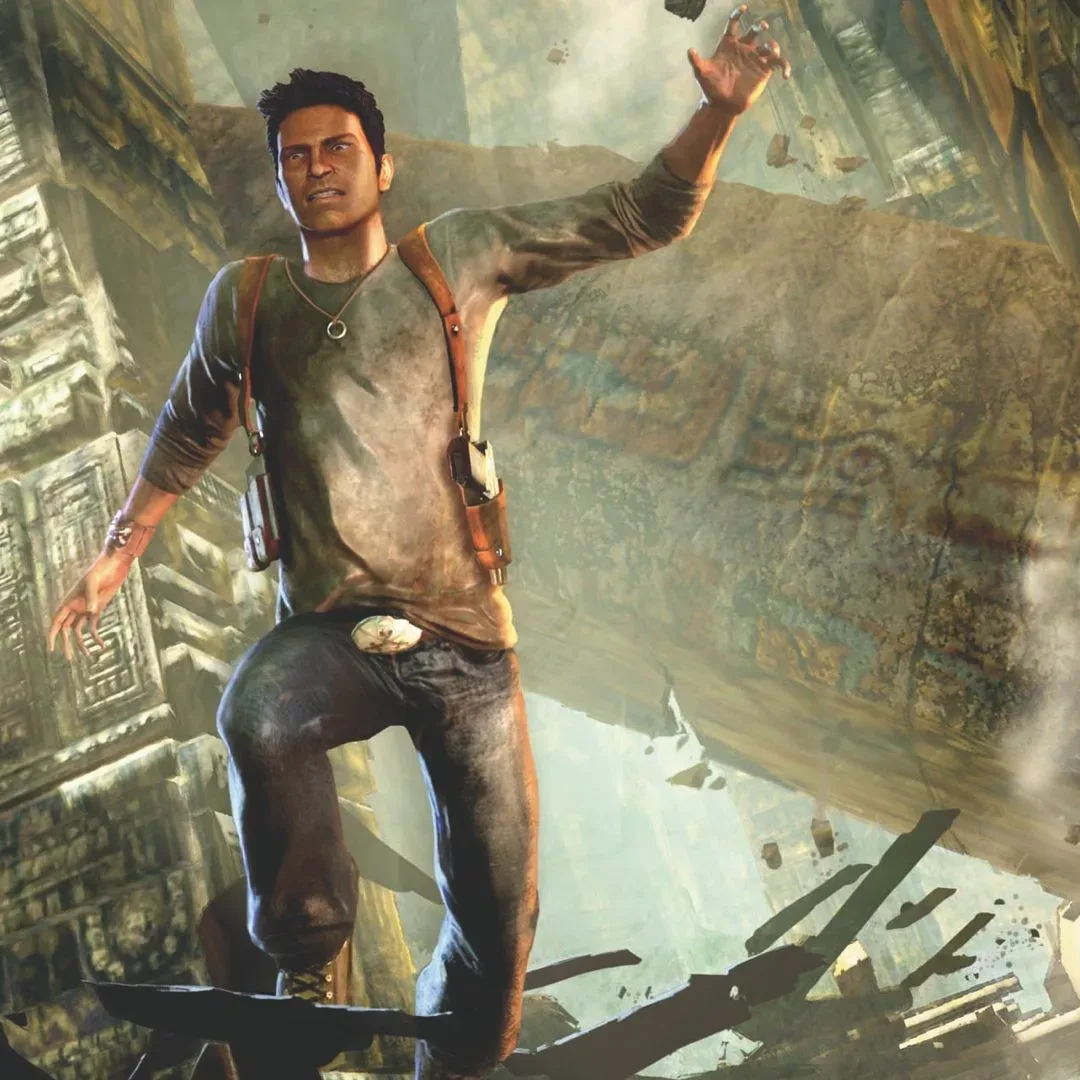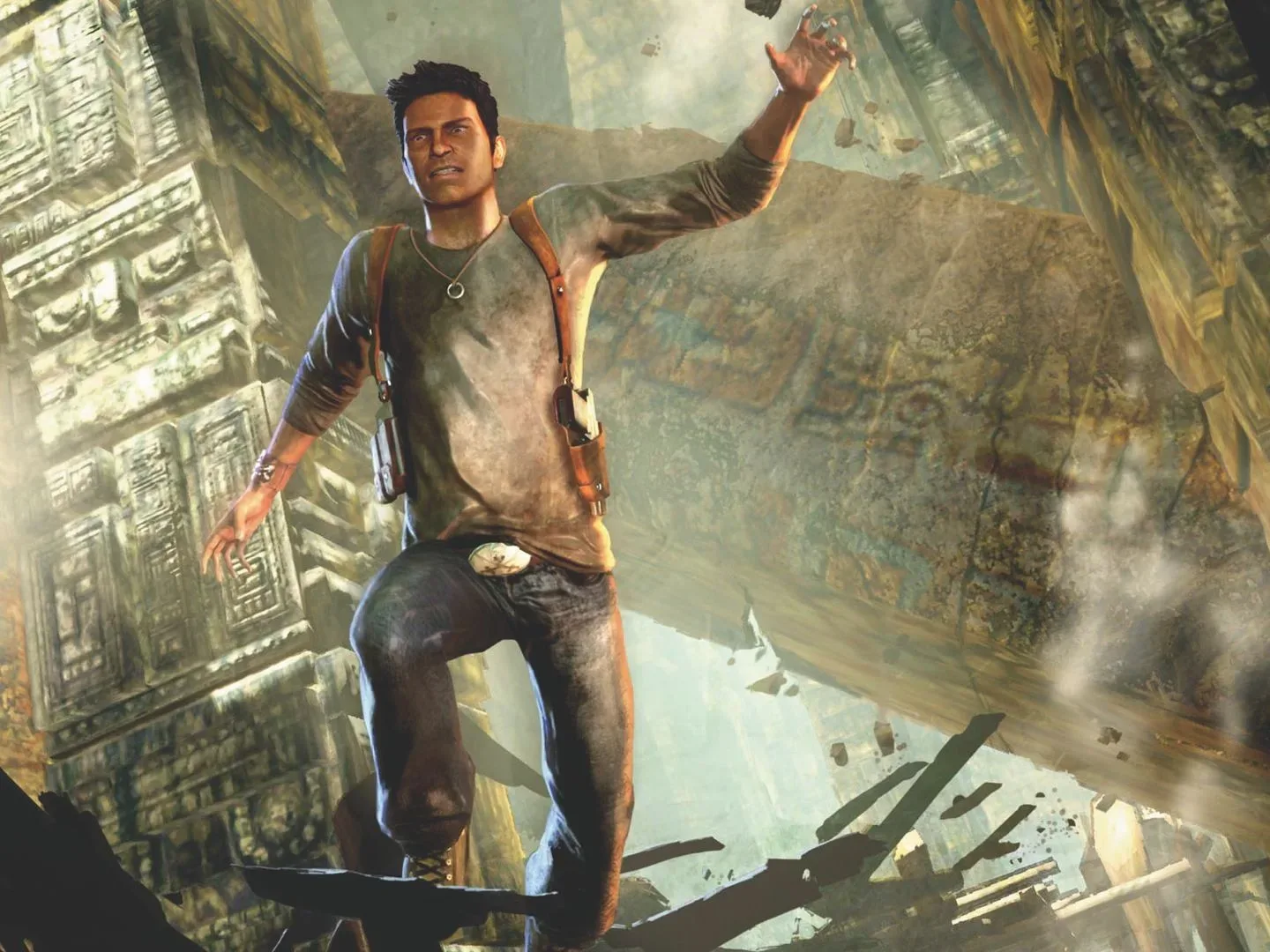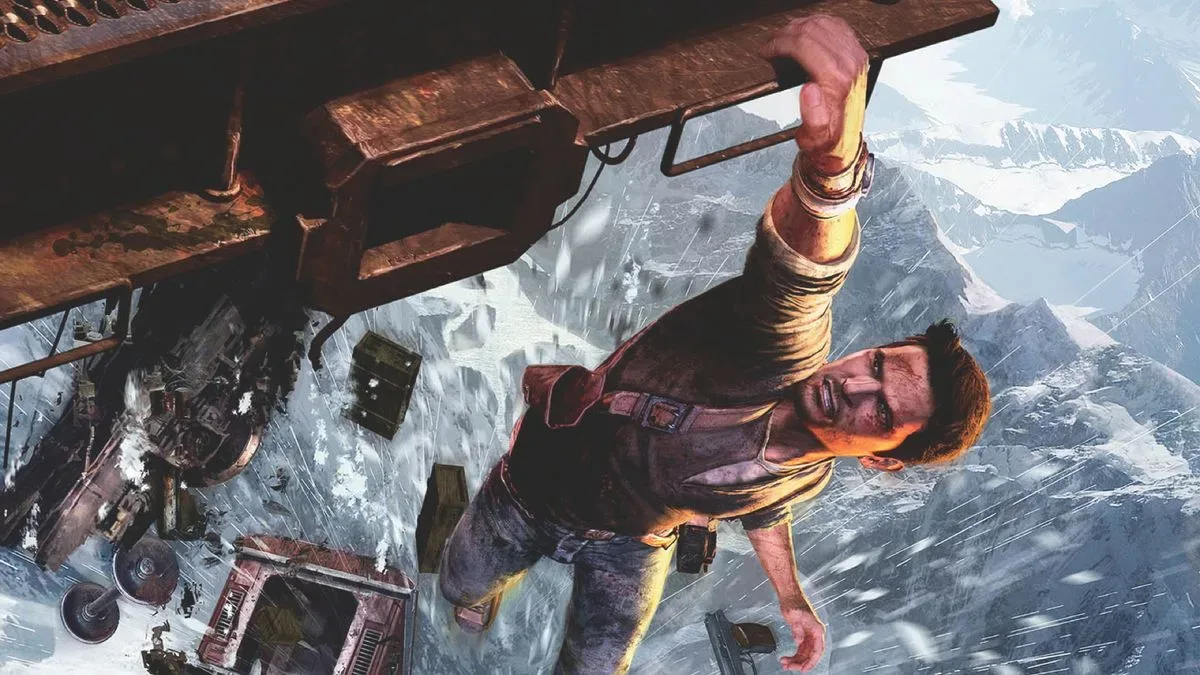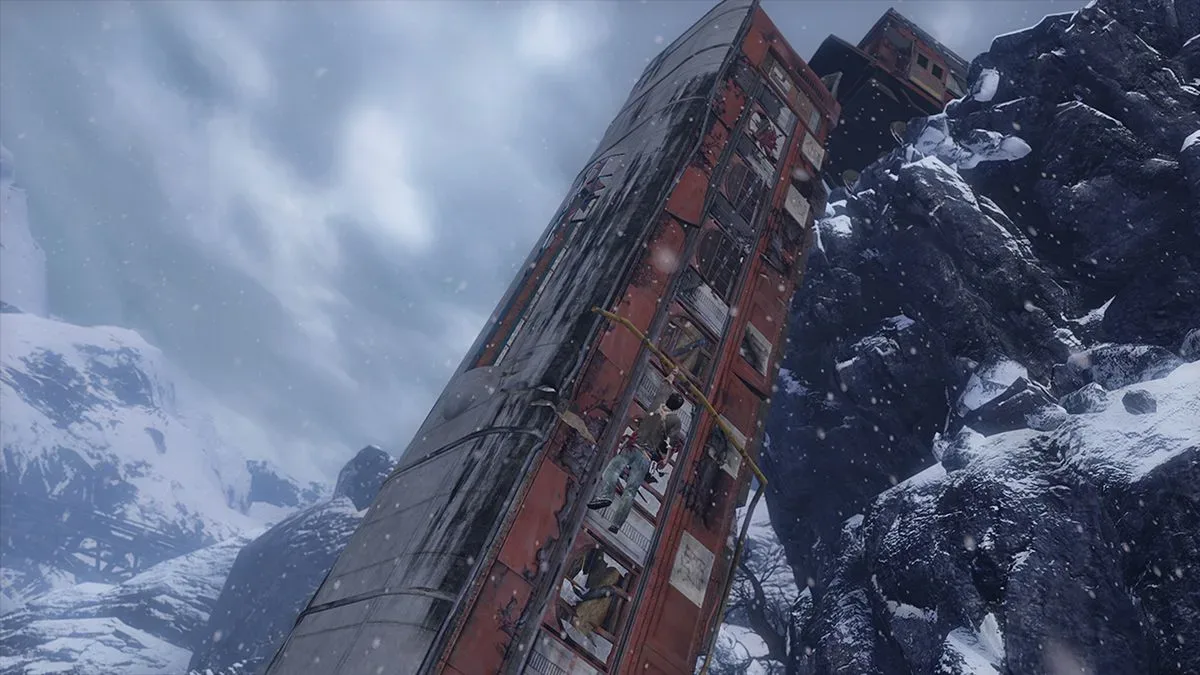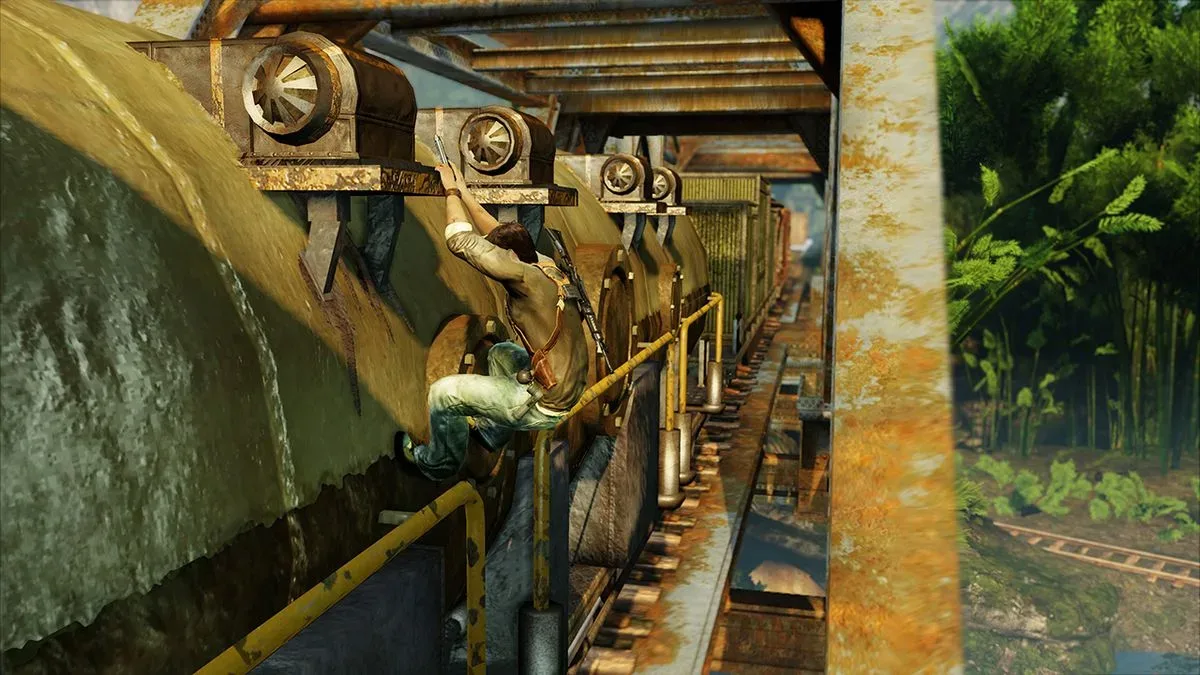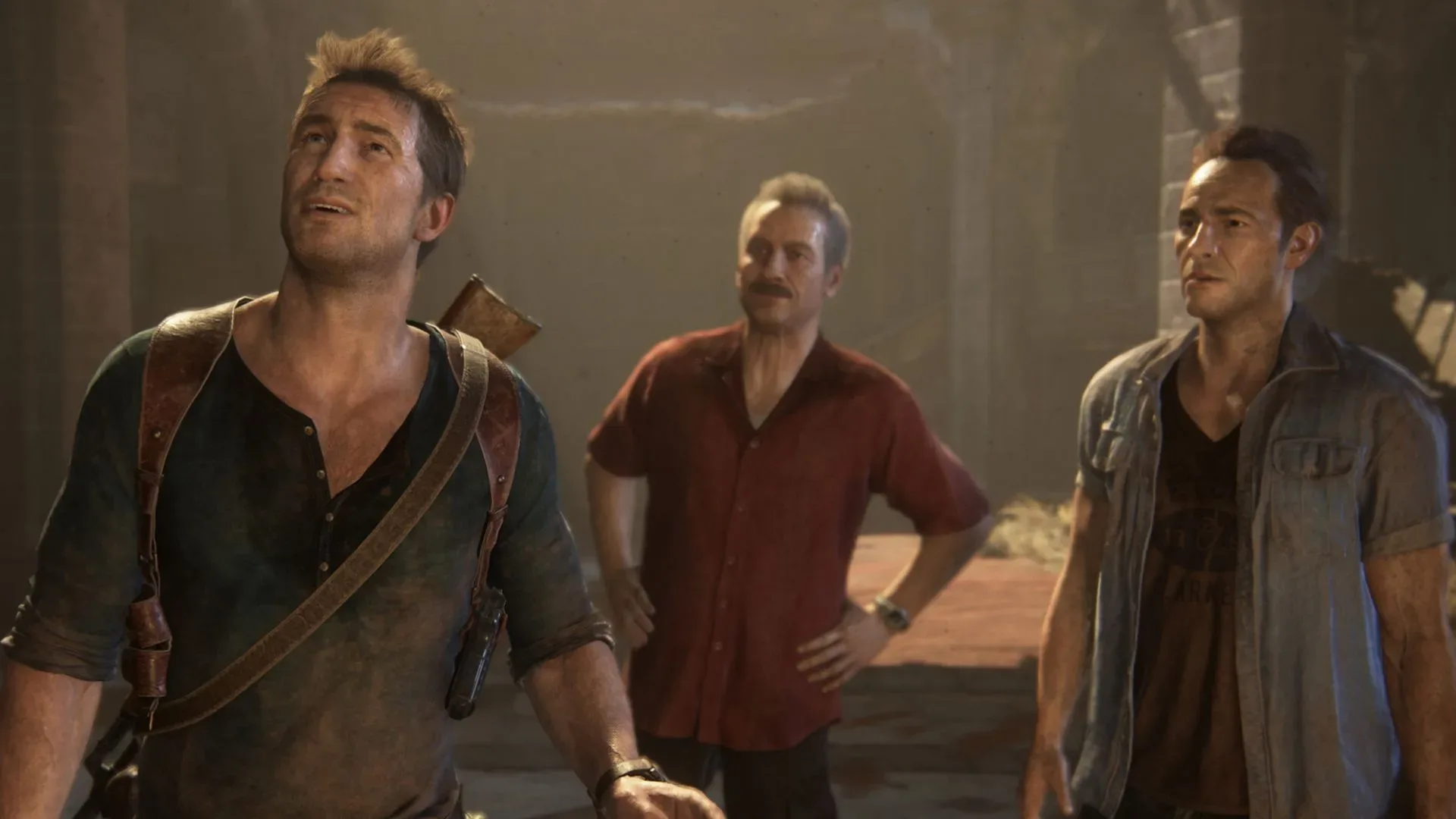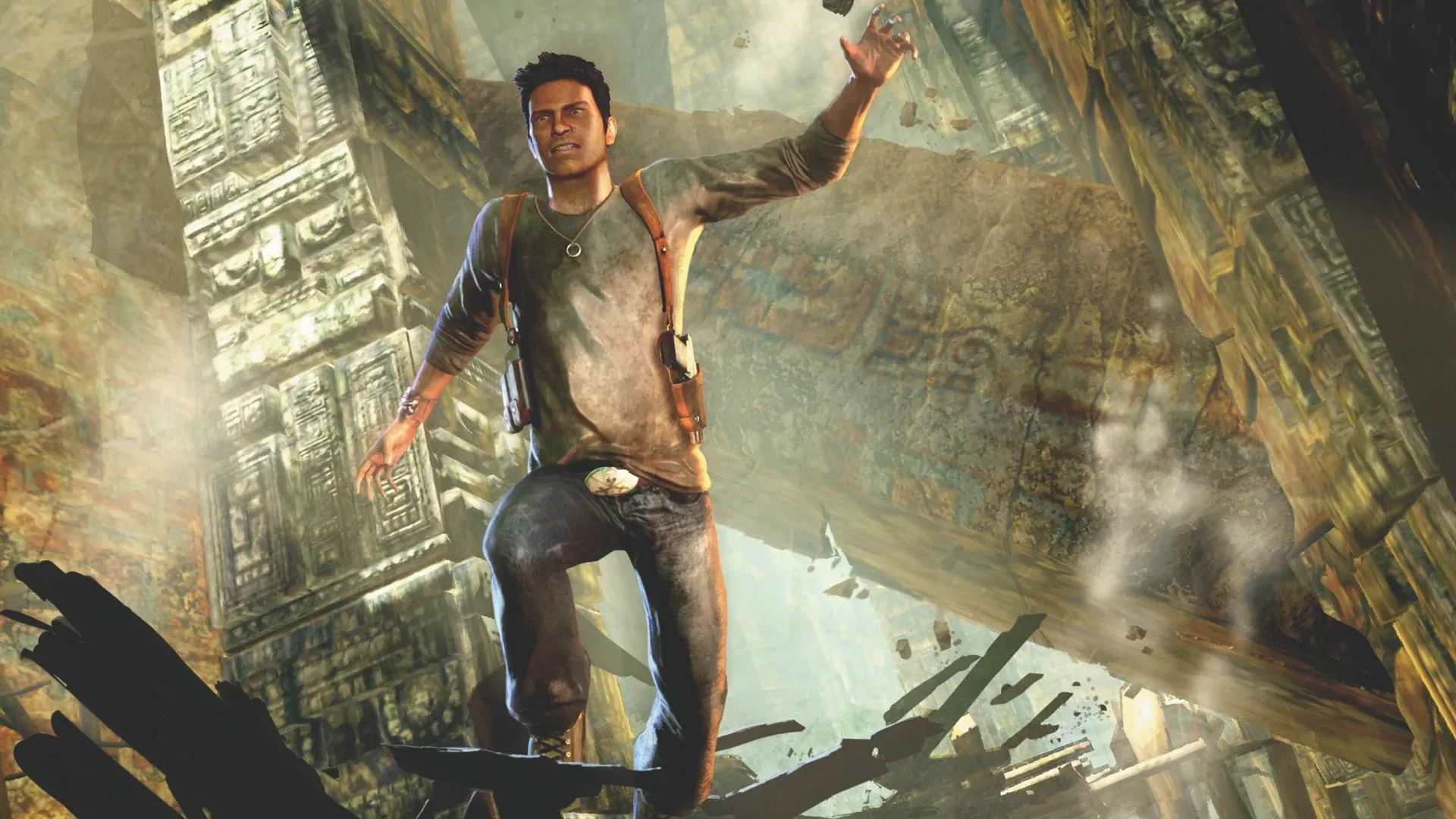
Uncharted 2: Among Thieves is often remembered in the loudest possible terms: the dangling train carriage, the moving train battle, a helicopter assault over Kathmandu, and a tank tearing into a mountain village. Those are fair memories. The game is built to make technical spectacle impossible to ignore. Yet its more durable achievement is quieter: it understands that explosions and impossible escapes only gain meaning when players care about the people running through them.
That combination made the game an emblem of the tightly structured, roughly 10-hour single-player campaign associated with the PS3 era. It does not offer a broad world designed for wandering. Its routes are deliberately controlled, its environments have hard boundaries, and its story regularly pauses play for scenes between characters. But those limitations are part of the design’s argument. Uncharted 2 trades freedom of destination for precision of momentum, using each encounter, vista and transition to keep its adventure moving with unusual confidence.
A linear adventure with a purpose
“Linear” is often used as a criticism in games, and it can be one. A linear game restricts the order in which players see places, face problems and learn story information. In Uncharted 2, the player generally travels along a prescribed route rather than choosing missions or inventing a route through a large map. Invisible walls and carefully placed scenery keep Nathan Drake moving toward the next objective.
But linearity is not the same thing as passivity. The game’s central question is not whether players can go anywhere; it is whether the journey can constantly make the next place feel urgent. Uncharted 2 uses climbing, cover-based combat and brief traversal puzzles as connective tissue between its major action beats. The result is a ride with very visible rails, but rails chosen for rhythm.
For more context, explore Yansyn-X2 Can Cry on Command, and That Makes Humanoid Robots Harder to Read.
Its opening is a compact demonstration of that rhythm. The story begins partway through its own chronology, introducing Drake injured inside a train carriage hanging over a mountain drop. The premise tells players a remarkable amount in moments: he is hurt, still capable of a joke, and trapped in a situation that reframes the carriage as a vertical obstacle course. It is a cliffhanger in the most literal sense, but it also establishes Drake’s defining mixture of vulnerability, improvisation and bravado.
This is where Uncharted 2’s cinematic reputation becomes useful rather than superficial. Its film influence is not merely a matter of desert vistas, pulp adventure imagery or dramatic camera work. It is evident in how the game arranges information. A delayed explanation, a sharp shift in perspective and a carefully selected reaction can establish stakes quickly. The game still has cutscenes, and therefore still divides storytelling from direct control at points. It does not solve that old tension between watching and playing. Instead, it makes the handoff feel purposeful enough that the interruptions support the pace.
The train is more than a famous set piece
The train sequence is the game’s clearest expression of this approach. It begins as wreckage in the opening, then returns as an active location where Drake scrambles across moving carriages while the landscape rushes past. It is technically flashy: the jungle appears to extend far beyond the player’s immediate route, and each carriage feels like a separate, unstable platform. It is also a remarkably direct piece of interactive storytelling.
Related coverage includes Uncharted 2: Among Thieves Still Understands That Spectacle Needs a Human Heart.
A train is inherently forward-moving. Its path is fixed, its momentum is legible and stopping is not usually an option. That makes it an unusually fitting setting for a game devoted to a guided adventure. Rather than hiding its structure, Uncharted 2 turns that structure into the fantasy. The player is not pretending to have limitless choice; they are trying to survive a journey already in motion.
The sequence also shows how the game converts cinematic ideas into playable ones. A film can make a moving train look dangerous through editing, framing and sound. A game needs to turn that impression into immediate decisions: where to climb, when to leave cover, which enemy to target, whether to push forward or wait for an opening. The train remains a spectacle, but it is also a changing combat space. Drake’s precarious route gives the firefight its character.
That distinction matters because Uncharted 2 is sometimes dismissed as “on rails” in a broader sense. Its strongest moments are highly authored, but authored does not mean empty. A roller coaster remains designed from start to finish; the thrill comes from how it controls speed, reveals and risk. Uncharted 2 applies a similar philosophy to a third-person action game, asking players to inhabit a carefully constructed chain of escapes rather than to build their own adventure from a toolkit.
Gunplay that suits Drake’s character
Most of the player’s agency arrives in combat. Uncharted 2 is a third-person shooter, meaning the camera sits behind or near Drake while players aim firearms, use cover and navigate arenas filled with enemies. It is also a cover shooter: walls, crates and other environmental objects become temporary protection between bursts of movement and fire.
Its shooting is not presented as pristine, military-style precision. Drake’s aim has a loose, energetic quality, and the game’s fights encourage dashes between cover, messy exchanges of gunfire, grenades, close-range attacks and abrupt explosions. The reticle—the aiming marker on screen—does not create the feeling of a clinically exact marksman. That looseness is not always elegant, but it is thematically appropriate. Drake is an adventurer constantly adapting to crumbling architecture, hostile ambushes and bad odds, not a soldier defined by discipline and control.
There is a major contradiction at the centre of this design. Drake’s likeability is one of the game’s greatest strengths, but much of what the player does as him is shoot large numbers of opponents. The game cannot entirely reconcile its playful, personable hero with the scale of the violence required by the genre. Its warmth does not erase that dissonance.
What it does do is occasionally challenge the assumption that combat is the only meaningful interaction available. Those brief changes matter precisely because the surrounding game is so committed to action. They show an awareness that a protagonist should be defined by more than how efficiently he gets through a firefight.
Tenzin and the power of cooperative play
The strongest example arrives after the train derailment, when Drake is found in the snow by Tenzin, a Tibetan Sherpa who brings him to a Himalayan village. Their relationship develops through a section involving ice caverns and yetis, with much of their connection communicated through cooperation rather than extended explanation. They work together, help one another progress and gradually build trust.
That is an important design choice. Cooperative interaction can communicate a relationship differently from dialogue because it asks the player to participate in the bond. The game’s approach recalls Ico, the PS2 adventure whose companionship was expressed through shared movement and mutual dependence. Uncharted 2 uses that idea on a smaller scale, but with a clear effect: Tenzin stops being scenery or a plot device and becomes someone Drake, and the player, has reason to protect.
When a tank threatens Tenzin’s daughter and the village, the action acquires a more specific emotional charge. The objective is still mechanically familiar—survive, escape, defeat the threat—but the motivation has been sharpened by the time spent building a relationship. The tank is not simply another escalation in a campaign full of louder weapons. It is a danger to people the story has asked the player to know.
The village itself delivers one of Uncharted 2’s most revealing ideas. After Drake recovers, he can walk among Tenzin’s community. The button normally associated with melee actions can instead prompt social gestures: handshakes, salutes and a chance to play football with children. No grand branching system is introduced. The game simply reassigns an established action button to human contact.
That small mechanical substitution is more eloquent than it first appears. It recognizes that interaction in games can mean more than combat, collecting or solving a gatekeeping puzzle. For a brief stretch, Drake is allowed to exist in a place without treating it as an arena. The quiet makes the surrounding chaos more meaningful, and it lends the later danger a sense of violation.
Why the supporting cast holds the adventure together
Uncharted 2’s people are not limited to Tenzin. Chloe, played by Claudia Black, is memorable because her interests remain her own. Her relationship with Drake is neither simple devotion nor simple hostility; she is attracted to him, connected to another man and alert to her own survival. That ambiguity gives her a degree of unpredictability that prevents her from functioning as a straightforward prize or moral compass.
Elena, played by Emily Rose, provides a different counterweight. Her relationship with Drake is built through scepticism, humour and mutual pushback rather than automatic romantic destiny. When the game brings the pair together at its close, the emotional payoff lands because their connection has been treated as reciprocal. The adventure does not need a boss encounter to do all the work of a climax; two people arriving at an honest understanding can matter more.
At the centre is Drake, voiced by Nolan North. He is unusually expressive for an action-game lead: anxious when circumstances demand it, funny without becoming detached from danger, and capable of genuine regret or tenderness. This is partly a writing achievement, but performance capture is important too. Performance capture records actors’ movements and performances for use in a digital character, while the production described here also involved rehearsal and workshopping on a digital soundstage. That process helps explain why conversations in Uncharted 2 often feel less like exposition delivery and more like people responding to one another.
Drake is not an empty vessel built to accept any player projection. He has a recognisable voice, habits and emotional limits. That can be risky: a defined character may not resemble every player. Yet the benefit is that the game can build scenes around his reactions and relationships. He is not merely the vehicle for the player’s actions; he is a person whose choices and attachments create context for them.
Spectacle works best when it has someone to endanger
The technical ambition is real. Uncharted 2 repeatedly frames scale as an event: a monumental Himalayan drop, collapsing Kathmandu structures, a helicopter chase and a tank attack amid stone houses. The game uses technology not just to show bigger spaces, but to make spaces appear fragile. Buildings tip, vehicles lurch and routes vanish behind Drake. The world seems determined to turn every escape into a new disaster.
But spectacle by itself is quickly exhausted. A collapsing building is more than a visual trick when it interrupts a relationship, threatens a shelter or forces a character to reveal something under pressure. The key to Uncharted 2 is that it pairs its most extravagant scenes with a cast capable of registering their consequences.
It remains a deliberately narrow, occasionally awkward action game, and its violence sits uneasily beside its most humane observations. Those flaws are not erased by the train or the performances. Still, the game’s willingness to make room for a handshake, a shared task, a joke after injury and a romance based on mutual regard gives its blockbuster machinery something many similar adventures lack: a human scale.
That is why the train remains memorable, but not sufficient. It is the vehicle that carries the player through the game’s most conspicuous achievement. The reason the ride sticks is that Uncharted 2 gives players people worth carrying forward.