Honkai: Nexus Anima has a powerful first impression: its creatures are extremely easy to like. The upcoming PC and mobile creature-collecting strategy game from miHoYo, published by HoYoverse, has introduced Anima that lean into playful animal and food motifs without making every design feel interchangeable. A doughnut-selling rabbit named Donubi, a ramen-themed seal called Pupanoo, and the pancake dog Puddlipup immediately establish the game’s cheerful, snack-heavy visual language. Hoggit, a notably fashionable pig, suggests the appeal is not limited to the menu-inspired side of its roster.
That strength matters in a creature collector. Players may care about stats, team synergy and combat efficiency, but the creatures themselves need enough personality to inspire attachment before those systems can take over. On that front, Nexus Anima appears to have a memorable foundation. The larger question is whether its battle format will let players appreciate that work—and whether the apparent depth of its systems will become meaningfully important in normal play.
An early session with a high-level save raised that question. Battles were quick, crowded and largely automated, even as tutorials outlined a substantial web of roles, traits and team effects. That does not prove the finished game lacks challenge; a late-game demo team may not represent a new player’s experience, and the release date remains to be confirmed. But it does highlight the balance Nexus Anima will need to find between accessibility, spectacle and player agency.
The Anima are the immediate selling point
Creature-collection games ask players to spend a great deal of time looking at, chasing and building around their companions. That creates a straightforward artistic test: can a creature make someone want to learn its name, add it to a team, or seek out another version with a different build?
Nexus Anima’s early designs seem well positioned to do that. Donubi, Pupanoo and Puddlipup use familiar food cues as a shortcut to charm, while their animal bases keep them legible as creatures rather than simply walking dishes. Hoggit demonstrates a different route: a fashion-conscious pig can convey attitude through silhouette and styling rather than an ingredient pun. Together, these examples imply a roster intended to mix cute, comedic and characterful ideas.
That variety is especially important because the game’s systems distinguish captures beyond species alone. If two creatures of the same species can play somewhat differently, players have a stronger reason to pay attention to the individual Anima they obtain rather than treating duplicates as automatically redundant. A collectible game lives or dies by those little moments of recognition: not just “I have one of these,” but “this is the one I want to develop.”
There is more structure here than a simple monster roster
The available details point to a team game built around positioning, class-like traits and individual modifiers. Players assign Anima to dedicated Frontline and Backline places. In practical terms, that means formation matters: front-line units are likely exposed to danger first, while back-line units can potentially operate with more safety or serve another specialist purpose.
Traits appear to define broad battlefield jobs. Protectors, for instance, draw enemy attention—often called aggro—and regenerate energy when hit. Aggro is the system that determines which ally an enemy chooses to attack. A protector that repeatedly becomes the target can shield less resilient teammates, while energy recovery gives it a reason to keep absorbing pressure.
Related coverage includes Honkai: Nexus Anima's Adorable Creature Designs Shine, but Its Autobattles Raise Questions.
Masterminds, by contrast, are described as high-damage Anima whose skills regenerate every second. This reads as a more offensively oriented role. The contrast between a unit rewarded for being attacked and one rewarded with regular skill recovery suggests that a full team could involve deliberate tradeoffs: absorb hits in one position, enable damage elsewhere, then select complementary human support abilities.
Another layer is the Disposition system. A Disposition is an additional ability that can vary between captured Anima of the same species. One Marshalbird, for example, had a Disposition that restored 5% health to the rest of its team when it was defeated. Such a trait creates an interesting tactical wrinkle. Losing that creature would not be purely negative if its fall triggers healing for survivors, though whether that effect is powerful enough to shape real team decisions is unknown.
There are also team-composition interactions tied to status effects. Joy can trigger a status called Ecstacy, although the early material did not explain what Ecstacy does. The distinction is worth preserving: an unexplained term is not evidence of a shallow system. It is evidence that the game will need clear in-game communication. If players are expected to choose Anima partly because their combined qualities activate statuses, they need to know precisely what those statuses change, when they trigger and why a particular combination is valuable.
Autobattle changes where the strategy lives
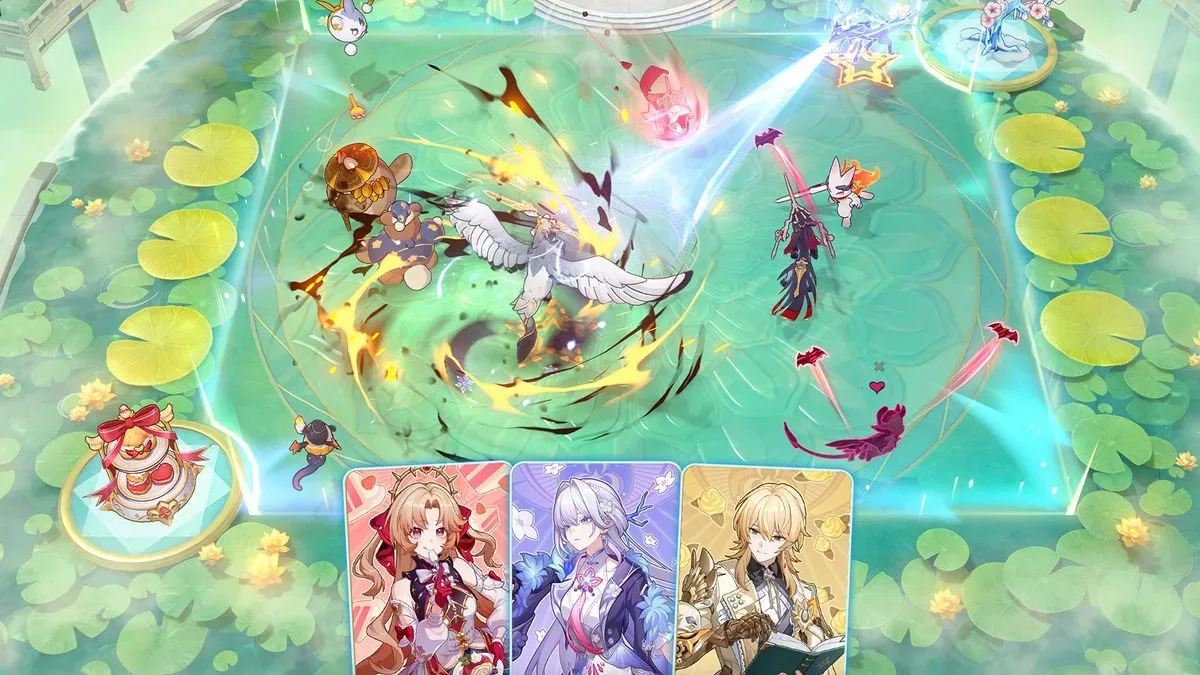
Nexus Anima’s combat is real-time and automatic at its core. Anima enter a top-down arena, move toward opponents and use their own abilities without direct control over each creature’s every action. The player is not entirely passive: cards representing human characters known as Eidos sit at the bottom of the screen, and their skills can be used when their cooldowns allow.
A cooldown is the period after an ability is activated during which it cannot be used again. That timing limitation can be a genuine source of decision-making. A player may need to decide whether to spend an Eidos skill immediately to prevent a collapse, or wait for a tougher enemy action. In an autobattler, this kind of intervention often becomes the primary moment-to-moment expression of skill, while team selection and formation carry much of the strategy before combat begins.
That structure is not inherently a drawback. Autobattling can be a strong fit for a game focused on preparation: selecting the right roles, finding useful Dispositions, arranging Frontline and Backline positions, and developing a team that executes a plan with minimal micromanagement. It can also keep encounters moving briskly on mobile devices, where lengthy command menus are not always ideal.
The concern is visibility. In the early session, battles reportedly ended in seconds, with the supplied team sweeping aside foes before there was much chance to parse individual actions or apply strategy. When combat resolves that quickly, even a thoughtfully designed formation system can feel distant. The player may see that a team wins without understanding why it wins—whether because of a Protector’s aggro control, a Mastermind’s damage, a specific Disposition, an Eidos card or simple statistical advantage.
That is the practical issue for Nexus Anima. Its systems sound like they should reward observation, but its battle speed may leave little room for it. Anima can also become visually hard to distinguish when many small characters clash in a compact top-down space. For a game whose creature designs are one of its clearest strengths, shrinking those designs into a fast-moving crowd is a presentation risk as well as a mechanical one.
Why the demo context makes a final judgment premature
The session used a pre-prepared save in the late level 40s rather than a fresh account, and the total time normally required to reach that point was not established. This is a major caveat. A demo team can be unusually strong, optimized for convenience, or equipped with progression advantages that a new player would not have. A high-level group fighting suitable or lower-level opponents may make any combat system look more automatic than it would during the game’s early learning curve.
Starting from the beginning could also make tutorials, team construction and individual mechanics easier to absorb gradually. Instead of receiving Frontline, Backline, traits, Dispositions, composition-based effects and Eidos cards in a concentrated burst, players may encounter them one at a time. That pace can make a complicated ruleset feel understandable rather than intimidating.
Still, the demo’s mixed signal is useful. It suggests Nexus Anima does not merely rely on cute designs; there is a framework beneath them with roles, individual variation and potential synergies. At the same time, it places a spotlight on how the finished game teaches those ideas and whether encounters eventually demand their use. Depth that is invisible in play is difficult for a player to value.
For people watching the PC side of upcoming releases, broader conversations about how games reach and support that platform remain relevant; recent discussion of PC development lessons around Monster Hunter Wilds and Ascendance is a reminder that platform plans are only one part of the experience. Nexus Anima is listed for PC and mobile, but no performance expectations or release timing beyond TBC have been established here.
What to watch before launch
- Battle pacing: Do later encounters last long enough for Eidos skills, formations and status effects to matter?
- Clear explanations: Will effects such as Joy and Ecstacy be defined in practical, readable terms?
- Team-building stakes: Are traits and Dispositions meaningful enough to make different captures feel distinct?
- Creature readability: Can players actually follow their favorite Anima’s actions amid real-time arena combat?
- New-player onboarding: Does the game introduce its many interconnected systems in a manageable order?
Honkai: Nexus Anima has already made the most important emotional introduction: its creatures look like they could inspire genuine collecting fever. The path from there to a lasting strategy game depends on whether its automated fights turn those appealing designs and layered systems into decisions players can see, understand and enjoy making.