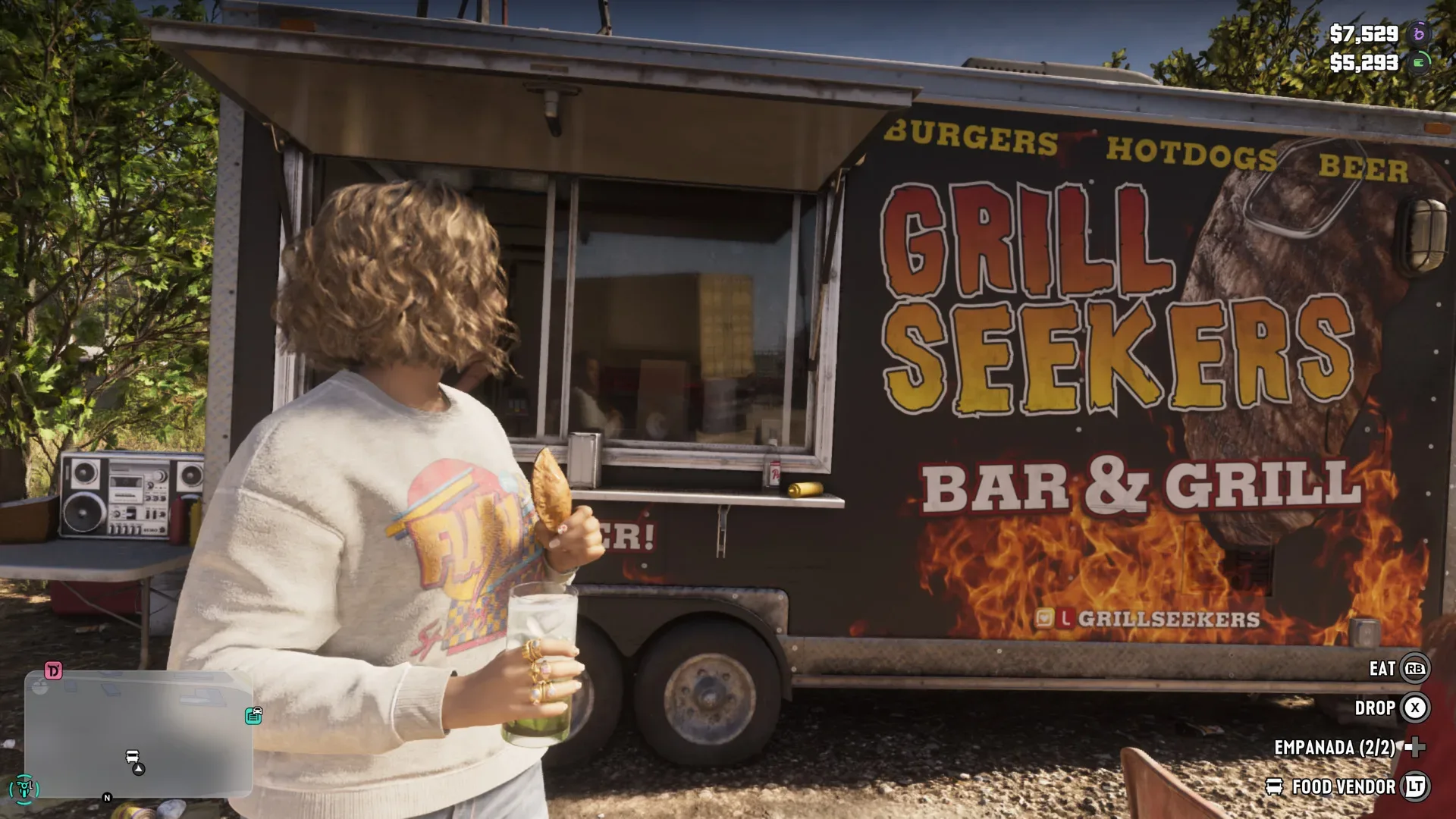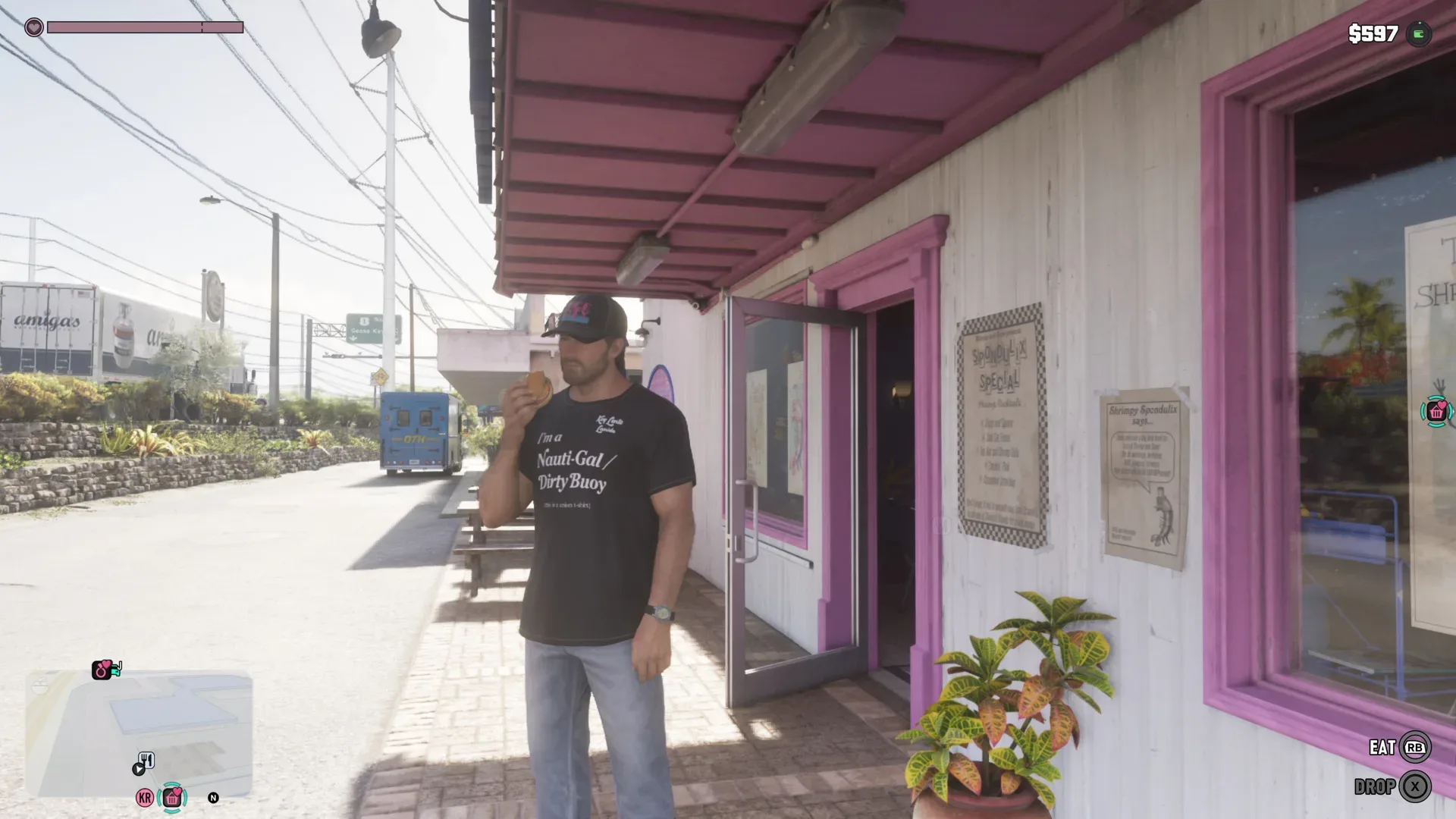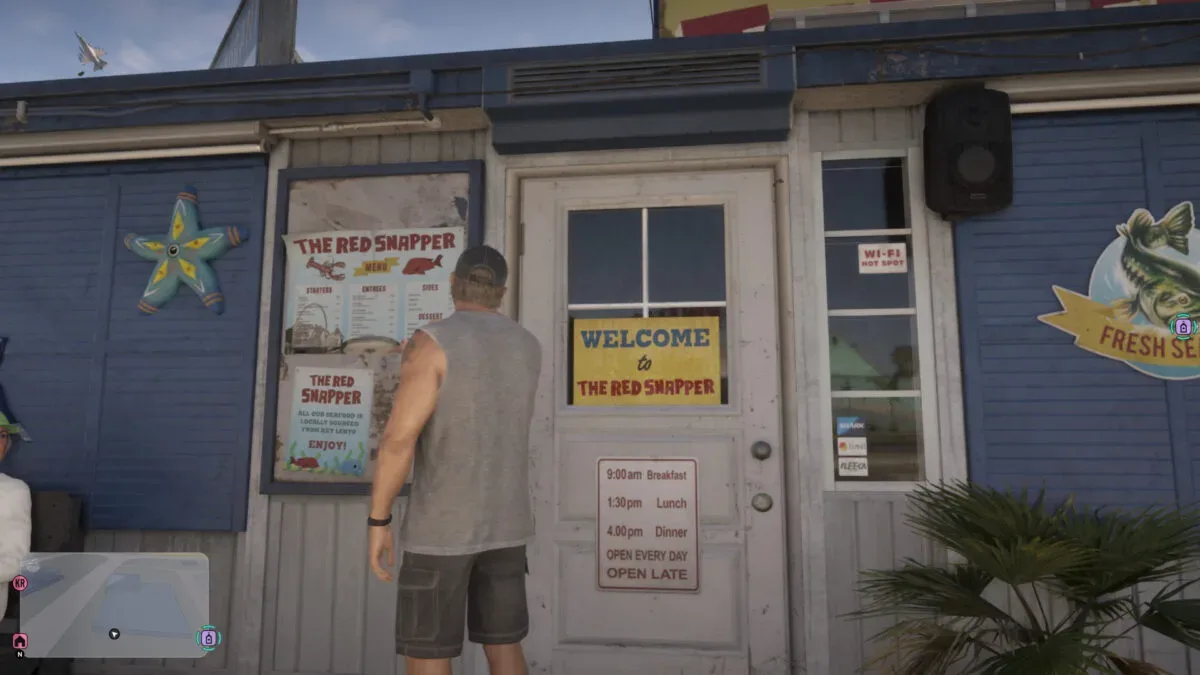
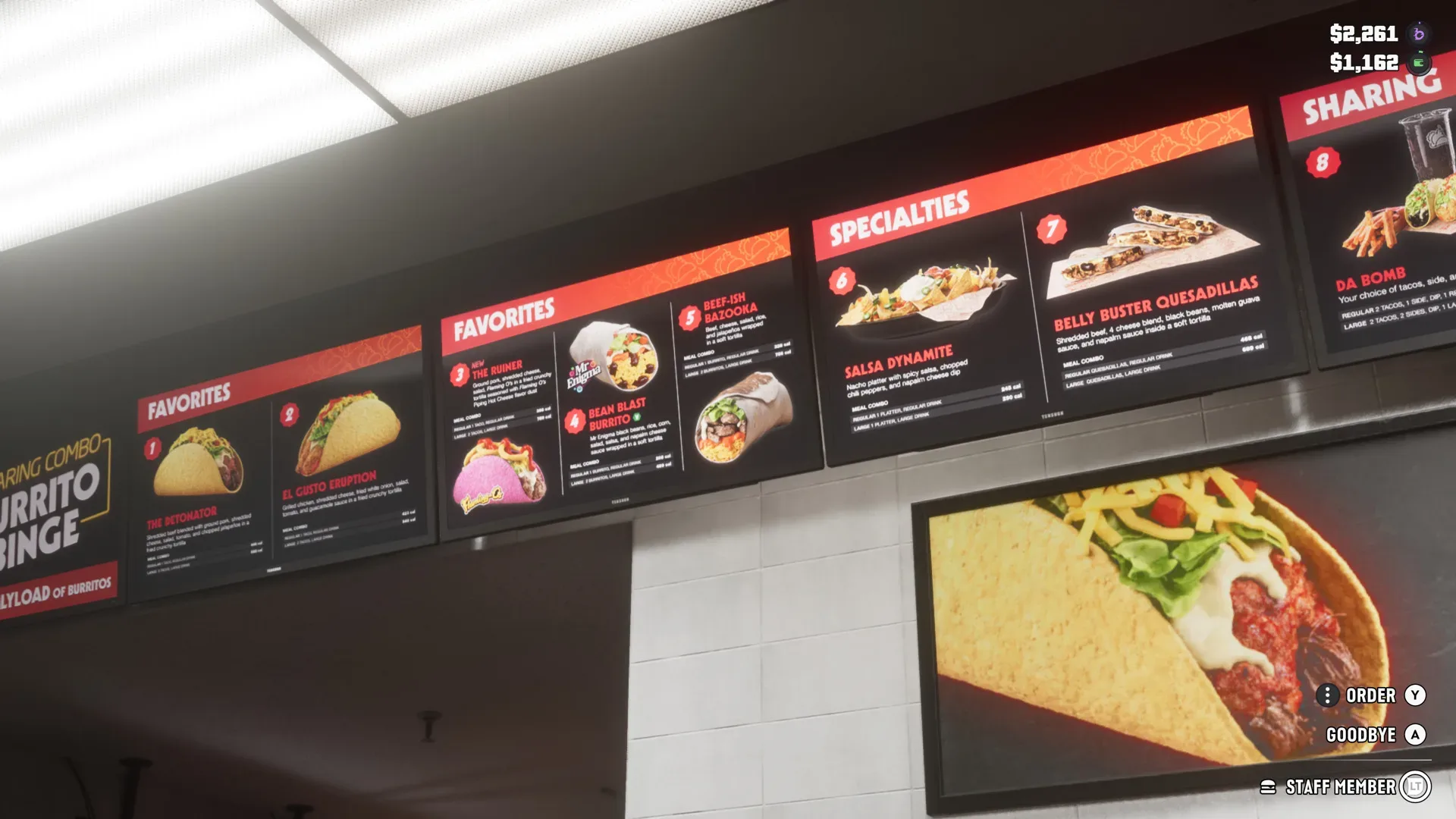
Grand Theft Auto VI apparently lets players watch food disappear a bite at a time, liquids lower inside their containers, and Jason and Lucia juggle a snack and a drink at once. That is the kind of granular simulation detail that can make an open world feel startlingly physical. An apple can be reduced to its core. A grilled fish sandwich can show differing levels of char. Burgers, tacos, croissants, empanadas and drinks have their own models rather than being abstract health items.
Yet for all that care, there is a conspicuous boundary around the game’s food culture: Jason and Lucia largely eat while moving. Food comes through takeout, fast-food counters and trucks. The pair can grab handheld items, recover health, and carry on. What they cannot do is settle into a proper meal: order a substantial dish, sit at a table for an extended stretch, and inhabit a restaurant as people rather than fugitives between errands.
That absence is funny on its face. A game capable of modeling the gradual demise of an apple apparently draws the line at spaghetti. But it also looks like a potentially sharp bit of environmental storytelling. GTA VI may have rendered a world full of menus, dining rooms and storefronts, while making its protagonists strangers to the ordinary comfort those places promise.
The food simulation is detailed where it counts for momentum
It is worth separating two ideas that can easily get mashed together: visual fidelity and activity depth. Visual fidelity is how convincing an object looks and behaves on screen. Activity depth is what a player can meaningfully do around that object over time. GTA VI’s described food system sounds unusually strong on the first point. A meal is not simply an icon that vanishes after a button press. Its visible state changes as it is consumed.
The dual-hand element is especially clever. Being able to hold an empanada in one hand and a mojito in the other, then switch between them, is a small interaction with a big effect on believability. People often carry more than one thing. The system turns that mundane fact into animation, prop handling and player choice. It also creates the sort of accidental comedy that fits Grand Theft Auto’s chaos: a player intending to take a drink can instead pull a weapon and create an entirely different problem.
Different food models and the changing level of a drink give consumption a physical endpoint. They tell the player that the item existed in the scene and was affected by an action. That is a more tactile approach than the old videogame convention in which a character touches a pickup and it instantaneously disappears, perhaps accompanied by a health bar increase.
But an impressively modeled snack is still a snack. It does not automatically create the social, domestic or narrative meaning associated with a meal.
A restaurant can be scenery, a service, or a story space
Open-world games commonly use restaurants in several different ways. They can be scenery, giving streets identity through signs, menus and buildings. They can be a service, offering a quick health refill or a low-stakes activity. Or they can be a story space, somewhere characters talk, celebrate, hide, argue, reconnect or simply spend unpressured time together.
Related coverage includes GTA VI’s missing spaghetti says a lot about Jason and Lucia.
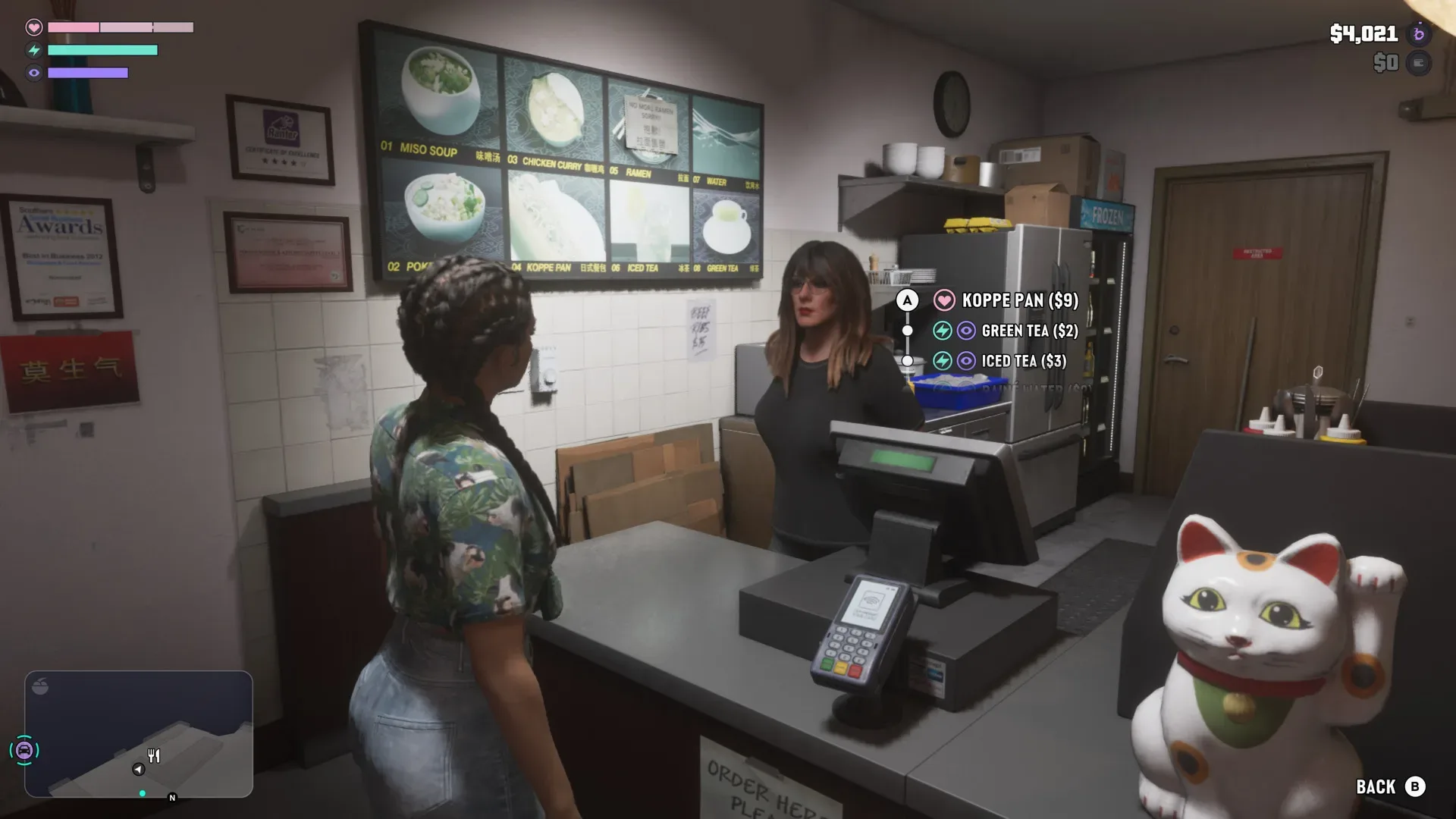
Based on the described limits, GTA VI gives players plenty of the first category and a streamlined version of the second. Many establishments appear to have posted menus, while accessible spots offer a narrow selection built around drinks and portable foods. Some places even allow the characters to sit. But the interaction stops short of the third category. There is no broad sit-down ordering experience, no home-cooking mechanic, and no clear indication that Jason and Lucia ever make a meal part of their relationship.
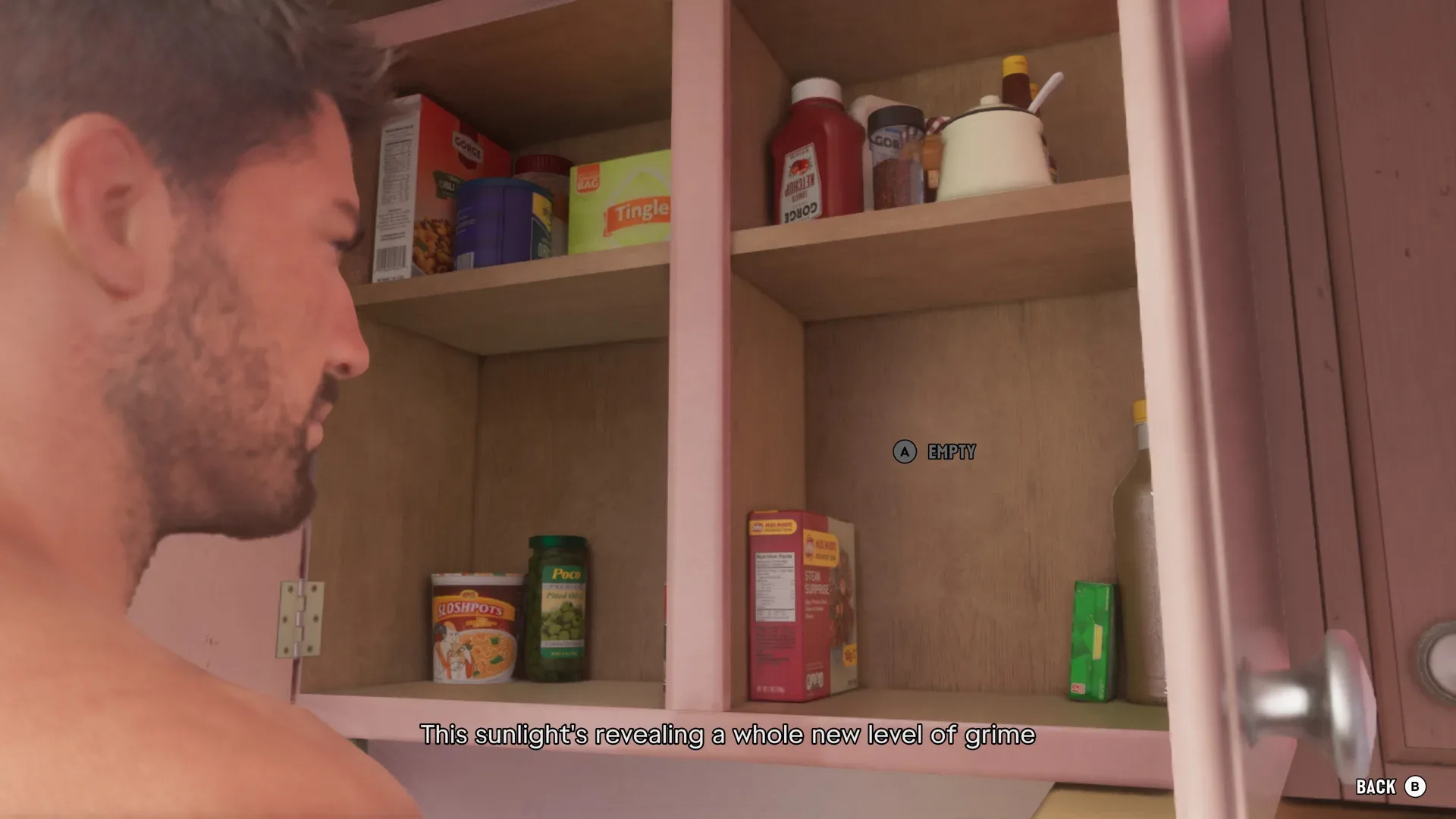
That distinction matters because a restaurant interior is not automatically a restaurant experience. If the player can see a menu but cannot order from it, the location becomes a deliberate-looking threshold: an invitation to normal civic life that remains unavailable. The same applies at home. Cabinets with bread, cereal and unused pots and pans can tell a story, even before either character says a word.
For players exploring Leonida’s businesses and landmarks, GTA VI’s world clearly has room for destination hunting beyond its missions; the guide to The Weeknd’s mansion in Peacock Estates is one example. The interesting wrinkle is that a dense map of things to find does not necessarily make every appealing door an available lifestyle choice for its protagonists.
Why handheld food fits Jason and Lucia
The lack of a relaxing dinner is not confirmed as a deliberate statement by the developers, so it should not be treated as settled authorial intent. It could reflect scope decisions, prioritization, or a simple preference for interactions that preserve GTA’s pace. Still, as an interpretation of what is visible in play, the pattern is hard to ignore.
Jason and Lucia begin from a precarious position. They are short on money, on the run, and living without the comforts that turn a residence into a settled home. A motel room without even a coffee pot sends a clear signal about impermanence. A fridge associated with alcohol and protein shakes rather than ingredients suggests a life structured around getting through the day, not planning an evening.
As their circumstances improve and they move into Vice City, that pattern apparently does not change. They may acquire wealth and a higher standard of living, but not the leisure to use it in the most ordinary ways. The game’s food interactions continue to emphasize what is portable, quick and easily interrupted.
That makes the food system an effective metaphor for a particular kind of instability. Luxury is not only the ability to afford something expensive. It is also being able to devote time to it without scanning for the exit, worrying about who might walk in, or expecting an emergency to end the moment. A slow dinner is a declaration that the next hour belongs to you.
Jason and Lucia’s meals, by contrast, sound transactional. Buy an item, consume it, receive a likely health benefit, move on. They can take a seat in limited cases, but the activity still does not seem to become a pause in which they enjoy each other’s company or discuss the food. The animation is elaborate; the emotional space around it is deliberately thin.
Closed doors can carry more meaning than open counters
There is a useful irony in the gap between the city’s presentation and the characters’ access to it. Leonida can appear abundant: restaurants display menus, buildings suggest varied cuisines, and venues look ready to serve a complete meal. But Jason and Lucia repeatedly encounter a smaller functional reality, where the usable choices boil down to water, soda, beer and a couple of hand-held dishes.
That repetition could frustrate anyone hoping for a food-focused role-playing layer. It also reinforces the reading that the characters are locked out of a conventional version of prosperity. They can see its signage and pass its windows. They do not get to participate in it in a sustained way.
Games often communicate character status through apartments, cars, wardrobes and bank balances. Food can do the same job more quietly. Cooking requires supplies, time, a stable place to prepare them and enough emotional calm to make the effort worthwhile. Dining out requires different forms of security: comfort in public, trust in the moment, and the expectation that no crisis will force an abrupt departure.
None of that needs an explicit cutscene to register. An unused pan can be as revealing as a monologue when paired with a world in which the characters are always in motion.
What is lost when food only restores health
There is nevertheless a genuine trade-off here. Players who love food in games are not merely asking for more objects to collect or another animation to admire. Food can provide character texture. A favorite dish, a disastrous attempt at cooking, an argument over a bill, or a quiet shared dessert can all establish personality and intimacy without advancing a plot through violence or exposition.
Other games have made memorable meals through very different methods. Some lavish attention on rendered feasts. Others use cooking systems to establish routine and resourcefulness. Still others do not visibly show the dish at all, instead letting dialogue about taste, price or a companion’s preferences do the work. The important ingredient is not necessarily photorealistic sauce or a huge recipe list. It is giving food a role beyond a numerical recovery item.
GTA VI’s handheld consumption still has character in its physicality, and it is far more expressive than a generic health pack. Yet if Jason and Lucia never comment on a meal, prepare one at home, or make dinner a destination, the system may remain emotionally detached. The player gets proof that a croissant can be eaten, not much sense of what eating means to the people doing it.
The missing plate of spaghetti becomes a tonal clue
There is no reason to assume every open-world game needs a fully simulated fine-dining feature. A system with reservations, menus, table service and branching date conversations could become a distraction from the central game. Nor does a good ending require a pasta course.
But the complete lack of a slow, substantial meal can still stand out precisely because GTA VI otherwise appears so intent on specificity. When a world has weather, radio programming, incidental dialogue, reactive food models and richly dressed businesses, a permanently inaccessible dinner table feels less like an accidental blank spot and more like a telling limitation.
It may be one of the game’s quietest observations about criminal ambition. Money can change an address, wardrobe or vehicle. It may not buy normalcy, privacy or peace. The characters can consume the city’s food, but they cannot quite belong to its ordinary rituals.
That is why the missing spaghetti is more than a joke about a menu option. It is a compact image of two people who may be able to grab almost anything, at almost any time, except the one thing a proper dinner represents: permission to stop running.