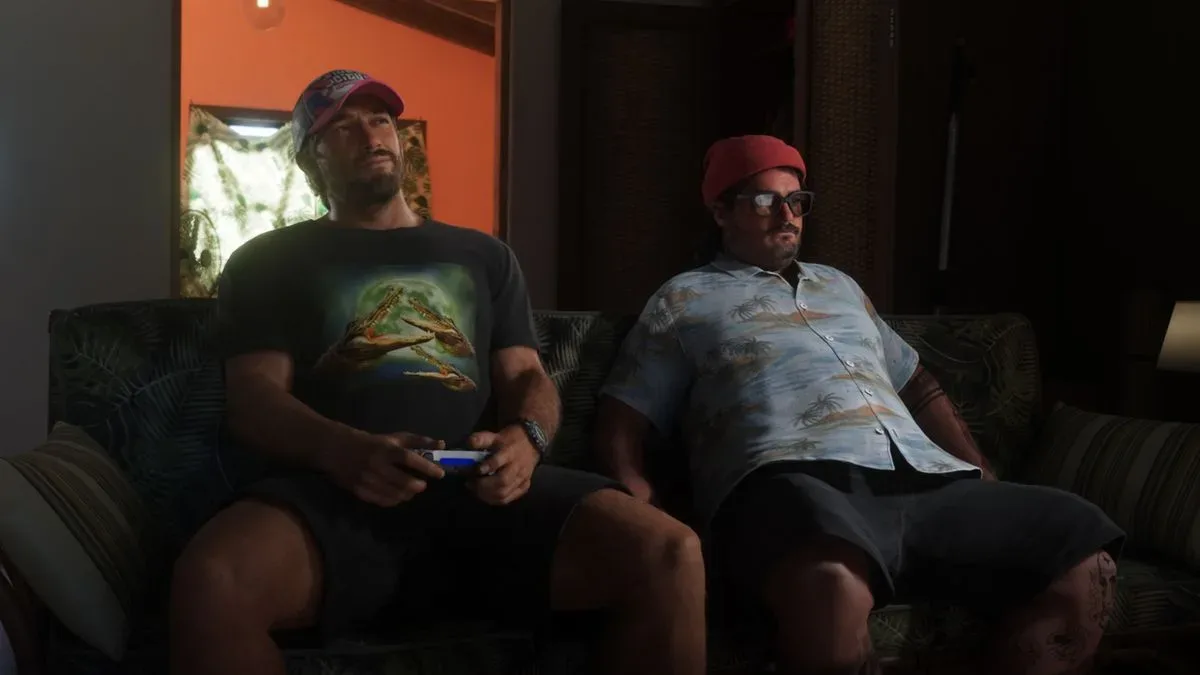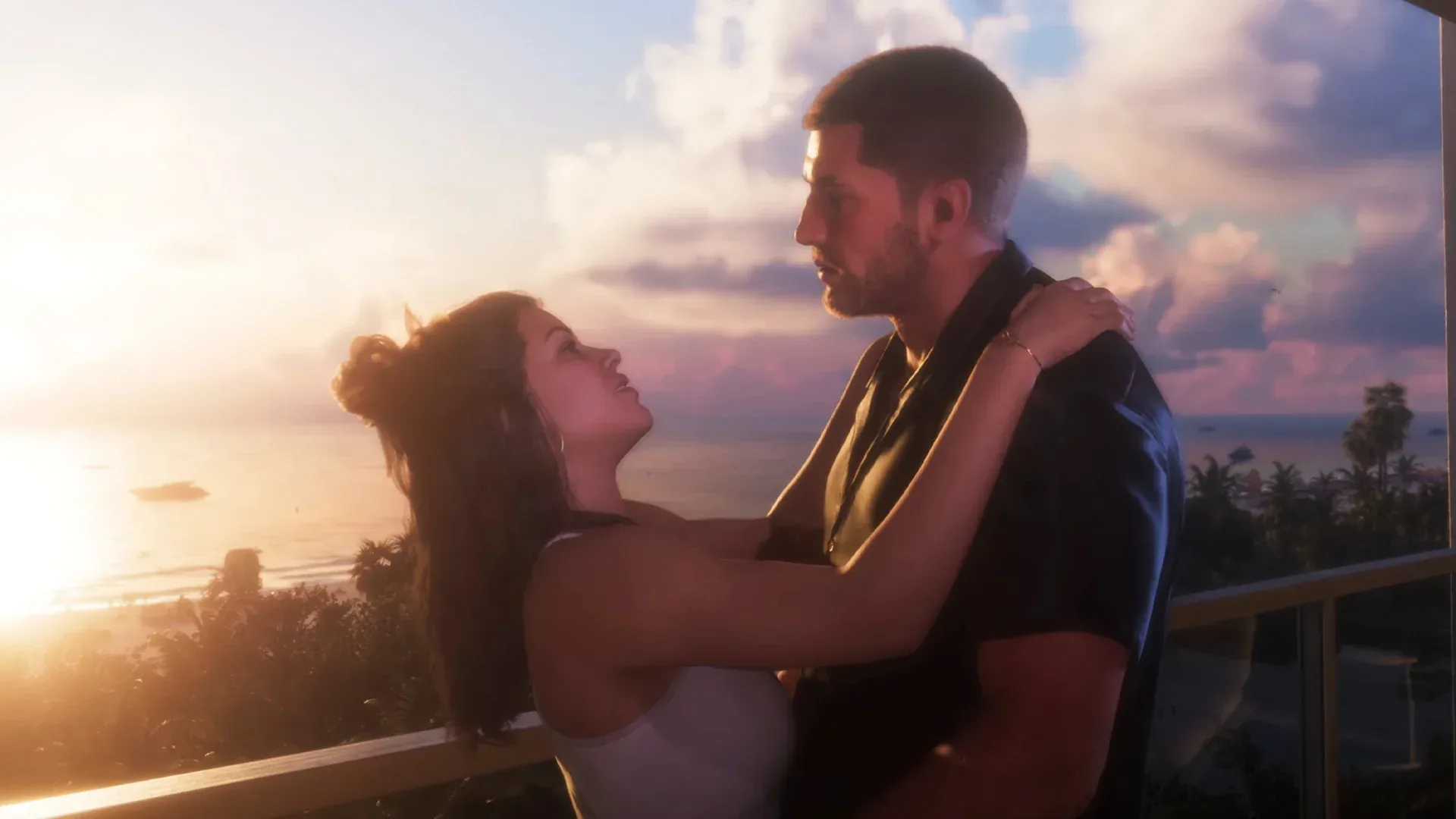

Grand Theft Auto has never had much trouble selling chaos. A fast car, a loud gunfight, a bad plan and a bigger city are dependable ingredients. What is more surprising about GTA 6’s early Key Lento material is the suggestion that its most persuasive fantasy may be considerably smaller: Jason living cheaply by the water, doing occasional work for dubious people, seeing friends, spending time with Lucia, and not yet treating every quiet moment as a runway toward catastrophe.
Key Lento, part of the Keys area on Leonida’s coast, is presented as the setting for the game’s opening chapter. Jason’s days can establish a recognizable cadence. He gets up, exercises outside, showers, has a protein shake, gets dressed—often in beach-appropriate clothes—and heads into the surrounding area. The available pastimes and diversions include fishing, birdwatching, basketball, television, the in-world JoyStation, drinks with Cal, treasure hunting, robberies, and work linked to Kingfisher and Donnie.
That list is not an argument that Jason has discovered a wholesome retirement plan. Drug thefts, hideout infiltrations and shootouts are plainly not the behavior of someone successfully staying out of danger. But the important distinction is one of scale. The opening appears to frame criminal work as an interruption in a day that otherwise has room for ordinary rituals, rather than making ordinary activities a brief pause between escalating set pieces.
A routine is doing narrative work
“Routine” can sound like an oddly modest word in an open-world crime game, but it is a potent piece of storytelling. A routine is a repeated sequence that lets players understand a character’s baseline: where they sleep, who they see, what they do for money, and what counts as a good day before the story begins taking things away.
Jason’s Key Lento baseline has a practical clarity. Brian’s house, once fixed up, is a waterfront home where Jason can stay without paying rent. His arrangement with Brian provides enough money and enough free time to support a low-key existence. Cal and a favored bar are nearby. Lucia is part of the evening home life. Even Jason’s wardrobe contributes to the feeling: board shorts and Hawaiian shirts are not major plot devices, but they communicate a character who is dressed for heat, water and a day with no office to reach.
This matters because a setting becomes more than scenery when it supports a believable use of time. Key Lento is not just a coastal backdrop to pass through on a mission marker. It is somewhere Jason can occupy. A player can begin with a workout or basketball, handle a job around lunchtime, explore afterward, and still return home for an evening with Lucia. Those choices form the outline of a life, even when the life is propped up by people and income sources that are obviously unstable.
The result is a version of player freedom that does not depend exclusively on map size or spectacle. Open-world design is often discussed in terms of how many activities it contains. Key Lento’s stronger idea is that activities can feel more meaningful when the game gives them a place in a daily rhythm. Fishing is not merely an icon on the map; it can be part of how a day is spent. A drink with Cal is not necessarily a side distraction; it helps establish Jason’s social orbit.
Why the calm cannot last
The opening’s appeal is inseparable from its instability. Jason wants more from Brian: more work, responsibility and money. Donnie becomes increasingly careless. The pull of Vice City is evident even before Lucia arrives. These pressures make it clear that Key Lento is not a permanent refuge, and it would be misleading to read it as one.
Related coverage includes GTA 6’s quiet opening gives Jason something to lose.
That tension is what makes the chapter more interesting than a simple request for a crime-game life simulator. Jason can imagine a quieter future with Lucia and Tomas if he could keep his head down, but the very people and arrangements supporting his present comfort point in the opposite direction. His connection to Brian and Donnie makes trouble feel less like a random plot intrusion and more like a debt finally coming due.
The chapter’s apparent turning point, “Tourist Trap,” closes out the Chapter 1 checklist and pushes the story beyond that early equilibrium. The movement toward Vice City and later locations such as Gellhorn is part of the game’s larger dramatic promise. Jason would not plausibly remain forever on a small coastal strip, whether Lucia entered the picture or not.
Still, there is a useful dramatic difference between knowing a character needs to leave and feeling that he has nothing to leave behind. Key Lento gives the departure weight because it supplies a credible alternative—not a safe or morally clean one, but a legible life with modest comforts and relationships. The player is not simply being pulled toward the next destination. They are being pulled away from a place that has learned how to feel like home.
The low-stakes fantasy inside the high-stakes game
The phrase “low stakes” needs some qualification here. Kingfisher confrontations and drug-related jobs are not low stakes in any literal sense. Yet they can function as lower-stakes storytelling relative to the bigger ambitions implied by Vice City, greater responsibility, more money and a widening criminal world. The opening does not remove danger; it makes danger manageable enough that Jason can pretend he has control over it.
That is a familiar and effective crime-story illusion. The character tells himself that one more job will preserve the lifestyle rather than destroy it. The player, meanwhile, is encouraged to enjoy that lifestyle precisely because the broader story has not yet exploded it. In Key Lento, a small robbery or treasure hunt can be read as the cost of keeping the lights on, not yet as the first step in a grander empire.
There is also a tonal advantage to placing this kind of material near the beginning. GTA 6 can introduce people gradually rather than treating its cast as a stream of names attached to mission objectives. Brian, Donnie, Cal, Lucia and Tomas all gain texture through their relationship to Jason’s lived-in routine. A home, nearby friends, a local bar and recurring obligations provide connective tissue that exposition alone cannot deliver.
That slower pace also makes the beachside comedy sharper. Jason being able to lift weights in the sun, drink a protein shake, patrol his closet for another pair of board shorts and then go do criminal errands is an inherently funny contrast. It paints him as someone attempting an aggressively relaxed lifestyle while standing in the path of consequences. The joke is not that he is carefree; it is that he is working very hard to maintain the appearance of being carefree.
A case for letting players linger
The central wish inspired by Key Lento is not that GTA 6 should abandon its story in favor of unlimited idling. A game built entirely around Jason fishing, watching television and slowly accumulating more Hawaiian shirts would eventually run out of momentum. The more compelling request is for a little more time to inhabit the status quo before the plot irreversibly changes it.
Longer does not necessarily mean larger. It could mean enough space for routines to develop, for players to recognize a favorite activity or local hangout, and for the apparent stability of Jason’s home life to become emotionally specific. When a game asks players to care about a turning point, letting them feel the texture of the pre-turning-point world is often more valuable than simply explaining what that world means.
Key Lento’s design, as described, seems particularly well suited to that purpose because it already offers a balance. There are leisure activities for self-directed play, social touchpoints through Cal and Lucia, practical tasks, and criminal work with immediate rewards. Brian’s house provides a stable center. The coastal surroundings reinforce the slower mood without making the area empty of things to do.
Players interested in a more structured relaxation activity elsewhere in the game can also consult the site’s GTA 6 meditation spots guide. That guide is separate from Key Lento’s opening-story appeal, but it points to the same broader idea: a huge criminal sandbox can benefit from activities that ask players to pause rather than constantly accelerate.
Key Lento’s real value is contrast
Vice City’s lure is not diminished by Key Lento. If anything, the contrast helps define it. The city represents possibility, appetite and escalation; the Keys offer proximity, habit and a version of comfort built from limited means. Jason’s desire for more is understandable, just as his attachment to the place he has is understandable.
That contradiction gives the opening its sting. Key Lento is not a paradise, and Jason is not a person one can reasonably expect to remain content there. It is a precarious pocket of calm supported by compromises that will eventually collapse. Yet it is calm enough, and textured enough, that the player can see why he might want to believe in it.
For a series associated with excess, that is a notably grounded hook. Before the bigger ambitions arrive, GTA 6 appears willing to spend time on the modest dream: a waterfront house, a partner at home, friends nearby, enough cash for the week, and one more sunny day before everything gets complicated.