Grand Theft Auto 5 occupies an unusual position in games: it began life on PlayStation 3, travelled through a further pair of console generations, and sold more than 170 million copies along the way. That kind of lifespan invites a different question from the usual “was it good?” appraisal. A return to Los Santos is less a nostalgia trip than a check on a digital city that has stayed inhabited, maintained and commercially important while the industry around it changed shape.
The answer is complicated. Its world remains an extraordinary achievement in environmental storytelling and sense of place. Its character-switching still feels like an elegant answer to several open-world problems at once. GTA Online has made the city feel less like a preserved 2013 artifact and more like a platform capable of absorbing new music, storylines and topical jokes.
But some of the campaign’s structure is visibly old-fashioned, and much of its comic voice has curdled. GTA 5 is still frequently impressive, often funny, and sometimes uncomfortable in ways that appear deliberate. It is also a game whose reflex to sneer at almost everyone can become tiring rather than incisive. Los Santos has endured; not every perspective embedded in it has done so gracefully.
A city designed to be read while moving
GTA 5’s visual strengths are not simply a matter of sharper textures and higher resolution. Those upgrades help, as do PS5-specific touches such as DualSense haptics that can convey the road beneath a vehicle or the low-end thump of a nightclub. Yet the more important accomplishment is how readable Los Santos remains at speed.
Open-world games are commonly judged from a screenshot distance: character models, fine geometry, reflections. GTA 5 can show its age when scrutinised up close. Its stronger trick is making a long drive feel coherent. Morning glare, pinking sunsets, neon, roadside grime, billboards and the changing density of buildings all give a player visual information about where they are and what kind of place they have entered. HDR and ray tracing reinforce that effect by changing how light, glass, chrome and distant architecture register across the day.
HDR, or high dynamic range, is a display technique intended to show a wider spread between bright highlights and dark areas. Ray tracing refers to rendering methods that simulate paths of light to improve effects such as reflections and shadows. Neither term automatically makes a game look “real,” but both are particularly useful in a city built around harsh sun, nighttime signage and reflective surfaces. In GTA 5, their practical value is atmosphere: they help Los Santos preserve the seductive, almost postcard-like quality that makes players want to drive through it.
Small additions, including cats darting into alleyways, and the option to take in the city through a first-person perspective, contribute to the same illusion. The point is not that every street corner perfectly mimics a real one. The point is that movement produces a convincing accumulation of details: traffic, architecture, rubbish, signage, pedestrians and changing weather or light. Los Santos feels lived in precisely because it is not sanitised.
That ugliness is essential to its geography. The gulf between Franklin’s neighbourhood and Michael’s Rockford Hills surroundings is not merely explained in cutscenes. It is mapped into the journey itself: compact homes and neglected lots give way to elevated, wealthier districts, then mountain roads and the thinly populated territory associated with Trevor. A player can understand the city’s hierarchy through altitude, distance and the condition of its built environment.
This is one reason the setting retains its force. The game’s satire may not always be subtle, but its spatial design is. Los Santos does not need a lecture to communicate inequality. It lets the road do the talking, then puts a mansion, a billboard, an empty lot and a spectacular view in the same frame.
Three protagonists, three ways to inhabit the map
The ability to switch among Michael, Franklin and Trevor remains GTA 5’s most influential design decision. It is often discussed as a storytelling device, and it is that: three protagonists provide contrasting routes into the same criminal world. Just as importantly, it is a functional solution to the dead time and tonal mismatch that can affect an open-world game.
When a player is stranded far from an objective, switching characters works as a form of diegetic fast travel. Diegetic means an element belongs to the fiction of the game world rather than sitting outside it as a plainly artificial menu function. Instead of selecting a point on a map and appearing there without explanation, the player cuts to another protagonist who has been carrying on with his own life. The practical benefit is speed; the creative benefit is that the shortcut also says something about character and place.
The mechanic can also compartmentalise player behaviour. Franklin suits careful city driving and upward mobility. Michael’s midlife dissatisfaction and memories of past crime fit a different register. Trevor is built as the extreme outlet: volatile, violent and disdainful of restraint. Players can attach different music choices and habits to each, creating informal role-play long before the multiplayer role-play communities that have flourished in GTA Online.
That flexibility helps explain why the map rarely feels like a single undifferentiated sandbox. The same road, mission marker or radio station can acquire a different tone depending on who is behind the wheel. It also lets GTA 5 jump from a coastal metropolis to the desert without treating the change as empty commuting.
There is a price, however. The split perspective gives the game range, yet it can dilute emotional commitment. Michael begins with the outline of a more introspective story: a former criminal dissatisfied with affluent suburban life and drawn back toward old habits. Franklin is a classic series striver, ambitious but not wholly comfortable with the path in front of him. Those premises suggest a drama with room for regret, aspiration and class tension. The game regularly prefers contempt to development.
When satire becomes a default setting
GTA has long distrusted the rich, the powerful and official authority. Those are durable targets, and GTA 5 can still find catharsis in its attacks on arrogant tech executives and exploitative systems. The Life Invader storyline, centred on CEO Jay Norris, lands because it directs the game’s hostility at concentrated power rather than solely at people with less of it.
Its broader satirical method is much blunter. GTA 5 frequently recognises a cultural subject, points at an exaggerated version of it, laughs, and moves on. That approach can produce a sharp joke when the target is clear. It can also leave the game mistaking recognition for insight. A topic being real does not by itself make the punchline revealing.
Time has made that limitation more visible in the campaign’s treatment of women and in its assumptions about who deserves ridicule. Michael’s wife and daughter, Franklin’s aunt and other women are too often assigned narrow, judgmental characterisations. Jimmy, Michael’s son, is presented as an especially hostile caricature of a headset-wearing player. The portrayal is not just mean; it can feel like a game scorning an audience it expects to keep playing.
The result is an odd tension. Los Santos itself is observant. Its roads, districts and debris convey structural differences with remarkable clarity. Many individual jokes are less observant, falling back on the idea that caring, changing or being annoying is inherently ridiculous. A worldview based on permanent derision eventually narrows the range of people the game can see.
The campaign’s notorious torture sequence is the clearest case of GTA 5 creating discomfort without entirely escaping its own appetite for spectacle. Trevor assists federal agents in the interrogation of a man who appears innocent, with the player selecting brutal methods including electrocution and waterboarding and performing the actions through controller input. The scene explicitly argues, through Trevor of all characters, that torture is ineffective as information-gathering. Yet Trevor also acknowledges pleasure in the violence. That contradiction is the point—and the problem. The sequence critiques torture while asking the player to enact it in detail, making it difficult to separate condemnation from indulgence.
This connects to ludonarrative dissonance, a term for friction between what a game says in its story and what it asks a player to do mechanically. GTA 5 often refuses to smooth over that friction. Trevor can be read as an embodiment of destructive player impulses, a character designed to make casual mayhem feel ugly rather than heroic. But knowing the game is provoking a response does not automatically make the provocation persuasive. Intentional discomfort can still be exhausting, especially when it relies on cruelty the game seems eager to stage.
Online turned Los Santos into an eternal present
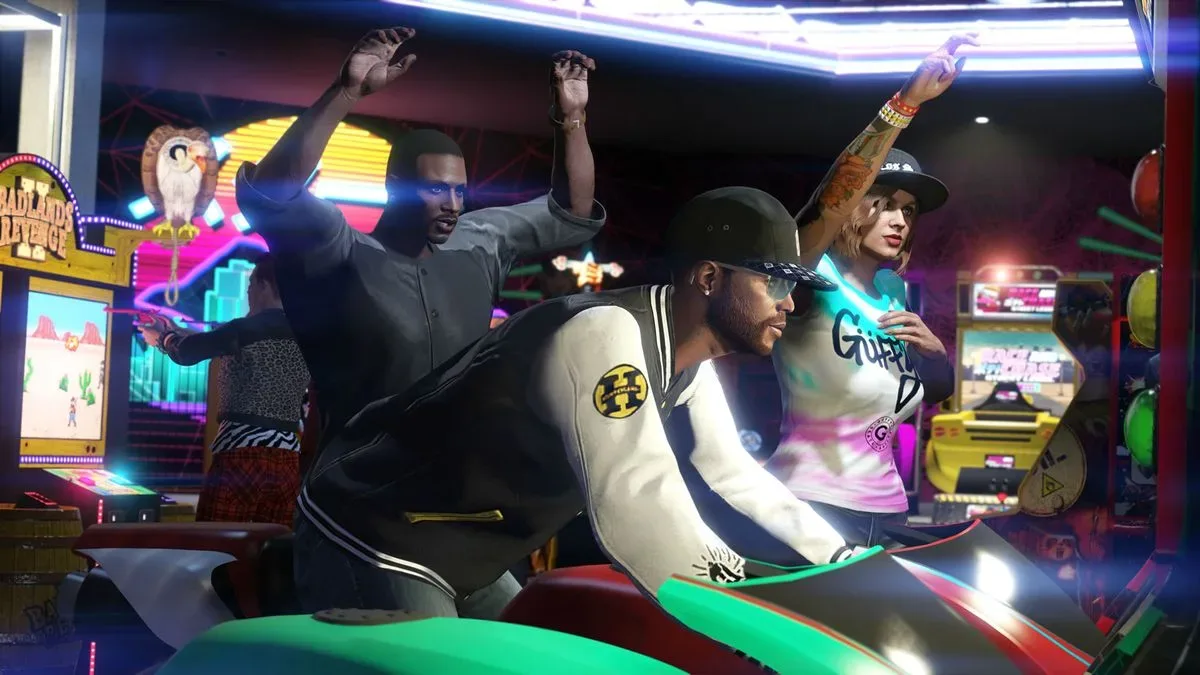
The single-player campaign is now only one layer of GTA 5. For many people, the name primarily means GTA Online, which takes priority on the game’s opening menu and has expanded into a much larger social and commercial space built on the original city.
Live service describes a game designed to receive continuing updates after launch. GTA Online did not originate the model, multiplayer concerts or virtual gathering spaces, but its enduring use of Los Santos illustrates what the model can do when its foundation is strong. The city has accommodated new radio stations, fresh ads and talk-radio segments, nightclub performances from real DJs, a Dr Dre EP, and follow-ups involving supporting characters from the campaign.
Those additions allow the setting to occupy a fuzzy “now.” Its built environment remains recognisably the same, while its soundscape and references keep being refreshed. In 2022, players also observed that some transphobic material had been removed. That change matters because it shows the world is not immutable: a game can be maintained technically while also reconsidering content that has aged badly.
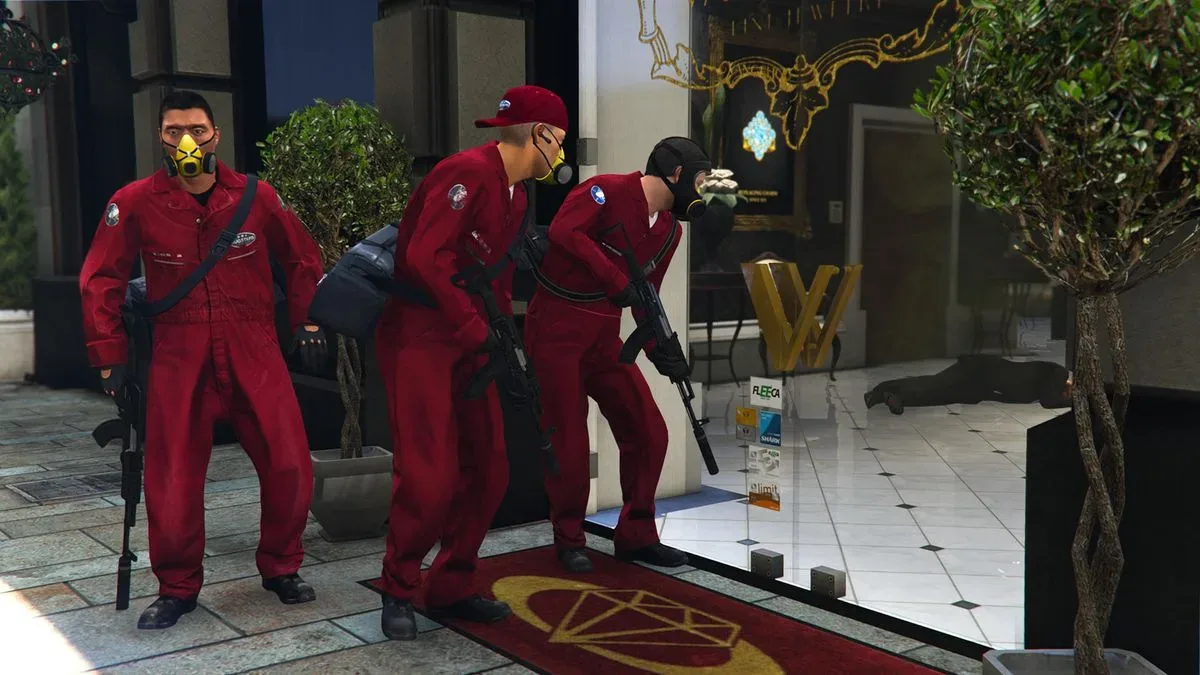
New Online stories have used the city’s existing mission framework to address newer anxieties. The Doomsday Heist update introduced Avon Hertz, a tech-billionaire figure in the same broad tradition as Jay Norris. Operation Paper Trail built a story around a deadly heatwave and energy crisis. These are not evidence that GTA 5 suddenly developed a more sophisticated mission language. The underlying format still often means moving between checkpoints and fighting successive enemy waves. Rather, they show how an old map can stay culturally responsive without being rebuilt from scratch.
That is both GTA Online’s achievement and GTA 5’s constraint. Longevity has given Los Santos new context, but it has also exposed the repetition beneath some of its action design. The city can feel permanently current; individual missions can feel unmistakably from an earlier open-world era.
Why the return visit still matters
GTA 5 did not reshape action games in the singular, immediately identifiable way GTA 3 did. Its legacy is stranger. It demonstrated that one richly authored city could become a long-term destination across console generations, then showed how a multiplayer service could grow into a second, much larger world on top of that foundation.
For a returning player, that means separating the elements that remain vital from those that merely remain familiar. The map continues to reward aimless driving because its social divisions, visual rhythms and physical transitions are built into the terrain. Character switching still makes the enormous space easier and more expressive to navigate. GTA Online’s continual additions explain how Los Santos avoided becoming a museum piece.
At the same time, GTA 5 is not improved simply because it is enduring. Some of its jabs at wealth and authority retain bite, while its treatment of women, its all-purpose nihilism and its reliance on provocation can feel much more limiting than they once did. Its shooting-and-checkpoint loops have not gained flexibility with age merely because new stories have been laid over them.
That mix is what makes revisiting it worthwhile. GTA 5 remains a landmark not because every part has survived unchanged, but because the exceptional parts are still easy to identify against the weaker ones. Los Santos is still a powerful virtual place: dazzling, dirty, unequal, inviting and frequently hostile. The game’s next chapter has plenty to live up to, even as it has plenty to learn from. For more on where that future may head, see our coverage of PC expectations around GTA 6.