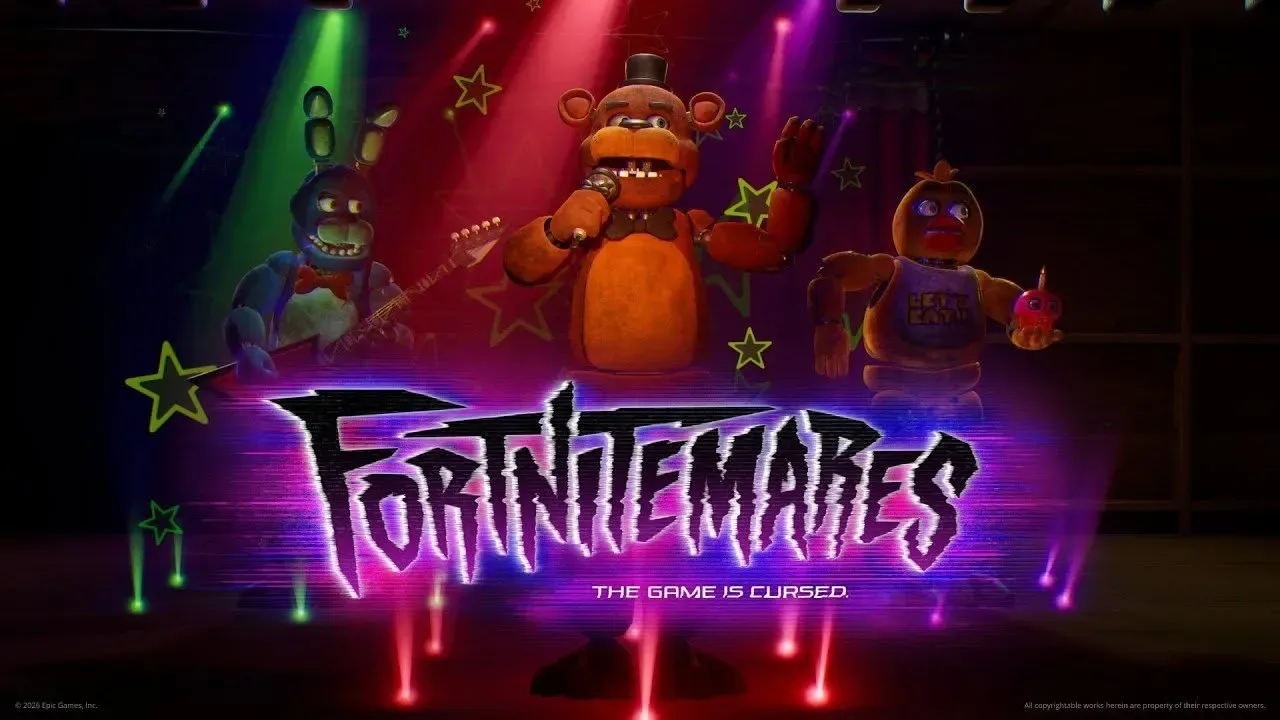
Fortnite has spent years becoming a cultural shorthand: the Battle Bus, flamboyant outfits, dances, llamas, bright weaponry and a vocabulary that can sound impenetrable to anyone who has never dropped into a match. That familiarity can make it easy to assume the game needs no introduction. Yet the Fortnitemares scare zone at Universal’s Halloween Horror Nights suggests a more interesting possibility: a physical attraction can introduce Fortnite to people who have deliberately stayed outside its orbit.
At Halloween Horror Nights, Fortnitemares is not simply a row of recognizable costumes intended as a reward for existing players. Its scale, lighting, sound and performers make the game’s Halloween identity legible even before a visitor understands every reference. A newcomer does not need to know why a skeleton banana is funny, what a purple llama signifies or why the crowd cheers when a character starts dancing. The questions themselves can become the hook.
A game world experienced from the outside in
The scare zone places visitors in Freaky Fields, a haunted farm setting associated with Fortnitemares. Actors emerge from detailed scenery, fog and purple storm-like lighting; performers carry stylized weapons, and Pumpkin Launchers fire overhead. A large Battle Bus sits at the center. It is an unusual order of operations for a game crossover: rather than playing first and visiting a real-world adaptation later, an unfamiliar audience member encounters the adaptation as their first meaningful contact with the fiction.
That reversal matters. Games are usually learned through systems. A player gets to grips with controls, objectives, maps, weapons and other rules, then begins to recognize a setting’s characters and symbols. A scare zone removes that requirement. Its first job is mood. The audience can understand that Freaky Fields is dangerous, playful, loud and knowingly ridiculous without knowing a single mechanic.
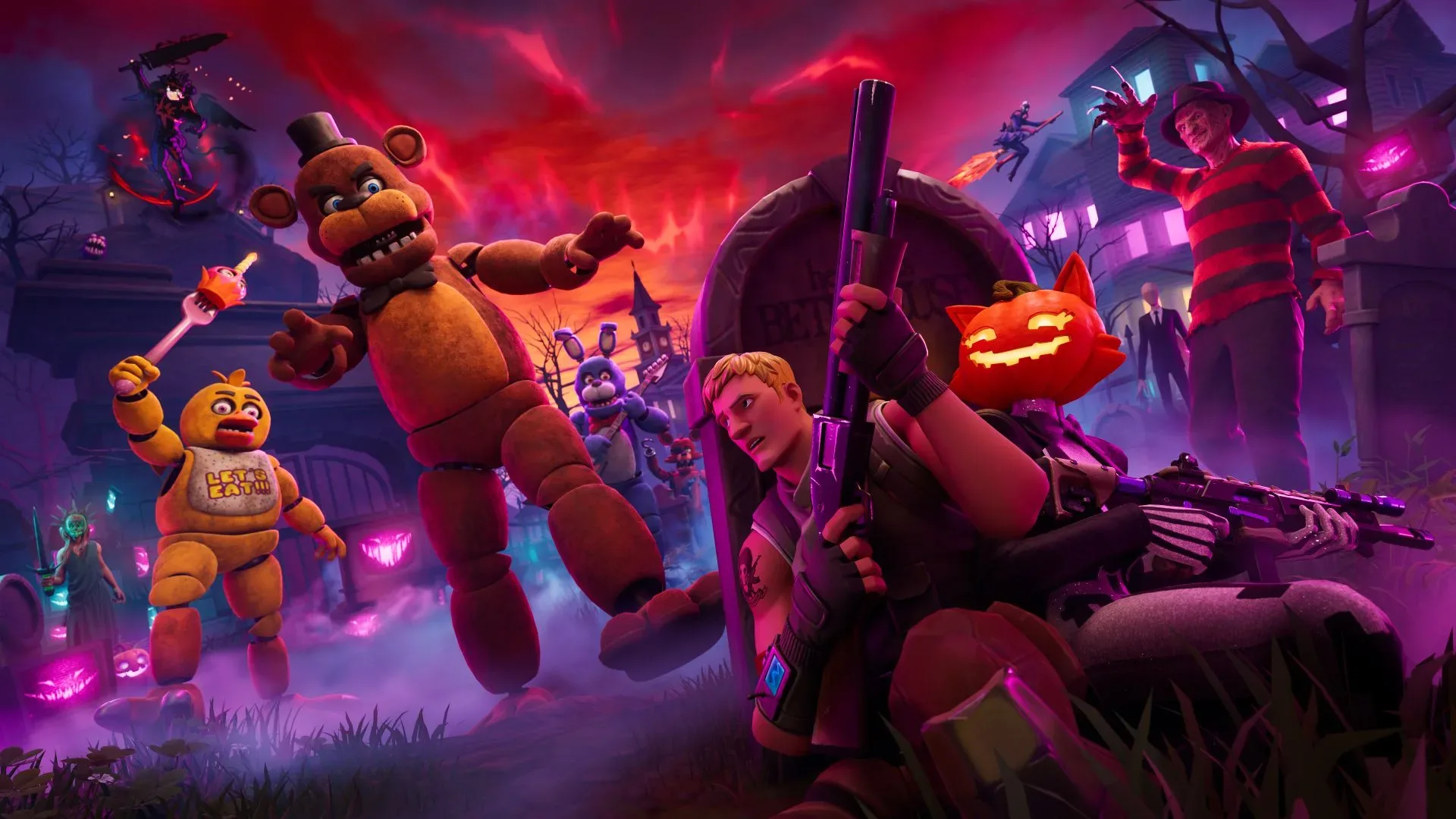
Fortnite’s visual language is particularly suited to this treatment. Its characters are designed to be seen quickly and remembered: a bear-and-tomato hybrid, a skeleton, a banana, a pumpkin-headed figure. The forms are strange enough to catch the eye at a distance, while Halloween Horror Nights supplies the atmosphere that turns them from menu-screen imagery into a live encounter. A visitor may arrive unable to name Cuddle Team Leader, Tomatohead, Skull Trooper, Hollowhead or Wrath. They can still understand that these are distinct personalities sharing a deliberately exaggerated horror world.
Why the unanswered references are useful
For longtime Fortnite players, references in Fortnitemares are payoff. A recognizable skin, weapon or emote connects an in-game memory to a real place. For newcomers, the same references work differently: they create a trail to follow. Who is that character? Why is that object important? What does an emote look like in the context of Fortnite itself?
In this setting, lack of familiarity is not necessarily exclusion. It can be a form of discovery. The visual joke of a skeletal banana does not require an encyclopedic explanation before it is amusing. The Battle Bus is imposing as a piece of scenery even to someone unaware of its gameplay role. Later, learning the meaning behind those details lets the visitor revisit that first encounter with greater context.
That is a valuable distinction for a crossover. The strongest adaptations do not merely demand that guests recognize a reference. They offer an immediate experience and leave room for recognition to deepen it. The Fortnitemares scare zone appears to use Fortnite’s established symbols as both fan service and an accessible front door.
Related coverage includes Fortnitemares at Halloween Horror Nights Turns a Fortnite Holdout Into a Dedicated Player.
A few Fortnite terms, without the initiation ritual
Fortnitemares is Fortnite’s Halloween-themed event identity and also the name used for the Halloween Horror Nights scare zone. In this case, it frames the game’s colorful design through haunted settings, costumed characters and seasonal imagery.
Skins are character appearances. They are cosmetic identities rather than a requirement to understand the attraction’s basic premise. The performers’ costumes bring several of these appearances into physical space, including the combined Cuddle Team Leader and Tomatohead look noted at the event.
Emotes are character actions, often dances or expressive gestures. In a live venue, an emote has an obvious advantage: a performer can pause, dance and interact with the people passing by. The behavior reads as celebratory even when the specific reference is new to the guest.
The Battle Bus is one of Fortnite’s instantly recognizable game symbols. At the scare zone, its oversized physical presence functions as a landmark as much as a reference. That kind of object helps a space feel like a place rather than a decorated corridor.
V-Bucks are the currency mentioned in connection with saving toward cosmetics, including the Halloween Horror Nights collaboration skins of Jack the Clown and Hamikuma. The key practical point for new players is simple: these are tied to appearance and fandom expression, not presented here as a prerequisite for beginning to play.
The attraction’s real achievement is translation
Theme-park versions of games often face a translation problem. A game gives its audience agency: players move, choose, react and set their own pace. A walk-through scare zone cannot replicate that exactly. It has to find another way to make a virtual world feel present.
Fortnitemares seems to answer that problem by translating mood and iconography rather than pretending to reproduce a full match. Dynamic sound design, theatrical lighting, fog, set pieces, costumed characters and guest-facing performances deliver the sensation of entering a heightened Fortnite Halloween scene. The Pumpkin Launchers, Skull Sickle and glowing-eyed figures provide movement and visual punctuation. The scene is built for watching, reacting and taking in at walking pace.
That is not a lesser version of the game; it is a different medium doing what it does well. A themed environment can give scale to a Battle Bus, texture to a haunted farm and a startling physical presence to characters whose usual home is a screen. Meanwhile, the game can supply the lore, play and ongoing reasons to return after the visitor goes home.
One reported response captures the potential of that handoff. A visitor who had skipped Fortnite through its rise in 2017 and 2018 left the event motivated to download it, then spent the following four weeks putting dozens of hours into the game. The scare zone did not merely prompt recognition; it prompted participation. The seasonal collaboration skins featuring Halloween Horror Nights icons Jack the Clown and Hamikuma then provided a further point of connection between the park event and Fortnite’s own cosmetic culture.
What newcomers can take from the crossover
There is a reassuring lesson here for anyone reluctant to start a huge, long-running game because it feels as if they have missed too much. You do not need to have followed every trend, played during the initial wave of excitement or understood every in-joke on day one. A striking character design, a seasonal event or a chance encounter with a physical installation can be a perfectly valid beginning.
- Start with the thing that caught your attention. If the Halloween characters are the appeal, Fortnitemares offers a natural thematic entry point rather than an obligation to master the game’s entire history.
- Let recognition grow over time. Seeing Skull Trooper, Hollowhead, Wrath or the Battle Bus in play after encountering them at the park can make learning feel rewarding rather than remedial.
- Separate cosmetics from the basic act of starting. It is easy for a game’s high-profile skins and currency to dominate conversation, but a newcomer’s immediate task is simply to see whether the game itself clicks.
- Keep the setup practical. Anyone playing through a display adapter may want to check the signal path before blaming the game or screen; our guide to USB-C to HDMI adapter limitations for gaming displays explains why that link in the chain can matter.
The final point is not that every theme-park crossover should serve as a tutorial. It is that immersion can be persuasive without being instructional. A themed environment can make a game feel worth investigating by presenting its personality in concentrated form: its shapes, colors, jokes, sounds and monsters all at once.
Fortnitemares runs through November 1
The Fortnitemares scare zone is scheduled to remain at Halloween Horror Nights at Universal Orlando Resort and Universal Studios Hollywood Resort through November 1, 2026. Existing Fortnite players have the obvious reason to visit: seeing familiar seasonal material transformed into a live setting. But the more intriguing audience may be the people who arrive with no connection to Fortnite at all.
For them, the scare zone offers an unusually low-pressure first encounter. No prior match results, no need to understand every item or reference, and no requirement to pretend the craze was never missed. Just a haunted farm, a purple-lit storm, a few bizarrely memorable faces and enough unanswered questions to make downloading the game seem like the next part of the attraction.