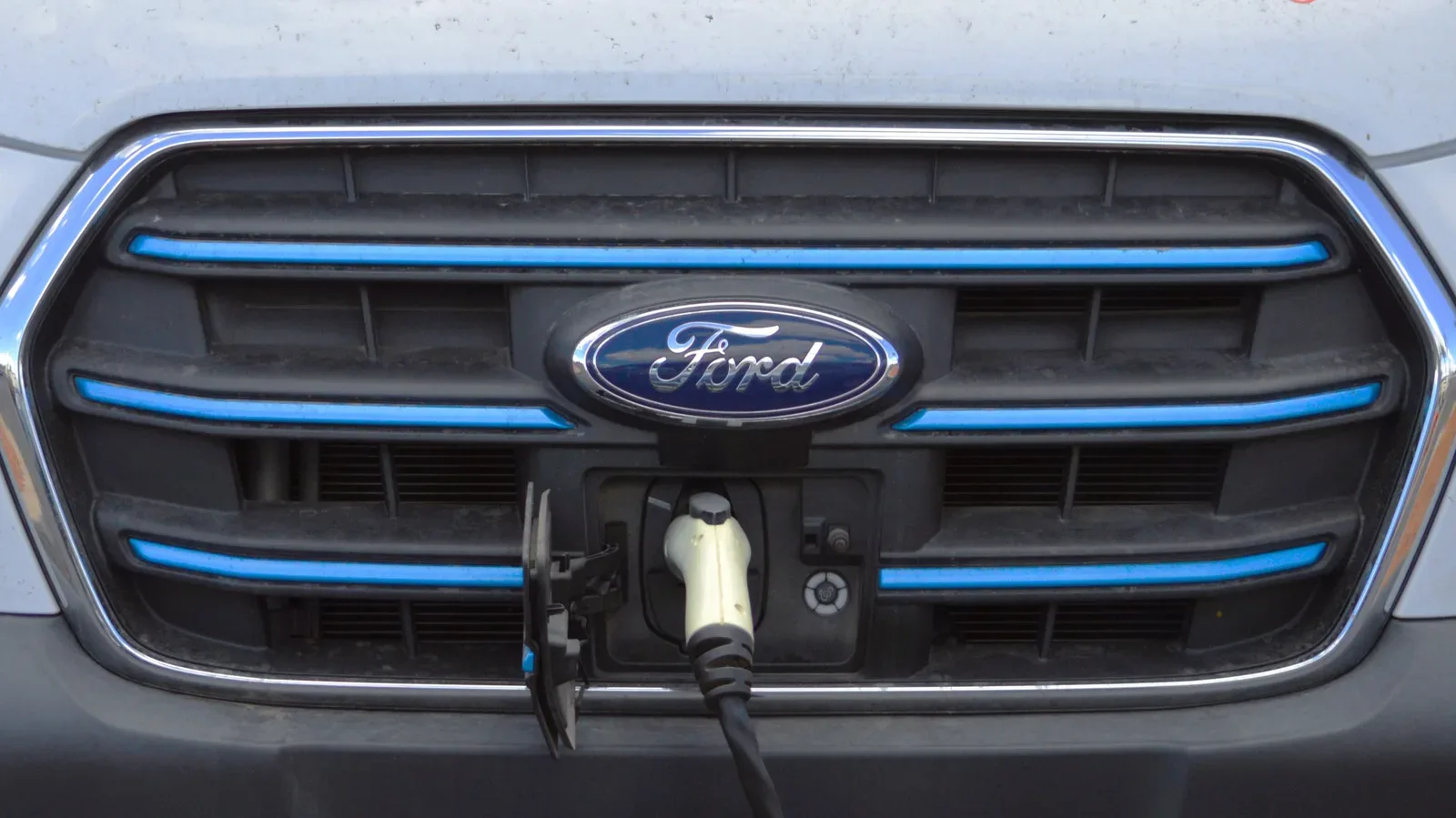
Two electric pickups are chasing a similarly ambitious price target, yet they appear to be making a very different argument about what an affordable vehicle should feel like inside.
Slate’s Blank Slate Truck is listed from $24,950 before its $1,450 destination charge. Ford’s Fathom begins at $28,350 before a $1,595 destination charge. Both therefore sit below $30,000 at their stated starting prices before destination, but the Fathom carries a $3,400 higher base price and a $3,545 higher price once those stated destination charges are included.
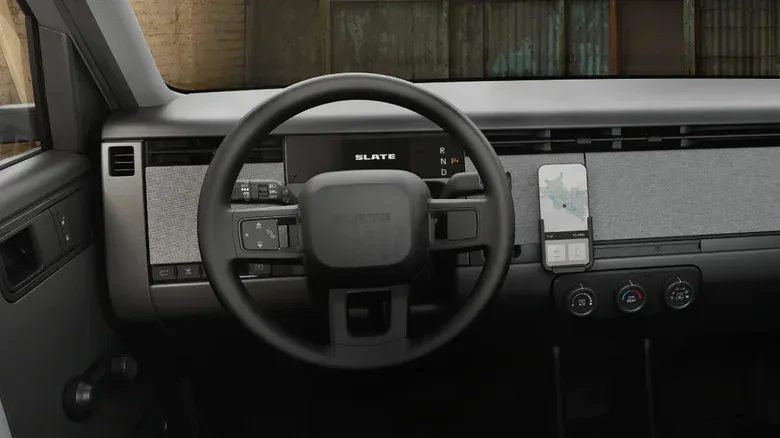
The potentially decisive difference is not a battery specification or a cargo figure—neither Fathom range, towing capacity nor payload has been announced. It is the dashboard. Ford says its five-seat Fathom will have a large touchscreen supporting Apple CarPlay and Android Auto. Slate has elected not to install a conventional infotainment screen at all. Instead, its truck provides standard phone mounting and charging, asking the owner’s phone to handle navigation, music and other compatible apps.
That contrast is more than a feature-list footnote. It reveals two definitions of value. Ford is trying to retain the cabin expectations buyers now treat as normal while finding manufacturing savings underneath the surface. Slate is stripping out a category of vehicle hardware and treating the smartphone already in a driver’s pocket as the evolving screen, app platform and connectivity device.
For shoppers, the right answer may depend less on which philosophy is objectively superior than on whether the truck is intended as a minimally equipped utility tool, a daily driver, or an invitation to customize.
Slate’s dashboard is deliberately incomplete—and that is the product idea
It would be easy to frame Slate’s design as simply missing CarPlay and Android Auto. That does not quite describe the setup. The company’s proposal is not an old-fashioned radio-first dashboard with phone connectivity removed; the phone or tablet is meant to be the infotainment system.
Phone mounting and charging are standard. Buyers can choose accessory speakers and a bracket for a larger tablet. The familiar app jobs—mapping, music and compatible communications tools—remain on the mobile device rather than being projected or integrated into a built-in center display.
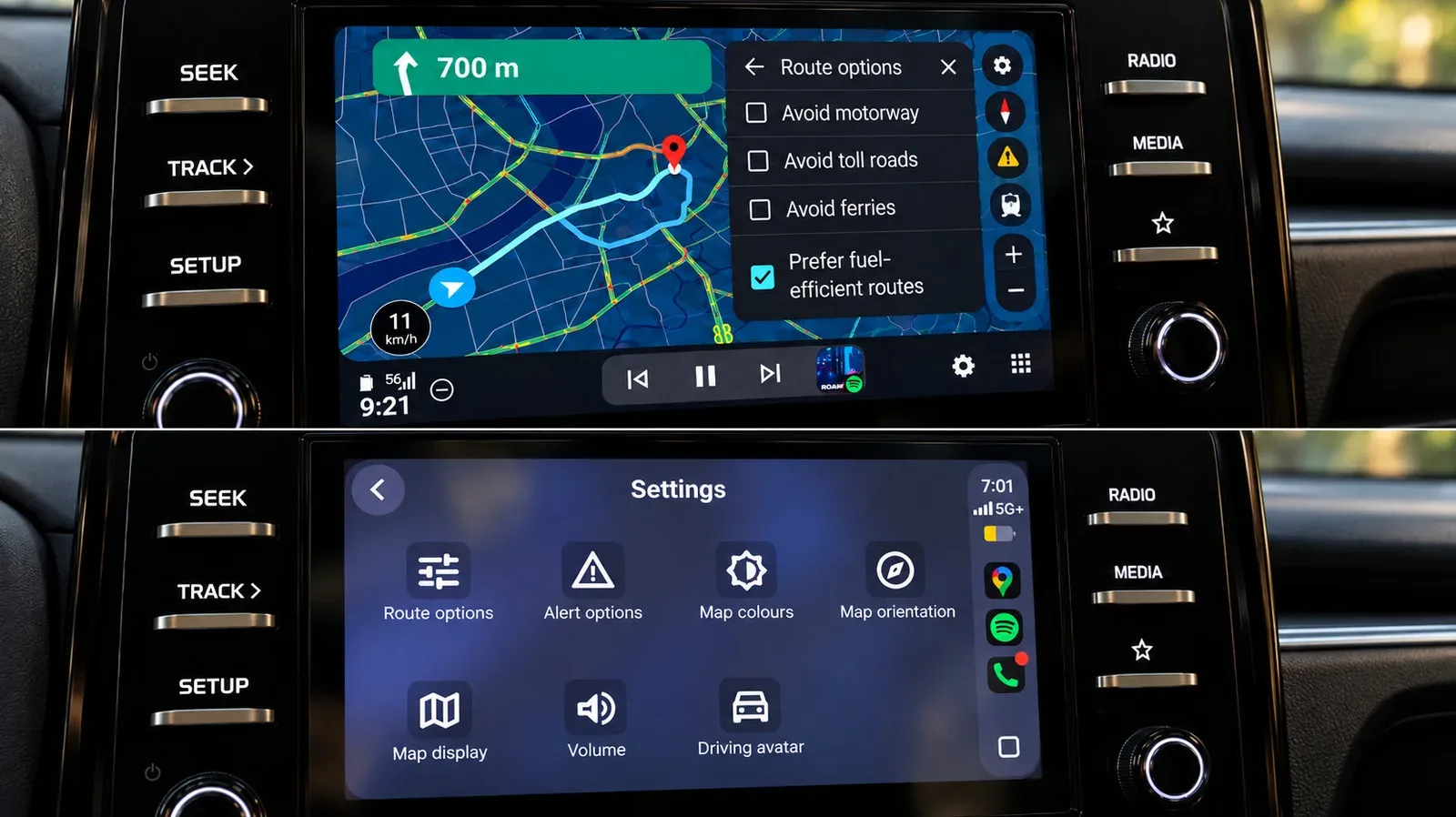
Infotainment is the industry shorthand for the vehicle system that combines information functions, such as navigation and settings, with entertainment functions including audio. CarPlay and Android Auto are phone-integration systems: compatible smartphone apps and controls are presented through a vehicle interface. Slate’s approach leaves those apps on the device itself. Ford’s approach puts the compatible phone experience on the Fathom’s installed display.
Related coverage includes Ford Fathom and Slate Take Opposite Paths on Affordable EV Tech.
There is a genuine durability argument for Slate’s decision. Smartphone software, app support and display technology can change much faster than a vehicle’s service life. If the primary screen is the buyer’s current phone, it can be replaced whenever the owner replaces the phone rather than remaining a fixed piece of dashboard hardware that may feel old after years on the road.
Slate also says vehicle software updates can be downloaded to a phone and transferred to the truck. That matters because it avoids requiring an embedded cellular connection for that update process. In plain terms, the phone can act as a bridge between downloaded software and the vehicle, rather than the truck needing its own permanent data connection.
That simplicity has practical limits. A phone screen is physically smaller than a built-in dashboard display, and a tablet mount or accessory speakers are still optional additions rather than the baseline experience. Owners who want a larger, integrated screen may see the standard arrangement as a cost-saving omission rather than a welcome reduction in complexity.
There is also early evidence of a different type of appeal: modification. Some prospective owners are already discussing aftermarket stereos, Raspberry Pi projects and ways to add CarPlay or Android Auto functionality. A Raspberry Pi is a small, low-cost computer commonly used in hobbyist electronics projects. The appeal here is not that Slate has promised a particular do-it-yourself solution—it has not—but that an intentionally sparse cabin could leave room for owners who want to build their own.
That is a compelling proposition for a certain buyer. It is also labor, research and possibly extra spending for someone who simply wants navigation, music and calls working from day one on a suitably sized display.
Ford preserves a familiar daily-driver experience
Ford’s Fathom takes the opposite route: cut costs in the vehicle’s engineering and manufacturing system while keeping the technology a mainstream buyer expects to see in the cabin. The large touchscreen, CarPlay and Android Auto make the Fathom feel structurally closer to the contemporary vehicle experience, at least from the supplied feature list.
The truck is also set to include a digital key, bidirectional power and hardware for Ford’s next-generation BlueCruise hands-free system. BlueCruise requires activation, an important qualifier: the presence of hardware is not the same thing as a statement that the feature will be operating for every Fathom owner immediately or automatically.
Bidirectional power means power can flow out from the vehicle’s battery for external use, rather than only into the battery for charging. The reported information does not detail outputs or use cases for the Fathom, so buyers should not assume capacities beyond the fact that Ford plans to include the capability.
A digital key is a phone-based key function. Like the touchscreen integration, it reflects Ford’s bet that affordable need not mean technologically bare. In practice, the Fathom’s pitch is not simply “more screen.” It is a lower-cost EV truck that still uses familiar built-in automotive interfaces alongside phone connectivity.
That convenience may be meaningful to a large share of the market. A 2025 consumer study covering more than 31,000 people across 30 countries found that 63% of U.S. respondents considered CarPlay or Android Auto somewhat or very important in their next vehicle. That does not prove every one of those respondents would select the Fathom, nor does it establish that Slate’s phone-first arrangement cannot meet their needs. It does show that smartphone integration is not a trivial specification for many prospective buyers.
Ford has not announced several of the practical figures pickup shoppers will eventually need to compare: projected driving range, towing capacity and payload. Those numbers could substantially change the comparison when they arrive. For now, Ford’s advantage is clearest in the cabin concept, while the total utility trade-offs remain unknown. Preorders are expected to begin in early 2027.
Two cost-cutting strategies, not one cheap-truck formula
It is tempting to reduce this matchup to “Ford includes more and Slate removes more.” The deeper distinction is where each company appears to be pursuing affordability.
Slate, beginning with a clean-sheet proposition, has questioned whether the vehicle needs dedicated infotainment hardware at all. Its two-door truck is positioned around fewer electronics and user-supplied devices. That makes the dashboard feel closer to a modular setup: the vehicle provides mounting, charging and the platform for accessories, while the buyer decides how much screen and audio equipment belongs in the cabin.
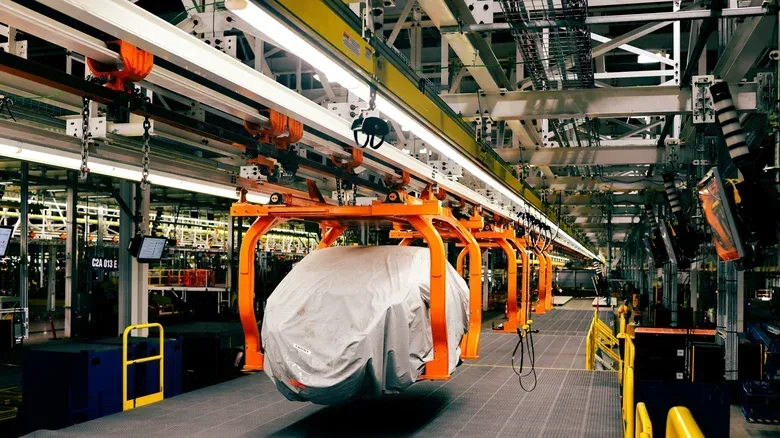
Ford is attacking complexity in production. It is investing $2 billion to retool Louisville Assembly Plant for its Universal EV Production System. Ford says the platform uses 20% fewer parts than a typical vehicle, 50% fewer cooling hoses and connections, and a wiring harness more than 4,000 feet shorter than the one in its first-generation electric SUV, the Mustang Mach-E. The company expects assembly to be 15% faster overall than the plant’s previous products.
A wiring harness is the organized bundle of electrical wiring and connectors that carries power and signals through a vehicle. Shortening and simplifying it can reduce both component complexity and the work required to assemble the vehicle. Likewise, fewer cooling hoses and connections means fewer pieces to manufacture and install. Those are not glamorous consumer-facing features, but they are the kind of changes that can make a lower sticker price possible without demanding that the dashboard look stripped down.
Ford’s figures are company-stated targets and comparisons, not independent measurements. Still, they illustrate a clear strategy: preserve a conventional cabin experience by making the vehicle below it less complex to build.
The screen issue is really an ownership-friction issue
The most useful way to assess these trucks is not to ask whether a giant display is inherently better than a mounted phone. It is to ask where each design places friction.
Slate places more responsibility with the owner. The driver supplies the device, lives with its screen size, decides whether speakers or a tablet bracket are worthwhile, and can explore aftermarket ideas if the basic setup feels insufficient. In return, the central technology is not locked to a single built-in screen that ages in place.
Ford places more equipment in the truck itself. The owner gets the familiar central-display experience and supported phone-integration systems, but also inherits a more conventional vehicle-tech stack. Ford’s manufacturing plan is an attempt to make that choice affordable without simply handing the job to the driver’s phone.
There is a faintly game-hardware-like question underneath the debate: should the platform be a simple base that owners personalize with their existing devices, or a complete appliance that works in a recognizable way from the outset? That same tension appears whenever compatibility and long-term support become part of a buying decision, including questions around features such as Xbox Smart Delivery support. The point is not that a truck dashboard is a console. It is that buyers notice when convenience, compatibility and future flexibility are unclear.
What buyers can know now—and what they cannot
There is enough information to identify the philosophical split, but not enough to crown a universal winner. Slate’s lower listed starting price is concrete, as are its standard phone mount and charging arrangement. Ford’s listed price, touchscreen support for CarPlay and Android Auto, digital key, bidirectional power and BlueCruise hardware are also concrete.
Several important decisions should wait for fuller specifications. Ford has not disclosed Fathom range, payload or towing capacity. The exact real-world usefulness of either truck will depend on needs that a center display cannot answer: trip length, work requirements, passenger needs and how the buyer values the two-door Slate configuration against Ford’s five seats.
Yet the infotainment choice will likely remain unusually important because it affects every drive. For a buyer who already mounts a phone, prefers fewer embedded electronics and likes the prospect of a customizable cabin, Slate’s blanker canvas could be the attraction. For a buyer who regards a large in-dash screen and native CarPlay or Android Auto support as basic modern equipment, the Fathom may justify its higher starting price before range and truck-capability figures are even part of the conversation.
The affordable-EV contest is therefore not only about how cheaply a pickup can be sold. It is about what counts as essential equipment when the price pressure is real. Ford’s answer is to hide the simplification in the factory. Slate’s answer is to put a phone mount where many shoppers expect to see a screen. The eventual sales result may reveal which compromise feels like smart minimalism—and which feels like something buyers should not have to bring themselves.