There is a familiar early-life arc to a fashion-making game. First comes the sensible work: make an outfit with the requested colour, fabric and style. Then comes the stage where a player discovers a pattern they like, uses it everywhere, and calls the resulting wardrobe a brand identity. And then, apparently almost immediately, comes the point where someone puts The Great Wave off Kanagawa on a dress and the rest of us have to reconsider what “a nice outfit” means.
That is where Dressmaker’s creative community appears to be. Players are sharing designs that move well beyond simply satisfying in-game clothing requirements. The work seen so far includes garments built around famous art, animals, stained-glass-like colour arrangements, historical costume inspiration, game-character recreations and intentionally ridiculous produce-based couture. The common thread is not just technical access to more materials or patterns. It is an impressive willingness to treat a virtual dress as a tiny canvas, sculpture and costume all at once.
It is worth stating the obvious before the fashion police arrive with their clipboards: a successful Dressmaker outfit does not need to resemble an exhibition piece. Making something that meets a character’s requested fabric, colour and style is already a legitimate win. A strange combination of textiles can be part of the fun, especially when the game is asking players to work within a limited set of options. But the shared creations demonstrate how far those limitations can be pushed when a player begins with an image, a mood or a reference rather than a checklist.
A dress can be a picture without becoming a costume
The standout art-inspired design is based on Hokusai’s The Great Wave off Kanagawa. The idea is immediately legible: the familiar curling wave and its dramatic blue-and-white motion are translated onto the body of a dress. That translation is the clever part. A painting is normally viewed on a flat surface, while a garment wraps, folds and changes shape. A successful recreation therefore needs the important forms placed where they will remain recognizable rather than being swallowed by a seam or scattered across the silhouette.
That is a useful way to understand why these community outfits are more than “using the correct colours.” Visual design relies on composition: the arrangement of shapes, tones and focal points so that a viewer’s eye knows where to go. On an art-themed garment, the main wave, a flower, a fish or a strong stained-glass panel has to become that focal point. Surrounding materials then support it rather than compete with it.
The same principle helps explain why a design can feel polished even when it is not packed with detail. A fish-themed dress and a koi dress can work because the core subject is clear. A monarch butterfly dress can use the insect’s distinctive colour contrast and wing-like shapes as a visual shorthand. The player does not need to reproduce every scale, feather or ripple for the outfit to communicate its inspiration. In fact, simplifying a reference may be the better decision when the garment itself is the medium.
The community is using references as a design language
Dressmaker players are not limiting themselves to one source of inspiration. Shared designs include a collection built around the stained-glass look, a costume for Edith inspired by Leon Bakst’s Firebird costume, a dress reminiscent of Mirabel’s outfit from Encanto, an Alice in Wonderland piece with a cel-shaded appearance, and a recreation of Zelda’s dress from The Legend of Zelda: Twilight Princess.
These examples land in different visual traditions, but they all answer the same design question: what are the few features that make this reference unmistakable? For a character outfit, it may be the overall silhouette, a key colour combination or a recognizable motif. For stained glass, it is likely the separation of bright colour fields in a way that suggests leading between panes. For cel shading, it is the illusion of deliberately placed blocks of light and shadow instead of smooth tonal blending.
Related coverage includes Dressmaker Players Are Already Turning Virtual Fabric Into Tiny Masterpieces.
Cel shading is an illustrative technique that makes three-dimensional forms appear closer to hand-drawn animation or comics by using distinct areas of shade rather than gradual transitions. Applied to a virtual dress, the effect is not literally changing a game’s lighting model. It is a design illusion created through colour and pattern placement. That is precisely why it is notable: the player is using available materials to imply a rendering style that belongs to another medium.
Likewise, the stained-glass collection reflects an understanding that the reference is as much about structure as colour. Random jewel tones do not automatically look like stained glass. The colours have to feel segmented and intentional. This is the difference between collecting attractive components and arranging them into a coherent design—a distinction that becomes especially apparent when players begin posting their work side by side.
Materials unlock options, but not imagination
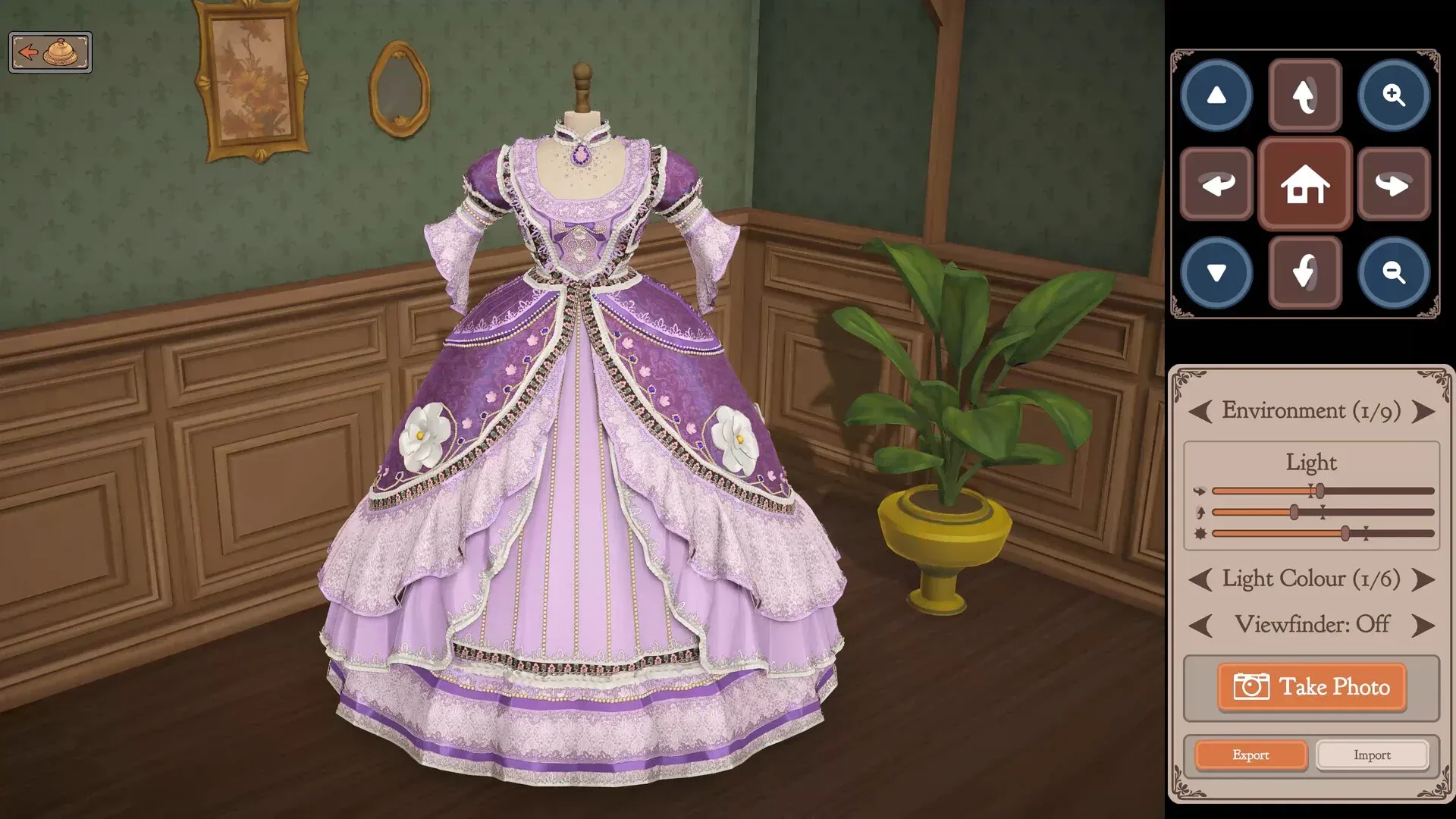
Some of the grandest gowns appear to depend on later-game materials and patterns, which creates an understandable gap between a new player’s workbench and the outfits now circulating online. A large ballgown needs the right available pieces before anyone can turn it into a sweeping art project. Progression matters because it expands the range of silhouettes and surface treatments a player can use.
Yet the designs on display also make a gentler point: more options do not automatically produce a stronger dress. Players still need to decide how much fabric to devote to a skirt, where a motif should sit, how colours should balance, and when a reference is clear enough to stop adding. One shared post even calls attention to using a great deal of material for a voluminous skirt. That kind of choice is part of the visual message. Extra volume can make an outfit theatrical, formal, playful or deliberately extravagant—but only if the rest of the concept gives that volume somewhere to go.
For players who have not reached those later materials, the practical takeaway is not to attempt an exact copy of a maximal ballgown with tools that are not available. Start with the design logic instead. Choose one dominant idea. Pick a limited palette tied to it. Use a motif in a place where it reads clearly. A cat-inspired dress, for example, can communicate “cat” through colour, markings or a compact decorative choice; it does not require every possible feline detail at once.
- Begin with a single reference: an artwork, animal, flower, character or object is easier to interpret than a pile of unrelated inspirations.
- Identify the visual anchor: decide what someone should notice first—the wave, butterfly wings, a fish shape, a distinctive skirt or a bold colour block.
- Limit supporting colours: a focused palette gives the main motif room to read.
- Match complexity to the available pieces: a smaller, cleaner concept can be more successful than an overstuffed imitation of a design made with later patterns.
- Leave room for the joke: the radish dress proves that a clear gag and committed execution can be as memorable as an elaborate reference.
The best posts create a useful kind of creative pressure
There is an intimidating side to seeing players make work this refined so early. It is easy to look at a Great Wave dress or a carefully interpreted fantasy costume and conclude that personal efforts are hopelessly behind. But community showcases can be more productive when treated as idea libraries rather than leaderboards.
A player who cannot reproduce a specific outfit can still learn from it. The Great Wave design suggests using a famous composition as a garment layout. The koi and fish dresses show how to build around a central subject. The Alice design points to the possibility of mimicking another art style through contrast and placement. The character recreations show the value of selecting a few signature elements over chasing total literal accuracy. And the radish dress makes a compelling case for following a silly premise all the way through instead of apologizing for it.
That variety is important. A community is healthier when polished homage, technical experimentation, personal taste and nonsense can sit next to each other. If every post had to look like a museum-ready gown, virtual dressmaking would become less welcoming. The fact that an intricate art recreation can share attention with a cat dress and a vegetable joke is evidence that the game’s design space is broad enough for different kinds of creativity.
It also speaks to why dress-up and customization games can inspire such immediate sharing. The finished piece is compact, visual and easy to understand at a glance, but it can still carry layers of decision-making. Viewers recognize the reference, admire the use of patterns or colours, and can imagine trying their own version. That feedback loop turns individual tailoring into a communal prompt: someone sees a butterfly dress and starts thinking about moths; someone sees stained glass and begins considering mosaic designs; someone sees a cel-shaded Alice and wonders what other visual styles can be faked with fabric.
Dressmaker has found its show-and-tell phase early
The current flood of shared work suggests that Dressmaker has entered the most entertaining period for any customization-focused game: the show-and-tell phase. Players are still discovering what their options mean, but they are already combining them in ways that make the game’s basic wardrobe requests look like the start of a much bigger conversation.
There is a parallel in the way other player-art communities celebrate a strong idea as much as a technically ambitious one; for another recent example of game spaces making room for community-made work, see this fan-art contest that will bring selected pieces into a game. Dressmaker’s standout garments do not need to be official additions to matter. Their value is in demonstrating possibilities that other players may not yet have considered.
So, yes, the people turning virtual cloth into recognizable art, animated-looking costumes, ornamental fish, elaborate skirts and impeccable fantasy references should probably be congratulated—and perhaps mildly investigated for having this much taste so soon. Everyone else can continue assembling odd but requirement-compliant outfits without shame. In a creative game, the imperfect dress is not the opposite of the masterpiece. It is often the first draft of the next wonderfully specific idea.