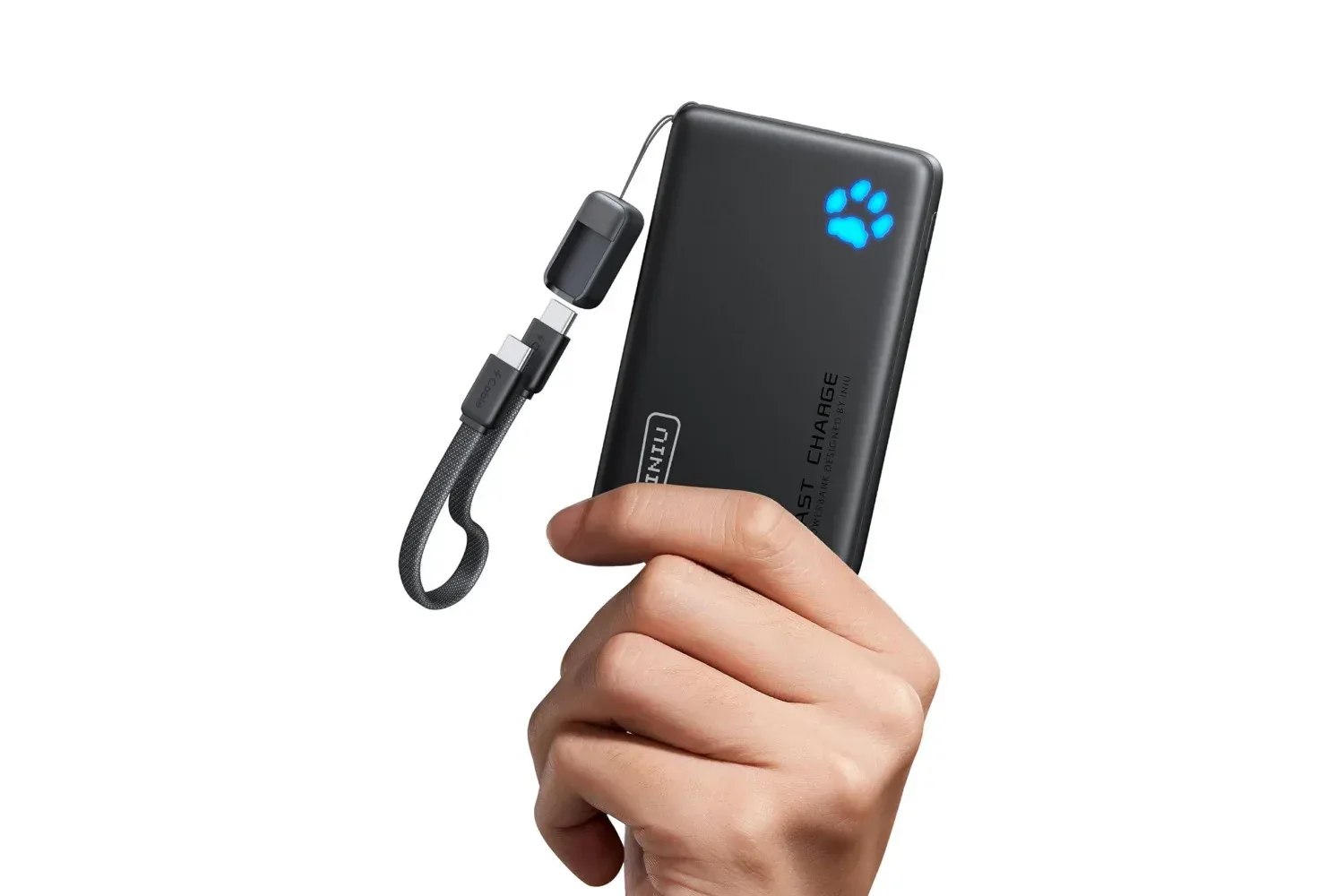

A power bank is rarely the most glamorous part of a gaming setup. Nobody opens a bag at a tournament, airport, café, or friend’s house hoping to show off a cable. Yet it can become the single most important item in that bag when a handheld, phone, controller, headset, or laptop runs low at exactly the wrong moment.
For players comparing Anker and Belkin, the useful question is not which logo wins a universal contest. The two companies overlap in cables, wall adapters, wired charging, wireless charging, and portable batteries, but their recent products point toward different priorities. Anker’s strongest case is high-power, information-rich charging for people carrying several demanding devices. Belkin’s is broader accessory variety, including products that combine charging with creator, display, phone-grip, and console-oriented needs.
That distinction matters more than brand loyalty. A player who travels with a gaming laptop, a phone, and a handheld has a different problem from someone who mainly wants a slim phone battery or a more comfortable way to capture mobile gameplay. The right choice starts with what needs power, how many things need it at once, and whether the charger has a job beyond charging.
The short version: match the bank to the bag
Anker is the more natural first stop for a demanding portable setup. Its current direction emphasizes laptop-capable output, simultaneous charging, displays that report what the unit is doing, built-in cables, and charging systems designed to handle several devices. This is the practical profile for someone whose travel kit includes a laptop alongside smaller hardware.
Belkin is especially compelling when charging is only one part of the purchase. Its range includes creator accessories such as tripods, magnetic phone mounts, and wireless microphones, and it has introduced combinations such as a power bank that also acts as a camera grip and stand. It has also shown a second-generation charging case for Nintendo Switch 2. That is a meaningful difference for players who stream, record clips, play on a phone, or want an accessory that solves a physical-use problem as well as a battery problem.
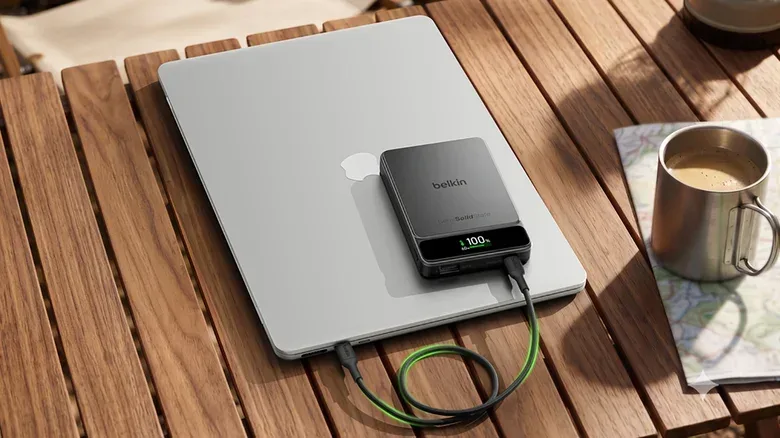
There is still overlap. Belkin’s newer UltraCharge 22K, rated at 22,000mAh and 65W, is intended to recharge laptops and tablets as well as phones. Meanwhile, Anker’s wireless MagGo 2 Pro is built around phone-friendly wireless charging. Neither company is confined to one narrow kind of buyer. The distinction is about where each lineup appears most focused.
What capacity and wattage actually tell a gamer
Two numbers dominate power-bank listings: mAh and W. They are related to different questions, and mixing them up leads to disappointing purchases.
- mAh, or milliamp-hours, is a capacity figure: it indicates how much stored battery capacity a power bank is described as having. It is useful when considering how much reserve power you want to carry.
- W, or watts, describes power delivery: in straightforward terms, it helps indicate how much power a charger can supply at a time. For equipment such as laptops and tablets, that figure is central to whether a portable charger is suited to the task.
- Multi-device charging means a unit can charge more than one connected device simultaneously. That convenience is valuable, but buyers should look at the product’s stated behavior for multiple connected devices rather than assuming every port will behave identically.
- Wireless charging removes the need for a cable between the bank and a compatible device, while wired charging still matters for devices that need it and for setups where a cable is more practical.
Applied to the products discussed here, Belkin’s 22,000mAh, 65W UltraCharge 22K belongs in the more ambitious portable-power conversation because it is positioned for laptops and tablets, not solely phone top-ups. Anker’s Laptop Power Bank 25K, 165W goes further toward a multi-device, high-output proposition. The 25K designation identifies its 25,000mAh capacity class, while the 165W rating signals a considerably higher-output design.
Related coverage includes Anker vs. Belkin: Choosing the Right Power Bank and Accessories.
That does not mean every gamer needs the largest number. A larger, more capable bank makes sense when the goal is to keep a laptop and other equipment going away from an outlet. It is less compelling when the only regular need is a phone charge during a commute. In that case, a thin magnetic unit such as Belkin’s 5,000mAh UltraCharge Pro Slim Magnetic Power Bank may be the more sensible form factor. Belkin says it is no larger or thicker than a standard credit card and supports both wired and wireless charging, but its capacity is framed for roughly a phone charge or a charge and a half rather than long sessions powering a collection of gear.
Anker’s appeal: visibility, output, and fewer loose pieces
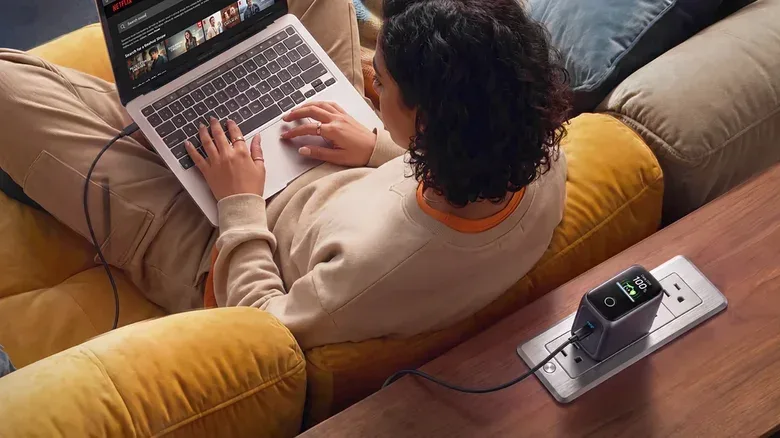
Anker’s recent hardware reflects a clear assumption: the owner may be anxious about power, may have multiple devices connected, and may want to know what the charger is doing. That is why displays are important. On the Anker Laptop Power Bank 25K, 165W, the screen can show power going to connected devices, temperature, and the charger’s overall health. Those are not merely decorative readouts when several devices are attached. They offer a quick way to understand the current state of the power hub in a bag or on a desk.
For gaming, that information can be more useful than it first sounds. A portable laptop setup often includes several competing needs: the computer, a phone used for authentication or communication, and perhaps a controller or headset. Knowing that a bank is sharing power across connected devices gives the owner a clearer picture than a row of anonymous LEDs.
Convenience design is another Anker strength. The 25K, 165W unit includes built-in cables, one of them retractable. Built-in does not automatically mean every cable scenario is covered, but it can reduce the number of separate items a traveler needs to remember. Anker’s IFA 2026 announcements continued that focus: the Laptop Charger Pro is designed to identify the connected laptop and optimize charging accordingly, while many of the company’s announced products included displays and support for charging multiple devices.
The MagGo 2 Pro adds a different kind of consideration. It charges compatible hardware wirelessly at 25W and has an integrated fan intended to help prevent overheating. Wireless power and heat management are relevant to players using their phones heavily, whether that phone is running a game, voice chat, streaming tools, or a companion app. The important qualifier is compatibility: a wireless charging feature only matters if the intended phone supports it.
In plain buying terms, choose Anker first when your charging wish list reads like a mini loadout: laptop support, several devices, higher power, real-time information, and integrated-cable convenience. It is the brand’s clearest area of emphasis.
Belkin’s appeal: charging that does more than charge
Belkin’s portfolio makes more sense when a buyer sees a power product as part of a wider mobile setup. The Stage PowerGrip, introduced at CES in January 2025, is the clearest example. It combines backup power with a camera grip and stand. For a mobile player or creator, that means an accessory can contribute to how the phone is held or positioned as well as how it is powered.
That approach extends into Belkin’s creator category, which includes tripods, magnetic phone mounts, and wireless microphones. These products are not substitutes for a high-output laptop battery, and they do not need to be. They speak to a buyer who records gameplay, makes short-form videos, streams from a phone, or simply wants better placement and handling of a device.
Belkin’s display ambitions also reach beyond charging. The ConnectAir Wireless HDMI Display Adapter, revealed at CES 2026, uses a USB-C transmitter dongle and a USB-A-to-HDMI receiver connected to a television, monitor, or projector to cast content wirelessly. It is a separate category from a power bank, but it reinforces the company’s broad accessory angle: portable setups can involve getting content onto a larger screen as well as keeping devices charged. Anyone considering it should distinguish the adapter’s display role from a charger’s power role; they solve different problems.
Gamers also have a direct console-adjacent item to watch in Belkin’s second-generation charging case for Nintendo Switch 2, revealed at CES 2026. The available detail establishes the product category, not its final real-world performance or full specifications. Still, the mere presence of such a case fits Belkin’s wider strategy of serving particular mobile-device routines rather than focusing exclusively on generic high-output bricks.
Belkin is not standing still on capacity. The UltraCharge 22K brings a 22,000mAh capacity and 65W output to its lineup, with a display and retractable cable among the convenience features. For someone who needs laptop and tablet capability but is also drawn to Belkin’s accessory ecosystem, it is the obvious product type to investigate.
Battery architecture and slim magnetic options
Belkin has also introduced solid-state power banks. The company says this battery architecture reduces the risk of fire and swelling. That is a safety-related claim from the manufacturer, not a guarantee that a battery can never have a problem, but it explains why the UltraCharge Pro Slim Magnetic Power Bank is notable beyond its card-like dimensions.
This is a different purchasing lane from a 22,000mAh or 25,000mAh unit. A 5,000mAh magnetic bank prioritizes portability and quick accessibility. It can be appropriate for a phone that needs a convenient buffer during a day out, while a larger unit is more appropriate for a setup built around extended time away from wall power. Buyers should avoid treating “portable” as one category; pocketable emergency power and a laptop-capable bag battery are distinct tools.
A practical choice checklist
- List the devices you genuinely expect to charge. Include the laptop if it travels with you, not just the phone you use most.
- Decide whether simultaneous charging is routine or occasional. If a phone, laptop, and accessories often share one bank, Anker’s multi-device emphasis is highly relevant.
- Prioritize output when laptop charging matters. Compare the stated wattage and the product’s intended device support, rather than buying by capacity alone.
- Consider information and cable management. A screen showing power, temperature, and charger health can be useful for a complex setup; built-in and retractable cables can simplify packing.
- Choose form factor honestly. A credit-card-like 5,000mAh bank is built for convenience, not a full travel workstation. Larger models trade some simplicity for broader capability.
- Account for the rest of the rig. A player who shoots clips or streams from a phone may get more value from Belkin’s grip, stand, mount, or microphone ecosystem than from extra charging headroom they will never use.
- Verify compatibility before treating a feature as essential. This is particularly important for wireless charging and for any laptop-oriented purchase.
There is no need to turn the decision into a console-war-style allegiance test. Anker appears best aligned with the player who wants serious portable power, high output, multiple-device support, and detailed status feedback. Belkin is a strong fit for buyers who want charging integrated into a more varied mobile, creator, display, or console-oriented accessory setup, while its UltraCharge 22K shows it can also serve more demanding power needs.
The most useful purchase is the one that removes friction from the way you already play. If your biggest fear is a laptop, phone, and accessories all fading at once, start with Anker. If your kit is built around a phone, a handheld, content creation, or a specific accessory shape, Belkin’s range deserves the closer look. For more context on how mobile hardware choices can affect play, see why Google’s Pixel phones moved from Snapdragon to Tensor and what that can mean for gaming.