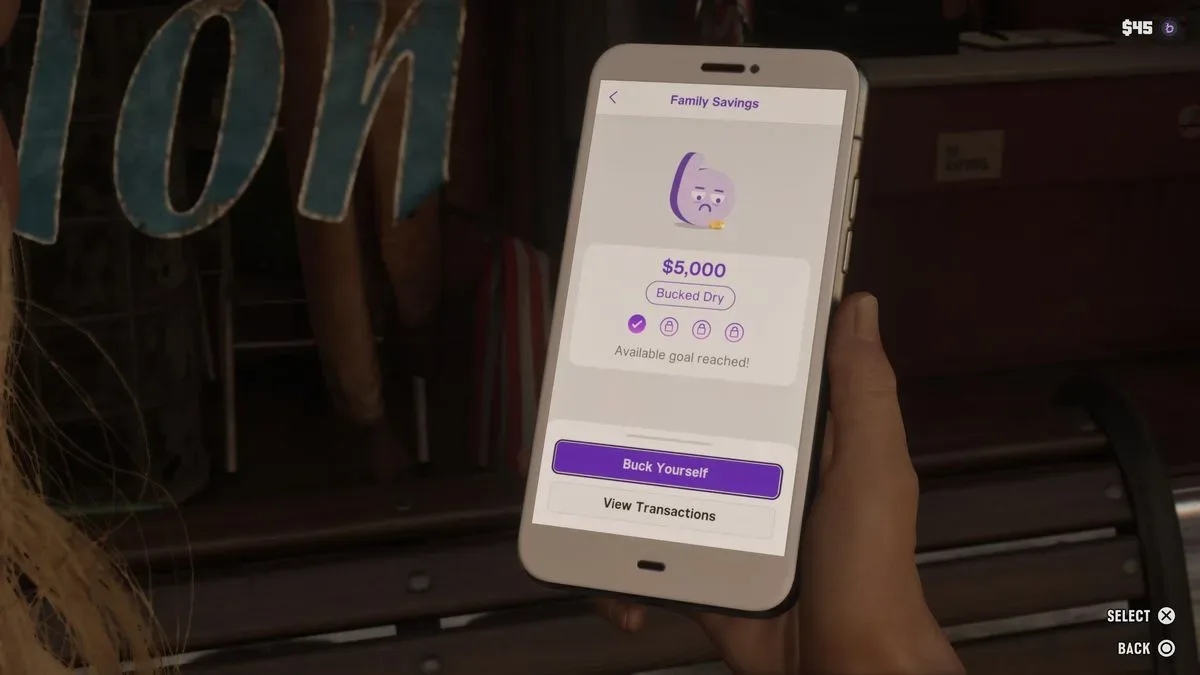

GTA 6’s BuckMe Family Savings account presents a deliberately uncomfortable money decision: players can put funds aside for Jason and Lucia’s future, but anything deposited becomes unavailable to spend or withdraw. It is optional, shared between the two protagonists, and carries story consequences without requiring players to participate.
That makes the answer to whether you should pay into it less straightforward than a typical upgrade purchase. Family Savings is not simply a second wallet. It is a permanent commitment of usable money in exchange for security, progress toward savings goals, and a role-playing choice that can shape character interactions and the ending encountered.
The most sensible approach is to treat it as protected, irreversible money—not an emergency fund. Deposit only amounts you are genuinely comfortable removing from Jason’s and Lucia’s active budgets, then continue to prioritize cash the characters can still use. For a wider explanation of how the game separates cash and accounts, see our GTA 6 money management guide.
What BuckMe Family Savings does
BuckMe Family Savings becomes available after unlocking the BuckMe online banking account in Chapter 1. It is a joint account, meaning Jason and Lucia can both contribute. Each character deposits from their own BuckMe Checking Account, but all contributions feed the same family total.
The essential rule is also the one that matters most: money placed in Family Savings cannot be withdrawn or spent. The account therefore provides the only fully secure way to set money aside, but the security comes from losing access to it entirely.
In practical terms, Family Savings is a separate long-term pool rather than a flexible banking tool. It is not described as an account players can dip into for a vehicle, equipment, activities, travel, or any other expense later. Before confirming a contribution, players should assume that money has left the playable economy for good.
How to deposit money into Family Savings
- Press Up on the D-pad to open the phone.
- Open the BuckMe app.
- Select the Family Saving option.
- Choose the Buck Yourself button.
- Enter the amount to invest from the current character’s BuckMe Checking Account.
The same Family Savings page also shows the total that has already been invested. Because both Jason and Lucia share the pool, checking it is useful before making a new deposit: the displayed total reflects the family’s combined commitment, not merely one character’s contributions.
Understand the five balance-limit tiers before committing heavily
Family Savings has five balance-limit tiers. The maximum balance associated with those tiers increases as players advance through the main missions. The game also offers a helpful acceleration mechanic: reaching a target threshold before the next balance-limit increase triggers a substantial interest boost, making it easier to approach the following goal.
Interest, in this context, means an increase to the account’s saved total rather than money immediately returned to a checking account. The account remains non-withdrawable even as it grows. That distinction is important. An interest boost can improve progress inside Family Savings, but it does not restore liquidity—the ability to use money when needed.
No specific tier amounts, target values, or interest figures are established here, so it would be unwise to plan around a precise number. What is clear is the structure: main-story progression expands the limits, and getting ahead of a threshold can earn a boost toward the next objective.
Why putting money aside can be worthwhile
The clearest practical benefit is certainty. Once money is in Family Savings, it is secured rather than remaining available for spending. Players who want a dependable record of a long-term investment, instead of carrying every earned dollar as active funds, have a reason to use it.
There is also an incentive to engage early and deliberately with the tier system. Since hitting a target before the next limit rises can produce a major interest boost, waiting until after every increase may not be the most efficient path for someone aiming to build savings. The exact optimum cannot be calculated without the figures for each threshold, but the design plainly rewards paying attention to targets as story progress advances.
Most importantly, the account matters narratively. Family Savings status affects some interactions between characters and influences the ending players see. That means deposits are not only an economic choice; they communicate something about the future Jason and Lucia are building. For players invested in role-playing or seeing a particular emotional direction for the pair, that may be a stronger reason than the interest mechanic.
Why you may want to keep most money out of it
The counterargument is decisive: locked money cannot solve a later spending need. A player who deposits aggressively may have a large protected balance while lacking accessible funds in a checking account. Since neither Jason nor Lucia can spend or remove the investment, contributing every available dollar offers no flexibility.
This is especially relevant because a joint account can make the total look more robust than either character’s active finances really are. The shared number may rise, but each protagonist still needs usable money in their own checking account for anything that requires payment. Do not mistake a high Family Savings total for spending power.
The account is also optional. Players do not need to treat it as a mandatory main-mission payment or assume they have failed by leaving it untouched. Its relationship and ending effects give it significance, but the choice remains personal. Someone focused on preserving maximum spending freedom can reasonably avoid deposits, particularly until they have decided what kind of outcome and characterization they want.
A balanced strategy: protect only money you can permanently lose access to
A cautious middle path suits the available information best. Keep enough funds in each protagonist’s BuckMe Checking Account to preserve choices, then make modest Family Savings contributions once a surplus exists. Revisit the BuckMe app as main missions increase the balance limits and assess whether the next target is within reach.
This avoids two unhelpful extremes. Depositing nothing means giving up the account’s secure-storage purpose, threshold boosts, and narrative involvement. Depositing everything turns savings into a self-imposed restriction. Measured contributions let players participate in the system without mistakenly treating irreversible transfers as normal saving.
Players who value the role-playing angle can take a more intentional approach. Decide whether Jason and Lucia should be portrayed as planning for a shared future, then make deposits that match that interpretation. Because savings status changes certain exchanges and the eventual ending, consistency may matter more to that experience than maximizing the account as quickly as possible.
Players motivated by mechanics rather than character expression should use the on-screen total and tier milestones as their decision points. Check whether a contribution would reach the current threshold before the next story-gated limit becomes available. If it would, the interest boost provides a clear rationale for committing funds. If it would not, holding money in checking preserves flexibility until a deposit has a more concrete purpose.
What this system means for GTA 6’s money decisions
Family Savings turns a familiar game resource into a long-term choice. Standard currency systems ask what a player can buy now. BuckMe asks whether some money should be made permanently unavailable for a future-facing goal. The shared account reinforces that framing by joining Jason’s and Lucia’s deposits into one total.
The design also links financial behavior to narrative rather than limiting it to a menu. The account’s influence on interactions and endings means a transfer may carry emotional weight beyond its numerical value. Still, the game does not force one answer: the system is optional, and the exact effects are kept spoiler-light.
The short answer
Yes, contribute to BuckMe Family Savings if you want the security of an untouchable pool, want to pursue its tier-and-interest progression, or want your financial choices to play into Jason and Lucia’s story. But do not put in money you may need later. Deposits cannot be reversed, so checking-account funds remain the safer place for any cash that still has a job to do.
Open the phone with Up on the D-pad, go to BuckMe, select Family Saving, and use Buck Yourself only after deciding that the amount is truly expendable. That is the key rule: Family Savings is an investment in the characters’ future, not money held for the next purchase.