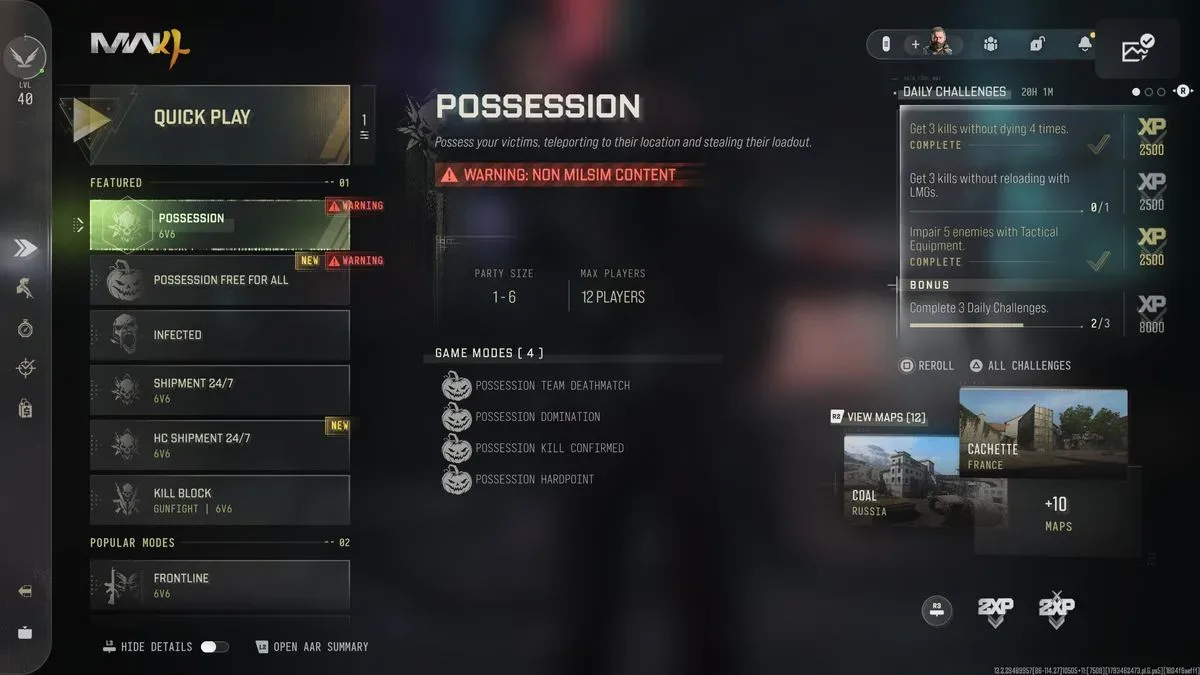
Modern Warfare 4 multiplayer has introduced a label that sounds much more severe than it is: “Non-Milsim Content.” It can appear on selected playlists, including the limited-time Halloween mode Possession, and it is essentially a clear heads-up about the kind of experience that mode intends to offer.
In plain terms, the label means the playlist is not trying to follow a realistic military-combat premise. It does not mean that the mode is unavailable, broken, separate from normal multiplayer progression, or that players must use special weapons. It is a content description: expect rules, powers, or scenarios that move well beyond the military framing usually associated with Call of Duty.
Possession supplies the obvious example. In that mode, a player can take control of an enemy they have killed. That body-switching concept is deliberately supernatural and has no claim to real-world combat realism. The “Non-Milsim Content” tag makes that expectation explicit before players enter the playlist.
What “milsim” means in MW4
Milsim is short for military simulation. In games, the term describes an approach inspired by military equipment, tactics, settings, or presentation. It is commonly used around military shooters, including Call of Duty and Battlefield.
The important nuance is that “military simulation” does not automatically mean a game is a literal simulator. Players often use the word in different ways. Sometimes they mean a game has a military setting and recognizable firearms. Other times, they mean the game emphasizes disciplined team movement, highly grounded mechanics, or a more serious tone.
For MW4’s playlist label, the practical meaning is narrower and easier to use: milsim content is the material that aims to remain within a military-themed, comparatively grounded framework; non-milsim content is the material that knowingly leaves that framework behind.
That distinction is about a mode’s premise, not a definitive measurement of how realistic every second of standard multiplayer may be. A fast-paced competitive shooter can still have military imagery without reproducing real combat. Conversely, a mode with an overtly impossible mechanic, such as possessing an eliminated opponent, is plainly outside even that loose grounding.
Why Possession gets the warning
Possession is a limited-time Halloween playlist, so its central hook is built around a horror-flavored ability rather than conventional military logic. A player who kills an enemy can leap into that enemy’s body and control it. That creates a key match-level risk: your own weapons can potentially be turned back against your team if an opponent commandeers your character.
Related coverage includes Modern Warfare 4 Milsim Content Explained: What the New Multiplayer Label Means.
The label is therefore useful as a shorthand for the mode’s ruleset. It tells players that the normal assumptions they may bring to a military multiplayer match are not necessarily safe assumptions here. Elimination does not simply remove a combatant from the immediate situation; it can lead to an enemy gaining control of that combatant’s body.
There is a meaningful difference between a cosmetic Halloween treatment and a mode whose core interaction changes how players return to the fight. Possession falls into the latter category. The non-milsim warning signals that its fantasy premise affects play, not just the atmosphere.
What the label does and does not tell you
What it tells you
- The playlist includes content that is not intended to be realistic military combat.
- Its rules may feature exaggerated, paranormal, fantastical, or otherwise implausible ideas.
- Players should read the mode description rather than assume it behaves like a standard multiplayer playlist.
What it does not tell you
- It does not say that a mode is lower quality, easier, harder, or less competitive.
- It does not declare that normal multiplayer is a full military simulation.
- It does not mean players are barred from bringing their own guns into Possession.
- It does not, on its own, explain every rule, limitation, or objective in the playlist.
That last point matters. “Non-Milsim Content” is a category label, not a complete mode tutorial. Its job is to frame expectations. Players interested in the exact tactical consequences of possession, weapon control, or scoring will still need the playlist’s own in-game rules and prompts.
Practical implications for multiplayer players
The clearest practical takeaway is that loadout familiarity still matters in Possession. Players can bring their own guns into the mode, but the possession mechanic introduces an unusual downside: those weapons may be commandeered by the other side.
That does not establish a universal best loadout or prove that one weapon class is safer than another. The available information does not provide that level of mechanical detail. It does mean players should recognize that equipment choice is connected to Possession’s central twist in a way it may not be in a conventional mode.
More broadly, the warning helps players pick playlists based on mood. Someone looking for military-themed multiplayer with fewer overtly fantastical ideas has a quick signal to avoid a marked mode. Someone who wants an event playlist designed around an unusual hook knows the label points toward exactly that sort of break from the ordinary.
Limited-time modes often benefit from this kind of direct signposting. They can use the same game, familiar maps, and player loadouts while asking participants to follow a different set of assumptions. Reading the playlist label before queuing is a simple way to avoid joining a mode expecting a standard tactical rhythm when its defining rule is body possession.
It is also a reminder that multiplayer labels are part of the rules communication, not just decorative menu text. Event systems can substantially change how players approach a match, as other games’ seasonal features do; see the unusual access-token setup covered in Fortnite’s Pirate Shop access-token story. In MW4’s case, the relevant change is not an item shop: it is the possibility that an enemy can claim control of a fallen player.
How to read the term without overthinking it
“Milsim” can invite debate because different players have different thresholds for realism. MW4’s use of “Non-Milsim Content” does not require settling that debate. The tag has a straightforward function: it identifies a mode that intentionally crosses out of a military-grounded concept and into something more fantastical.
For Possession, the evidence is the mechanic itself. Taking over a defeated enemy’s body is not presented as conventional military action, so the label fits. Players who enjoy an absurd seasonal twist can treat it as an invitation. Players who prefer a more grounded presentation can treat it as an efficient warning.
Ultimately, “Non-Milsim Content” means MW4 is being upfront about a playlist’s tone and design. Possession may still let players bring their preferred guns, but its body-control rule is the point: this is Call of Duty multiplayer temporarily stepping away from realism in favor of a Halloween premise.