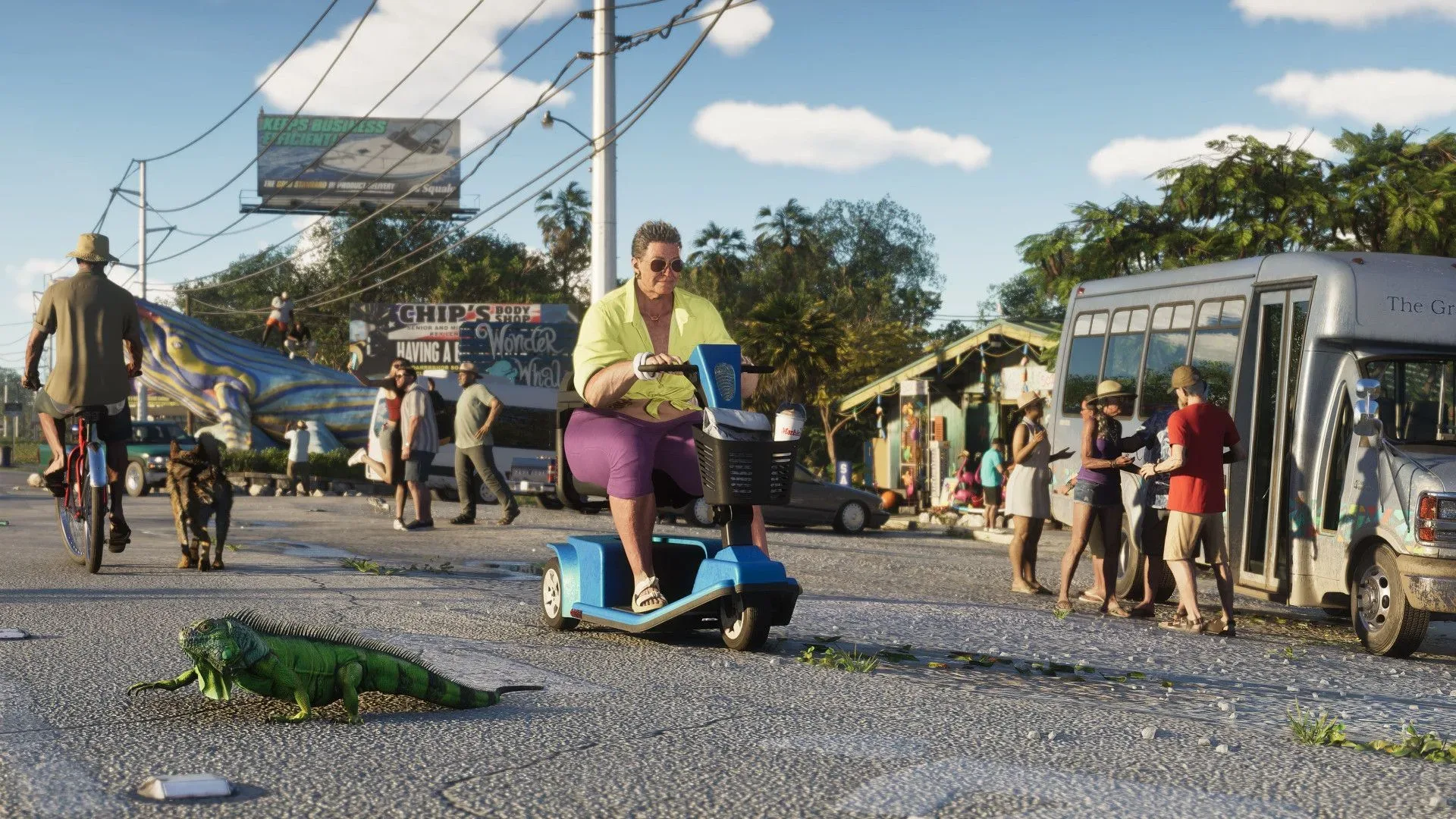

Grand Theft Auto VI’s Leonida is being framed as a place where the sensible first question is not “where do I go?” but “what system do I need to understand before I go there?” A broad, evolving collection of GTA VI guides now spans the game’s opening chapter, day-to-day navigation, crime systems, money handling, weapons, vehicles, leisure activities, and the relationship between its two central characters, Lucia and Jason.
That breadth matters because the early-game essentials are not limited to combat or missions. The guide coverage identifies manual saving, fast travel, the in-game Index, time-of-day changes, control options, character switching, vehicle ownership, refuelling and banking as distinct subjects. In other words: Leonida may be huge, but the immediate learning curve is also spread across a lot of separate systems.
For a spoiler-light start, the clearest practical order is to sort out how progress is recorded, how objectives are found, how travel works, and how the game’s two protagonists are managed. Everything else—from cash and cars to Wanted Levels and Chapter 1’s more consequential calls—becomes easier to approach once those basics are no longer mysteries.
Start with the systems that protect your time
The most valuable early discovery is that GTA VI includes manual saving. That is a small detail with large implications: players should learn the save process before experimenting with a mission, a purchase, a vehicle theft or a choice they may later want to revisit. Manual saving means a player can deliberately create a point of return rather than assuming every moment is being preserved in exactly the way they expect.
That does not automatically answer every question about checkpoints, failed missions, consequences or alternate outcomes. It does establish that saving is a system worth learning on its own, rather than an invisible background feature.
The next priority is the Index, which is presented as a way to locate the next objective. In practical terms, an objective index is a navigation or information tool: it should help turn the sprawling setting into a readable list of current directions, leads or tasks. Players who are unsure whether they have missed the intended next step should look to the Index before treating aimless exploration as a progression problem.
Fast travel is another separately covered feature, and that distinction is useful. A large open-world map can make fast travel more than a convenience; it can affect how efficiently players return to objectives, shift between activities, or escape the feeling that every errand needs to become a cross-state drive. The available coverage also includes a full map of Leonida and a list of revealed locations, making map literacy a central part of the starter experience.
Other early setup questions have dedicated entries as well: first-person mode, classic GTA V-style controls, changing the time of day, the cast list, cheats, Ultimate Edition items, GTA+ rewards, and the current status of Online or multiplayer. The useful takeaway is not to assume that a familiar series convention works exactly as it did before. GTA VI gives these topics enough weight to warrant checking individually.
Related coverage includes GTA 6 Guide Coverage Builds Out From Vice City Basics to Chapter 1 Choices.
Leonida navigation is more than a mission marker
Guide coverage splits navigation across the full Leonida map, fast travel and individual locations. That division suggests different needs rather than duplicate information. A map is the broad geographic view; a location guide is for a particular destination; fast travel is the means of reducing repeat journeys. Players will likely use all three at different moments.
There is also a practical reason to avoid rushing through the map solely as a route between main objectives. Leonida’s activities extend to radio stations and podcasts, landmarks, animals, strip clubs and workouts that build Strength and Cardio. Those are not necessarily mission-critical, but they establish that the world includes systems and destinations beyond the main story loop.
The animal coverage needs one important distinction. It concerns animals that can be added to an in-game collection and an option to pet animals. It is gameplay tracking, not physical collecting, and it belongs alongside exploration and side activities rather than any real-world collecting hobby.
Workouts are also described in terms of gaining Strength and Cardio quickly. Those names appear to designate character attributes or progression stats. A stat is simply a numerical or named measure associated with a character’s capabilities; here, the key point is that downtime can intersect with advancement rather than existing only as decoration.
Crime has its own vocabulary: profiles, Heat and Wanted Levels
GTA VI’s criminal side is organized around several named concepts: Criminal Profiles, Wanted Levels, a Heat system and the possibility of reaching a Six-Star Wanted Level. These are related topics, but they should not be flattened into one generic “police alert” mechanic.
Wanted Level is the clearest term for many series players: it indicates the level of law-enforcement attention directed at the player. The separate reference to a Heat system signals that GTA VI uses Heat as a meaningful piece of its crime vocabulary too. Rather than guessing how it works, players should treat the dedicated explanation as the place to learn its rules and interaction with Wanted Levels.
Criminal Profiles appear to be another formal game concept, not merely a colorful label for an on-screen reputation. The availability of a specific explainer is a cue that it may influence the criminal progression loop in a way players should understand before making assumptions. A guide also addresses how to earn professional criminal statuses, reinforcing that crime is not presented solely as spontaneous street-level chaos.
The vehicle section adds a further wrinkle: respraying a vehicle is associated with shifting vehicle Heat. That makes resprays a potentially strategic action, not just cosmetic customization. Since the exact rules are not set out here, the safe advice is simple: learn what vehicle Heat means before spending money or treating a paint job as a guaranteed reset button.
Money management is a separate skill from making money
GTA VI’s money guides are divided between farming cash, managing money through BuckMe bank, deciding whether to pay into a family savings account, using ATMs, and selling illegal goods or stolen items. That is a notable spread. It implies that earning money, storing it, accessing it, allocating it and converting property into cash are all different concerns.
Money farming usually means repeating efficient activities to build funds quickly. But a cash-making route is only one side of the equation if the game also asks players to consider a family savings account or handle money through a named bank service. The existence of a “should you” guide for the savings account is especially notable: it flags a decision rather than a mere button prompt.
For new players, this makes a strong case for delaying impulsive spending until the relevant money systems are clear. That is not a claim that any particular investment is optimal; it is a straightforward response to the number of separate financial mechanics identified in the game. Learn the tools first, then decide what role cash should play in vehicles, weapons, activities and progression.
Vehicles are a full ownership loop, not just transport
The vehicle guides cover stealing, owning more vehicles, repairing, refuelling, selling cars and bikes, respraying, changing vehicle Heat, acquiring a jet and obtaining a specific 1995 Mitsubishi associated with Paul Walker’s Fast and Furious image. Land, sea and air transport are all part of the stated vehicle scope.
The important practical implication is that a vehicle can have a life after the theft. Ownership, repair, fuel and resale each have their own guide topics, which suggests players should think about whether a particular car or bike is worth keeping rather than treating every ride as disposable.
Loadout management receives comparable attention on the weapons side. A loadout is the selection of equipment a player has prepared for use. GTA VI guide coverage separates changing and managing a loadout from weapon ownership and from storing, managing and recovering guns at Ammu-Nation. These are three different questions: what is carried now, what is owned, and how weapons are handled through the shop.
That division should be useful to anyone trying to minimize confusion after acquiring gear. A gun that exists in ownership rules may not be identical to a weapon currently in the active loadout, while storage and recovery can form another layer of management. The game also supports a non-lethal approach as much as possible, though the guide collection makes clear that an arsenal remains part of the broader toolkit.
Lucia, Jason and the relationship layer
Lucia and Jason are not only characters in the story; their relationship status and the ability to switch between them have dedicated guidance. The relationship is described as important alongside the pair’s criminal life, while romance and relationship status are treated as their own topic.
For players, the immediate lesson is to avoid viewing character switching as merely a presentation trick. If switching is a separately explained mechanic and relationship status is separately tracked, both may be relevant to how someone approaches the story. The precise outcomes and conditions belong in the individual guides, but the category structure alone tells newcomers to pay attention rather than button through these elements.
Chapter 1 is where spoiler discipline becomes useful
The current walkthrough emphasis is Chapter 1, with a stated spoiler warning. It includes a complete Chapter 1 walkthrough alongside help for Mandy’s sink, a railing repair, the Exotic Animals Front illegal operation, and several choices involving Donnie, Brian and Arnold.
Choice-specific entries ask whether players should sell to Donnie or Brian, save or spare Arnold, and whether Donnie can be saved. Those titles establish that decisions and possible outcomes are part of the opening chapter. They do not, by themselves, justify assuming every choice has the same scale of consequence. Players who want to preserve discovery should use the broad walkthrough only when stuck, then consult the named decision guide only after deciding how much they want revealed.
Mission replay is another key question covered separately. It is relevant for anyone who wants to see alternative paths, revisit a favorite sequence, improve performance, or clean up trophies and achievements. For the wider story structure, see the GTA VI mission list organized by chapter.
A practical first-session checklist
- Learn manual saving before taking risks or making purchases.
- Use the Index when the next objective is unclear.
- Check map and fast-travel options before turning a long trip into a detour.
- Understand the distinction between Wanted Levels, Heat and Criminal Profiles before escalating crime.
- Separate cash generation from banking, ATM use, savings decisions and selling goods.
- Treat cars and bikes as assets with ownership, repair, fuel, resale and respray considerations.
- Keep Chapter 1 choice guides until they are actually needed, if avoiding spoilers matters.
There is plenty here for players who want pure mayhem, but the guide map suggests a more nuanced opening: GTA VI asks players to understand how they move, save, earn, manage attention from the law and navigate a relationship-driven story. Learning those foundations first should make the rest of Leonida feel less like a pileup of icons and more like a city with systems worth mastering.