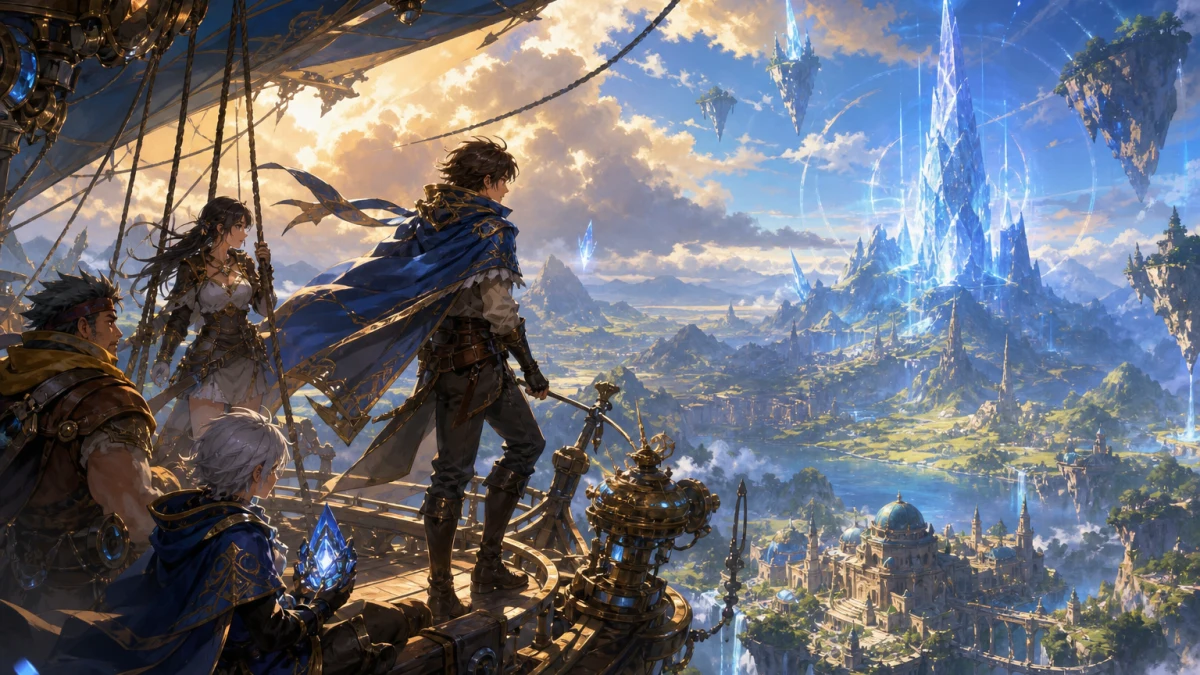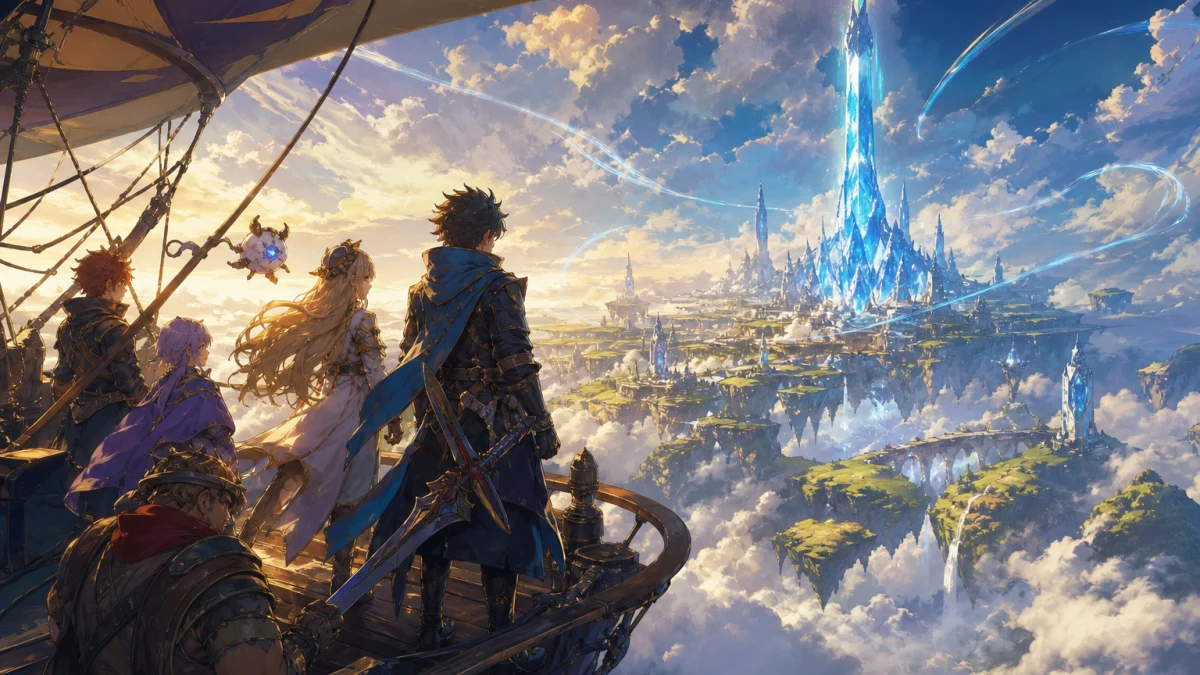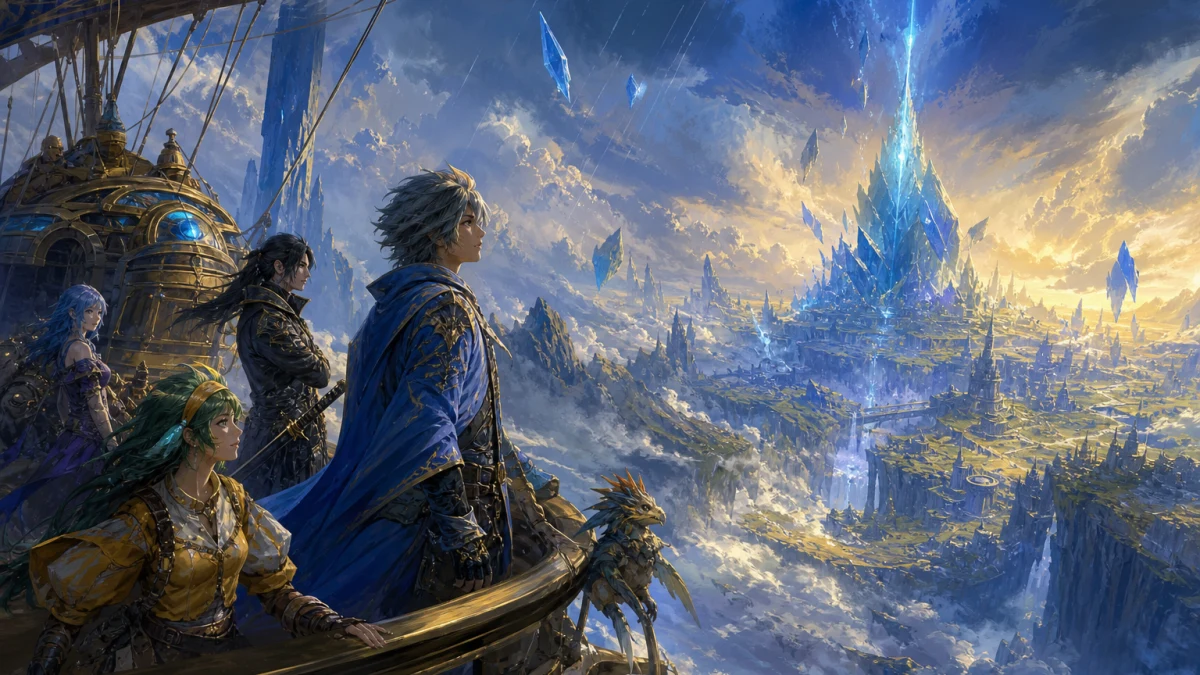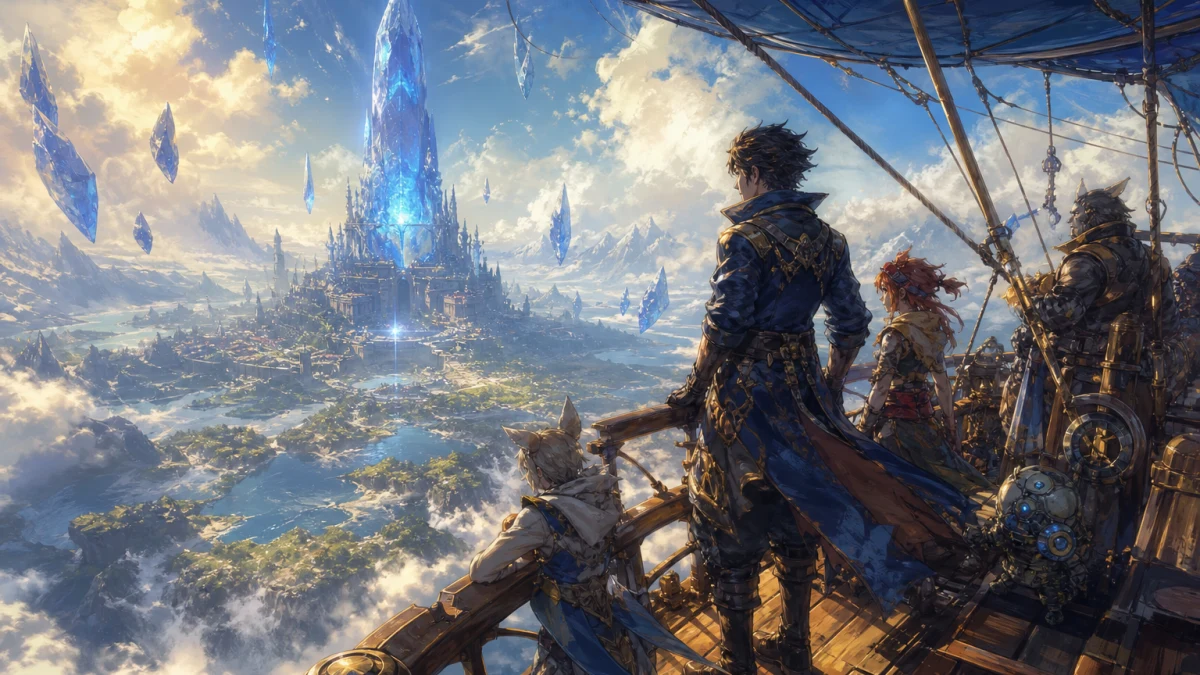
Final Fantasy Resonance looks backward and forward at the same time. Its pixel-art characters, Crystals, airships, chocobos, moogles, jobs and visiting heroes evoke different periods of Final Fantasy history. Its three-dimensional environments, dynamic cameras and modern lighting make clear that this is not simply a newly localized 16-bit game. Meanwhile, its principal cast and story come from Final Fantasy Brave Exvius, a mobile RPG rather than one of the numbered console entries.
That combination can make Resonance appear more complicated to approach than it should be. A newcomer may reasonably wonder whether Cloud, Tidus and the Warrior of Light arrive with decades of required reading, whether Brave Exvius is homework, or whether the classic presentation assumes familiarity with the first six Final Fantasy games. The practical answer is no. Recognition can enrich the experience, but the available evidence presents Resonance as a self-contained console RPG designed to introduce its own version of this world.
This is a prelaunch reference, not a review or an account of completed play. Final Fantasy Resonance is scheduled for October 22, 2026 in the United States, eight days after this article’s publication date. The guide therefore separates confirmed information from developer interview details and leaves late-game judgments open until the full public release can establish how consistently the finished adventure serves first-time players.
Evidence note: Fact-checked against currently available sources on October 11, 2026. This prelaunch reference is based on Square Enix announcements and storefront information available before the scheduled October 22, 2026 release, supplemented by developer interviews. The reported total of 26 Visions, production details and design intentions come from pre-release interviews; the complete roster, late-game context, final balance, platform performance and launch-patch effects remain unverified. Conclusions about newcomer accessibility and the lack of required prior play are evidence-based inferences from the announced rebuild and stated design goals, not claims based on a completed review playthrough.
The short answer for newcomers
You do not need to finish Final Fantasy I through XVI before playing Final Fantasy Resonance. The numbered series is not one continuously serialized story in which every new installment assumes knowledge of the previous chapter. Although recurring imagery and terminology create a recognizable Final Fantasy identity, most major entries introduce their own setting, cast, conflict and interpretation of familiar ideas. Resonance uses that shared vocabulary, but it is not Final Fantasy XVII or a sequel to Final Fantasy XVI.
You also do not appear to need a prior Final Fantasy Brave Exvius playthrough. That qualification matters because Resonance is based on the first story arc of Brave Exvius rather than being wholly disconnected from it. However, Square Enix describes the project as an extensive rebuild, not a direct port or a continuation beginning after the mobile story. It introduces Rain, Lasswell, Grandshelt and the central crisis within Resonance itself. Reconstructed dungeons, revised systems and expanded character material further indicate that the console game is expected to establish its own version of the journey.
Older Final Fantasy games can still provide valuable context. Someone who knows why the Warrior of Light design is associated with the first game, recognizes a chocobo immediately or has strong memories of Final Fantasy VI’s sprite-driven scenes will notice layers that a first-time player may not. Those layers are better understood as recognition and resonance than as an admission test. The central question is whether the game explains what a person, ability or creature does here, not whether every player understands its publication history.
The same distinction applies to Brave Exvius veterans. They may recognize locations before Resonance fully introduces them, compare altered character relationships or notice where a familiar sequence has been expanded. A newcomer encounters those things as part of the present story instead. Neither perspective is inherently the correct one. One offers comparison; the other offers discovery without expectations formed by the earlier mobile structure.
A newcomer can therefore separate three kinds of knowledge. Necessary knowledge is what Resonance teaches about its characters, world and systems. Optional franchise knowledge includes recognizing recurring creatures, job names and legacy heroes. Comparative knowledge comes from remembering how Brave Exvius originally handled the same people or events. Only the first category should be needed to follow the central adventure, and the available prelaunch evidence indicates that the console game has been structured accordingly.
This also means that choosing Resonance as a first Final Fantasy is not starting in the wrong place. The series has no single universally required doorway. A player drawn to pixel art, turn-based battles or this particular cast can begin here, then explore earlier games if a Vision, job or visual influence inspires curiosity. Historical knowledge can grow outward from the new experience instead of serving as a barrier placed in front of it.
Because Resonance is unreleased at this article’s publication date, no responsible guide can guarantee that every late cameo or callback will be equally clear without outside knowledge. Public materials strongly support newcomer accessibility, and the developers have expressly discussed Resonance as a way for people unfamiliar with Final Fantasy to understand the series’ appeal. The free opening demo also gives prospective players a direct way to assess the introduction. What remains unproven is how well the entire game maintains that accessibility once its full roster and later story are in play.
- Required before starting: no numbered Final Fantasy game.
- Apparently required before starting: no Brave Exvius playthrough.
- Potentially helpful: basic familiarity with terms such as Crystal, job, chocobo and summon.
- Entirely optional: recognizing every Vision or recurring enemy by sight.
- Important expectation: this is a prelaunch guide, not a verdict on the complete game.
What kind of Final Fantasy is Resonance?
Final Fantasy Resonance is a single-player, turn-based role-playing game made for consoles and Windows PC. It is scheduled for PlayStation 5, Xbox Series X|S, Nintendo Switch, Nintendo Switch 2 and PC. Its strategic battles use weaknesses, staggering, extra turns and large Resonance attacks, but the finer details of party construction and progression belong to a dedicated combat explanation. For newcomer purposes, the key point is that this is a structured standalone RPG rather than a multiplayer service or a numbered-series prerequisite course.
Square Enix is marketing Resonance as the first HD-2D Final Fantasy. That phrase describes its presentation, not its place in the chronology. Pixel-art characters inhabit modeled environments shaped by lighting, depth, camera movement and effects. The visual concept draws an intentional line back to the franchise’s early pixel era while asking what that style might have become through continued technical development. It does not claim that Resonance was designed under the same constraints as an NES or SNES game.
The source material is the first story arc of Final Fantasy Brave Exvius. Rain and Lasswell, knights from the Kingdom of Grandshelt, lead a crisis involving the world’s Crystals and the mysterious forces threatening them. Those foundations are important enough that calling Resonance wholly original would be misleading. Equally, calling it a simple conversion of the mobile game would obscure the newly constructed environments, revised structure, altered systems and additional character-focused content discussed by its creators.
Resonance consequently occupies an unusual but understandable position. It is an adaptation and reconstruction of an existing Final Fantasy branch, packaged as a conventional single-player console RPG. It is neither a new numbered sequel nor merely a remaster preserving an old release. It also is not presented as a replacement for the complete history of Brave Exvius. Its announced foundation is specifically the first arc, reshaped for this game.
Square Enix’s description of the project as a celebration of classic and modern Final Fantasy helps explain the apparently mixed ingredients. Crystals, jobs and sprite-based heroes evoke earlier titles. Characters such as Cloud and Tidus broaden its references to later eras. Stagger mechanics and cinematic presentation are associated with more modern design language. Resonance is using Final Fantasy history as a palette, not selecting one previous entry and reproducing all of its rules.
That framing gives newcomers a useful expectation. Resonance may teach what Final Fantasy often feels like—an adventurous party, a threatened world, spectacular magic, recurring creatures and dramatic set pieces—without functioning as a comprehensive summary of every game. Final Fantasy has repeatedly reinterpreted itself. A celebratory project can therefore be recognizably part of the series while combining systems and imagery that never coexisted in precisely this form before.
It is also useful to distinguish format from ancestry. Resonance comes from mobile-origin material, but the announced product is a standalone single-player RPG for consoles and PC. Conversely, its pixel-art look does not make it an archival reissue. Those distinctions prevent two common misconceptions: that players are buying the original mobile application on new hardware, or that they are receiving a lost game from Final Fantasy’s 16-bit period. The project is contemporary even when its imagery is deliberately historical.
Why Final Fantasy games usually stand alone
The Roman numerals can intimidate anyone arriving decades into Final Fantasy’s history. In many entertainment series, a high number implies a long chain of continuous plot developments. Final Fantasy generally works differently. Square Enix describes its mainline games as having their own worlds, stories, characters and mechanics. A player can usually choose an entry based on its setting or style rather than beginning with the original and proceeding in release order.
The franchise still cultivates continuity of identity. Crystals recur. Chocobos repeatedly serve as distinctive birds and mascots. Airships make impossible journeys possible. Spell names, jobs, monsters, summons and character names return in altered forms. Their reuse creates familiarity, but it does not automatically place every appearance in one universe. A Crystal in one Final Fantasy need not have the same origin, limitations or metaphysical role as a Crystal in another.
This is why recognizing a term should not lead a newcomer to search for a universal lore explanation. The local game’s explanation takes priority. If Resonance establishes what an esper means in its world, that information matters more than the rules for summons in Final Fantasy VI, Final Fantasy X or another installment. Historical comparison can be interesting, but carrying one game’s assumptions into another can produce more confusion than clarity.
There are exceptions to the general standalone model. Final Fantasy has direct sequels, remakes, multipart projects and shared subseries. Titles with an explicit connection normally signal it through their names and marketing. Final Fantasy X-2 follows Final Fantasy X, for example, while the modern Final Fantasy VII projects intentionally draw on Final Fantasy VII. The existence of those links does not turn every numbered game into a chapter in one linear saga.
Resonance has one clearly declared ancestry: Final Fantasy Brave Exvius. Its heroes and source story come from that game. That does not make it a continuation of Final Fantasy I through XVI, nor does the appearance of heroes from selected older titles merge all their histories with Grandshelt’s chronology. The Visions are an in-game mechanism for legacy characters to accompany the party. Their presence is part of Resonance’s design, not proof that every represented world has always occupied one continuous map.
A useful newcomer rule is to distinguish narrative continuity from franchise vocabulary. Rain and Lasswell’s relationship, their kingdom and the Crystal crisis belong to the narrative foundation inherited from Brave Exvius. Chocobos, moogles, jobs and familiar magic belong to the wider vocabulary. Cloud or Tidus appearing as a Vision adds a deliberate crossover layer. These categories can interact without becoming the same thing.
That model also explains why prior knowledge offers flavor instead of basic comprehension. Veterans may identify the era or game represented by a design and anticipate the broad identity attached to a familiar job. Newcomers receive whatever information Resonance supplies about that element’s present function. Unless the released game proves otherwise, the central story should be judged by whether it establishes its own stakes, not by how many references a player can annotate.
The one earlier game behind Resonance
Final Fantasy Brave Exvius is the relevant predecessor, but the relationship requires careful wording. Resonance uses the mobile game’s first story arc as its foundation. Rain, Lasswell, the Kingdom of Grandshelt and other central people and places do not merely resemble Brave Exvius creations; they originate there. Anyone seeking the most direct historical context should look to Brave Exvius rather than trying to identify a numbered Final Fantasy that supposedly comes before Resonance.
That does not mean a newcomer should study a complete Brave Exvius synopsis. Resonance begins with its own introduction to Rain and Lasswell and rebuilds the relevant adventure for its new format. Consuming a detailed recap could reveal developments that Resonance intends to present dramatically. For someone who values fresh story discovery, avoiding extensive mobile-game lore videos is likely more useful than preparing through them.
The term “port” is inadequate because a port ordinarily suggests that the same underlying game has been transferred to new hardware, perhaps with technical modifications. Square Enix has explicitly rejected that characterization. Developer interviews describe ground-up work on dungeons and backgrounds, changes to battle design, revised presentation and additional side stories. The result may follow recognizable narrative landmarks, but the journey between them is not simply the mobile application running on consoles.
“Remake” can be useful in casual conversation, yet it also risks implying a scene-for-scene reconstruction whose boundaries are already known. The safer description before release is an extensive console rebuild based on Brave Exvius’s first arc. That language acknowledges both inheritance and transformation. It also leaves room for reordered material, expanded relationships and structural changes without claiming unannounced departures or a particular endpoint.
Returning Brave Exvius players are likely to recognize the principal cast, broad setup and named locations. The Earth Shrine is a concrete example of how that recognition may work: veterans know its narrative place, while Resonance turns it into a conventionally explorable dungeon with routes, treasure and encounters. Familiarity can therefore make differences conspicuous. A newcomer simply receives the rebuilt location as the game’s normal standard.
The expanded side material provides another reason not to treat prior knowledge as mandatory. The developers have discussed character-focused quests involving Rain, Lasswell, Nichol, Jake and Lid, including material that explores backgrounds and relationships not depicted in the original version. Even veterans cannot assume they already possess every relevant scene. Resonance is designed to add information, not only replay what an existing audience remembers.
Prior experience may nevertheless change emotional emphasis. A returning player can compare a redesigned sprite with its mobile basis or appreciate an expanded conversation because it fills a known gap. A newcomer may instead judge whether that conversation establishes a convincing relationship on its own. The latter audience should not feel compelled to reconstruct the earlier version merely to validate its response.
The most practical conclusion is that Brave Exvius offers optional comparative context, not apparent homework. Resonance is starting from the relevant beginning rather than asking players to arrive after a mobile finale. Until the complete game is available, it would be too strong to promise that every adaptation choice will be equally transparent. The announced structure, however, consistently points toward introduction and reconstruction rather than assumed prior completion.
What the rebuild changes for a first-time player
Rebuilding the source matters because mobile and console RPGs can organize attention differently. A console adventure generally asks players to inhabit spaces, follow routes, investigate side paths and understand locations as parts of a connected journey. Developer accounts say Resonance’s dungeon level design was constructed from scratch to provide that kind of exploration. This is not merely a graphical shell wrapped around the earlier sequence of encounters.
The Earth Shrine illustrates the change without requiring a lengthy plot recap. In Resonance, it has paths to travel, treasure to find and random encounters. Its purpose is therefore spatial as well as narrative. A first-time player can learn about the world by moving through a place and observing how it is staged. The earlier mobile structure is not required knowledge for navigating or understanding that location.
The battle system was also treated as changeable rather than sacred source material. The creators have spoken about reshaping features to suit a console RPG, while official descriptions emphasize a turn-based format built around weaknesses, staggering, extra turns and Resonance attacks. The crucial newcomer point is not how to optimize these systems, but that Resonance is expected to teach the version it actually uses. Importing assumptions about Brave Exvius’s mobile mechanics could be less helpful than approaching the tutorials afresh.
That boundary is particularly important because the Brave Exvius name may prompt questions about mobile monetization and rotating crossover events. The available materials frame Resonance as a standalone, single-player console experience. They do not justify importing every mobile feature into it. Concerns based on the predecessor’s structure are understandable, but they should not be converted into claims about systems Square Enix has not announced for Resonance.
Character-focused side quests can help the rebuilt world stand on its own. Additional stories for Rain, Lasswell, Nichol, Jake and Lid are intended to explore personal backgrounds and relationships. For newcomers, that material may provide context that the more compressed original presentation did not. For returning players, it may challenge the belief that they already know the complete characterization attached to familiar faces.
The project’s handling of crossover material has likewise been described in terms of establishing Resonance’s worldview rather than depending on the rotating collaborations associated with a long-running mobile title. That does not eliminate fan service: Visions are central to the premise, and familiar figures appear in side content. It does mean those appearances are being selected and placed within a standalone console game rather than arriving through an indefinite schedule of limited events.
A rebuilt introduction cannot automatically guarantee perfect accessibility. Some adaptations explain old assumptions unevenly, and a veteran may understand why a reveal matters before the script has fully contextualized it for others. That is one of the issues only the complete release can settle. Still, new dungeons, additional character stories and revised systems are substantial evidence that Resonance is doing more than asking unfamiliar players to catch up.
For a first-time player, the sensible approach is to trust Resonance to introduce its principal terms until it demonstrates otherwise. Read its character entries, follow its tutorials and treat its environments as new spaces. Looking up the mobile equivalent of every location could spoil the adaptation and obscure what has changed. Comparison is best saved for after a scene, chapter or full playthrough rather than used as a substitute for the game’s own presentation.
Pixel art, HD-2D and the difference between them
“Pixel art” and “HD-2D” are related descriptions, but they are not interchangeable. Pixel art refers to imagery intentionally composed through visible, controlled pixel forms. In Resonance, the characters use sprite-based designs that connect immediately to Final Fantasy’s older visual tradition. Their proportions, animation and silhouettes communicate personality without attempting photorealism.
HD-2D describes the larger staging in which those sprites appear. Resonance combines pixel-art characters with three-dimensional environments, modern lighting, shadows, depth effects and camera movement. Official descriptions also mention pixelized 3D models. Consequently, not everything visible should be classified as a flat sprite or as pixel art in exactly the same technical sense. The effect depends on several visual methods operating together.
The environments provide perspective and volume that a traditional tile-based background could only suggest. A camera can frame a location from a dramatic angle, shift during an event or emphasize the scale separating a small character sprite from a structure. Lighting can direct attention, establish time or mood and anchor figures in the space. Shadows help prevent the characters from appearing pasted over an unrelated backdrop.
This blending creates the style’s productive tension. Sprites preserve abstraction: a few controlled movements can imply an expression or gesture. Three-dimensional staging supplies physical depth and cinematic flexibility. Modern effects can add atmosphere around both. The scene invites memories of old role-playing games without pretending to have been produced under their hardware restrictions.
Calling Resonance a restored 16-bit game would therefore be inaccurate. There is no original 16-bit Resonance release being cleaned up for a modern display. Its scenes were composed for contemporary hardware, and its backgrounds were built for this project. Even where a sprite has a foundation in Brave Exvius art, developers have discussed adjustments and redesign rather than a blanket enlargement of unchanged assets.
The “HD” portion should not be interpreted as a promise about a specific output resolution or frame rate. Those are platform-performance questions requiring separate verified specifications and testing. Here, HD-2D is Square Enix’s label for the visual approach: classic-looking characters integrated into dimensional, effects-rich scenes. It communicates style more than a complete technical specification.
Dynamic camera work is particularly important to that distinction. Early Final Fantasy games generally staged events within a comparatively fixed playfield. Resonance can reframe a confrontation, bring a background element forward or coordinate camera motion with effects and sound. That capacity changes how sprite performance works. A small movement can become dramatic because the entire composition supports it.
For newcomers, the simplest description is that the heroes look deliberately pixelated while their world has modeled depth. The game is not asking players to overlook the contrast. It is using the contrast as its identity. Whether that combination appeals is subjective, which is one reason the free demo is more informative than screenshots alone: still images cannot fully convey camera movement, animation timing and transitions between exploration, events and combat.
- Pixel-art sprites: deliberately constructed character imagery.
- 3D environments: modeled spaces with depth and perspective.
- Modern composition: lighting, shadows, effects and camera movement.
- Pixelized 3D models: a related technique, not proof that every object is a flat sprite.
- Not implied by the label: a guaranteed resolution, frame rate or identical look on every platform.
How the art connects to Final Fantasy’s early history
Final Fantasy I through VI form the series’ principal early pixel-art lineage. Released across the NES and SNES eras in their original forms, those games established much of the imagery later associated with classic Final Fantasy. Square Enix’s Pixel Remaster collection preserves and revises that lineage with updated pixel presentation and quality-of-life changes, making the first six games more readily available to modern players.
Those six entries should not be treated as visually or mechanically uniform. The original Final Fantasy’s comparatively simple figures and environments belong to a different technical moment from Final Fantasy VI’s elaborate event staging. Character scale, color use, animation and dramatic ambition evolved across the period. Referring to “the pixel era” is useful historical shorthand, not a claim that every game looked or played alike.
Director Hiroto Furuya has identified Final Fantasy VI’s pixel-based event scenes as a major personal influence. That connection concerns expressive staging rather than narrative continuity. Resonance is not a sequel to Final Fantasy VI, and its kingdoms, characters and Crystal conflict do not inherit that game’s storyline. The relevant lesson is that sprites can carry large emotional events when movement, framing, effects and sound are carefully coordinated.
Final Fantasy VI is an especially understandable reference because it pushed small character graphics through dramatic ensemble scenes. Resonance has access to tools unavailable to that game, including fully dimensional backgrounds and freer cameras. Its creators can therefore pursue a similar confidence in sprite performance without imitating the exact construction of an SNES scene. Influence describes a creative starting point, not a production template.
Square Enix’s broader marketing imagines Resonance as a continuation of pixel art’s evolution. That framing asks a hypothetical question: if Final Fantasy had continued pursuing sprite-based heroes alongside new rendering technology, what might a modern expression look like? The answer is not simply “more pixels.” It involves integrating intentionally pixelated figures into environments with contemporary depth, lighting and cinematic movement.
Nostalgia is part of the appeal, but exact imitation is not the goal. A veteran may associate a party walking through an ornate interior with a favorite early installment. A newcomer can appreciate the clarity of silhouettes and the theatrical quality of the staging without sharing that memory. The image works in the present even when its historical echoes go unidentified.
This distinction protects Resonance from an unhelpful expectation. It should not be evaluated as though every sprite, menu and encounter must obey Final Fantasy VI or Final Fantasy V. The project combines legacy aesthetics with modern systems and with source material created much later in Brave Exvius. Its classic appearance does not impose one old game’s mechanics on everything beneath it.
Playing the first six games may deepen a person’s understanding of the artistic lineage, but it is an optional historical tour, not preparation for basic comprehension. A newcomer curious about the connection could sample the Pixel Remaster releases later. Starting six RPGs solely to become “qualified” for Resonance would invert the intended accessibility. Resonance itself may instead become the reason someone develops an interest in those earlier works.
Why the sprites required more than an upscale
Brave Exvius already used pixel-art characters, so it would be easy to assume that Resonance could enlarge those graphics and place them over new backgrounds. Developer interviews describe a more involved process. Some existing character foundations were useful, but assets that did not meet the console project’s visual target were redrawn or redesigned. The distinction matters because scale alone does not make art fit a new scene.
A sprite designed for one camera, display size or background treatment may look awkward in another. Its proportions can seem inconsistent with the surrounding architecture. Its outline may disappear under different lighting. An animation readable on a mobile screen may need altered timing when a cinematic camera draws attention to it. Integrating the character means reconsidering how each visual decision behaves within the new composition.
The backgrounds themselves were created from the ground up for Resonance rather than simply extracted from Brave Exvius. That changes the relationship between characters and place. A dimensional room has floors, walls, elevation, light sources and camera perspectives that affect where a sprite can plausibly stand. Even deliberately stylized art needs internal visual logic if players are to read movement and depth clearly.
Developers have discussed adjusting sprite placement, lighting and shadows and, where necessary, the pixel art itself so characters blend with their environments. “Blend” does not mean erasing the deliberate contrast between flat-looking figures and modeled spaces. It means making that contrast feel composed. A character should appear to occupy the room, receive its mood and stand on its floor rather than hover above a decorative plate.
Shadows are one practical anchor. Lighting is another. A bright background can swallow a pale sprite unless contrast is managed; a heavily shadowed area can make an unchanged character look artificially luminous. Color, edge treatment and positioning all contribute. These are small decisions in isolation, but HD-2D succeeds or fails through their accumulation.
Cinematic scenes add further coordination. The developers have highlighted an opening confrontation whose sprite positions, effects, background, sound and timing had to work together. A dramatic sequence is not created by the character graphic alone. It emerges from when a sprite moves, where the camera looks, when an effect appears and how the audio punctuates the action.
This helps explain why describing the presentation as “old graphics with new effects” misses the craft. The pixel figures remain intentionally abstract, but the scenes around them are authored as complete compositions. Producer Keisuke Nakashima has emphasized the beauty of each individually composed scene as an HD-2D principle. That focus suggests careful arrangement rather than a universal filter applied automatically to inherited art.
For newcomers, this production history clarifies what to watch for without demanding technical expertise. Notice whether characters appear grounded in a location, whether the camera supports rather than obscures a gesture, and whether lighting makes important action readable. Those observations are more useful than counting how many assets began with Brave Exvius foundations. The artistic question is how convincingly every part functions in Resonance now.
Crystals: tradition, theme and this game’s own crisis
Crystals are among Final Fantasy’s oldest recurring ideas. The first game placed them at the heart of its world journey, and later installments repeatedly reinterpreted crystalline power as a source of balance, magic, political authority, danger or mystery. A newcomer does not need a universal Crystal encyclopedia because there is no single rulebook governing every appearance across the franchise.
Their flexibility is the point. In one setting, Crystals may be elemental anchors. Elsewhere, they can be resources, sacred objects, symbols or mechanisms with very different consequences. The word creates a Final Fantasy association, but each game must establish why its Crystals matter. Familiarity tells a veteran to pay attention; local storytelling provides the actual explanation.
Resonance opens within a kingdom protected by Crystal power and sends Rain and Lasswell to investigate a weakening magical barrier at the Earth Shrine. The resulting confrontation turns an apparently contained mission into a larger threat. That is enough setup for a newcomer guide. Detailing the disaster, its aftermath or the identities behind it would intrude on the dedicated story primer and diminish the value of encountering the opening directly.
The important distinction is that Resonance tells its own Crystal-centered crisis. It is not a missing chapter from the original Final Fantasy’s quest, nor does using elemental language require knowledge of the Warriors of Light’s adventure. The game inherits its immediate plot foundation from Brave Exvius, then reconstructs that material for this release.
Crystals also perform useful thematic work. They make invisible systems of protection and stability tangible. A kingdom can organize its security and identity around something visible, while the damage or loss of that object communicates a change in the world. Even a player with no series history can understand that a threatened source of protection creates political and personal consequences.
For veterans, the setup carries deliberate familiarity. A Crystal in danger signals a recognizable Final Fantasy pattern, much as an airship promises expanded horizons. Resonance can then confirm, complicate or redirect those expectations. The pleasure lies partly in variation: seeing what this particular world does with an established motif rather than receiving an identical Crystal mythology again.
Newcomers should therefore resist reading a general franchise wiki to decode every early reference. Such research can expose unrelated plot twists and encourage false assumptions. When Resonance defines a Crystal, barrier or shrine, accept that definition as authoritative for its world. Historical comparisons can wait until the game has established the boundaries of its own version.
The same method applies to other recurring names. Recognition is a signal, not a solution. Knowing that Final Fantasy has used Crystals for decades may explain why the imagery matters to the brand, but it does not reveal who threatens them, how their power operates or where Resonance’s story will end. Those answers belong to this game.
Airships, chocobos, moogles and espers
Square Enix has confirmed airships, chocobos, moogles and espers for Resonance. Together, they form a compact introduction to Final Fantasy’s recurring iconography. All four have long histories, yet none should be assigned one rigid function across every game. A newcomer needs only a broad orientation before allowing Resonance to define the details.
Airships are fantastical flying vessels associated with travel, technological ambition and the expansion of an adventure’s scale. The original Final Fantasy used airship travel as a major part of its world journey, and later games repeatedly redesigned the concept. Resonance begins with Rain as commander of an airship squadron and Lasswell as his friend and deputy, so airships are integrated into the heroes’ immediate lives rather than reserved as an unexplained veteran reference.
A chocobo is the series’ signature large bird, commonly associated with transportation and travel. Individual games vary its habitats, colors, abilities and surrounding activities. Recognizing one may make a veteran smile before the name appears, but no player should assume every chocobo follows rules learned elsewhere. Its local role must come from Resonance.
Moogles are small recurring beings and major series mascots. Their appearance and social function have changed considerably between settings. They may be inhabitants, helpers, specialists or something more particular to a game’s world. The useful newcomer response is not to search for a single moogle biography but to treat them as a familiar Final Fantasy species whose Resonance incarnation will have its own context.
Espers broadly belong to the series’ tradition of powerful summoned beings. Final Fantasy has used several terms for related concepts, including summons and eidolons, and has varied whether such beings are allies, spirits, deities, creatures, sources of magic or combinations of those roles. “Esper” has special associations for longtime players, but Resonance must still define what the term means within its systems and story.
These elements help create series identity without forcing shared continuity. An airship in Resonance is not automatically the same craft seen in another world. A moogle’s presence does not prove travel between every numbered universe. A recurring creature can be redesigned in appearance, personality or function while remaining recognizable. Final Fantasy often works through variation on motifs rather than strict replication.
For veterans, these motifs create anticipation. An airship may suggest broader travel, while an esper may invite comparison with favorite summon systems. Those are expectations, not confirmed promises about progression. Newcomers are arguably freer to accept the implementations as presented without waiting for one older game’s model to return.
The safest low-spoiler glossary is therefore simple: airships fly, chocobos are iconic birds, moogles are recurring mascot creatures and espers are associated with powerful summoned entities. Anything more exact should come from Resonance. This approach provides enough vocabulary to follow marketing material without importing lore that may not apply.
- Airships: recurring flying vessels; exact travel functions vary.
- Chocobos: iconic bird creatures often linked to transportation.
- Moogles: recurring mascot beings whose roles differ by world.
- Espers: this game’s place within the broader tradition of powerful summon-like entities.
- Newcomer rule: learn the Resonance version before applying another game’s lore.
Jobs and magic as shared language
Jobs and magic give Final Fantasy a reusable mechanical language. A job typically represents a combat discipline or adventuring role, such as Warrior, Monk, White Mage, Black Mage, Dragoon or Summoner. A familiar title can quickly communicate broad strengths, but exact abilities and progression differ between games. Knowing the archetype may help a veteran predict; it does not replace reading Resonance’s descriptions.
The original Final Fantasy established classes and later class changes as prominent ideas. Final Fantasy III made switching among a wide range of jobs central to party development. Its roster included now-familiar roles such as Warrior, Monk, White Mage, Black Mage, Dragoon, Evoker and Summoner. These labels helped turn party composition into a flexible expression of strategy rather than a fixed cast assignment.
Final Fantasy V further developed job customization, encouraging players to combine learned abilities and explore interactions between roles. That history explains why longtime fans often respond enthusiastically to the mere mention of a job system. “Jobs” can imply experimentation, identity and a connection to the series’ foundational mechanics even before the current game’s exact rules are known.
Final Fantasy VI took a different approach, giving individual characters stronger predefined identities while allowing customization through magic and summons. Its example is useful because it shows that early pixel-era Final Fantasy did not follow one design template. A game can feature a distinctive cast and still provide meaningful control over magical growth or party roles.
Resonance’s developers have identified jobs and magic among the Final Fantasy traditions important to the project. That establishes their thematic relevance without making every progression detail appropriate for this guide. How jobs interact with Visions, equipment, skills or party optimization belongs in the separate combat reference and in the game’s tutorials.
Magic names can work much like jobs. Returning terminology allows experienced players to infer broad categories, while the present game determines costs, targeting, power and tactical value. A spell that sounds familiar should still be read on its own terms. Balance changes, translation choices and system context can substantially alter how an old name behaves.
For a newcomer, the advantage of shared vocabulary is learnability rather than obligation. “White Mage” communicates support and restorative associations more quickly than an entirely new invented title might. If Resonance introduces an unfamiliar variation, its interfaces and tutorials should provide the operative information. Players need not research how that job worked in Final Fantasy III to understand its current toolset.
Veterans should apply the opposite caution: familiarity can create overconfidence. A role associated with one statistic or equipment type in an older game may be implemented differently here. Classic inspiration does not guarantee identical command lists, party sizes or progression paths. Resonance combines traditions with modern systems, and its own rules remain decisive.
The historical touchpoints are therefore best used as context. Final Fantasy III shows why job switching became influential; Final Fantasy V shows the appeal of flexible combinations; Final Fantasy VI demonstrates an alternative blend of defined characters and customization. Resonance can draw from that heritage without being mechanically interchangeable with any of them.
Who the Visions are
Visions are the clearest place where Resonance’s self-contained story meets the wider franchise. Official descriptions characterize them as echoes of Final Fantasy characters who aid the party with their own skills and abilities. That definition gives them an in-world and mechanical role. They are not simply portraits displayed outside the adventure for fans to collect as trivia.
Cloud, Tidus and the Warrior of Light are confirmed legacy examples. Cloud is associated with Final Fantasy VII, Tidus with Final Fantasy X, and the Warrior of Light represents the earliest numbered game’s heroic tradition. Newcomers do not need summaries of those games to distinguish these figures from Rain and Lasswell. Resonance’s principal cast belongs to the Brave Exvius-derived world; Visions bring echoes of other Final Fantasy identities into its party framework.
Producer comments have referred to 26 Visions. A complete official roster was not available in the material used for this guide, so that figure should not be turned into a speculative list. Characters who appeared in Brave Exvius events, fan requests or unofficial databases are not thereby confirmed for Resonance. Only announced examples should shape prelaunch expectations.
Sephiroth requires especially precise treatment. Square Enix confirms that players can find and challenge him for a special reward. It has not confirmed in the cited material that he becomes a recruitable Vision. His presence is real; his possible recruitment remains unresolved. Challenge appearances, party membership and Vision status should not be collapsed into one claim.
The Visions’ selection was reportedly guided by more than popularity. Developer discussion cites factors including Brave Exvius popularity polling, narrative usefulness, gameplay interest and overall balance. That suggests the roster is curated to serve the game’s structure rather than functioning solely as a ranking of famous faces.
For newcomers, that curatorial approach is encouraging because a selected character should have a present purpose. The game still needs to explain the relevant skill, limitation or narrative role, regardless of how beloved the original appearance may be. A person who has never met Tidus should be able to understand what his Vision contributes here even if the emotional recognition differs.
Visions should also be distinguished from espers. Both can involve powerful allies and evoke Final Fantasy history, but official material presents Visions specifically as echoes of characters with skills and abilities. Treating every summon-like concept as interchangeable would erase distinctions Resonance may rely on. The game’s terminology should guide interpretation.
The safest expectation is layered accessibility. On the first layer, a Vision is an ally and gameplay resource explained by Resonance. On the second, its design and abilities may reference another title. On the third, a veteran may bring personal memories of that character’s original journey. The first layer needs to work for everyone; the others provide optional enrichment.
- Confirmed Visions include Cloud, Tidus and the Warrior of Light.
- A producer has referred to 26 Visions, but no complete verified roster is provided here.
- Sephiroth is confirmed as a discoverable challenge, not confirmed here as recruitable.
- Visions are separate from Resonance’s main Brave Exvius-derived cast.
- Unannounced characters should not be inferred from polls, mobile events or fan databases.
What series veterans get from the Visions
Veterans bring a history of recognition to each Vision. A silhouette, weapon, color scheme or battle pose can identify a character before the script does. That recognition compresses years of associations into a brief appearance. Resonance can use it to generate excitement quickly, but the effect is personal: different players will care about different eras and heroes.
Signature abilities may carry similar meaning. A familiar attack is not merely a mechanical option for someone who remembers its earlier context. It can recall a climactic battle, a party role or a style of play. This guide avoids cataloging those references because doing so would spoil older games and pre-empt Resonance’s own introductions. The key point is that an ability can function effectively even when only part of the audience recognizes the callback.
The Warrior of Light demonstrates how recognition itself can vary. Some players associate the title broadly with the heroes of the first game; others know a later visual representation shaped by crossovers and promotional art. Resonance can use that established iconography while still explaining the Vision’s current function. There is no entrance exam testing which historical layer a player recognizes.
Cloud and Tidus similarly arrive with identities larger than a single cameo. Veterans may read personality, themes or expectations into their presence. Newcomers see designed allies whose usefulness and role emerge here. Neither response prevents the other. The risk arises only if a game relies on affection for the original instead of providing a coherent present purpose.
The reported selection process suggests an effort to avoid that problem. Popularity mattered, but so did narrative use, gameplay interest and roster balance. A famous character who cannot serve the intended structure is not automatically the best choice. Conversely, a less universally recognized character may earn a place by offering a distinctive tactical or thematic contribution.
Veterans may also enjoy comparisons with Brave Exvius. Because that mobile game hosted extensive Final Fantasy crossovers, returning players can assess how Resonance recontextualizes the concept within a fixed console roster. Yet they should not assume that an older event’s dialogue, rarity, availability or mechanics carry over. Resonance has its own selection and structure.
Recognition can enrich a moment without deciding the central plot. That is the ideal boundary for a crossover-facing system in a newcomer-friendly game. A veteran gets an additional emotional chord, while Rain and Lasswell’s journey remains understandable through its own scenes. Whether the released game consistently preserves that boundary is an open question rather than a prelaunch fact.
Veterans may find it useful to let Resonance reveal its references before consulting a roster guide. Immediate lookup can reduce a staged introduction to a checklist. It can also expose unannounced encounters. Since the game is deliberately presenting itself as a celebration, discovery is part of the appeal even for people who already know the represented characters.
The healthiest expectation is not that every favorite must appear, nor that each Vision will reproduce an entire original character arc. Twenty-six reported slots require selection and compression. A Vision can honor an identity through design, function and a limited narrative role without turning Resonance into a sequel to that character’s home game.
What newcomers may miss—and why that is acceptable
A newcomer will inevitably miss some references. A veteran may recognize a musical turn, an enemy name, a weapon shape or a variation on a familiar pose. That difference is normal in a series celebration. Accessibility does not require every audience member to experience every association identically; it requires the game to provide enough local meaning to understand what is happening.
Missing a callback is not the same as missing a plot instruction. If a character’s skill damages an enemy and Resonance explains how to use it, the player has the necessary information even without recognizing its origin. If a recurring creature appears as a challenge and the game establishes why the party confronts it, its older publication history is supplemental. The distinction should guide both player expectations and later criticism.
Gilgamesh is a useful example. The name has appeared repeatedly across Final Fantasy, often with variations that reward longtime familiarity. Official material confirms Gilgamesh among Resonance’s side-content examples, but that does not establish exactly which prior incarnation, continuity or jokes apply. A newcomer can meet the Resonance presentation first rather than researching every historical appearance.
Ultima Weapon is another recognizable name confirmed in side content. Across Final Fantasy, “Ultima” and associated weapon or enemy concepts signal exceptional power, but implementations vary. The name prepares a veteran for importance; it does not provide a universal strategy or lore answer. Resonance must establish the challenge on its own terms.
Sephiroth carries much broader cultural recognition, yet precision remains necessary. He can be found and challenged for a special reward. The context of that encounter, its outcome and whether it leads to recruitment should not be invented before release. A newcomer need only understand what Resonance tells them at the point of discovery. Reading a complete Final Fantasy VII synopsis beforehand would be disproportionate and potentially spoiler-heavy.
Some callbacks may nevertheless land more weakly for first-time players. A reveal built around recognizing a silhouette naturally produces a different response when the silhouette means nothing yet. That is acceptable if the subsequent scene supplies interest and clarity. It becomes a problem only when recognition substitutes for motivation, explanation or characterization. Public opening materials cannot settle how the full game handles every such case.
Newcomers can preserve surprise by avoiding “every reference explained” videos and unverified roster pages. Those resources often combine confirmed appearances with speculation, datamining or mobile-game assumptions. They may also spoil the source games far beyond anything Resonance requires. A basic glossary provides enough preparation without mapping every possible cameo.
There is no need to feel that a scene was experienced incorrectly because another player recognized more. Final Fantasy’s long history creates multiple valid entry points. Resonance may be someone’s first encounter with Cloud or a moogle, and that first encounter can later lead outward to older games. References do not only reward prior fandom; they can also create future curiosity.
That outward path can remain selective. Enjoying one Vision does not oblige a player to begin every represented game immediately, just as recognizing a recurring monster does not require studying all earlier appearances. A newcomer can finish Resonance, identify which characters or traditions were most compelling, and choose a related older title afterward. Curiosity is a better guide than chronology.
The traditions Resonance changes rather than preserves
Resonance’s classic imagery can obscure how deliberately modern and hybrid the project is. Its turn-based combat includes weaknesses, staggering, extra turns and Resonance attacks. Those concepts do not reproduce the battle systems of Final Fantasy I through VI wholesale. Even when a job or spell name is familiar, the surrounding turn economy can change how it functions.
Staggering is a particularly clear modern signal. Broadly, it rewards pressuring an opponent’s vulnerabilities until a more advantageous state is created. Extra-turn mechanics add another layer of tempo and planning. This article does not attempt optimization advice, because the dedicated combat guide and final public version are the proper places for detailed strategies. Their presence alone is enough to show that “classic” does not mean mechanically frozen.
The presentation likewise transforms its inspiration. Early sprite events generally worked within fixed views and hardware-limited backgrounds. Resonance uses dynamic angles, dimensional scenery, modern lighting and coordinated effects. A scene can evoke Final Fantasy VI’s confidence in pixel acting while using a production method that game never possessed.
Its Brave Exvius material is also substantially changed. Ground-up dungeon layouts, revised battles, new backgrounds and expanded side stories turn adaptation into reconstruction. A mobile veteran should not expect every route, encounter or rhythm to remain intact. A newcomer should not assume the console release carries all of the original game’s structures simply because it shares characters and a story foundation.
This willingness to change is itself consistent with Final Fantasy history. The series repeatedly revises combat, progression and presentation rather than enforcing one permanent formula. Jobs can be central in one entry and absent or transformed in another. Summons can be equippable resources, party members, story beings or spectacular attacks. Reinvention is as much a tradition as chocobos.
The “classic and modern” description should therefore be taken literally as a combination. Classic motifs offer recognizable anchors. Modern staging and systems reinterpret them. Brave Exvius provides the narrative foundation, while console-oriented design changes how players move through it. Visions celebrate multiple eras without turning the game into a mechanical anthology of every represented title.
This protects newcomers from a false choice. A person does not need to prefer every old Final Fantasy convention to enjoy Resonance, nor should a veteran expect historical purity. The relevant question is whether the hybrid design coheres: whether its old vocabulary and newer mechanics support the same adventure. That judgment requires the finished game, but the intended mixture is already clear.
It also prevents visual assumptions from becoming genre assumptions. Pixel art does not necessarily mean minimal storytelling, extremely short playtime, fixed cameras or simplistic combat. Those associations come from particular older technologies and games, not from the mere use of sprites. Resonance is deploying pixel art within a contemporary production and should be approached on that basis.
A newcomer’s low-spoiler preparation checklist
The most effective preparation is deliberately limited. Do not begin with a marathon through every numbered game. That would involve hundreds of hours and introduce many unrelated worlds, systems and stories. If Resonance appeals now, its standalone structure is a reason to start now rather than postpone the experience until an imaginary curriculum is complete.
A basic glossary can reduce uncertainty without spoiling anything. Know that Final Fantasy often reuses Crystals, airships, chocobos, moogles, jobs, magic and summon-like beings. Understand that recurring names do not automatically imply one timeline. Learn that Visions are echoes of legacy characters who assist the Resonance party. That is enough conceptual scaffolding for the opening.
Avoid detailed Brave Exvius plot recaps if you want to enter fresh. Because Resonance rebuilds the first arc, a comprehensive synopsis is likely to reveal identities, reversals and destinations that the console game may dramatize in a revised form. Reading only the basic premise—Rain and Lasswell are Grandshelt knights drawn into a Crystal crisis—preserves more discovery.
Try the free demo rather than relying exclusively on promotional screenshots or secondhand impressions. It covers the opening through the end of Chapter One and is estimated by Square Enix at roughly three to five hours. That is enough time to inspect the visual presentation, introductory storytelling and basic rhythm directly. Save data can carry into the full release.
Use the game’s tutorial material instead of assuming that familiar terminology equals familiar rules. A veteran may recognize Black Mage or an elemental weakness but still misread the new turn structure. A newcomer begins without those habits and can learn the current definitions cleanly. If tutorial reminders are available in the version you use, keeping them enabled initially is sensible.
Adjustable difficulty is listed on PlayStation, but the exact presets and parity across every platform were not fully documented in the research material. Players should inspect the settings available in their own demo or final version rather than relying on an unverified universal list. Difficulty can be used to support learning, not to validate whether someone is a legitimate Final Fantasy player.
Do not pre-build a party around unannounced Visions. A reported total of 26 does not reveal the complete roster, acquisition order or final balance. Fan lists may mix confirmed characters with expectations based on Brave Exvius. Planning around such speculation can produce confusion and expose spoilers.
Finally, decide whether references matter to your enjoyment. If recognizing legacy heroes is the primary attraction, a spoiler-light look at the three confirmed examples may be useful. If discovery matters more, let Resonance introduce them. Both approaches are reasonable; neither requires finishing their original games first.
- Skip the numbered-series marathon.
- Read only a short, spoiler-light vocabulary guide if desired.
- Avoid full Brave Exvius story summaries before starting.
- Download the free demo on your intended platform.
- Keep tutorials or reminders enabled while learning the systems.
- Inspect the available difficulty settings rather than assuming platform parity.
- Treat unofficial Vision rosters as speculation unless Square Enix confirms them.
- Let Resonance define recurring terms before importing rules from another game.
Using the demo as a starting point
The free demo is the strongest available prelaunch tool for a newcomer because it replaces abstract questions with direct exposure to the opening. Square Enix has released it on all announced launch platforms: PlayStation 5, Xbox Series X|S, Nintendo Switch, Nintendo Switch 2 and PC. Prospective players can therefore assess the version relevant to their intended hardware rather than extrapolating entirely from a trailer.
Its content runs from the beginning through the end of Chapter One. Square Enix estimates approximately three to five hours, though individual reading and exploration habits may produce different totals. That scope should provide more useful context than a short promotional clip while remaining a bounded introduction rather than a substitute for the full game.
Save data can carry into the complete release. For anyone already inclined to buy Resonance, the demo can function as an early start instead of discarded progress. Players should still follow the storefront’s account, region and version requirements when transferring data; the general carry-over promise does not justify inventing platform-specific steps absent from the verified material.
Newcomers can use the demo to answer four practical questions. First, do the pixel sprites and three-dimensional environments feel cohesive in motion? Second, does the opening introduce Rain, Lasswell and Grandshelt clearly without Brave Exvius research? Third, is the turn-based pace appealing? Fourth, do the menus and tutorial explanations make recurring Final Fantasy vocabulary understandable?
The demo is also the right place to test tolerance for the aesthetic contrast at the heart of HD-2D. Screenshots can show composition, but they cannot fully demonstrate animated sprites, moving cameras, lighting changes or the timing between sound and effects. A style that looks unusually soft or sharply contrasted in a still image may read differently during a complete event.
It can provide a low-risk check on storytelling tone. Resonance begins with a conventional fantasy mission that expands into a larger crisis. Someone seeking a party-driven, world-saving adventure can see how quickly the characters and stakes are established. Anyone hoping for a different tone can make that judgment before purchasing, without needing a review to dictate a reaction.
The demo can also help separate franchise anxiety from ordinary preference. A player may discover that unfamiliar names are adequately introduced but that the battle pace or visual treatment is not personally appealing. Conversely, someone who expected the history to feel overwhelming may find that the opening requires no more background than any other fantasy RPG. Either result is useful because it answers the purchasing question without turning taste into a test of series literacy.
Prospective players should judge what the demo actually contains rather than expecting it to answer every release-day question. It can show the opening’s tutorial cadence and artistic direction, but it cannot verify the eventual frequency of optional bosses, the complete Vision acquisition structure or the weight given to late callbacks. A favorable opening is encouraging evidence, not proof that every later chapter follows the same balance.
This article does not present impressions from playing the demo. Its statements about duration, chapter coverage and carry-over come from Square Enix’s published information. Readers should use their own demo experience as the direct evidence for subjective questions such as visual appeal, pacing and interface comfort.
The demo cannot settle everything. Its opening cannot prove how later Visions are introduced, whether optional references remain clear, how side quests develop the supporting cast or whether late-game balance changes. It is a representative starting sample, not a review build of the entire adventure.
For players concerned about spoilers, the demo offers a clean boundary. Complete Chapter One, decide whether to continue on October 22 and avoid searching beyond that point. Since progress transfers, there is no need to consult a full walkthrough merely to prepare. The opening can be allowed to function as an opening.
- Available free on every announced launch platform.
- Covers the opening through the end of Chapter One.
- Estimated at approximately three to five hours.
- Supports save transfer to the full game.
- Best used to judge presentation, tone and introductory clarity—not late-game quality.
What remains unknown before release
The complete extent of Resonance’s legacy references remains unknown. Public material confirms selected Visions and side-content names, but it does not provide a verified full roster or every context in which a callback appears. A producer has referenced 26 Visions, yet filling those slots from speculation would blur the line between announcement and expectation.
It is also unclear whether every callback is explained equally well for newcomers. Official descriptions define Visions and developer comments emphasize accessibility, but late-game scenes are not publicly documented in full. Some appearances may work primarily as bonuses for veterans; others may receive substantial local characterization. The finished game is needed to assess that balance.
The endpoint and precise scope of the Brave Exvius adaptation should not be inferred beyond the confirmed first-arc foundation. “Based on the first story arc” establishes the source, not a scene-by-scene contents list or a guarantee about every related storyline. Reordering, expansion and omission remain possible within an extensive rebuild.
Sephiroth’s status is another explicit boundary. He is confirmed as a character players can find and challenge for a special reward. Recruitment as a Vision has not been confirmed in the cited material. Any guide that converts the encounter into promised party membership is moving beyond the evidence.
The final balance between nostalgia and independent storytelling cannot be judged from opening materials alone. The early chapters can establish Rain and Lasswell effectively while later content becomes more reference-heavy, or the reverse may occur. Only a complete playthrough of the public game can show whether its self-contained ambitions hold consistently.
Platform differences also remain incompletely documented. This guide does not make claims about resolution, frame rate, loading time or comparative image quality. Adjustable difficulty appears in PlayStation information, but exact options and feature parity should be checked on each platform. Launch patches may further alter interfaces, balance or performance.
Regional PC unlock timing deserves a narrow note. The US Steam page lists October 22, 2026, while a Square Enix Asian announcement identifies October 23 for Steam in that region. Players outside the United States should consult their local storefront rather than assuming one global clock. The announced US console and storefront date used here is October 22.
No final launch patch notes or complete-game manual were available for this prelaunch reference. Advice about tutorials, terminology and the demo can therefore be grounded in published material, but post-launch changes may require revisions. Random encounter frequency across the entire game, late progression and final challenge tuning cannot be established from descriptions of early content.
These unknowns do not overturn the basic newcomer conclusion. Resonance is built and marketed as a single-player console RPG that reconstructs its relevant Brave Exvius starting arc while celebrating Final Fantasy history. They simply define what cannot yet be promised: flawless explanation of every cameo, exact late-game independence, complete platform parity and a definitive judgment on the finished balance of old and new.
- Unknown: the complete Vision roster and acquisition order.
- Unknown: whether every late callback receives equal newcomer context.
- Unknown: the exact adaptation endpoint and all deviations from Brave Exvius.
- Unconfirmed: Sephiroth as a recruitable Vision.
- Not yet reviewable: late-game narrative balance and progression.
- Not established here: performance comparisons or full platform-feature parity.
- Subject to change: launch balance, interfaces and other patch-sensitive details.
Final Fantasy Resonance asks newcomers to learn one game, not an entire franchise chronology. Its immediate ancestry lies in Final Fantasy Brave Exvius, but its first-arc story, dungeons, backgrounds, systems and character material have been rebuilt for a self-contained console release. Knowledge of the mobile original should provide comparison rather than basic eligibility.
Its pixel-art heroes and recurring Crystals, jobs, airships, chocobos, moogles and espers connect it to Final Fantasy history. Visions extend that celebration through characters such as Cloud, Tidus and the Warrior of Light. None of those references means all Final Fantasy games share a single continuity, and recognition should add context rather than replace Resonance’s own explanations.
The free Chapter One demo is the best preparation available before launch. It lets each player judge the HD-2D presentation and opening clarity directly, carries progress into the full game and avoids the spoilers that can accompany exhaustive Brave Exvius research. The remaining uncertainty concerns the later adventure: only the October 22 release can show how consistently Resonance keeps its legacy accessible after the introductory hours.
Sources
- Final Fantasy Resonance launching October 22, 2026 — Square Enix Asia News Portal
- Free Demo for Final Fantasy Resonance Now Available — Final Fantasy Portal Site
- Final Fantasy Resonance — Square Enix Store
- Final Fantasy Resonance on Steam
- Final Fantasy Resonance Demo — PlayStation Store
- Final Fantasy Resonance Director and Producer Interview — RPG Site
- Final Fantasy Resonance Director and Producer Interview — Nintendo Wire
- Final Fantasy Resonance Developer Interview — Automaton
- Final Fantasy XVI: Everything You Need to Know — Square Enix
- Final Fantasy Pixel Remaster Series — Final Fantasy Portal Site
- Final Fantasy Resonance Announce Trailer — Square Enix