Major spoilers for Final Fantasy 7 Remake, Episode INTERmission, and Final Fantasy 7 Rebirth follow.
Final Fantasy 7 Revelation is positioned as the third and final chapter of the Final Fantasy 7 Remake trilogy, with a stated release date of April 8, 2027. It has a considerable task ahead of it. The trilogy began as a reimagining of the 1997 RPG’s opening stretch, then steadily made its central question far larger than “how faithfully will these scenes be recreated?” The immediate threat remains Sephiroth, but the stakes now encompass the Planet, the Lifestream, the Black Materia, multiple realities, and Cloud Strife’s increasingly fragile perspective on all of it.
For players returning after a long gap, the most useful way to approach the story is to separate its three overlapping layers: Shinra’s exploitation of Mako and persecution of its opponents; Sephiroth’s personal history and plan; and the strange fate-defying timeline fractures introduced by the remake project. The first layer explains why Avalanche fights. The second explains why Cloud is drawn toward Sephiroth. The third means that events familiar from the original game may still matter without happening in precisely the same way.
That is what makes the road to Revelation less a straight recap than a map of connected crises.
Remake begins with Avalanche’s fight against Shinra
Final Fantasy 7 Remake is set entirely around Midgar, the towering, divided city controlled by Shinra. Cloud, formerly a member of Shinra’s elite SOLDIER force, works as a mercenary for Barret Wallace’s Avalanche cell. Avalanche believes Shinra’s extraction of Mako energy is draining the Planet’s life force, and its opening operation is an attack on Mako Reactor 1.
One key alteration arrives almost immediately. Avalanche’s bomb is a dud; President Shinra causes the far more destructive explosion. It is an important shift in responsibility. The group remains radical and willing to strike a reactor, but Shinra’s leadership actively worsens the catastrophe. Barret nevertheless presses forward with another mission against Mako Reactor 5, joined by Cloud and Tifa Lockhart, Cloud’s childhood friend from the Sector 7 slums.
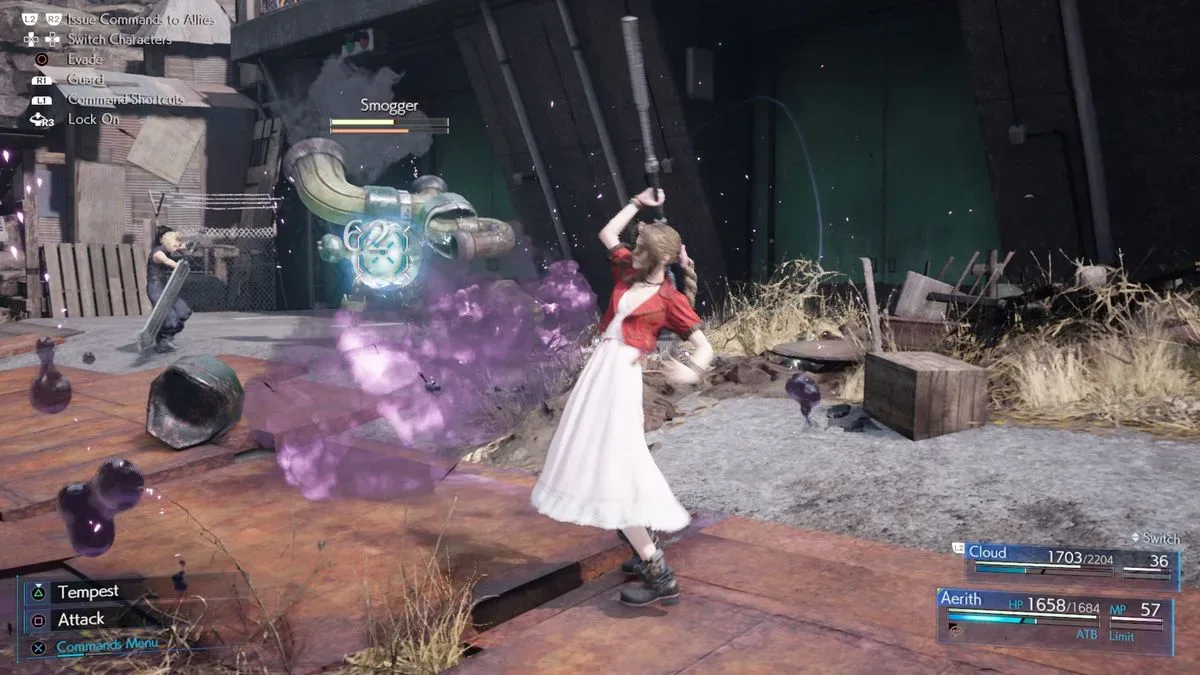
Midgar’s story also broadens the human cost around the group. Jessie receives more background, including her former work as a theater actress and her father’s Mako-related coma. Cloud begins suffering visions involving Sephiroth. And Aerith Gainsborough enters the story not merely as the flower seller Cloud encounters, but as someone being followed by both Shinra’s Turks and mysterious hooded entities.
Those entities become the trilogy’s most consequential new device. Red XIII later calls them the Whispers. They act as arbiters of fate: beings that intervene when events risk veering away from the path established by the original Final Fantasy 7. Their purpose is deliberately meta-textual, but within the narrative it has practical consequences. They push Cloud away from choices that would disrupt key events, prevent Barret from dying after a seeming fatal attack, and keep the party’s journey moving along a recognizable route.
Related coverage includes Final Fantasy 7 Revelation: Everything to Remember Before the Remake Trilogy Finale.
The Sector 7 plate changes the conflict from covert sabotage to open tragedy
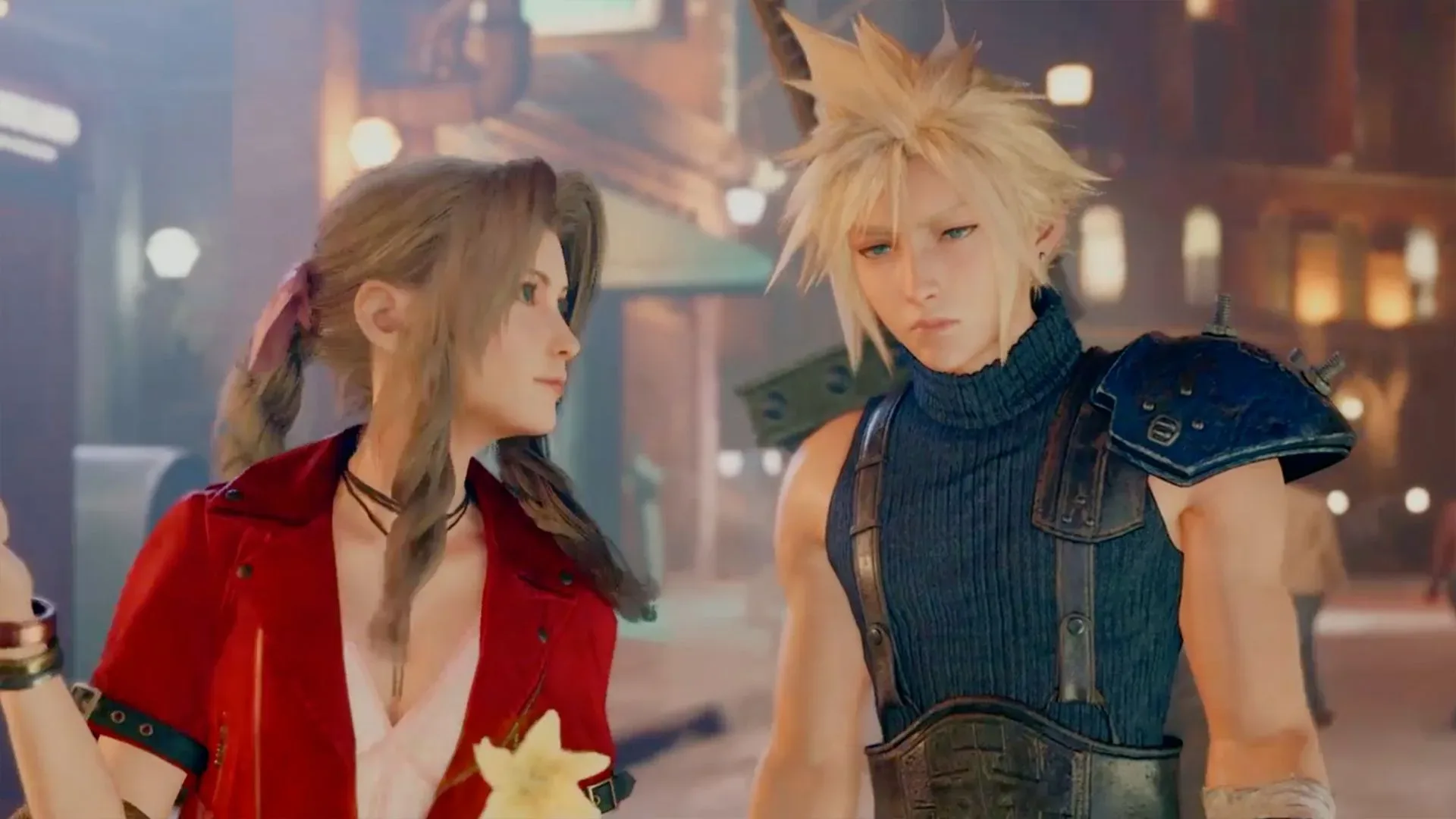
After the second reactor operation goes wrong, Cloud falls into the Sector 5 church and meets Aerith again. Their route back toward Sector 7 leads them to Wall Market and Don Corneo’s manor, where Tifa has gone undercover. The trio learns Shinra plans to collapse the Sector 7 plate onto the slums below, ostensibly to eliminate Avalanche while accepting mass civilian deaths as collateral damage.
Cloud, Tifa, Barret, and their allies cannot stop it. The plate falls, devastating the sector. Biggs and Jessie are believed killed in the immediate aftermath, while Aerith gives herself up to Shinra to keep Barret’s daughter Marlene safe. The disaster clarifies the imbalance at the center of the early story: Avalanche can attack infrastructure, but Shinra has the power and willingness to erase whole communities.
The rescue operation at Shinra headquarters adds more of the saga’s mythology. Aerith is the last known descendant of the Cetra, or Ancients, a people tied to the Lifestream. The Lifestream is the Planet’s spiritual life force, and it is the basis of the Mako Shinra harvests. Shinra wants Aerith’s connection to the Cetra because it believes she can lead it to the Promised Land, a place associated with great Mako wealth.
At the headquarters, the party frees Aerith and gains Red XIII, another of Hojo’s captives. Sephiroth kills President Shinra, clearing the way for his son Rufus to take control. Hojo, meanwhile, remains a central figure in the web of experiments that affects Aerith, Red XIII, the black-robed test subjects, and Sephiroth’s origins.
Defying fate is the remake trilogy’s point of no return
The escape from Midgar ends with Cloud’s party confronting Sephiroth and the Whispers beyond the city. By defeating the force that preserved the original story’s destined course, the group does not simply leave Midgar behind. It opens the possibility that the future is no longer fixed.
That break is immediately reflected in images of alternate outcomes. Biggs and Jessie are shown alive in one reality despite the plate collapse. More dramatically, Zack Fair survives the Shinra assault that killed him in the original game’s history and in Crisis Core. Zack is seen carrying an injured Cloud toward Midgar, which makes him far more than a background figure from Cloud and Aerith’s past.
This is the essential interpretive rule for Revelation: the trilogy has not discarded the original story’s major landmarks, but it has turned expectation itself into a source of tension. Familiar events can recur, be resisted, be reframed, or unfold across more than one timeline. The fate system made that uncertainty explicit.
It is also worth keeping the terminology tidy. A timeline in this story is an alternate sequence of events or reality, not merely a flashback or a character imagining a different outcome. A rift is a visible sign that the boundaries between those realities are becoming unstable. The distinction matters because Cloud’s visions and mental strain create another source of uncertainty entirely: not every strange thing he sees is necessarily shared by the rest of the party.
INTERmission gives Yuffie, Wutai, and Deepground greater weight
Episode INTERmission runs alongside the events of Remake and follows Yuffie Kisaragi, a young ninja from Wutai. She arrives in Midgar on behalf of Wutai’s interim government, intending to steal Shinra’s supposed “Ultimate Materia.” Materia is the setting’s magical resource, typically used to grant spells or abilities, so an ultimate version would represent a potent strategic prize.
Yuffie works with Sonon and a local Avalanche cell, while learning that Barret’s team is viewed as a radical splinter group from a larger Avalanche organization. The distinction helps complicate the movement’s politics: “Avalanche” is not one perfectly unified force with one method or purpose.
The mission fails because the Ultimate Materia is not actually there. Yet its consequences are severe. Sonon sacrifices himself so Yuffie can escape, and Yuffie clashes with Scarlet, Shinra’s weapons chief, plus the clandestine military group Deepground and its leader Nero the Sable. Her loss gives her a more personal reason to oppose Shinra, while also planting elements from the wider Compilation of Final Fantasy 7 into the remake continuity.
Wutai’s importance expands further in Rebirth, where it openly declares war on Shinra. Revelation therefore has at least two intersecting conflicts to handle: the world-scale war between those powers and Sephiroth’s reality-threatening agenda.
Rebirth follows Sephiroth beyond Midgar — and into Cloud’s past
In the main Rebirth timeline, Cloud’s group reaches Kalm after leaving Midgar. Cloud recounts the Nibelheim incident from five years earlier, when he and Sephiroth were sent to investigate a Mako reactor in Cloud’s hometown. Sephiroth learned that he had been created using cells from Jenova, an extraterrestrial life-form he comes to regard as his mother. His ensuing breakdown leads to Nibelheim’s destruction and massacre.
The party follows black-robed former Shinra test subjects, believing that their movements will lead to Sephiroth. The journey takes them through Junon, Costa del Sol, Mt. Corel, the Gold Saucer, Gongaga, Cosmo Canyon, and Nibelheim. Those stops develop the party’s history: Barret faces accusations over the destruction of Mt. Corel’s reactor; Red XIII reveals his true name, Nanaki, and that his maturity is closer to a human teenager’s despite his deep voice; and Nibelheim has been unnervingly rebuilt by Shinra.
Yuffie becomes a full party member, as do Cait Sith and, in story roles, Cid Highwind and Vincent Valentine. Cid owns the Tiny Bronco, while Vincent is a former Turk with a vampiric, beast-transforming nature. Neither Cid nor Vincent is playable in Rebirth, but both now travel close enough to the main conflict that their eventual roles remain pertinent.
For broader context on the modern PlayStation landscape around major game releases, see this look at PS5 reaching 100 million sell-in units.
Black Materia, Meteor, and Reunion define Sephiroth’s current plan
Rebirth makes Sephiroth’s objective more expansive. The Black Materia is the object sought in the Temple of the Ancients, and Sephiroth wants it to summon Meteor, a catastrophic force that would destroy the Planet. Weapons, enormous guardians that serve as part of the Planet’s defense, appear as the crisis grows.
But Meteor is only part of the danger. Sephiroth explains “Reunion” as a plan to forcibly combine alternate universes into a paradise that he would rule. The word therefore refers to far more than characters reuniting or gathering around a shared goal. In this version of the story, it names an attempted merger of realities under Sephiroth’s control.
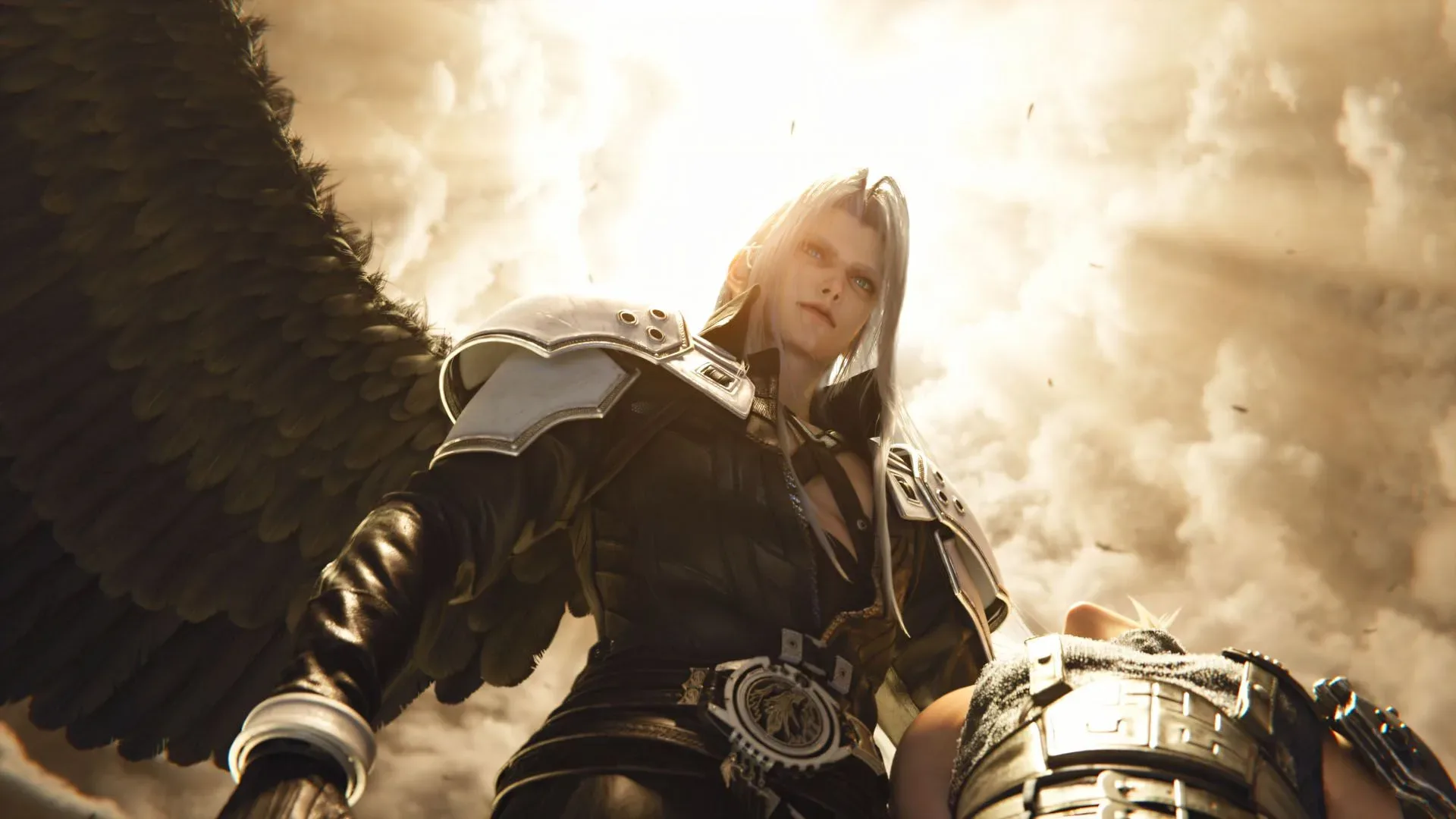
Cloud’s vulnerability is critical to that plan. Although the party obtains the Black Materia at the Temple of the Ancients, Sephiroth manipulates Cloud into surrendering it. That control continues the pattern established by Cloud’s visions and unstable memories: Cloud is capable and determined, but he is also the person Sephiroth can most directly exploit.
The Whispers return as well, now divided by alignment. White Whispers aid the Planet, while black Whispers serve Sephiroth. Their presence means the defeat of the Arbiter of Fate did not remove the struggle over destiny; it changed its shape. Rather than a single force enforcing one established history, the story now depicts competing forces trying to steer the future.
Aerith’s death remains real, but Cloud’s experience is not simple
The Forgotten Capital delivers Rebirth’s most emotionally and narratively complicated event. Aerith goes there to pray for the Planet’s help against Sephiroth. Cloud reaches her after passing through a tear in the Whispers’ barrier. He resists an attempt to make him kill Aerith with the Buster Sword, then blocks Sephiroth and disarms him. A temporal distortion nevertheless results in Sephiroth killing Aerith, with her White Materia falling into the water.
The immediate reality for the rest of the party is grief: Aerith has died. Yet Cloud’s experience diverges from theirs. He continues to see her, and an alternate Aerith later aids him during the battle against Sephiroth. This should not be flattened into a clean resurrection claim. The evidence instead presents intersecting timelines and a protagonist whose perception is already compromised. Aerith’s condition, the status of the Aerith who helps Cloud, and what Cloud can reliably understand are all questions Revelation must address.
Zack’s thread is equally unstable. His surviving reality splits into multiple branches based on different decisions, including an effort to save a version of Biggs. Zack eventually confronts Sephiroth, and Cloud joins him temporarily across universes. Their shared battle forces Sephiroth to withdraw, but it does not settle the fracture between worlds.
By Rebirth’s close, the party departs aboard the Tiny Bronco to continue hunting Sephiroth. Cloud finds that he still possesses the Black Materia and fuses it with his Buster Sword. He can see a black rift in the sky that the others cannot. He says goodbye to Aerith’s ghost, who remains behind, then recommits himself to stopping Sephiroth.
What Revelation needs to resolve
Revelation does not need to reproduce every remaining event from the 1997 game exactly to provide resolution. It does, however, need clear answers about the questions the remake trilogy intentionally created:
- Can Sephiroth’s Reunion plan truly merge realities, and what would it do to the Planet and Lifestream?
- Why can Cloud see the black rift and Aerith when the others cannot?
- What is the status of Zack’s branching worlds, and can his survival alter the main timeline?
- What role will the Black Materia fused with Cloud’s Buster Sword play?
- How will the Planet’s white Whispers, Sephiroth’s black Whispers, and the Weapons affect the final conflict?
- Where do Wutai’s war with Shinra, Deepground, and the wider Compilation elements fit into the ending?
The cleanest summary is that Cloud’s team still fights to save the Planet from Mako exploitation and Meteor, but the final confrontation is no longer confined to one known history. Sephiroth is seeking dominion over a set of collapsing or converging realities, Cloud is carrying the Black Materia while struggling with what he sees, and Aerith and Zack remain present in ways that resist a simple reading. April 2027 is where this remake’s biggest gamble — changing fate without abandoning the emotional stakes of Final Fantasy 7 — is due to be answered.