There is a particular kind of tension that traditional Minesweeper creates almost by accident. A board offers information, but not necessarily certainty. A number tells the player something precise about nearby danger, yet turning that fact into a safe action can require patience, inference, and a willingness to leave one ambiguous square alone until the rest of the board speaks more clearly. You’ll Be Mined, developed and published by Andrei Kovalev, takes that familiar logic and places it inside a more overtly gamey structure: a score-focused, incremental dungeon crawler in which the board is also a timed run.
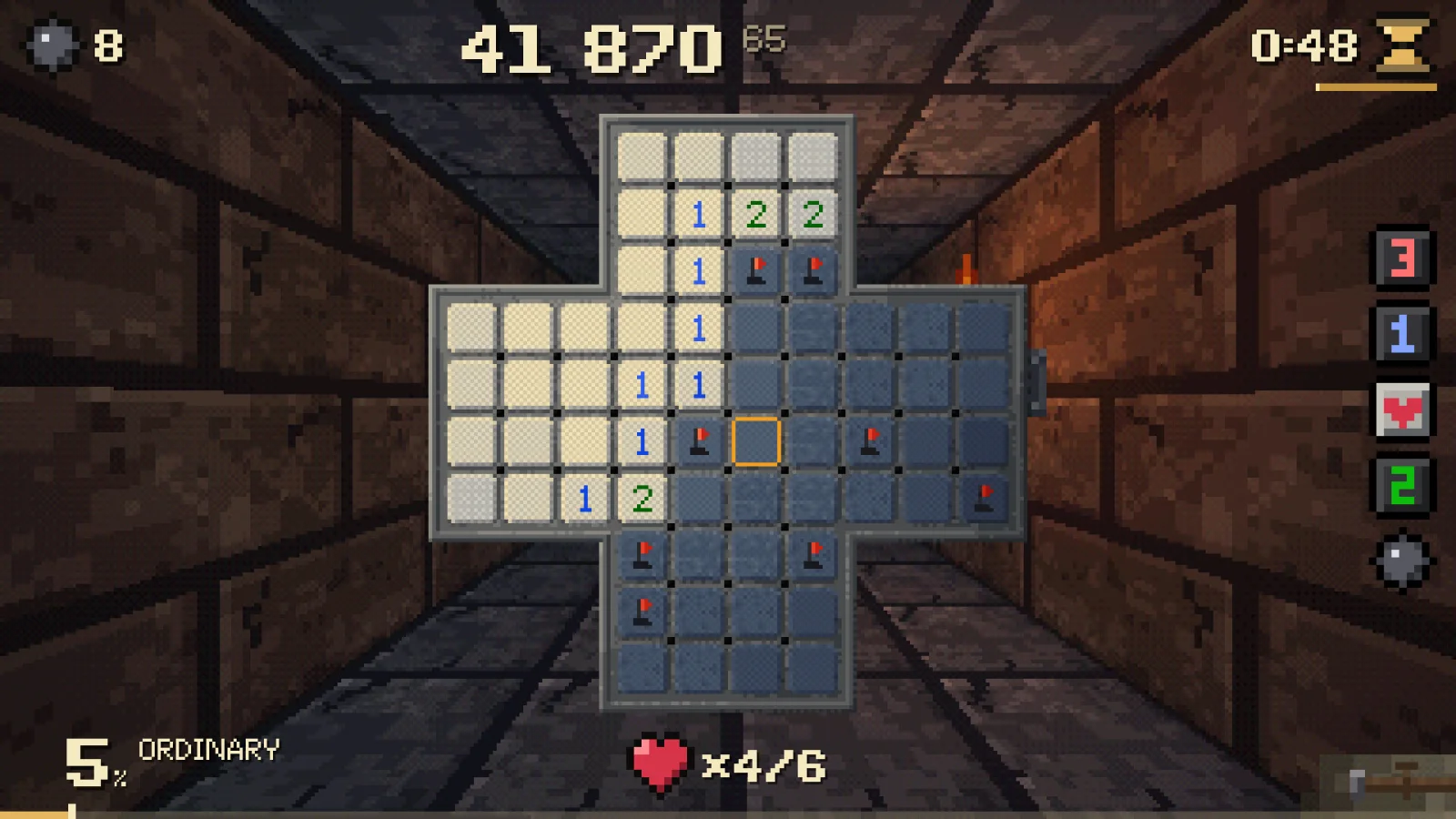
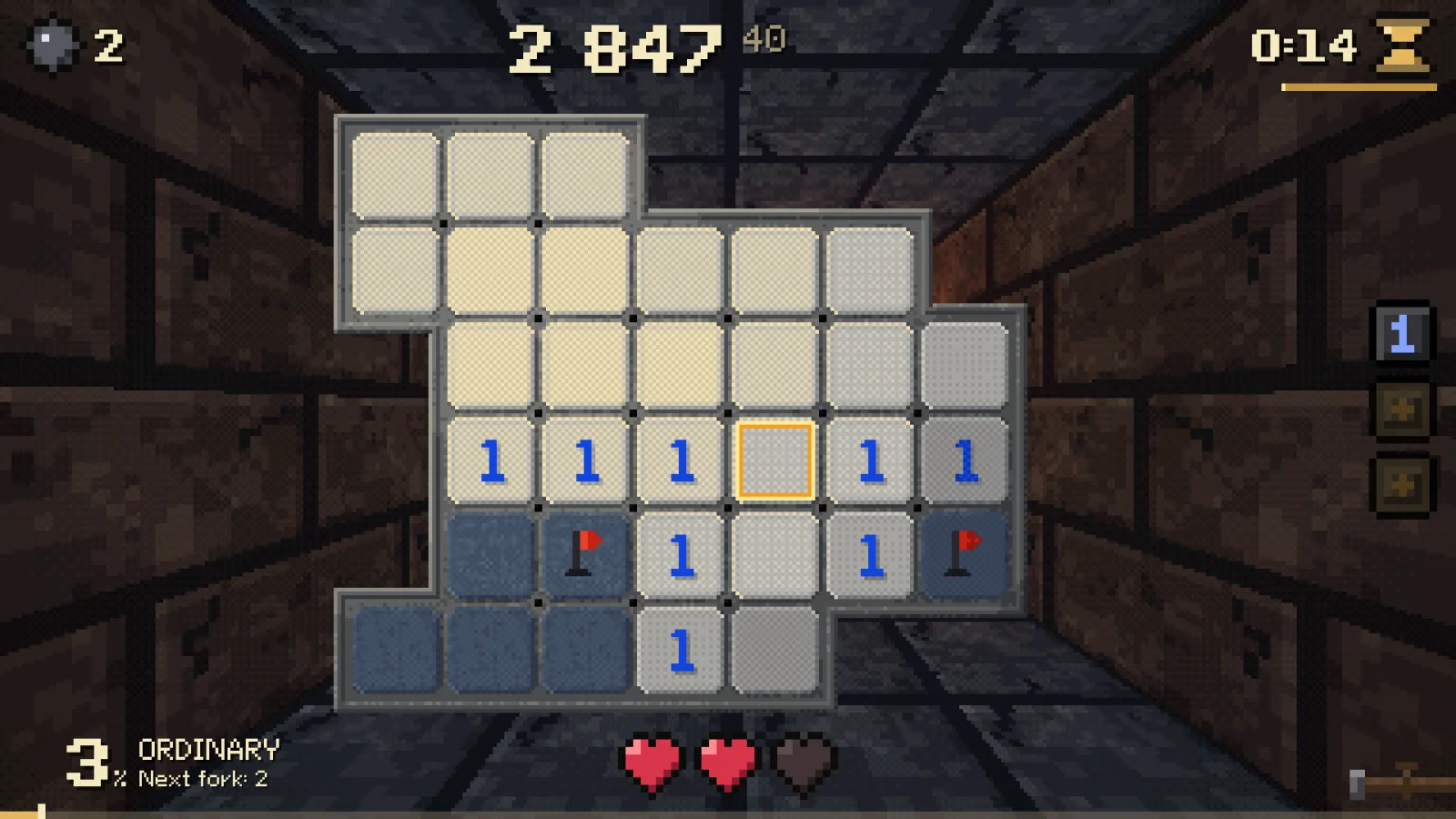
A free public PC demo is available, while the full game remains upcoming. Its stated rules offer a useful design proposition to examine. In each round, players face a Minesweeper-style board under a time limit. Opening cells adds seconds, mines cost hearts, and a run ends when either the clock reaches zero or hearts are exhausted. That is a compact rule set with a consequential premise: time and survival are separate resources, and a correct reveal may matter not only because it avoids a mine but because it restores the capacity to keep thinking.
The game’s title makes a very direct promise of subterranean misfortune, but its more interesting idea is not simply that Minesweeper has been dropped into a dungeon. It is that deduction, tempo, score-building, and route economics are meant to occupy the same loop. A cell can be information. It can be danger. It can be a way to preserve a dwindling run. Under the right scoring conditions, it may also be an opportunity that is worth more than its neighbors. That creates room for a puzzle game in which the correct answer and the strategically valuable answer are not always identical.
A puzzle board where waiting has a cost
Classic Minesweeper usually grants deliberation an almost unlimited runway. A player can stare at a cluster of numbered cells, trace possibilities, walk away, and return without the puzzle imposing a new penalty for that pause. The meaningful pressure comes from uncertainty and the permanent cost of uncovering a mine. You’ll Be Mined adds a second cost: even a player who refuses to make a bad deduction cannot remain undecided forever if the round timer continues to decline.
That adjustment could change the emotional weight of every safe-looking move. Because opened cells add time, revealing space is potentially both a logical success and a tempo action. A chain of confident deductions could replenish the player’s ability to assess the next problem. Conversely, a stalled board could become expensive even before a mine enters the picture. The announced loop therefore makes knowledge more than a defensive resource. Knowledge may also be productive, creating the time needed to turn the next patch of uncertainty into another set of deductions.
That is more interesting than attaching a stopwatch to a familiar puzzle merely for panic. A timer can flatten thought into hurried clicking when it is only punitive. Here, the time returned by opened cells creates the possibility of a reciprocal relationship. The player is pressured to act, but successful reading of the board may purchase more room to act well. The eventual tuning will determine whether that recovery feels generous, demanding, or erratic. As a design proposition, however, it makes speed a consequence of deduction rather than an entirely separate test of reflex.
The hearts system adds another axis to the same decision. A mine costs a heart, while zero hearts ends the run. That distinction suggests that some risk can be survivable, whereas time loss and health loss need not have identical strategic meanings. A player might face a board position where accepting a heart loss is undesirable but less immediately terminal than letting the clock expire. Another situation could make every remaining heart precious while a successful reveal would restore enough time to continue. The exact balance of those exchanges will matter, but the fundamental idea is clear: the game is not presenting every mistake as the same kind of mistake.
This two-budget structure could make a familiar Minesweeper question more complicated in a useful way. In the traditional puzzle, uncertainty is often resolved through deduction, flagging, or a reluctant guess. In You’ll Be Mined, uncertainty may be assessed through its effect on both immediate survival and future pace. The player is potentially evaluating not just whether a move is safe, but what it does to the clock, what it risks doing to health, and whether it opens a route toward better scoring conditions. That is a lot to ask from a cell grid, which is precisely why legibility will be central.
The break room turns continuation into an economic question
Between rounds, You’ll Be Mined has a break room offering healing, extra time, potions, and modifiers. Progress also involves an escalating exit toll. Taken together, those elements make the space between boards more than a breather or a cosmetic hub. The break room is positioned as the place where a run’s immediate puzzle outcomes become decisions about preservation, investment, and advancement.
Healing plainly speaks to the heart budget. Extra time speaks to the clock. Potions and modifiers can potentially alter the value of future choices. The escalating toll gives those purchases a competing claim on the same broader run economy. That arrangement could create a useful question after each round: is the next priority to repair the current situation, buy a tool that may improve later boards, or preserve enough resources for the cost of moving on?
That is an important distinction from an upgrade shop that only asks which number should become larger. An escalating exit toll can make restraint part of the decision, because spending now may carry a later opportunity cost. If modifiers meaningfully reshape the way a player approaches a board, the break room could be where a score run gains an identity rather than merely a larger collection of numbers. A cautious route might prioritize survival resources and time. A more ambitious route might reserve resources for scoring effects or tools that make danger useful. Those are possible strategic shapes implied by the structure, not guarantees about how any one option will perform.
The full game’s eventual test is whether healing, time, potions, and modifiers create genuinely different priorities or converge on one obvious shopping list. Similarly, the exit toll needs to turn planning into a meaningful part of the crawl rather than a routine accumulation requirement. The most promising version of this economy would keep the board at the center: purchases should complicate the act of reading mines, not feel like a detached layer where the puzzle’s logic stops mattering.
Score-building can make risk legible—or obscure it
Multipliers and cell-specific bonuses are part of You’ll Be Mined’s stated score-building tool kit. Those systems indicate that clearing a board is not necessarily the only objective; how, where, and under what conditions cells are opened may affect the value of a run. This is where the score-focused description becomes especially significant. A player pursuing survival might seek the safest available route through a board, while a player pursuing a larger score might be tempted toward a more conditional sequence of reveals.
That possibility fits unusually well with Minesweeper-style play. The underlying puzzle already asks players to distinguish a deduction from a guess. Bonuses and multipliers could add another distinction: not just whether a cell is safe, but whether it is strategically valuable to open now. A scoring system that rewards informed sequencing could turn the same board into different problems for different goals. It could also give experienced puzzle players reasons to revisit a rule set after they understand its basic mine-reading grammar.
Yet score systems need clarity if they are to feel like strategic invitations rather than post-hoc accounting. Players need to understand what a multiplier rewards, what a cell bonus changes, and what has been sacrificed by choosing one line over another. In a timed puzzle, that information must be readable quickly enough to support decisions without reducing every board to a frantic checklist. The important design question is whether high-value opportunities can be communicated clearly while leaving enough ambiguity for genuine judgment.
One announced potion is particularly illustrative: it can turn mines into hearts. Even described at that level, it offers a notably different relationship to danger. Instead of mines being solely a threat to be avoided, that effect suggests a conditional strategy in which hazards can become recovery. It may support riskier score routes, emergency stabilization, or another purpose depending on its rules and availability. What matters most is the design direction. A system that can invert the meaning of a mine has the potential to make board knowledge, health management, and item use interact rather than sit in isolated layers.
That inversion is also a useful example of why the game’s best ideas will need strong explanation. Turning a mine into a heart is immediately legible as a surprising reversal, but its broader implications could be complex. Does it encourage a player to approach known mines differently? Does it create a short-term rescue that conflicts with another scoring goal? Does it combine with modifiers in ways that establish distinct build paths? The announced ingredients invite those questions. Their answers will decide whether the game’s incremental framing deepens Minesweeper logic or merely adds a layer of effects around it.
A dungeon with a small asynchronous trace of other people
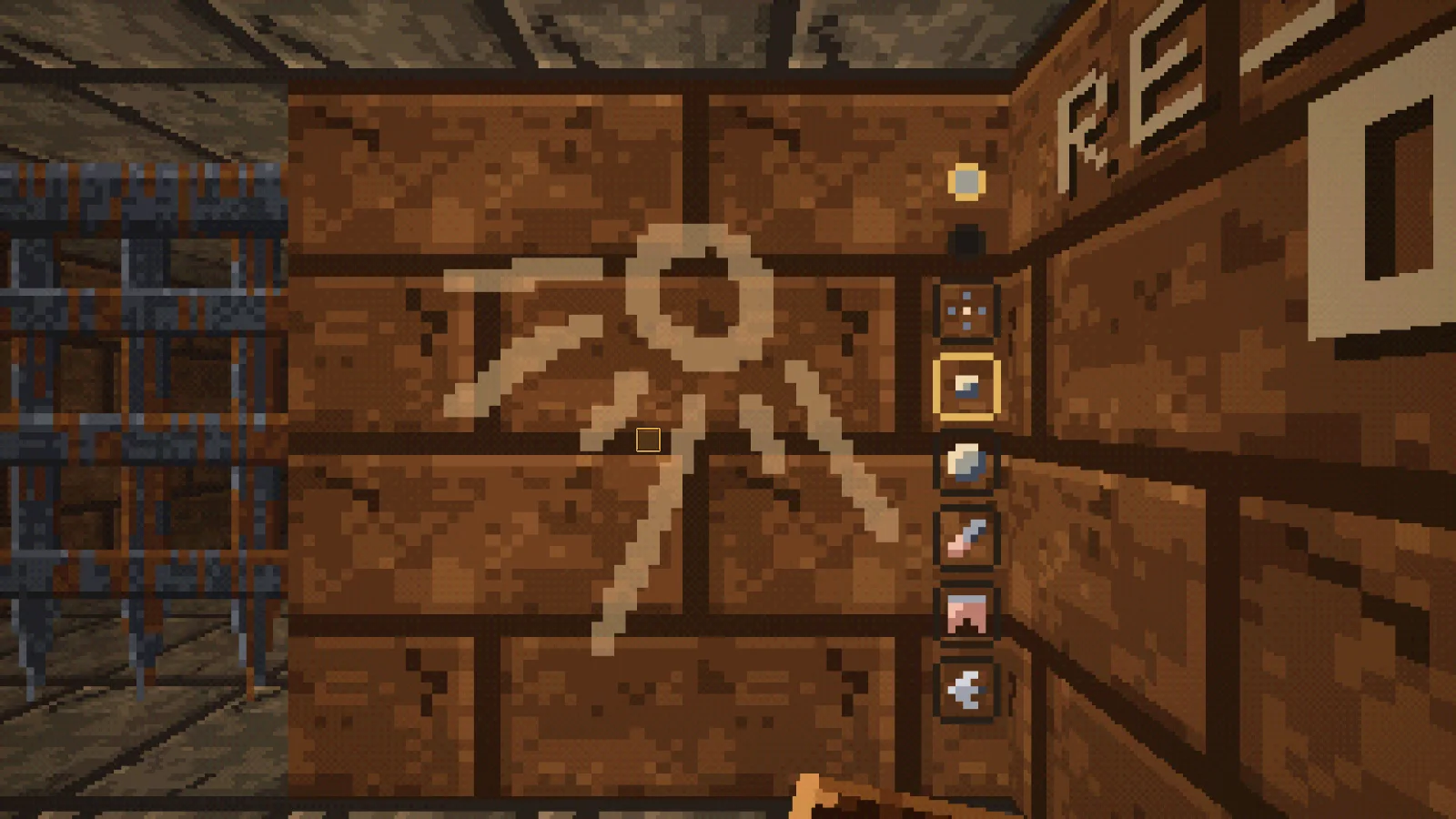
The dungeon includes a wall-drawing feature through which players can encounter drawings left by others in their own dungeons. The game is listed as single-player and includes leaderboards, achievements, and asynchronous multiplayer elements. None of that makes it a live cooperative game. Instead, the wall drawings point toward a restrained social layer: other people can leave a visible trace inside an otherwise individual run.
That is a fittingly modest idea for a puzzle dungeon. Minesweeper is traditionally private and silent; a player confronts a field of hidden information with no need for another person to be present. Drawings found in a dungeon could lend the setting a sense that someone else has passed through the same kind of space without turning the game into a conversation or requiring synchronized play. Their value may be atmospheric, playful, or community-oriented. How naturally they sit alongside the score loop will be a matter of presentation and context.
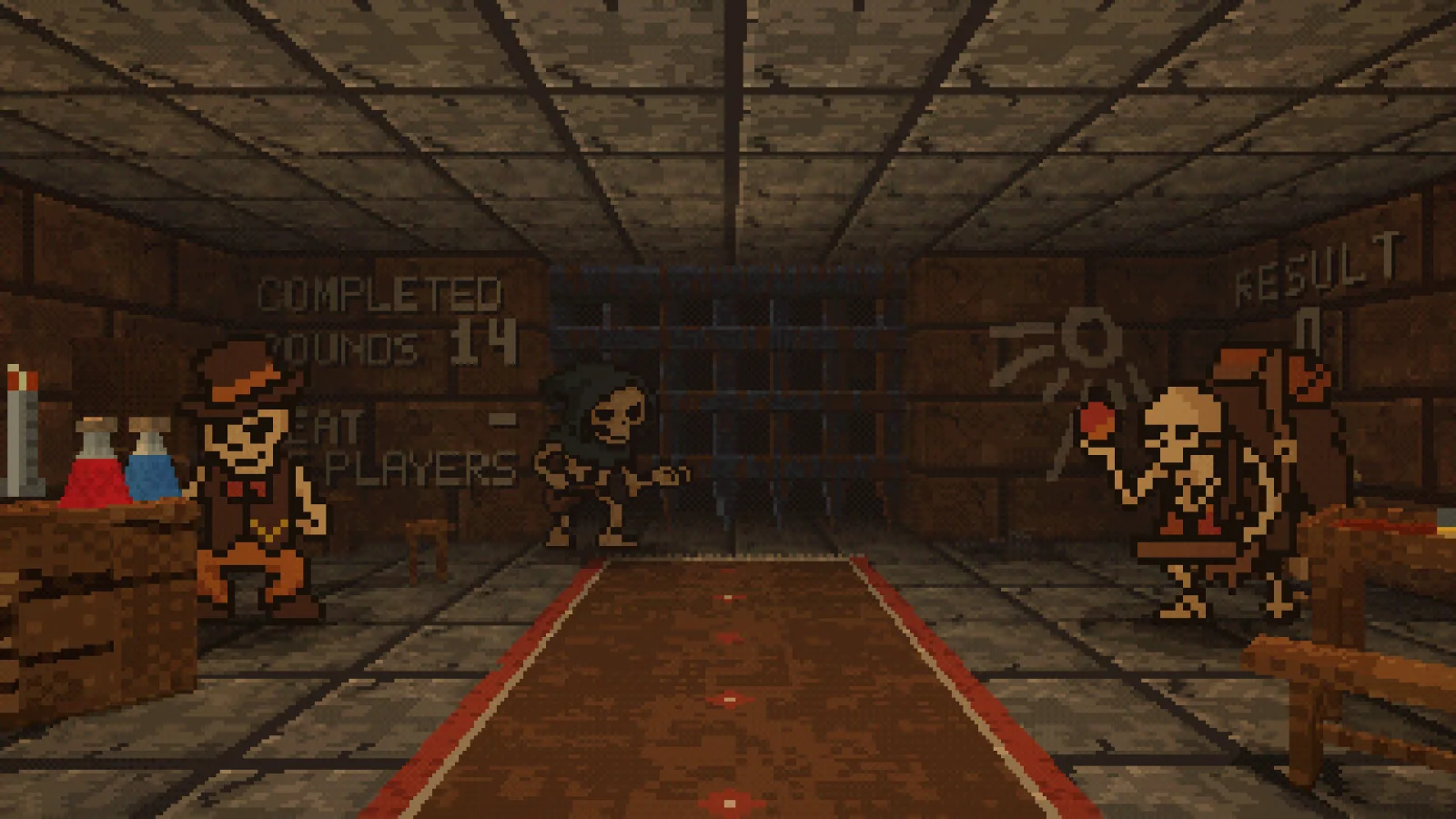
The named merchant, card sharp, and gatekeeper similarly establish dungeon figures without defining their roles, personalities, or narrative functions. Their presence indicates that the crawl has identifiable inhabitants beyond anonymous boards, but they should not be mistaken for a fully described story. For now, they are signals that the progression structure may have some character around its puzzle machinery rather than presenting every interlude as an abstract menu.
Who this design may suit
The clearest audience fit is for players who already enjoy the logical grammar of Minesweeper but would welcome a more run-based, score-conscious framework around it. The timer and heart structure suggest that careful deduction will be asked to coexist with pace. Score chasers may be drawn to multipliers, bonuses, and modifiers if their effects support intentional mastery. Players interested in incremental systems may find the break-room choices and exit toll appealing if progression produces evolving decisions rather than only bigger totals.
Players who value leisurely, unconstrained puzzle solving may want to pay particular attention to the timer’s role. Timed deduction can be exhilarating when information is readable and recovery is meaningful, but it can also be less accommodating for people who prefer extended analysis. Accessibility around time pressure is therefore an especially worthwhile question for the full release. Any options, explanations, or modes that address different ways of engaging with the board will shape who can comfortably share in the game’s central idea.
The broader question is whether You’ll Be Mined can make its layers reinforce one another. Its announced design has a clean thematic logic: reveal cells to earn time, avoid or manage mines to protect hearts, use the break room to prepare for another board, and decide how much risk is worth taking for score and progress. The strongest version of that loop would make a player’s understanding of the board carry directly into their economy and build decisions.
For now, the public PC demo is the entry point to this premise, and the full game is still upcoming. Readers looking for another game feature with a design question at its center can also read our Furyball: Rogue Revenge early-access preview.