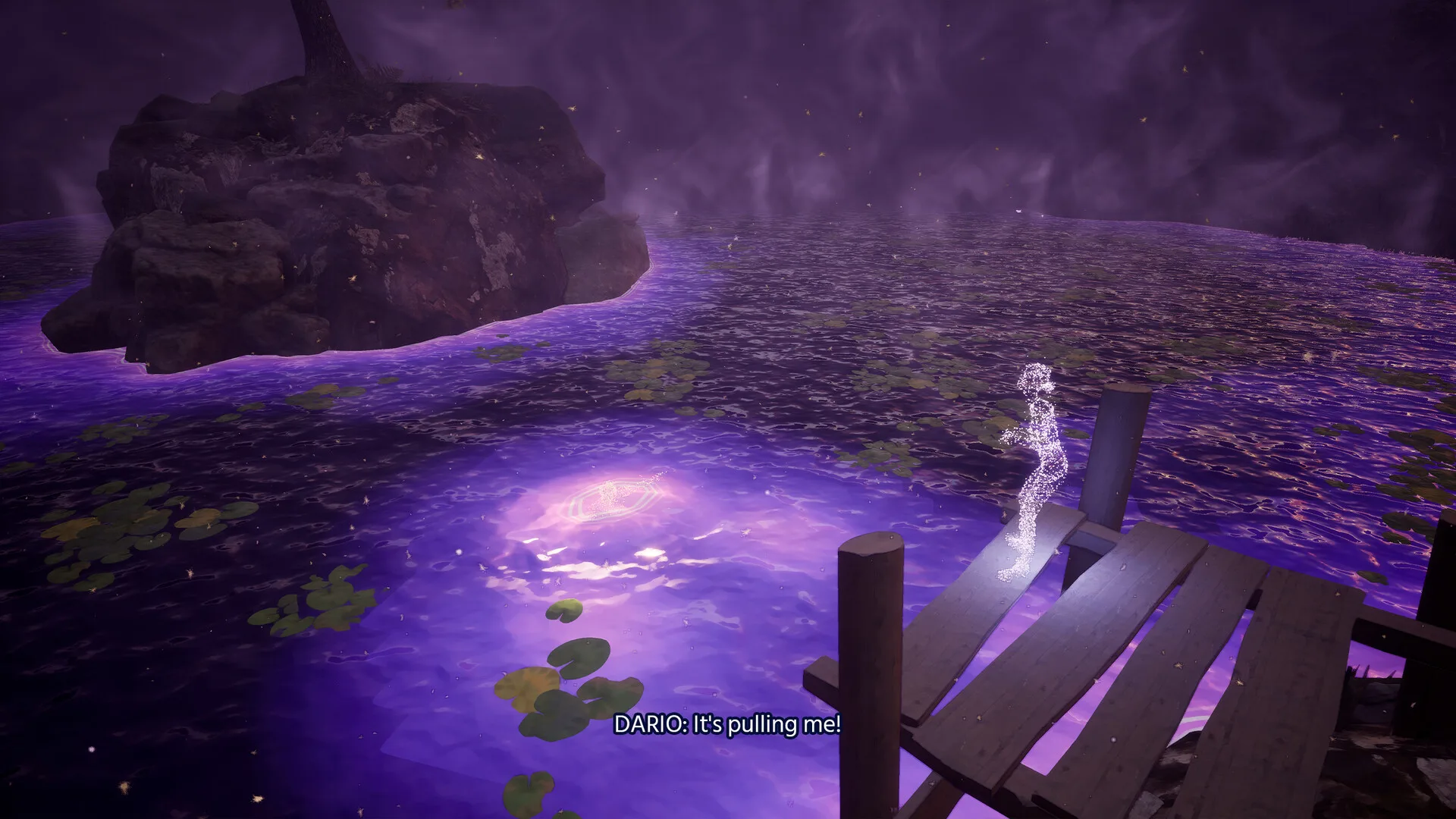
Echoes of Mora turns a flooded village into a mystery told across two points in time. Selkies Interactive’s standard PC edition presents a self-contained story estimated at roughly two to three hours. Mora is searching for her missing brother after he disappears near a violet lake. The village is later flooded, leaving the player to explore submerged remains, silent houses, and lost objects in search of clues.
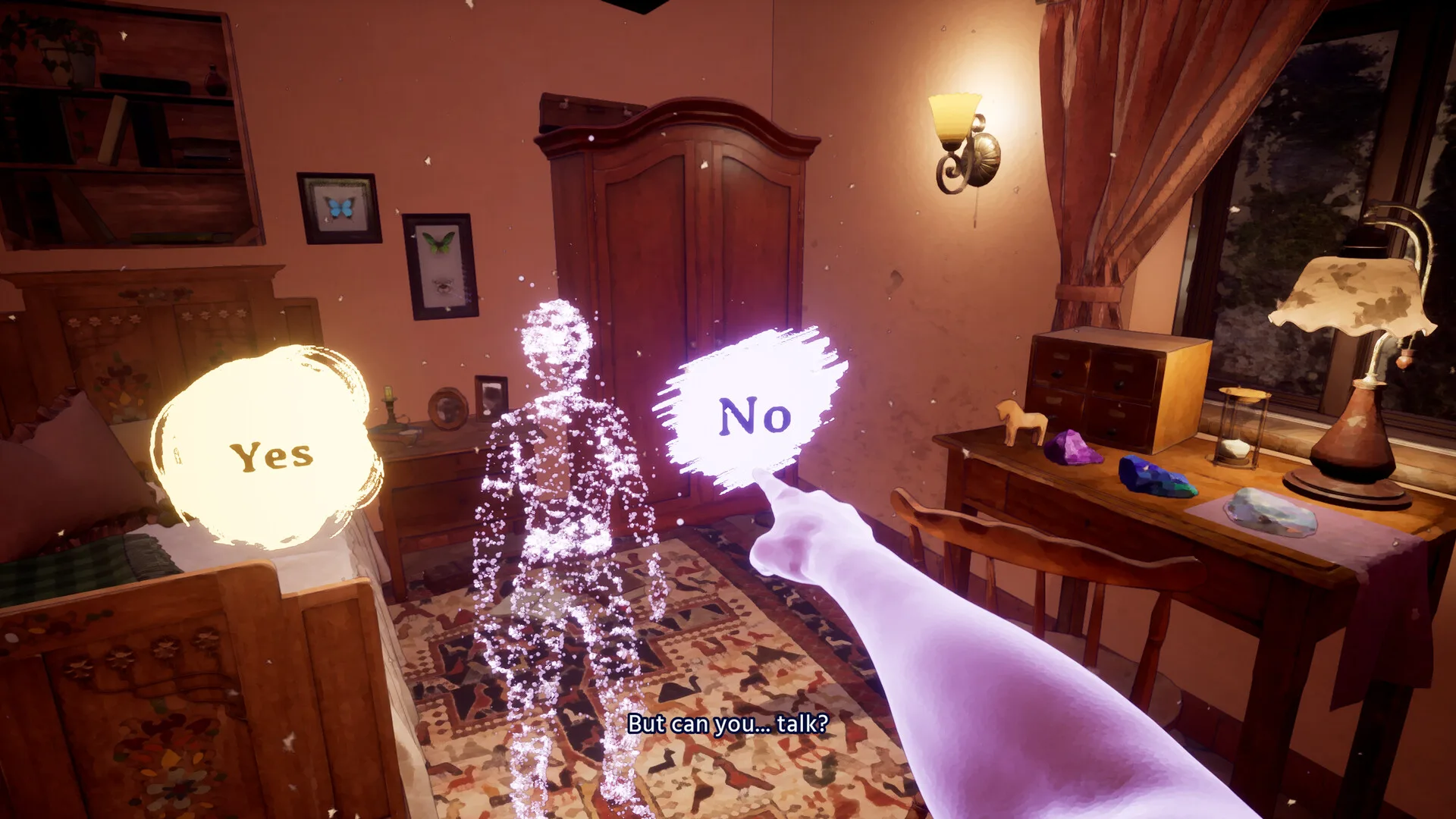
The premise gains a more unusual dimension through Echoes: portals to the village before the flood. Fragments hidden in the sunken world, including fragments placed behind small puzzles, unlock these passages. In the earlier village, Mora alone can see the player. Discoveries can be shared with her in conversation to guide her search, and choices influence the ending. Optional Traces preserve lost memories from villagers’ lives. The stated design also has no timers or dangers.
Those details create a compelling narrative-design question. Can one location tell two stories at once: ordinary life while it is being lived, and the meaning of that life after disruption has made it inaccessible? Echoes of Mora’s central opportunity lies in allowing the flooded village to operate as evidence while its earlier version provides lived context. For a short adventure, that relationship could make careful observation feel like more than a pause between plot points.
A village as aftermath and context
A flooded settlement is naturally evocative, but its possible value is not confined to atmosphere. Water changes the legibility of a place. A house remains a house, an object remains an object, and familiar routes may still be visible, yet their normal use has been interrupted. The result is a world of fragments: things that once belonged to routines but now require interpretation.
That makes the submerged village a useful setting for a mystery. The player is not simply pursuing an answer hidden somewhere in an abstract level. They are moving through consequences. Silent homes and displaced belongings point toward lives that can no longer be observed in their ordinary form. The flood does not need to explain every question for absence itself to become meaningful. A changed village can make the player aware of what is no longer available to ask directly.
Echoes, which lead to the pre-flood village, could give those remnants a second narrative life. Environmental mysteries often ask players to reconstruct the past from what remains. The structure here suggests a variation on that idea: remnants in the flooded present unlock direct access to an earlier version of the same setting. A detail that initially reads as unexplained evidence may acquire a different emotional or practical meaning when the player encounters the village before its destruction.
For a game estimated at two to three hours, revisiting a location across time can also be an economical design choice with thematic value. The adventure need not rely on a long series of separate places if a room, path, or object can change meaning through contrast. Returning to space is not automatically repetition in this model. It can be the method through which the village becomes more readable.
Fragments as a rhythm of attention
The stated structure places fragments in the flooded village and behind small puzzles, with those fragments unlocking Echoes. That establishes a sequence between exploration and narrative access. The player first investigates the aftermath, then earns a route to its earlier context. The past is not merely supplied as exposition; it is reached through engagement with what the flood has left behind.
At its best, that can make fragments more than practical gates. They offer a reason to inspect the environment before the game provides additional context. The basic rhythm may be straightforward: explore a submerged area, find a clue or fragment, resolve a small obstacle, enter an Echo, and bring fresh information into Mora’s search. The exact cadence of this loop is unspecified, but the premise supports a clear relationship between looking and learning.
The emphasis on small puzzles is equally useful as an expectation-setting detail. Players looking for elaborate puzzle chains should not assume a dense puzzle-box adventure. Yet modest obstacles can fit a compact narrative game when they perform a purpose beyond simply delaying access. They may slow the player before a discovery, encourage attention to the arrangement of a place, or provide a small interval of participation before a new piece of story context arrives.
That trade-off places considerable importance on what follows each obstacle. When a puzzle is intentionally light, its significance may rest on the discovery it frames or the question it raises. In the most promising reading of Echoes of Mora’s structure, fragments do not simply pad out access to portals. They regulate the pace at which the player learns to read the village.
Traces and the choice to remember more
Traces are described as optional lost memories from villagers’ lives. That suggests a distinction between completing the central search and recovering a wider sense of place. Mora’s brother gives the narrative a clear emotional focus, but the village can become more than a backdrop if its other inhabitants have memories worth seeking out.
Optional content can feel disconnected when it exists solely to extend play time or reward completion. Traces have a more natural thematic role because the setting is already concerned with what survives after a flood. Looking for a lost memory can become an act of attention rather than an obligation. It acknowledges that the player is not only chasing required clues, but also considering what else was interrupted, obscured, or left behind.
The exact presentation and narrative effects of Traces are not specified. Still, their stated purpose leaves room for a particularly fitting form of optional exploration: one that broadens the player’s relationship with the village without necessarily distracting from Mora’s immediate concern. The main path can ask what happened to one person; the optional material can invite consideration of the larger community that made the setting a home.
The absence of stated timers and dangers matters here. Without a declared countdown or environmental threat driving every decision, detours can be framed around curiosity and care rather than tactical efficiency. There is room, in principle, to pursue an object or memory simply because it seems meaningful. The tension shifts away from evasion and survival toward uncertainty, remembrance, and the question of what deserves investigation.
Guiding Mora with incomplete knowledge
Mora’s ability to see the player in the pre-flood village creates an interesting asymmetry. The player has access to a later, submerged version of the village, while Mora exists in its earlier state. But being connected to the future does not make the player omniscient. A lost object may imply a relationship without proving its meaning. A fragment can unlock an Echo without settling how a discovery should be understood.
Sharing discoveries with Mora may therefore be more than a dialogue function. It can be an act of judgment. The player is asked to convert partial evidence into guidance for someone searching for her brother. That is a more delicate role than merely delivering an item to a quest character. Information can be helpful, upsetting, uncertain, or open to several interpretations, and the choice to raise it with Mora can carry emotional weight even when the path forward remains fairly direct.
Choices influence the ending, although their frequency and scale are not specified. The grounded expectation is not an enormous branching narrative, but a concise authored mystery with some ending variation. Such a framework can still be meaningful if the choices reflect habits the player develops during the adventure: what they investigate, which memories they value, and what they choose to disclose.
This is where Echoes of Mora’s premise has an ethical interest. Guidance is not automatically harmless because it is intended to help. Knowledge gathered from a damaged future may have consequences when offered to someone in an earlier moment. The game does not need a sprawling morality system for that tension to matter. A small number of carefully placed conversations could be enough to make the player consider the difference between possessing a clue and knowing how to use it.
Fit, scope, and the role of the PC demo
Echoes of Mora’s stated design points toward atmosphere, investigation, environmental reading, and a concentrated narrative scale. That makes reader fit especially important. Players seeking extensive action, elaborate mechanical systems, or demanding puzzle challenge may find its announced priorities less aligned with their interests. Players drawn to brief mysteries, exploratory pacing, optional story details, and choices shaped by incomplete information may find more to investigate.
The standard PC edition supports keyboard and mouse or controller, and it does not imply that VR hardware is required. A separate VR app and a PC/VR bundle also exist, but this feature concerns the standard PC version. For another discussion of a PC game structured around attentive observation, see Joking Joystick’s Last Call PC design feature.
A PC demo is available for players who want to assess whether the game’s general presentation and pace suit them. A demo cannot settle how later developments or ending variation will land, but it can help clarify a more basic question: does the idea of exploring a flooded village, unlocking visits to its past, and following Mora’s search create the kind of curiosity a player wants from a narrative adventure?
Memory and responsibility beneath the water
Echoes of Mora’s design proposition is clear. A flooded village can be a mystery space and a record of interrupted lives, while Echoes provide access to the same community before the disaster. Fragments and small puzzles govern movement between evidence and context. Traces make room for memories beyond the central search. Conversations with Mora may turn collected information into responsibility rather than a simple inventory task.
The premise sets a focused course, though the strength of its connections depends on how fully the village rewards attention. Echoes of Mora appears built for players willing to linger over a place, follow incomplete evidence, and treat a brief running time as an opportunity for concentration. The available PC demo is an appropriate next step for anyone deciding whether this quiet two-era mystery matches the kind of adventure they want.