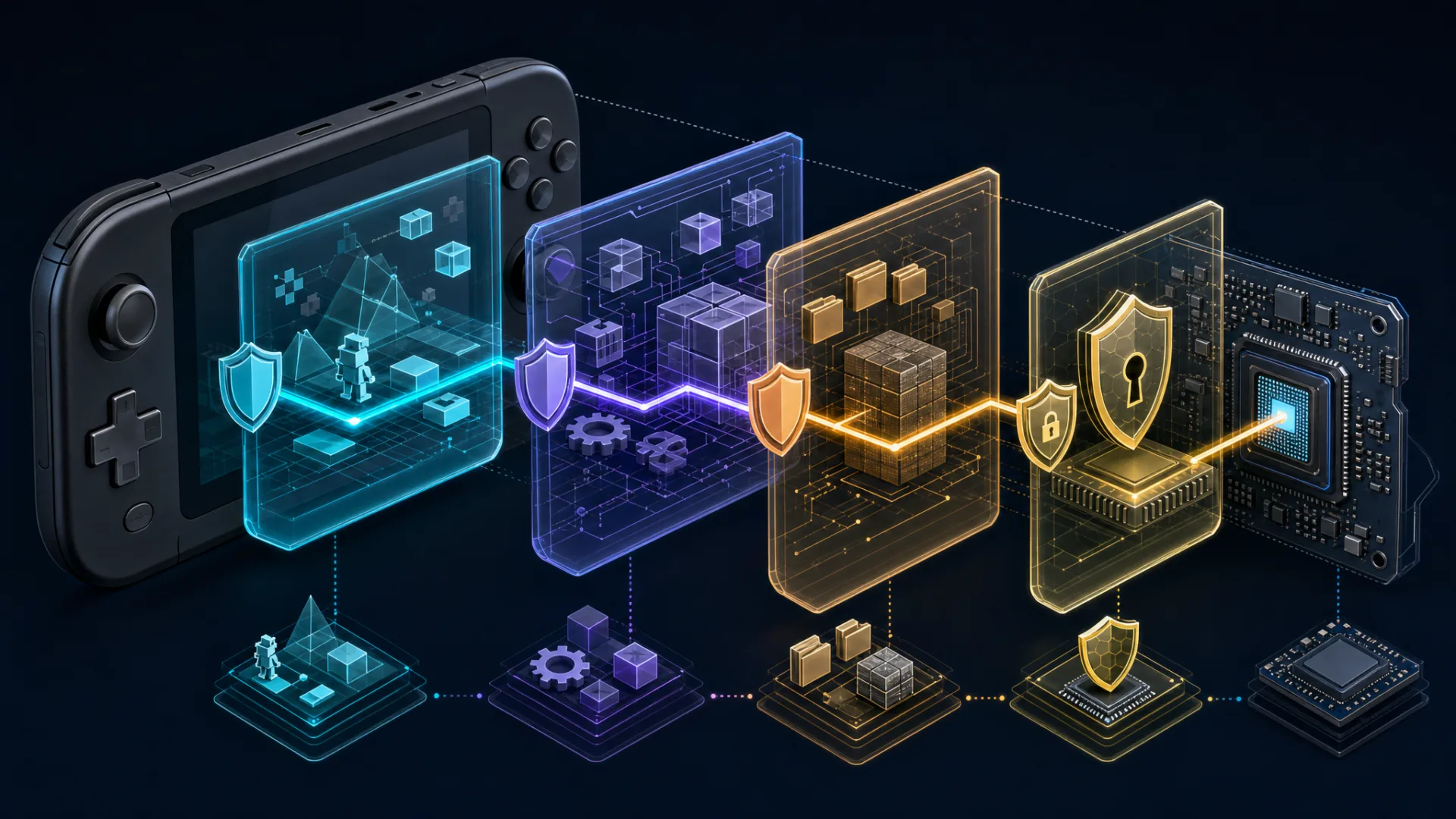
What NS2JB Is—and Why the October 2026 Disclosure Matters
NS2JB is a software-only, tethered jailbreak claim for Nintendo Switch 2 system software version 23.0.1. It was published by security researcher Sammy Hajhamid, who uses the handle pepsipu. In plain English, the project demonstrates a way for a specific Switch 2 software environment to run small pieces of native code with privileges normally reserved for built-in system services.
That description is deliberately narrower than “the Switch 2 has been fully hacked.” NS2JB is not a permanent jailbreak, a boot-ROM compromise, a modchip, or a finished custom firmware distribution. Restarting the console ends the modified runtime state, and the published demonstration must be launched again with help from a separate computer. The public claim is also tied to a particular system-software release and a particular version of SmileBASIC, an application available on the Nintendo Switch platform.
The disclosure matters because it appears to cross several meaningful boundaries at once. The research starts inside a user-facing application, reaches a privileged filesystem service, and then demonstrates native execution in that service. That is a substantially more interesting result than a simple application crash or a narrow homebrew launcher. At the same time, it does not establish unrestricted control of every security layer on Switch 2, nor does it prove that the method works on other firmware versions, hardware revisions, or software releases.
The short version
- What it is: a software-only, tethered jailbreak proof of concept for Switch 2 system software 23.0.1.
- Where it begins: the Nintendo Switch version of SmileBASIC, rather than a Switch 2 browser exploit.
- What it reaches: native code execution with the permissions associated with ordinary system modules, including the built-in filesystem service involved in the chain.
- What it enables in principle: research-oriented homebrew experimentation, reverse engineering, game modding, save backup work, and exploration of peripherals through memory-mapped hardware interfaces.
- What it does not provide: persistence after reboot, a boot-ROM exploit, a modchip, finished custom firmware, or demonstrated compatibility with arbitrary versions.
- What the October 2026 publication establishes: a public proof of a sophisticated exploit chain under specific conditions—not a general-purpose consumer jailbreak for every Switch 2.
The distinction is important for readers who encounter short social-media descriptions of the project. “Jailbreak” can describe a broad family of techniques, from a temporary application-level escape to a durable compromise of a device’s earliest boot code. Those outcomes are not interchangeable. NS2JB sits in the middle of that spectrum: it is more capable than a simple homebrew entry point, but less foundational and less persistent than a boot-ROM exploit or a modchip-assisted modification.
Known Versus Not Established
| Question | What is established by the public material | What is not established |
|---|---|---|
| Which software is affected? | The published claim targets Nintendo Switch 2 system software 23.0.1 and a specified SmileBASIC release. | Compatibility with later or earlier system software, other SmileBASIC versions, or every console revision. |
| Is it permanent? | No. A restart ends the modified runtime state. | Any persistent installation mechanism or permanent change to the console. |
| Is it tethered? | Yes. A separate computer participates in launching the public demonstration, and the process must be repeated after reboot. | That the console remains physically attached to the computer during ordinary use. |
| Is it custom firmware? | No. The public demo does not install a finished custom firmware distribution. | A complete, polished replacement or extension of Nintendo’s operating environment. |
| Does it execute native code? | Hajhamid reports native execution inside the privileged filesystem service, with the service’s permissions. | Unrestricted control over all security domains, secure boot, or every protected service. |
| Does it enable piracy or online cheating? | The project’s claimed research uses include homebrew, reverse engineering, modding, save backup work, and peripheral research. | That piracy, cheating, ownership-check bypasses, or online abuse are safe, lawful, supported, or part of the project. |
| Was artificial intelligence the researcher? | OpenAI Codex instances assisted a human-led research effort with exploration, analysis, packaging, and a demonstration modification. | That an AI autonomously discovered, validated, or operated the jailbreak without human direction. |
Why the October 2026 Disclosure Is Significant
The timing matters because Nintendo Switch 2 launched on June 5, 2025, so the disclosure comes relatively early in the platform’s public life. Early disclosures can shape how researchers, developers, preservationists, and platform owners understand a new console’s boundaries.
NS2JB is notable not merely because an application contains a bug. Modern consoles are built as layered systems. An application bug is usually enclosed by process isolation, permission checks, signed metadata, filesystem validation, and other barriers. Turning one mistake into meaningful native execution requires crossing several of those boundaries without losing control of the process.
Hajhamid’s account describes such a progression. The initial vulnerability is a 32-bit integer-overflow condition in SmileBASIC’s handling of array-item removal. In general terms, an integer overflow occurs when a calculation produces a value outside the range the chosen numeric type can represent. If later code trusts that wrapped value, it may calculate an incorrect location or size.
In this case, the reported consequence is an out-of-bounds memory read/write primitive inside the Switch 1 application environment running on Switch 2. That primitive is then used with return-oriented programming, or ROP. ROP does not require injecting a conventional new program into executable memory. Instead, it reuses short sequences of instructions already present in the process, linking them together so the processor performs a new sequence of operations.
That first stage is only one part of the story. The chain then targets the privileged built-in filesystem service, commonly called the fs sysmodule. Hajhamid reports a path-normalization-related memory corruption in that service that can be converted into arbitrary read and write access within the service’s memory. This is a major change in position: the research is no longer confined to the original application’s normal privileges.
The final stage concerns how the system validates executable content. The loader normally relies on signed metadata and filesystem hashes. According to the write-up, control over the filesystem service allows the chain to substitute an executable filesystem object after valid metadata has already been accepted. The loader therefore receives an arbitrary main executable while still seeing the signed process information it expects.
At a high level, this is a trust-boundary failure assembled from multiple weaknesses. One bug supplies memory access in an application. A later weakness supplies control within a privileged service. The combination then interferes with the relationship between validated metadata and the executable object actually delivered to the loader.
The public demonstration is intentionally narrower than the underlying research. It runs small native functions inside the filesystem service, checks their results, restores the original instructions, and cleans up. That behavior is useful evidence that the claimed primitive works, but it is not the same thing as distributing a consumer-ready operating environment.
The repository’s own account also emphasizes timing sensitivity. A physical test described for October 21, 2026 succeeded on the third fresh boot after two earlier attempts stopped at validation checks and cleaned up. That detail is not a reliability guarantee for other users. It is evidence that the public demonstration can be sensitive to runtime conditions even in the researcher’s environment.
Jailbreak, Exploit Chain, Homebrew Entry Point, Custom Firmware, Boot-ROM Exploit, and Modchip
These terms are often used interchangeably in public discussion, but they describe different layers of a console modification. Understanding the differences helps put NS2JB in proportion.
Jailbreak
A jailbreak is an umbrella term for defeating or bypassing restrictions that limit what software can run or what actions a device permits. It does not specify where the weakness exists, whether the result persists after reboot, or how much control the researcher gains.
A jailbreak can be temporary or permanent. It can begin in an application, a browser engine, a system service, or the boot process. It can provide only enough authority to launch homebrew, or it can expose much broader control. Calling NS2JB a jailbreak is accurate in this broad sense, but the label alone does not describe its capabilities.
Exploit chain
An exploit chain is a sequence of weaknesses and techniques used together. One vulnerability may provide memory corruption; another may cross a privilege boundary; a third may defeat a validation assumption. Each link has a job.
NS2JB is best understood as an exploit chain rather than one isolated bug. The SmileBASIC issue provides the initial foothold. The reported filesystem-service corruption advances the chain into a privileged process. The manipulation of the executable object and signed metadata relationship then supports native execution in that service.
Breaking any link can stop the chain. A system update might repair one vulnerability, change memory layout, alter validation behavior, or remove the particular version relationship on which the chain depends. That is why version specificity is central to understanding the disclosure.
Homebrew entry point
A homebrew entry point is a way to start unofficial software or research code. It is often the first visible result of a vulnerability, but it does not necessarily imply deep system access.
An entry point may launch a user-mode application while leaving the rest of the operating system’s security boundaries intact. That can still be valuable for independent software, accessibility tools, preservation research, and experimentation. However, it should not automatically be described as a complete jailbreak or custom firmware environment.
NS2JB goes beyond the narrowest meaning of an entry point because its reported chain reaches native execution inside a privileged system service. The public demo nevertheless remains a proof of the underlying capability rather than a finished homebrew ecosystem.
Custom firmware
Custom firmware is a sustained software environment that extends, replaces, or modifies the console’s normal operating system behavior. A mature custom firmware project typically includes a repeatable boot or launch process, user-facing tools, compatibility work, documentation, and a broader set of supported features.
NS2JB is not custom firmware. It does not install a complete replacement environment, and it does not persist across a restart. The distinction matters because a jailbreak can be an enabling step toward future custom firmware research without being custom firmware itself.
Boot-ROM exploit
A boot-ROM exploit targets code stored in a read-only or otherwise highly protected part of the device’s earliest startup process. If that code contains a vulnerability, the result may be unusually powerful because it runs before many later security checks and software updates.
Boot-ROM weaknesses are often associated with long-lived research value, but their importance depends on the exact architecture and what later security layers still enforce. NS2JB is not described as a boot-ROM exploit. It starts from software running after the console has already entered its operating environment.
Modchip
A modchip is hardware installed in or connected to a console to interfere with, augment, or redirect part of its startup or security process. It may provide capabilities that a software-only method cannot, including earlier control during boot or a route around software changes.
NS2JB is not a modchip replacement. Hajhamid’s write-up explicitly distinguishes the method from a modchip and identifies additional research needed for broader custom-firmware goals. A software-only, tethered result and a hardware-assisted, potentially persistent modification should not be treated as equivalent.
| Term | Plain-English meaning | How NS2JB relates |
|---|---|---|
| Jailbreak | A broad method for bypassing platform restrictions. | Yes, in the broad sense; the term alone does not indicate permanence or total control. |
| Exploit chain | Several weaknesses linked together to cross security boundaries. | Yes; the published work describes multiple stages. |
| Homebrew entry point | A way to begin running unofficial software or research code. | Related, but NS2JB’s reported result reaches beyond a simple user-mode launcher. |
| Custom firmware | A sustained, user-facing modified operating environment. | No; the public demo does not install one. |
| Boot-ROM exploit | A weakness in the earliest startup code. | No; NS2JB begins in software running after startup. |
| Modchip | Hardware used to alter or assist the console’s security or boot process. | No; NS2JB is software-only and tethered. |
Switch 2 Hardware and System Context
Nintendo’s hardware specifications provide useful context for the platform under discussion, but they do not prove anything about NS2JB. A console’s processor, screen, storage, wireless radios, and peripherals describe the environment in which software runs. They do not by themselves reveal whether a particular vulnerability exists or how difficult it is to chain.
Switch 2 uses a custom NVIDIA processor. Nintendo’s built-in display is a 7.9-inch, 1920-by-1080 LCD with a wide color gamut, HDR10 support, and variable refresh rates up to 120 Hz. In TV mode, the console supports output up to 3840-by-2160 at 60 frames per second, or 1920-by-1080 and 2560-by-1440 at up to 120 Hz in supported software. HDR10 is supported, and a September 10, 2026 system update added TV-mode variable refresh rate.
Those display features describe the target platform, but the verified material does not connect them to NS2JB or establish any exploit-related display capability. They are not evidence that NS2JB can manipulate the display pipeline or bypass protected graphics services.
Internal storage is 256 GB of UFS storage. Expansion uses compatible microSD Express cards, with Nintendo listing support up to 2 TB. The repository separately lists more than 20 MiB of free space in the SmileBASIC save as a requirement of the published demonstration. That requirement is not a statement about the console’s total storage capacity or a general measurement of the exploit’s resource needs.
Switch 2 includes Wi-Fi 6, Bluetooth, two USB-C connectors, and wired LAN through the dock. The public NS2JB requirements describe a computer and console on the same reachable network. That networking relationship is part of the tethered launch arrangement. It does not mean NS2JB is a network exploit that can compromise arbitrary consoles remotely, and it does not establish that the method works across the internet.
The console also includes a built-in microphone. Joy-Con 2 controllers attach magnetically, contain mouse sensors, and support HD rumble 2. These features are relevant to homebrew developers and peripheral researchers because they create hardware interfaces that independent software may want to study. Hajhamid’s claimed capability set includes exploring peripherals through memory-mapped input/output, but the public disclosure does not establish unrestricted control of every accessory or every protected hardware path.
Nintendo rates the battery at 5,220 mAh and estimates roughly two to 6.5 hours of use depending on activity. Battery capacity and runtime can matter in repeatable testing because power state, thermal behavior, and handheld versus docked operation can affect a test environment. Still, the verified material does not establish battery-dependent exploit behavior, and readers should not infer that one operating mode is universally more reliable.
Why platform specifications need careful handling
Technical specifications can make a console sound like a collection of independent components: processor, storage, display, radios, controllers, and operating system. Security research sees something different—a set of trust boundaries connecting those components.
An application may request access to a filesystem service rather than touching storage directly. A game may receive controller input through an input service rather than reading hardware registers itself. A display request may pass through graphics processes and validation layers. Each boundary is intended to limit what one component can do to another.
The significance of NS2JB lies in the reported movement across those boundaries, not in any single headline specification. The chain begins in application behavior, reaches the filesystem service, and then uses that service’s position in executable loading and validation. The custom NVIDIA processor and high-resolution display help identify the target platform, but they are not the mechanism that proves the chain.
Sammy Hajhamid and the Human Work Behind the Disclosure
NS2JB is credited to Sammy Hajhamid, who publishes under the handle pepsipu. Hajhamid identifies himself as a Caltech undergraduate. His profile lists prior work at Neuralink, Trail of Bits, Zellic, and OtterSec, organizations associated with advanced engineering and security research.
He also describes participating in capture-the-flag competitions with DiceGang and competing in the International Cybersecurity Competition with the U.S. Cybersecurity Team. That background helps explain the blend of skills visible in the project: vulnerability analysis, memory-safety reasoning, operating-system boundaries, binary behavior, validation, and the practical discipline required to build a repeatable test harness.
The publication presents the work as a research project rather than a casual discovery. Hajhamid led the research, hardware setup, testing, technical decisions, validation, and publication. Those roles matter because an exploit chain is not complete when someone notices a crash. Researchers must determine whether the behavior is controllable, whether the result is repeatable, which privileges are obtained, what cleanup is possible, and how narrowly the finding depends on software versions.
The documented test behavior illustrates that process. The public demo’s timing is sensitive, and a physical test succeeded on the third fresh boot after two earlier attempts stopped at validation checks and cleaned up. That kind of result calls for careful language. It supports the existence of a working demonstration in the stated environment, but it does not support a promise that every reader will obtain the same result.
What the AI assistance did—and did not mean
Hajhamid’s write-up says that several OpenAI Codex instances assisted with exploration, analysis, packaging, and a Mario Kart World modification demonstration. This is best understood as AI assistance inside a human-designed and human-supervised research workflow.
It would be inaccurate to say that an AI autonomously jailbroke Switch 2. The verified account attributes the technical decisions, hardware setup, testing, validation, and publication to Hajhamid. Codex instances contributed to parts of the work, but the project required a researcher to define goals, construct the test harness, interpret results, select promising directions, verify behavior, and decide what could responsibly be published.
That distinction is not merely a matter of credit. Security research is full of misleading intermediate results. A model may suggest a promising interpretation of a crash, identify a pattern in data, or help package a demonstration, but those suggestions do not independently establish a vulnerability. Human-led validation determines whether a suspected memory error is real, whether it can be controlled, whether it crosses a privilege boundary, and whether the resulting claim survives testing.
The same principle applies to the Mario Kart World modification demonstration. An AI-assisted modification example can show how research tooling supports experimentation, but it does not transform a proof of concept into a consumer product. Nor does it establish that all games, updates, save formats, peripherals, or online systems are equally accessible.
The most accurate framing is therefore straightforward: NS2JB was human-led security research with AI assistance. Hajhamid directed the investigation and remained responsible for the technical and empirical claims. The AI tools were part of the workflow, not independent researchers with autonomous authority over the console.
Why the author’s profile is relevant
Hajhamid identifies himself as a Caltech undergraduate, and his profile lists prior work at Neuralink, Trail of Bits, Zellic, and OtterSec. That background gives readers context about the researcher but does not independently verify NS2JB’s technical claims. The result must stand on the disclosed technical reasoning, public source, documented tests, and future independent review.

The Platform Boundary in Practical Terms
For readers interested in emulation, homebrew, preservation, or security, the most useful way to view NS2JB is as a newly documented research boundary. It shows that, under the stated software conditions, a path exists from a consumer application to privileged native execution. That may support future investigation into system behavior, save handling, peripheral interfaces, and game research.
It does not erase the boundaries that remain. The chain is not described as a boot-ROM compromise. It does not install custom firmware. It does not remain active after restart. It does not establish compatibility across arbitrary releases. It does not make ownership checks, online services, or Nintendo’s security architecture irrelevant.
The hardware context reinforces the same point. A powerful processor, fast storage, high-refresh display, modern wireless connectivity, and new controller features create an attractive target for independent research. But the console’s capabilities are mediated by software services and permissions. What a researcher can do depends on which boundary the chain reaches, which privileges that boundary grants, and which protections remain outside it.
NS2JB is therefore significant without being limitless. It is a carefully scoped public demonstration of a sophisticated software exploit chain on a specific Switch 2 environment. Its importance comes from the quality and depth of the boundary crossing—not from a claim that every Switch 2 has become permanently open.
What NS2JB Actually Requires
The most important qualification attached to NS2JB is also the easiest to overlook: the public claim is tied to a very specific software combination. Sammy Hajhamid describes NS2JB as a software-only, tethered jailbreak for Nintendo Switch 2 system software version 23.0.1. The public repository describes a matching environment involving Nintendo’s Switch version of SmileBASIC, specifically version 4.4.9, along with a computer running macOS or Linux and Node.js 22 or newer.
Those details are not merely setup preferences. In exploit research, the operating-system version, application version, and surrounding runtime can determine whether a memory-management behavior exists, whether code is located where expected, whether an internal service responds in a particular way, and whether a later stage can continue. A result demonstrated on one exact software build is not automatically a result demonstrated on every nearby build.
The published material also identifies more than 20 MiB of free space in the SmileBASIC save as a requirement. The computer and console must be able to communicate over the same reachable network. A USB keyboard is described as helpful, but not mandatory. The packaged demo does not require an npm installation or a compiler, while developers reproducing the native helper from source may use Zig 0.15.2.
That distinction between ordinary use of the packaged demonstration and development from source matters. It prevents a reader from treating every tool named in the repository as a mandatory part of the public demo. Conversely, it also prevents the opposite mistake: assuming that a packaged archive eliminates every environmental dependency.
| Requirement or condition | Publicly stated detail | Why it matters |
|---|---|---|
| Target console software | Nintendo Switch 2 system software 23.0.1 | The public chain depends on behaviors and internal layouts associated with this exact system-software version. Compatibility with another version is not established. |
| Starting application | SmileBASIC 4.4.9, using the Nintendo Switch version | The initial bug is reached through the Switch 1 application environment rather than through a Switch 2 browser exploit. |
| Computer operating system | macOS or Linux | The repository’s public requirements identify these computer platforms for the computer-side portion of the demonstration. |
| Node.js | Version 22 or newer | The computer-side package uses a current Node.js environment as part of its host-side support. |
| SmileBASIC save capacity | More than 20 MiB free | The demonstration needs room in the application’s save area for its data and supporting material. |
| Network relationship | The computer and console must be on the same reachable network | The computer participates in the tethered launch and must be able to communicate with the console. |
| USB keyboard | Helpful, not mandatory | It can make interaction more convenient, but it is not listed as an absolute requirement for the public demonstration. |
| Compiler for ordinary use | Not required for the packaged demo | The repository says no npm installation or compiler is needed for the packaged demonstration. |
| Compiler for development from source | Zig 0.15.2 may be used by developers reproducing the native helper | This is a development consideration, not a requirement imposed on every reader of the packaged demo. |
| Acquisition format | The ZIP is a computer-side package, not a SmileBASIC import file | It describes how the public materials are organized and avoids confusing a host package with an in-application project file. |
Why the exact software versions matter
Software is not a static container around an exploit. It is part of the exploit’s operating environment. When developers compile an application, change a library, alter a compiler setting, revise a memory allocator, or patch a bug, the resulting program can differ in ways that are invisible to ordinary users but decisive to security research.
Consider a vulnerability that depends on an application mishandling the size of an array. A later release might fix the arithmetic, reject the same input, change the order in which memory is allocated, or place neighboring data somewhere else. Even if the visible application feature appears unchanged, the security behavior may be completely different.
The same problem applies to the operating system. Internal services can gain new validation, change their data structures, move code, or alter the permissions of a process. A technique that reaches a privileged service on one build may fail safely, crash, or behave unpredictably on another. A technique that appears to work on a later build may also rely on a different bug and therefore no longer represent the published NS2JB chain.
That is why “Switch 2 support” is too broad a description for the public claim. The verified claim is narrower: NS2JB is associated with Switch 2 system software 23.0.1 and SmileBASIC 4.4.9, using the conditions described by the author and repository. Nothing in that claim establishes compatibility with earlier or later firmware, another SmileBASIC release, another hardware revision, or a different host environment.
Version matching also acts as a security boundary in a broader sense. Modern consoles separate applications, operating-system components, and privileged services through multiple layers of validation and access control. If one layer changes, the path between those components can close. Security researchers therefore treat version identifiers as evidence about the exact test subject, not as decorative labels attached to a general-purpose tool.
What “Tethered” and “Non-Persistent” Mean
NS2JB is described as tethered and non-persistent. Those terms are related, but they describe different aspects of the result.
Tethered means that a separate computer participates in launching the modified runtime state. The console is not self-sufficient after the initial process. The computer and console need to communicate over the specified reachable network, and the computer-side portion remains part of the launch arrangement.
Tethered does not mean that a cable must remain physically attached to the console during every moment of use. In this case, the relevant relationship is the participation of another computer over a network. Nor does tethered mean that the console is permanently attached to a particular computer for ordinary operation. It means the computer is part of the process required to establish the state.
Non-persistent means that the state does not survive a restart. If the console reboots, the modified runtime state ends and the process must be repeated if the owner wants to return to that state. The public demo does not install custom firmware that automatically loads at boot.
These limitations change the practical character of the research. A persistent modification can affect the boot process or remain active across ordinary restarts. A non-persistent result is closer to a temporary research session: the system returns to its normal state after reboot, at least as described by the public materials. That may reduce some forms of persistence-related risk, but it does not make the activity harmless or consequence-free.
A temporary runtime state can still crash the console, corrupt data, expose local network traffic or files, interfere with online services, or trigger account and console enforcement. “Non-persistent” should therefore not be read as “risk-free,” “officially supported,” or “unable to make lasting changes.” It describes how the modified execution state behaves across a restart, not every possible effect of running untrusted or experimental software.
The distinction also explains why NS2JB should not be presented as a consumer custom-firmware release. The public demonstration runs small native functions inside the privileged filesystem service, checks their results, restores the original instructions, and cleans up. That is a proof that a significant capability can be reached under the stated conditions. It is not the same thing as a complete, polished operating environment that boots independently and supports a broad library of homebrew software.
Why tethering limits the claim
Tethering provides useful context for judging what has actually been demonstrated. A successful session shows that a computer-assisted chain can move from the starting application to native execution in a privileged system component under the tested circumstances. It does not show that the console can independently reproduce the result after every restart.
It also means that reliability can depend on more than the console’s installed software. Network reachability, host operating-system behavior, timing, and the condition of the application save can all become relevant. The repository describes the public demo as timing-sensitive and reports a physical test that succeeded on the third fresh boot after two earlier attempts stopped at validation checks and cleaned up. That report is evidence of a working demonstration, but it is also evidence that the demonstration is not necessarily deterministic in every environment.
“Tethered” is therefore both a capability description and a reliability warning. It tells readers that the method is not a one-time installation that quietly transforms the console forever. It also signals that the host computer and launch conditions remain part of the research setup.

From SmileBASIC to Initial Code Execution
The first stage of NS2JB begins with the Nintendo Switch version of SmileBASIC rather than a browser running on Switch 2. SmileBASIC is a programming environment, and the published chain uses a bug in how the application handles removing an item from an array.
At a high level, the issue is a 32-bit integer-overflow condition. The important point is not a particular input or numeric value, but the way a calculation can produce a result that no longer represents the amount the program intended to represent. That incorrect result then influences how the application identifies or handles a location in memory.
From there, the chain obtains an out-of-bounds memory read/write primitive in the Switch 1 application environment running on Switch 2. This is the initial foothold. The research does not begin with unrestricted access to the whole console. It begins inside the application context and uses a memory-safety failure to obtain capabilities that the application was never meant to have.
Integer overflow in plain language
An integer is a whole-number value used for things such as lengths, positions, counts, and sizes. A fixed-width integer can represent only a limited range. If a calculation exceeds that range, the result may wrap around or otherwise become inconsistent with the programmer’s expectation.
A simple non-operational analogy is an odometer with a fixed number of digits. Once it reaches its maximum displayable value, adding one does not produce a longer number; the display rolls over. Computer arithmetic can behave in comparable ways when code does not properly account for the limits of a data type.
In a memory-safe design, a size calculation should be checked before it is used to decide how much data to copy or which element to remove. If the check is missing or incorrect, a wrapped result can make a legitimate-looking operation refer to the wrong region of memory. The bug is in arithmetic, but its consequence can be a memory-safety failure.
Not every integer overflow becomes an exploit. It may simply produce an error, terminate the application, or be caught by a validation check. Turning an overflow into a useful research primitive requires understanding the application’s memory layout, execution model, and defensive checks. That is why identifying the bug is only the beginning of the chain.
What an out-of-bounds read or write means
Programs store data in regions with defined boundaries. An array, for example, is expected to contain a known number of elements. A valid access asks for an element inside that range. An out-of-bounds read happens when code retrieves data from beyond the intended boundary. An out-of-bounds write happens when code changes data beyond that boundary.
An out-of-bounds read can disclose information that the application did not intend to reveal. That information might help researchers understand the surrounding memory or defeat assumptions about where objects are located. An out-of-bounds write can alter neighboring data, control information, or program state. In the wrong circumstances, it can redirect execution.
These descriptions do not mean that every out-of-bounds operation provides arbitrary control. The result depends on what lies next to the affected object, whether the memory is writable, whether the operating system detects the access, and whether additional integrity checks intervene. A useful primitive is one that can be shaped into a dependable security capability, not merely one that causes a crash.
Hajhamid’s write-up describes the SmileBASIC condition as enabling an out-of-bounds memory read/write primitive. The public fact is therefore stronger than “the application has a bug,” but narrower than “the application immediately controls the entire console.” The primitive is an intermediate capability used to build the next stage.
Why return-oriented programming enters the picture
Return-oriented programming, commonly shortened to ROP, is a way of arranging short pieces of code that already exist inside a program or its libraries. These pieces are often called gadgets. A gadget may perform a small operation and then transfer control to the next location. By linking many such pieces, researchers can make existing code perform a larger task without injecting a conventional block of new executable instructions at that point.
The technique became important because modern systems often mark ordinary data memory as non-executable. In other words, a process may be allowed to store data in a region but not run that data as instructions. ROP works around that particular barrier by reusing code that is already marked executable.
A non-technical analogy is assembling a sentence from words already printed in a newspaper. The researcher is not printing a new set of words in the protected area; the researcher is arranging existing words to produce a new meaning. The analogy is imperfect, but it captures the central idea of code reuse.
In NS2JB’s initial path, the out-of-bounds memory capabilities are used alongside ROP inside the Switch 1 application environment running on Switch 2. The high-level purpose is to move beyond the original memory bug and prepare a route toward a more privileged target. The precise arrangement is intentionally outside this explanation because reproducing it would turn a conceptual account into an operational exploitation guide.
Why a Switch 1 Application Is an Interesting Research Surface
One of the unusual features of the research is that the starting point is the Nintendo Switch version of SmileBASIC while the target hardware is Nintendo Switch 2. That does not mean the two consoles are identical, and it does not mean every Switch application automatically provides a path into Switch 2 system software. It means the newer platform can run a relevant application environment whose behavior is useful for research.
A compatibility environment can be attractive because it brings along a substantial body of existing software. A researcher may be able to examine older application code, older assumptions, and older interfaces while observing how they operate under a newer console’s compatibility design. Legacy software can contain bugs that were never security-relevant in its original context or that become more interesting when the surrounding platform changes.
The value is not simply that the old application is “less secure.” Compatibility layers are complex systems. They must translate or preserve expectations about graphics, memory, input, files, processes, and operating-system services. The more faithfully a newer platform supports older software, the more of that software’s behavior must remain available. That can create a useful research surface, even when the platform adds defenses around it.
At the same time, the compatibility environment is a boundary, not a magic tunnel. An application begins with the permissions granted to it. A bug inside that application does not automatically grant access to privileged services. Researchers must still cross those boundaries, and each crossing requires another vulnerability, design weakness, or trusted interface.
In the published chain, the initial application-side memory primitive is followed by work targeting the privileged built-in filesystem service, commonly called the fs sysmodule. That later stage is separate from the initial SmileBASIC bug. The application environment provides the starting surface; it does not by itself constitute the final privileged capability.
From application context to a privileged service
The next reported target is a path-normalization-related memory corruption in the filesystem service. Path normalization is the process of turning a path into a consistent form, such as resolving redundant separators or special directory components. This sounds mundane, but filesystem code handles security-sensitive boundaries: which file is being requested, which directory contains it, and whether a request can escape an intended location.
A memory-corruption flaw in such a service can be serious because the service operates with more authority than an ordinary application. In the reported chain, control over the filesystem service is used to obtain arbitrary read/write access inside that service. That is a major escalation from the original application context, but it still should not be described as unrestricted control over every security layer on the console.
The chain then takes advantage of how the loader handles signed metadata and filesystem hashes. In broad terms, the loader verifies that the expected metadata and filesystem information are valid. Hajhamid reports that control over the filesystem service allows the exploit to substitute an executable filesystem object after valid metadata has already been accepted. The result is that the loader receives an arbitrary main executable while still seeing valid signed process metadata.
This distinction matters. The chain is not described as simply forging the platform’s signatures. It is described as changing what a trusted filesystem operation returns after the relevant signed information has been accepted. That is a conceptual example of why security systems are built from multiple layers: a strong signature check can still be undermined if a privileged component later supplies the wrong object to the code that relies on the check.
According to the write-up, this produces native code execution with the permissions of ordinary sysmodules and with the filesystem service’s privileges. The public demo then invokes small native functions inside fs, checks their results, restores original instructions, and cleans up. This is a meaningful proof of a privilege boundary crossing, but its scope should remain precise.
Why the WebKit Route Is Not NS2JB
The public discussion around console jailbreaks often focuses on browser exploits because browsers are widely exposed, complex, and historically important research targets. NS2JB should not be described as a browser-based jailbreak, however. A separate WebKit avenue was explored, but it did not become the published successful chain.
The distinction is important for both technical accuracy and risk assessment. A WebKit route would begin in the browser engine, using a vulnerability in the way the browser processes web content. NS2JB’s released chain begins in the Nintendo Switch version of SmileBASIC and uses the application’s array-handling bug. These are different entry points, different codebases, and different assumptions about how the console reaches the first vulnerable condition.
Exploring a route does not establish that the route works. Security research routinely involves dead ends, partial primitives, defensive checks, and approaches that are eventually abandoned in favor of another path. A browser avenue can be valuable even if it does not produce the final demonstration, because investigating it may reveal platform behavior or rule out a tempting assumption. But it should not be folded into the successful chain after the fact.
The result is a clean separation:
- The released NS2JB path starts from SmileBASIC rather than WebKit.
- The initial published bug is an integer-overflow condition in SmileBASIC’s array item-removal handling.
- The path uses an out-of-bounds memory read/write capability and ROP in the Switch 1 application environment running on Switch 2.
- The later escalation targets the privileged filesystem service.
- The WebKit avenue was explored separately and did not become the published successful chain.
That separation also prevents a common form of overstatement: treating every investigated vulnerability as though it were part of one seamless exploit. The verified public account supports a narrower and more useful conclusion. NS2JB is a version-specific, computer-assisted research demonstration that turns an application-side bug into a path toward native execution in a privileged system service. Its starting point is SmileBASIC, not the Switch 2 browser, and its results do not establish compatibility with arbitrary firmware or a permanent custom-firmware environment.
From an App Bug to a Privileged System Service
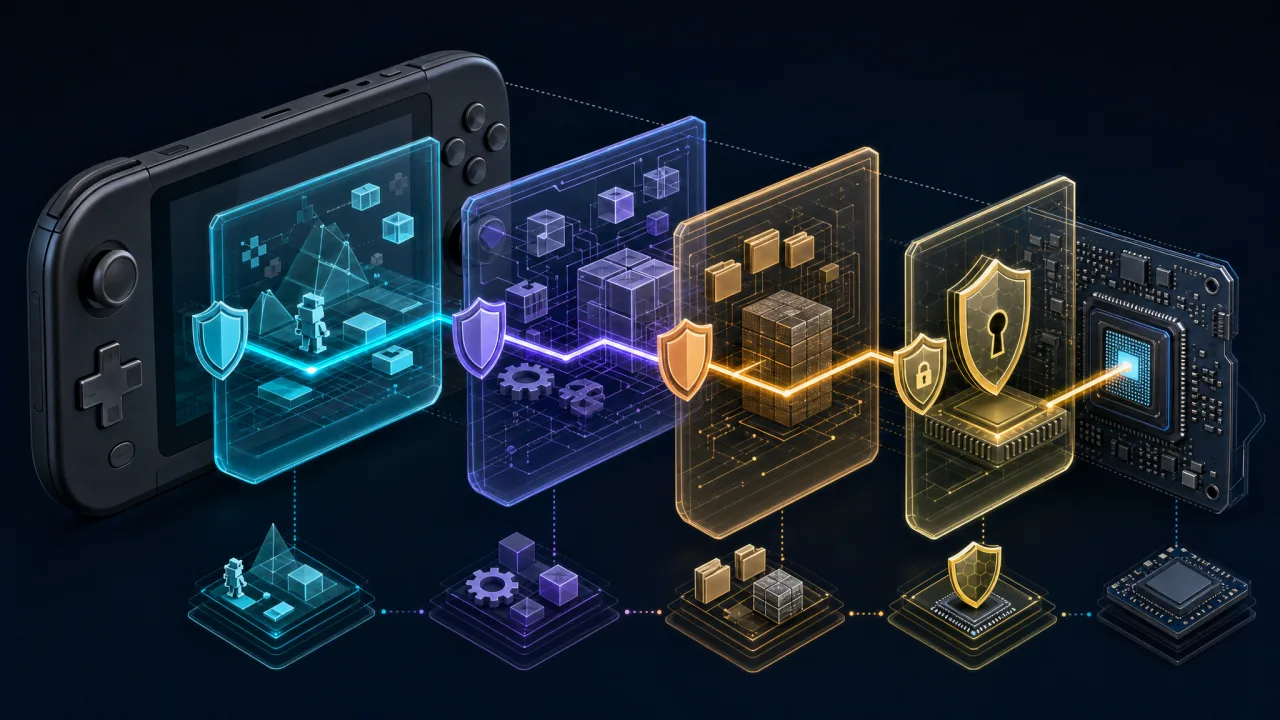
The most important part of NS2JB is not that it begins in SmileBASIC. The more consequential step is where the chain eventually goes: a privileged background component of the operating system commonly called the filesystem service, or fs sysmodule.
Modern consoles are not governed by one monolithic program. They are collections of cooperating components. A game, a system menu, a controller service, an update service, and a filesystem service may all run as separate processes or modules. Each component receives only the permissions it needs, at least in principle. This division is called privilege separation.
A game should be able to read its own assets and save data, for example, but it should not automatically be able to rewrite the operating system. A controller service may communicate with input hardware, but it should not have unrestricted access to every user file. A filesystem service needs broader authority because other programs depend on it to open, create, verify, and manage files.
These boundaries are designed to limit damage. If an ordinary application crashes, the ideal outcome is that the application closes while the rest of the console remains protected. If a highly privileged system service contains a memory-safety flaw, however, the consequences can be much more serious. Control of that service may provide a path to operations that are unavailable to ordinary applications.
NS2JB's reported chain is therefore best understood as a progression across boundaries. It starts with a bug in the Nintendo Switch version of SmileBASIC running on Switch 2, uses that environment to obtain increasingly useful memory access, and then targets a privileged operating-system service. The significance lies in that transition, not merely in the presence of an application-level vulnerability.
What “sysmodule” means
A sysmodule is a system component that performs work on behalf of the operating system or other software. The name is more useful as a category than as a promise of identical architecture across every platform. In practical terms, these services sit below ordinary games and applications and above the deepest firmware and hardware mechanisms.
Some services handle audio, networking, controllers, displays, accounts, or storage. They may communicate with one another through operating-system interfaces rather than directly exposing their internal implementation to every application. Those interfaces create boundaries: one process asks another to perform an approved operation, and the receiving service decides what it can do.
Privilege is not one simple ladder. A component may have access to a particular device, filesystem area, or kernel interface while lacking access to other protected resources. The reported NS2JB result should therefore not be translated into “complete control of the console.” The verified claim is more specific: native code can run with the permissions of ordinary sysmodules and with the filesystem service's privileges.
That distinction matters. A service-level foothold can be highly valuable for research without automatically defeating every remaining security layer. It does not establish that all processes can be controlled, that every encrypted or authenticated object can be opened, or that the system can be permanently replaced.
Why the Filesystem Service Is Such a Valuable Target
Nearly every useful activity on a game console touches storage. Games load executable code, textures, audio, patches, downloadable content, configuration files, and save data. The system reads update packages and verifies metadata. Applications ask for handles to files and directories rather than directly manipulating storage hardware.
The filesystem service is valuable because it stands at that intersection. It can interpret paths, enforce permissions, open storage objects, check metadata, and mediate requests from other software. It is not necessarily the only important security component, but it is a particularly strategic one.
Control of a storage mediator can change what another component receives. A program may believe it has opened a particular file, while the filesystem layer has actually selected, transformed, or supplied the underlying object. In a well-designed system, cryptographic verification and access controls are meant to ensure that this substitution cannot result in unauthorized executable code being accepted.
NS2JB's reported chain attempts to operate at precisely that junction. The write-up describes a path-normalization-related memory corruption in the filesystem service that can be converted into arbitrary read and write access inside that service. In plain language, the service is made to read from or write to locations it was not supposed to touch.
That is a serious class of flaw because the vulnerable code is not an isolated document viewer or an unprivileged game. It is code that helps the operating system decide which stored objects exist and how they should be delivered to other components.
Path normalization in plain language
A path is a description of where something is stored. It may contain directory names, separators, relative references, or special components that mean “move up one directory.” Before a service acts on a path, it generally needs to turn different textual descriptions into a consistent internal form.
This process is called normalization. A normalized path might remove redundant separators, resolve relative-directory markers, and enforce rules about which locations are valid. The goal is to make security decisions about the actual destination rather than about an ambiguous spelling of that destination.
Path handling becomes dangerous when the rules used to validate a path differ from the rules used to access it. A check may conclude that a path remains inside an approved directory, while a later parser interprets the same string differently. A service may also mishandle unusual lengths, unexpected separators, or edge cases created when path components are combined.
The fact pack identifies the reported issue as a path-normalization-related memory corruption. It does not establish that every path-handling error has the same effect, nor does it justify generalizing the result to unrelated operating systems. In this case, the reported outcome is that the corruption can be developed into arbitrary read and write access within the filesystem service.
Why privilege changes the threat model
Memory corruption in an ordinary application is already undesirable, but its reach may be constrained by the application's permissions. Memory corruption in a privileged service is different because the attacker is not merely trying to make one game misbehave. The attacker is attempting to make an operating-system component perform actions using its own authority.
This changes the threat model in two ways. First, the vulnerable process may be able to access resources that an application cannot. Second, the service may be trusted by other components. A game does not have to persuade every protected subsystem directly if it can influence a service that those subsystems already rely upon.
That does not mean the service is a universal master key. Privilege boundaries can be layered. A process may possess filesystem authority but still lack kernel-level control, boot-time control, or the ability to alter code that is verified elsewhere. The result is a stronger position inside the system, not proof that every boundary has disappeared.
For public-interest security reporting, this distinction is important. Describing a privileged-service exploit as “full system access” can mislead readers about both capability and risk. The verified description is narrower and more useful: NS2JB reportedly reaches native execution in a service with ordinary sysmodule permissions and the filesystem service's privileges.
The Signed-Content Trust Chain
Consoles do not normally execute every binary found in storage. They use a trust chain: a series of checks intended to establish that software was authorized and has not been altered. The exact implementation can be complicated, but the general idea is straightforward.
Imagine a sealed package containing a program. A signed metadata record identifies what the package is, how it is structured, and which cryptographic hashes should describe its contents. A trusted verifier checks the signature on that metadata. It then checks the relevant filesystem objects against the recorded hashes. If both stages agree, the loader has evidence that it is handling an approved executable rather than an arbitrary replacement.
There are several layers in that description. A digital signature helps establish that metadata was produced by a trusted signer. A hash helps establish that a particular object matches the content described by the metadata. The filesystem service supplies or mediates the objects that the loader examines. The loader then creates a process from the accepted executable.
This arrangement is designed to make simple file replacement ineffective. Changing the executable should change its hash, causing verification to fail. Changing the metadata should invalidate its signature, causing the earlier trust check to fail. Security depends not only on the cryptography but also on the correctness of the code connecting these stages.
The reported object-substitution concept
Hajhamid's write-up describes a way to exploit the filesystem service after valid signed metadata has already been accepted. At a high level, the service can be made to substitute an executable filesystem object while the loader still sees metadata that appears valid.
This is not the same as forging a Nintendo signature. The reported concept instead targets the relationship between the trusted description and the object ultimately supplied to the loader. If the loader accepts the signed description at one point and later receives a different executable object through a compromised service, the trust chain can be undermined without breaking the underlying signature algorithm.
The timing aspect is central to the explanation. A loader may perform checks in one phase and use the resulting object in another. If a privileged service can alter what is supplied between those phases, the object that was checked and the object that is executed no longer match in the way the designers intended.
This kind of issue is often discussed using the shorthand “time of check versus time of use.” The phrase describes a general design hazard: a security decision is made about a resource, but the resource changes before it is used. The exact NS2JB mechanism must not be reduced to a generic recipe, and the public material does not establish compatibility beyond the stated software versions.
The important conceptual point is that trust can fail at the handoff between components. Strong signatures do not by themselves correct a compromised privileged service that is trusted to deliver the object being checked or launched.
What Native Execution at Sysmodule Privileges Means
“Native execution” means that processor-level code is running inside the target service rather than merely using the application's normal scripting or extension interfaces. That is a meaningful change in capability. Native code can interact with the service's memory and call conventions in ways ordinary application logic cannot.
In NS2JB's reported case, the execution occurs with permissions associated with ordinary sysmodules and with the filesystem service. This can make it possible to inspect service behavior, experiment with storage-related interfaces, and investigate how the operating system handles protected resources.
It still does not mean that every application, every security boundary, or every boot stage is automatically controlled. Native code inherits the limits and risks of the process in which it runs. Reaching a service is not identical to reaching the kernel. Reaching a running service is not identical to changing what happens before the operating system starts.
The distinction also explains why the project is described as a proof of the primitive rather than a finished custom-firmware distribution. A research demonstration can show that code execution is possible and can validate the relevant memory-access behavior without providing a stable, user-facing operating environment.
What the Public Demonstration Does—and Does Not—Prove
The public demo reportedly runs small native functions inside the filesystem service, checks their results, restores the original instructions, and cleans up. Restoration is a significant detail. It indicates that the demonstration is designed to minimize the lasting changes made during a run rather than leave a permanently modified system image behind.
Cleanup does not make the technique risk-free. Temporary changes can still crash the console, damage data, expose information, or trigger security responses. It also does not turn a service-level proof of concept into custom firmware. It shows a controlled demonstration of the claimed primitive, not a general-purpose replacement for the operating system.
The demo is also timing-sensitive. The repository reports that a physical test in October 2026 succeeded on the third fresh boot after two attempts stopped at validation checks and cleaned up. That account is useful evidence of variability, not a reliability guarantee. It shows that the published demonstration can be sensitive to run conditions and that a successful result for one setup should not be assumed for every console.
The demonstration retains the tethered and non-persistent limits explained earlier: a separate computer participates in establishing the runtime state, restarting ends that state, and the public demo does not install custom firmware.
Demonstrated Capabilities and Future Research
Capabilities associated with the public claim
The fact pack attributes several possible uses to the reported capability set. These include homebrew experimentation, reverse engineering and game modding, save-data backup, and exploration of peripherals through memory-mapped I/O. Those categories describe research directions and claimed capability, not a guarantee that every tool or project will work.
- Homebrew experimentation: Researchers may investigate software that is not part of Nintendo's normal application distribution model, subject to the limits of the available privileges and runtime.
- Reverse engineering: Analysts may study how software and services behave, which can improve understanding of the platform and identify additional defensive issues.
- Game modification research: Native access may support experimentation with game behavior, though compatibility, stability, online policy, and ownership rules remain separate questions.
- Save-data work: The claimed capability set includes backing up saves. Backup reliability and the legal status of particular uses vary, and a backup feature does not imply that protected content can be copied or restored without restrictions.
- Peripheral research: Memory-mapped hardware interfaces may provide opportunities to study connected devices, but access to one class of interface does not establish unrestricted control of every peripheral.
What remains future research
Broader custom-firmware goals remain a separate research problem. The write-up says the method does not provide the same capabilities as a modchip and identifies additional work as necessary. A running service-level foothold does not automatically provide a permanent boot-time modification, a universal loader, or a stable platform for every homebrew application.
It is also not evidence of safe piracy, online cheating, or the defeat of ownership checks. None of those outcomes follows automatically from native code execution in the filesystem service, and the project should not be represented as endorsing them.
Compatibility is another unresolved boundary. The public claim and repository are tied to SmileBASIC version 4.4.9 and Switch 2 system software 23.0.1. The facts provided do not establish compatibility with earlier or later firmware, other SmileBASIC versions, different hardware revisions, or future updates.
| Capability or question | Verified position | What should not be inferred |
|---|---|---|
| Native code execution | Reported inside the filesystem service with ordinary sysmodule and fs privileges | Automatic control of every process or the kernel |
| Persistence | Not persistent; reboot ends the modified runtime state | A permanent jailbreak or installed custom firmware |
| Storage research | Includes claimed save backup and filesystem-oriented experimentation | Unrestricted access to all protected content |
| Game modification | Reverse engineering and modding are among the claimed research uses | Safe online cheating or universal compatibility |
| Hardware research | Peripheral exploration through memory-mapped I/O is identified as a possible use | Control over every device or hardware security layer |
| Software versions | Public materials specify SmileBASIC 4.4.9 and system software 23.0.1 | Compatibility with arbitrary versions |
How NS2JB Compares With Other Kinds of Console Exploit
Terms such as “browser exploit,” “custom firmware,” “boot-ROM exploit,” and “modchip” are often used interchangeably in casual discussion. They describe different points in the platform's startup and trust model. Comparing them helps explain both what NS2JB accomplishes and what it does not.
| Category | Typical entry point or property | Persistence | How NS2JB differs |
|---|---|---|---|
| NS2JB | Application and service chain beginning in the Switch version of SmileBASIC, reaching the filesystem service | Tethered and nonpersistent | Targets a running privileged service; does not install custom firmware or replace boot-time trust |
| Browser exploit | A vulnerability in a browser or web-rendering component | Usually nonpersistent unless combined with additional exploits | NS2JB is not a browser-based jailbreak; a separate WebKit avenue was explored but was not the published successful chain |
| Persistent custom firmware | A software environment that remains available across restarts through changes to startup or system components | Persistent by design | NS2JB's public demo disappears on reboot and is not a finished custom-firmware distribution |
| Boot-ROM exploit | A flaw in immutable or earliest-stage startup code | Generally powerful and difficult for later software updates to remove | NS2JB is not a boot-ROM exploit and does not claim that kind of foundational access |
| Modchip | Additional hardware that influences startup or hardware-level behavior | Typically persistent while installed | NS2JB is software-only and the write-up says it does not provide the same capabilities as a modchip |
NS2JB versus a browser exploit
A browser exploit normally begins when a specially crafted page reaches a vulnerable parser, renderer, or scripting engine. The browser is attractive because it handles complex, attacker-influenced content, but browser code generally starts with application-like permissions. A complete jailbreak may therefore require several additional stages to cross process and kernel boundaries.
NS2JB does not fit that pattern. Its initial path uses the Nintendo Switch version of SmileBASIC rather than relying on a Switch 2 browser exploit. The research explored a separate WebKit avenue, but that avenue did not become the published successful chain.
The comparison is not a ranking. A browser bug can be extremely valuable when paired with further privilege escalation. It simply begins in a different component and should not be used as a label for NS2JB.
NS2JB versus persistent custom firmware
Custom firmware generally refers to a sustained software environment that changes how the console operates, often by loading modified components during startup or by providing a continuing homebrew interface. Persistence is the defining practical difference: after a restart, the environment remains available or can be relaunched without repeating the original vulnerability chain in the same way.
NS2JB is explicitly nonpersistent. Restarting the console ends its modified runtime state, and the public demo does not install custom firmware. The need for a separate computer to participate in launching the exploit is another reason to describe it as a tethered jailbreak rather than a finished custom-firmware solution.
NS2JB versus a boot-ROM exploit
Boot-ROM code runs at one of the earliest stages of startup and is often stored in hardware that cannot be updated through an ordinary system update. A flaw there can have unusual durability because later software may be unable to repair the vulnerable code already embedded in the device.
NS2JB does not claim such a position. Its chain begins in application software and proceeds through runtime services. Even if it reaches a highly useful privileged component, that does not make it a boot-ROM exploit. It remains subject to the limits of the running software environment and the exact versions for which the chain was reported.
NS2JB versus a modchip
A modchip is physical hardware installed to influence the console's startup or other low-level behavior. It can offer a persistent foothold because the hardware remains present across reboots. That does not make every modchip safe or lawful, but it explains why a software-only, tethered method should not be presented as an equivalent.
NS2JB requires no reported hardware modification and is described as software-only. Its runtime state ends when the console restarts. The author's write-up specifically says the method does not provide the same capabilities as a modchip. The difference is therefore both practical and architectural: one operates through a temporary software chain, while the other changes the physical environment in which the console starts or runs.
Why the Boundaries Matter
NS2JB's significance is best captured by the boundary it crosses. It is not simply an application crash, because the reported chain reaches a privileged filesystem service. It is not a boot-ROM compromise, because it does not establish control at the earliest startup layer. It is not persistent custom firmware, because rebooting removes the modified runtime state. And it is not a modchip, because it does not add hardware or provide equivalent capabilities.
The result is a technically interesting middle ground: a software-only, version-specific, tethered research chain that reportedly reaches native execution in a service trusted with important filesystem operations. That is enough to make the work relevant to homebrew researchers, reverse engineers, preservationists, and platform defenders while leaving substantial questions about reliability, scope, persistence, and future development.
What NS2JB Cannot Currently Do
NS2JB is best understood as a narrow, version-specific research result, not as a finished replacement operating system for Nintendo Switch 2. The published claim concerns a software-only, tethered jailbreak for Nintendo Switch 2 system software 23.0.1, using the Nintendo Switch version of SmileBASIC. That scope matters. A proof that reaches native code execution in selected system services is significant, but it does not automatically translate into unrestricted control of the console.
NS2JB is not a boot-ROM exploit. It does not establish control at the earliest immutable stage of the console’s startup process. It is not persistent: restarting the console ends the modified runtime state, and the public demonstration does not install custom firmware. Because it is tethered, a separate computer participates in launching the process, and the process must be repeated after a reboot.
That does not mean the console remains physically connected to a computer during ordinary play. “Tethered” describes how the modified state is started, not a requirement that a cable or network connection remain present at all times. The distinction is important because the word is often used loosely in jailbreak coverage.
NS2JB is also not a modchip replacement. A modchip operates at a different point in the platform’s trust chain and can provide capabilities that this software path does not currently provide. The research write-up explicitly identifies further work as necessary before broader custom-firmware goals could be claimed.
Nor does the project demonstrate compatibility with arbitrary firmware versions, earlier releases, later releases, different SmileBASIC versions, or every hardware revision. The public claim is tied to the specific software combination documented by the researcher. Applying the label “Switch 2 jailbreak” to the entire product line would therefore overstate what has been shown.
The public demonstration is not a consumer-ready custom firmware distribution. It runs small native functions inside the privileged filesystem service, checks their results, restores the original instructions, and cleans up. That is a useful proof of an execution primitive. It is not equivalent to a mature homebrew environment with stable APIs, broad hardware support, installers, recovery tools, or a tested application ecosystem.
The claimed capability set includes homebrew experimentation, reverse engineering and modding games, save backups, and exploration of peripherals through memory-mapped input and output. Those possibilities remain materially different from unrestricted access to every security boundary. Native code execution with the permissions reported in the write-up does not mean every protected component, account system, online service, or ownership check has been defeated.
Reliability Is a Separate Question From Feasibility
A proof of concept answers one question: can the researchers make the chain work under the documented conditions? It does not answer every question that matters to an ordinary console owner.
The public demo is timing-sensitive. The repository records a physical test in which the process succeeded on the third fresh boot after two attempts stopped at validation checks and cleaned up. That detail is not evidence of failure; experimental security research routinely involves retries and controlled variation. It is, however, evidence that the demonstration should not be described as a one-click, deterministic consumer tool.
Reliability can vary with system state, timing, storage contents, software versions, network conditions, peripherals, and differences between test units. The fact that a researcher succeeded on a particular setup does not guarantee that another user will obtain the same result. Nor does a successful run prove that an unsuccessful run is harmless.
There is also a difference between “the chain reached its intended endpoint” and “the console remained healthy afterward.” A proof-of-concept author may deliberately limit the demonstration, restore modified instructions, and clean up temporary state. A repackaged or altered copy may not behave in the same way. Even a faithful implementation could expose edge cases that were not visible during a small number of tests.
For that reason, maturity should be judged by more than whether source code is publicly available. Useful indicators include independent review, reproducible builds, documented recovery procedures, testing across multiple units, clear version boundaries, transparent change history, and a community capable of identifying malicious or defective releases. NS2JB’s public status, as described in the supplied material, is closer to an important research proof than to a mature end-user platform.
Why version specificity matters
Modern consoles are collections of tightly coupled software components. A change to one service can alter memory layout, validation behavior, timing, or the availability of an entry point. A system update may close one weakness while changing unrelated assumptions on which later parts of a research chain depend.
NS2JB’s documented requirements include Nintendo Switch 2 system software 23.0.1 and SmileBASIC 4.4.9. Those numbers define the claim’s boundary; they do not form a general compatibility promise. Readers should treat statements about other versions as unverified unless the researcher specifically confirms them.
The same caution applies to hardware revisions. Nintendo Switch 2 launched on June 5, 2025, and its platform includes a custom NVIDIA processor, fast internal storage, wireless connectivity, a built-in microphone, and other hardware that may be relevant to future research. None of those platform facts proves that the published chain works on every unit, and hardware specifications should not be confused with exploit compatibility.
Risk Is Broader Than “Could It Brick?”
“Bricking” is the most familiar warning attached to console modification, but it is only one category of risk. A more complete assessment includes the console, its data, its network environment, its accounts, and the software supply chain around the project.
System and console risk
An unstable modification can cause crashes, hangs, unexpected reboots, or loss of functionality. A temporary failure may disappear after a restart. More serious damage could affect system software, storage contents, or the ability to use particular features. The supplied policy material also notes the possibility of permanent or temporary loss of functionality when unauthorized modifications or software are involved.
There is no basis for promising that a reset will always repair a failed experiment. Nor should a reader assume that because the public demonstration restores original instructions, every derivative tool or future variation will do the same. A package made by an unknown party may contain additional changes that are not obvious from its description.
Save-data and storage risk
Save data is valuable even when it is not irreplaceable in a legal or financial sense. It can represent hundreds of hours of progress, locally stored settings, creative work, or records that are not fully reproduced by online synchronization.
Research software can crash while reading or writing data. A corrupted save may affect one game, several games, or a broader storage operation, depending on what was being accessed. “Backing up saves” is a stated area of interest for the project, but the existence of a research primitive does not make every backup path safe, complete, or officially supported.
Readers should therefore separate a defensive backup strategy from an experiment. Preserve important data using ordinary, supported mechanisms where available, and do not treat a backup made by an unreviewed tool as the only copy. Irreplaceable information should not live solely on research hardware.
Online-service and account risk
A modified runtime can change what the console sends, receives, stores, or exposes while connected to a network. This creates uncertainty around online play, account services, telemetry, cloud-related functions, and other platform features. Even if a particular demonstration does not target those systems, it does not follow that an altered environment is invisible to them.
Possible consequences include loss of online services, account enforcement, removal of content obtained through unauthorized devices or modifications, or other restrictions imposed under Nintendo’s policies. The exact outcome can depend on facts that are not publicly predictable, including what software ran, what data was altered, and how Nintendo detects or interprets it.
Using a primary account on experimental hardware increases the cost of an adverse outcome. The same is true of keeping payment information, irreplaceable saves, or other sensitive material on the device. Isolation reduces exposure; it does not guarantee safety.
Privacy and local-network risk
The documented requirements place the computer and console on the same reachable network. That fact alone does not establish malicious behavior, but it means the research environment involves communication between two devices. Readers should understand what software is running on the computer, what permissions it has, and what information could be visible to it.
Untrusted packages can expose local files, credentials, network traffic, or identifying information. A malicious tool may do more than attempt the advertised task. It could include unrelated surveillance, destructive behavior, or a hidden remote-access component. Public availability of source code does not prove that a distributed package matches that source, and a familiar project name does not authenticate every file carrying it.
A defensive approach is to use a segregated research computer, avoid sensitive accounts on that machine, review the project’s source and release history, verify release integrity where trustworthy verification information exists, and wait for independent community review. These precautions address risk; they do not explain how to launch the jailbreak.
Supply-chain and malicious-repackaging risk
Security research attracts both careful contributors and opportunists. Once a project becomes newsworthy, malicious actors can publish files that imitate its name, branding, documentation, or screenshots. They may advertise an easier version, a newer compatibility claim, or a supposed recovery utility.
The NS2JB repository’s packaging details make this especially relevant. The public package is a computer-side archive rather than a SmileBASIC import file, and the repository states that there is no published SmileBASIC download key. Confusion over those facts can create an opening for fake “keys,” modified archives, or unofficial mirrors.
Readers should be suspicious of packages that demand unrelated credentials, bundle unexplained software, disable security tools, or promise compatibility beyond the verified version boundary. They should also be wary of tutorials that remove safety checks, conceal their provenance, or pressure users to act before independent review. No article can certify an unverified download merely because it uses the right project name.
Nintendo’s Agreement and the Question of Law
Nintendo’s Switch 2 User Agreement, effective September 2026, prohibits a broad range of activity involving the platform and its software. The listed restrictions include publishing, copying, modifying, reverse engineering, decompiling, disassembling, bypassing or defeating protections, installing unauthorized software, and exploiting software outside its intended use.
The agreement also says Nintendo may remove content obtained through unauthorized devices or modifications and may render the console or software permanently unusable in whole or in part when it determines or suspects a violation.
Those are platform rules and contractual terms. They are not a universal summary of copyright law, computer-misuse law, consumer rights, research exceptions, or preservation rules. The legal position can vary by jurisdiction, purpose, device ownership, distribution method, and the specific act involved. Readers should not treat this article as legal advice.
That distinction cuts in both directions. A platform agreement may impose consequences even where a person believes an activity is lawful under local law. Conversely, a contractual prohibition does not by itself settle every question about what a jurisdiction permits. Anyone conducting serious research, distributing tools, or working with preserved software should seek advice qualified for the relevant location and facts.
“Homebrew,” “preservation,” and “piracy” are not interchangeable terms. Homebrew generally refers to independently created software made to run outside an official development and distribution pipeline. Preservation can involve documenting hardware, software behavior, or access to works that might otherwise disappear. Piracy generally involves unauthorized copying, distribution, or access to copyrighted material. A technical capability may be usable in all three contexts, but that does not make the contexts morally, contractually, or legally equivalent.
Cheating is another separate category. Modifying a local game for research or accessibility is not the same as manipulating online play to gain an unfair advantage. The project’s claimed capabilities do not establish that online cheating is safe, lawful, supported, or part of the research. Nor does native code execution prove that ownership checks or network protections have been bypassed.
Responsible Research and Preservation
Responsible work begins with a narrow question and a controlled environment. Researchers should define what they are trying to learn, avoid unnecessary access to personal data, document the exact software versions involved, and preserve an unmodified reference environment for comparison. They should record failures without publishing operational details that would unnecessarily increase harm.
Good disclosure practices matter as much as technical novelty. Researchers who identify a platform weakness should consider notifying the affected vendor, allowing time for assessment, and clearly separating verified behavior from speculation. Public documentation should explain the security significance without turning every reader into an operator.
Preservation work benefits from restraint. A preservationist may care about documenting a system, studying obsolete formats, or keeping legally obtained personal data usable. Those goals do not require distributing copyrighted game files, bypassing ownership checks, or encouraging people to connect modified systems to online services. Safer projects can focus on documentation, archival metadata, emulation research where lawful, and tools that operate on user-created or legitimately acquired material.
Homebrew developers likewise benefit from clear boundaries. Independent software can be written without bundling proprietary assets, encouraging unauthorized copies, or promising access to commercial content. A healthy ecosystem should make it easy to distinguish original applications, research utilities, copyrighted game data, and unofficial modifications.
Defensive Precautions Without an Operational Tutorial
- Do not use a primary console as the only research device. A separate unit reduces the consequences of crashes, enforcement, and data loss.
- Keep irreplaceable saves and personal files elsewhere. Use supported backup options where available, and maintain more than one copy of important material.
- Separate accounts and credentials. Avoid exposing a primary Nintendo account, payment details, work credentials, or private files to an experimental computer or console.
- Review provenance. Prefer the researcher’s documented release channels, inspect source where possible, and be cautious about repackaged archives and unofficial “fixes.”
- Check integrity information. When a project provides trustworthy release verification, compare the file you obtained with that information. An integrity check does not prove that the project is safe, but it can detect accidental or malicious alteration.
- Isolate the research network. A separate network or restricted environment can reduce exposure of unrelated devices and files. It cannot make untrusted software trustworthy.
- Do not disable security controls casually. Requests to turn off protections, grant broad permissions, or run unexplained bundled software deserve scrutiny.
- Read the version boundary. Do not assume a guide or package applies to a different system release, SmileBASIC release, hardware revision, or region.
- Wait for review. Independent analysis, recovery documentation, and reports from multiple researchers are stronger evidence of maturity than a viral demonstration.
- Accept the possibility of doing nothing. Waiting is a legitimate risk-management decision, especially when the goal is curiosity rather than a necessary preservation task.
How Nintendo and the Community May Respond
Nintendo may respond through software updates, changes to validation and service behavior, enforcement against accounts or consoles, legal action, or some combination of those measures. The company’s agreement reserves broad consequences when it determines or suspects violations, but no particular response should be assumed in advance.
A system update could close the specific weaknesses described in the research, alter the behavior of affected services, or make the documented version combination unavailable to new users. It might also change unrelated features. Conversely, the existence of a public proof does not mean Nintendo will immediately explain its technical response.
The research community is likely to focus on reproducibility, version analysis, defensive understanding, and safer tooling. Independent reviewers may inspect the chain, identify assumptions, test whether reports are being overstated, and examine distributed packages for tampering. Developers may build legitimate homebrew experiments around documented primitives, while platform researchers may investigate the remaining boundaries without claiming that they have already been crossed.
Community response can also create risk. Pressure to produce an easier package can encourage rushed releases, poor disclosure, or unsafe repackaging. Responsible coverage should reward accurate scope rather than dramatic claims about “full control,” “free games,” or guaranteed compatibility.
Plain-Language Glossary
Arbitrary read/write
A capability that lets software read from or write to memory locations beyond the narrow operation originally intended. In security research, it is powerful because it can allow one vulnerability to influence unrelated data or code. It is not the same as automatically controlling every part of a system.
Boot ROM
Code stored in a read-only part of a device and used very early in startup. A vulnerability at this level can be unusually durable because later software updates may not be able to replace the affected code.
Brick
A state in which a device loses some or all useful functionality. A soft brick may be recoverable; a permanent brick may not be. The word is often used broadly, so reports should specify what actually stopped working.
Custom firmware
A replacement or modified system-software environment that changes how a device operates. NS2JB’s public demonstration is not a finished custom firmware distribution.
Exploit
A technique that uses a software or hardware weakness to produce behavior outside the system’s intended design.
Filesystem service or fs sysmodule
A privileged system component responsible for filesystem-related operations. NS2JB’s reported chain reaches native code execution with the permissions of ordinary system modules and the filesystem service’s privileges.
Homebrew
Software created independently of the official platform holder’s development and distribution channels. Homebrew is not synonymous with piracy.
Integer overflow
A calculation result that exceeds the range a fixed-size number can represent. If software handles the result incorrectly, a small or ordinary input can lead to an unexpected size, index, or memory operation.
Jailbreak
A general term for defeating restrictions that limit what software a device may run or what a user may access. The term does not specify how broad, permanent, reliable, or legally permitted the result is.
Memory corruption
A condition in which software changes memory in a way the program did not intend. Corruption may cause a crash, incorrect behavior, or a security vulnerability.
Native code execution
The ability to run machine-level instructions in a process or service rather than being limited to the application’s ordinary scripting or data functions.
Out-of-bounds access
Reading or writing outside the memory area assigned to an object, array, or buffer. It is a common class of software flaw and can expose data or alter unrelated state.
Persistent
Still present after a restart. NS2JB is described as non-persistent because restarting the console ends the modified runtime state.
Privilege
The permissions available to a process or service. Code running with filesystem-service privileges is more powerful than ordinary application code, but it is not automatically equivalent to total platform control.
Proof of concept
A demonstration that a security idea works under defined conditions. A proof of concept may lack the reliability, interface, recovery tools, testing, and safeguards expected from consumer software.
Return-oriented programming
A technique that combines short sequences of existing machine instructions to achieve a new behavior, often when directly injecting new code is restricted. The concept can be explained without publishing a usable chain.
Signed metadata
Information authenticated with a cryptographic signature to show that it came from an approved source and was not altered. Correctly signed metadata does not necessarily guarantee that every object used alongside it is safe if a separate service can be manipulated.
Supply chain
The chain of people, tools, source code, build systems, archives, and distribution channels through which software reaches a user. Weakness anywhere in that chain can produce a malicious or altered package.
Tethered
Dependent on a separate launching step, commonly involving another computer, after a reboot. It does not necessarily mean a permanent physical connection during use.
Frequently Asked Questions
Does NS2JB permanently unlock a Switch 2?
No. The verified description calls it tethered and non-persistent. Restarting the console ends the modified runtime state, and the public demo does not install custom firmware.
Does it work on every Switch 2?
That has not been established. The documented claim is tied to system software 23.0.1, SmileBASIC 4.4.9, and the researcher’s tested conditions. Compatibility with other versions or hardware revisions should be treated as unknown.
Is NS2JB a browser jailbreak?
No. The published successful chain begins with the Nintendo Switch version of SmileBASIC. A separate WebKit avenue was explored but did not become the published successful chain.
Does a successful run install custom firmware?
No. The public demonstration runs selected native functions inside the filesystem service, validates results, restores original instructions, and cleans up. That is a proof of the underlying capability, not a finished custom-firmware platform.
Does native code execution mean full control?
No. It means code can run with the reported service permissions. Other security boundaries, services, ownership systems, online systems, and hardware protections may remain outside that capability.
Can it be used for piracy?
The verified material does not establish that piracy is safe, lawful, supported, or part of the project. A technical capability should not be treated as permission to copy or distribute copyrighted software.
Can it be used to cheat online?
Nothing in the verified claim establishes safe or reliable online cheating. Connecting a modified environment to online services can create additional technical, account, and policy risks.
Could a failed attempt erase my saves?
Data loss is a practical risk whenever experimental software can crash or interact with storage. The supplied material does not provide a guarantee of save safety. Important data should not exist only on research hardware.
Can Nintendo ban an account or console?
Nintendo’s September 2026 agreement says it may remove content obtained through unauthorized devices or modifications and may render the console or software permanently unusable in whole or in part when it determines or suspects a violation. The exact response to any particular case is not predictable.
Is the project illegal?
That cannot be answered universally from the available facts. Nintendo’s agreement prohibits a broad range of modification and circumvention activity, but contract terms are not a complete statement of every jurisdiction’s law. Legal outcomes vary with location and circumstances.
Is open-source code automatically safe?
No. Source availability can improve auditability, but users may run a different binary from the one they inspected. Dependencies, build systems, release archives, and unofficial repackaging can all introduce risk.
Why is the lack of a published SmileBASIC download key relevant?
It helps distinguish the documented package from claims that a key or an unofficial installer is required. It also gives readers a reason to distrust files that demand unexplained credentials or present themselves as an “official” missing component.
What is the safest way to learn about the project?
Read the researcher’s technical explanation and repository documentation, compare them with independent security analysis, and keep the activity theoretical or isolated unless there is a compelling, lawful research reason to proceed. This article intentionally does not provide launch instructions.
Does tethered mean the console must stay connected to a computer?
No. It means the modified state depends on a separate launching process and is lost after a restart. It does not by itself describe what happens during all normal use.
Why should readers care if they never plan to modify a console?
The research illustrates how application-level flaws, memory corruption, privileged services, signed metadata, and supply-chain trust interact in a modern platform. It also shows why a narrow proof of concept should not be confused with a universal unlock.
A Narrow Result With Wide Consequences
NS2JB is important because it demonstrates a carefully constructed path from a software flaw in SmileBASIC to native execution in a privileged Switch 2 service under a tightly defined version boundary. That is meaningful security research. It is not, however, a finished product, a permanent unlock, a modchip substitute, or a promise of unrestricted homebrew.
The responsible response is to preserve the distinction between what has been demonstrated and what remains uncertain. Researchers can study the implications, developers can pursue legitimate homebrew, and preservationists can document the platform without collapsing those activities into piracy or cheating. Users who value their saves, accounts, online access, and hardware should treat unreviewed packages and unsupported versions as avoidable risks, not invitations.
NS2JB’s lasting significance may therefore be less about an immediate consumer jailbreak than about the security lessons exposed by the chain: version boundaries matter, privileged services deserve scrutiny, signed metadata is not the end of a trust analysis, and public code does not eliminate supply-chain danger. Until the project receives broader independent validation and safer surrounding tooling, its proper place is as a constrained research result—not a reason to gamble with a primary console.