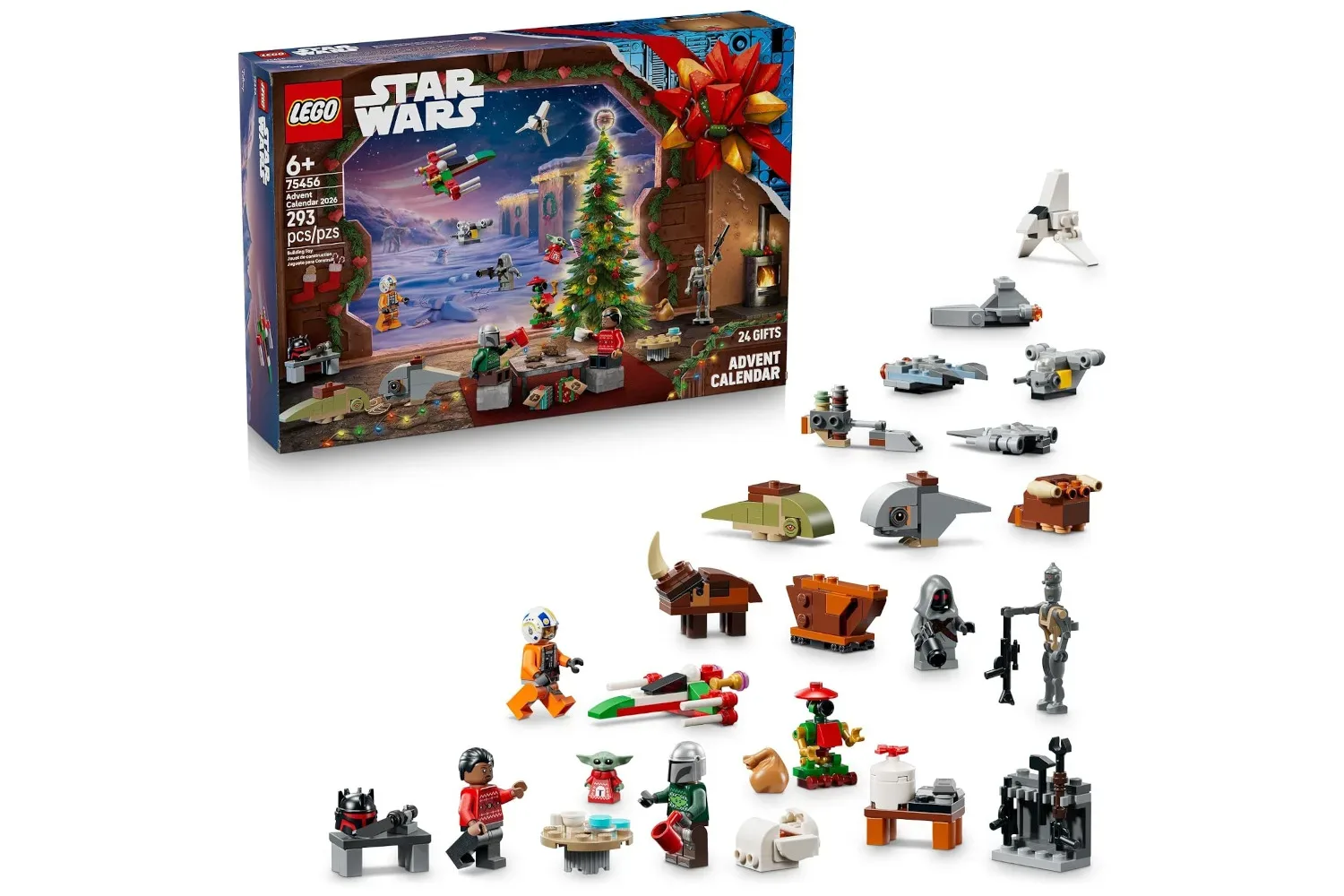
A LEGO Star Wars Advent Calendar is listed at $30, reduced from its stated regular price of $45. That is a $15 reduction, or roughly one-third off, for a set designed to turn a single box into 24 separate December openings.
The calendar contains 293 pieces distributed behind its 24 doors. Rather than functioning as one large build that is completed immediately, it parcels out its components across the month: each day produces a small LEGO surprise, whether that is a miniature build, an accessory, an animal, furniture, or a minifigure.
For Star Wars fans, that format is the central appeal. It combines the short, repeatable ritual of an advent calendar with a licensed building-toy collection that can remain useful after the last door is opened. The pieces are standard LEGO components, so the set’s contents can be incorporated into other LEGO Star Wars displays and play sessions rather than being limited to December.
What the $30 set includes
The reported calendar has 24 doors and 293 total pieces. Individual compartments include a mix of small builds and character-focused items, meaning the experience is deliberately varied from day to day instead of being 24 identical mini-models.
For more context, explore Call of Duty: Modern Warfare 4 Preload, Campaign Early Access and Launch Times Explained.
Its seasonal angle is also more than a decorative box. Some minifigures are Christmas-themed, including a Grogu figure in a Christmas jumper. That makes the calendar a hybrid of franchise merchandise and holiday display item: it can be opened gradually, but its distinctive seasonal figures may also be worth saving for a festive LEGO scene in later years.
“Minifigure” is LEGO’s term for its small articulated character figures. In practical terms, minifigures usually matter most to people building scenes, collecting character variations, or looking for recognizable focal points in a larger setup. A holiday-themed version does not turn the calendar into a rare-item guarantee, but it does give the set an identity beyond a generic assortment of bricks.
The smaller non-character items serve a different role. Mini-builds, animals, and furniture can help fill out a display, become props for minifigures, or simply offer a quick daily construction activity. A calendar’s value is therefore not only in its final piece total. Its format intentionally spreads that value across 24 brief openings and builds.
Related coverage includes LEGO Star Wars Advent Calendar Drops to $30 Ahead of the Holidays.
Why the advent-calendar format matters
Traditional advent calendars count down the days leading to Christmas by opening one compartment at a time. LEGO applies that same format to building toys. The result is not intended to be assembled all at once; the timing is part of the product. Someone buying it as a December activity may get more from keeping the doors closed until their corresponding days than from opening the package immediately.
That distinction is useful when comparing it with a conventional LEGO set. A standard boxed set typically centers on one model and a single longer build session. This calendar instead offers 24 smaller moments, with an uneven mix of components and figures. The overall 293-piece count gives a sense of the total material included, but it does not mean every daily opening will be equally substantial.
For families, the daily structure can make the calendar easier to share than a one-session build. For an individual collector or Star Wars fan, it can function as a compact seasonal display project. And for someone primarily interested in pieces and figures, opening everything early remains possible; the contents can still be used like other LEGO after the calendar portion is over.
That flexibility is an important practical point. The calendar is not a sealed collectible that loses its purpose once opened. Its intended use is opening it. The long-term benefit comes from keeping the parts, combining them with compatible sets, or reusing its holiday elements in future displays.
Age guidance and supervision
The set is intended for builders aged 6 and up. That guidance is especially relevant because the calendar contains small pieces and divides its contents into many small individual builds. Younger children may need supervision, both for help with assembly and for safe handling of smaller components.
Age recommendations are not a measure of whether an adult can enjoy the product. They are primarily an indication of the expected building complexity and the suitability of the included parts. Adults who enjoy Star Wars, LEGO displays, or holiday traditions may find the calendar just as appropriate; the 6+ marking simply signals that its construction is aimed at a relatively accessible level.
Buyers choosing a calendar for a child should also consider how it will be opened. A door-a-day routine is a natural way to keep the contents organized, while opening the full set early can leave many small builds and loose pieces to sort at once. Neither approach is wrong, but the calendar’s compartmentalized design makes gradual opening the tidier option.
What the discount changes
At its listed $45 regular price, the calendar is positioned as a licensed seasonal product as much as a straightforward box of bricks. At $30, the price proposition changes noticeably for shoppers who were already interested in the Star Wars theme or the December format.
The saving is $15. That does not establish a permanent price, and listings can change, but it is the figure to compare with the stated normal price rather than treating $30 as an assumed long-term baseline. People shopping specifically for an advent calendar should also weigh timing: a discount is most useful before the December opening window has begun, since the product’s day-by-day ritual is a major part of its appeal.
This is also a purchase where the recipient matters more than the raw piece count alone. A Star Wars fan who enjoys minifigures and small seasonal builds may appreciate 24 distinct reveals. Someone who wants one large, detailed display model may get more satisfaction from a traditional set instead. The calendar is best understood as a month-long assortment, not as a substitute for a centerpiece build.
Best fit for Star Wars and LEGO fans
The set makes the most sense for shoppers looking for a gift that mixes daily activity with a familiar franchise. It offers 24 days of small surprises, Christmas-styled elements, and reusable LEGO parts that can connect to a broader Star Wars collection. The presence of a festive Grogu, along with other builds and minifigures, gives it a clear holiday character rather than presenting it as an ordinary assortment repackaged for December.
It may be less suitable for anyone seeking a complete large-scale model, a calendar for a child younger than the stated age range, or a purchase based solely on assumptions about future collectibility. The supplied details support its use as a building and display product; they do not establish rarity, limited production, or resale value.
Still, for a $30 listing, the combination is straightforward: 293 pieces, 24 doors, Star Wars-themed daily reveals, and components that remain compatible with other LEGO once the festive countdown ends. For households planning their December traditions or gift shopping ahead of time, that makes it a practical option to consider while the reduced price is available.
Shop the products
Check current price, model and availability at the retailer.