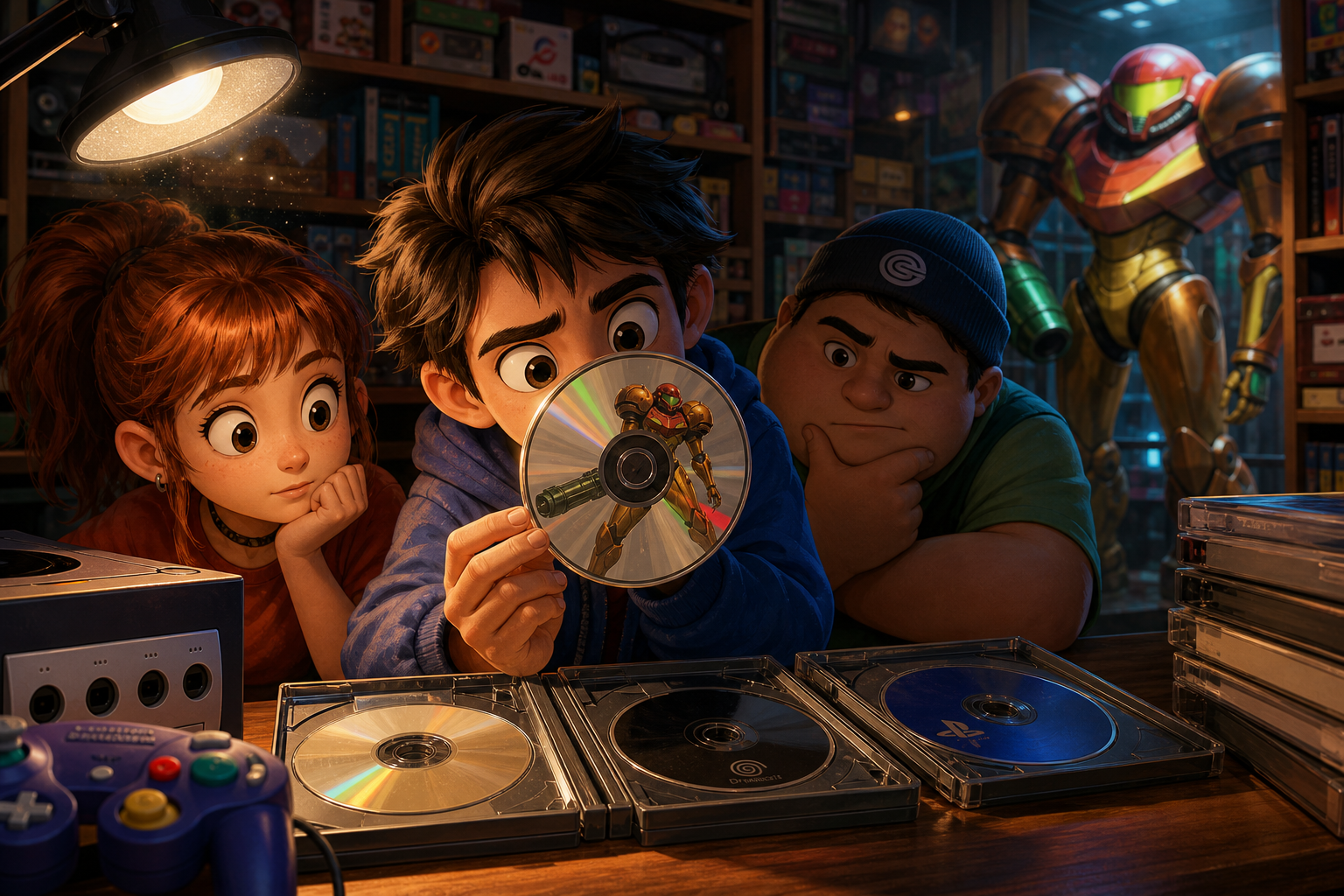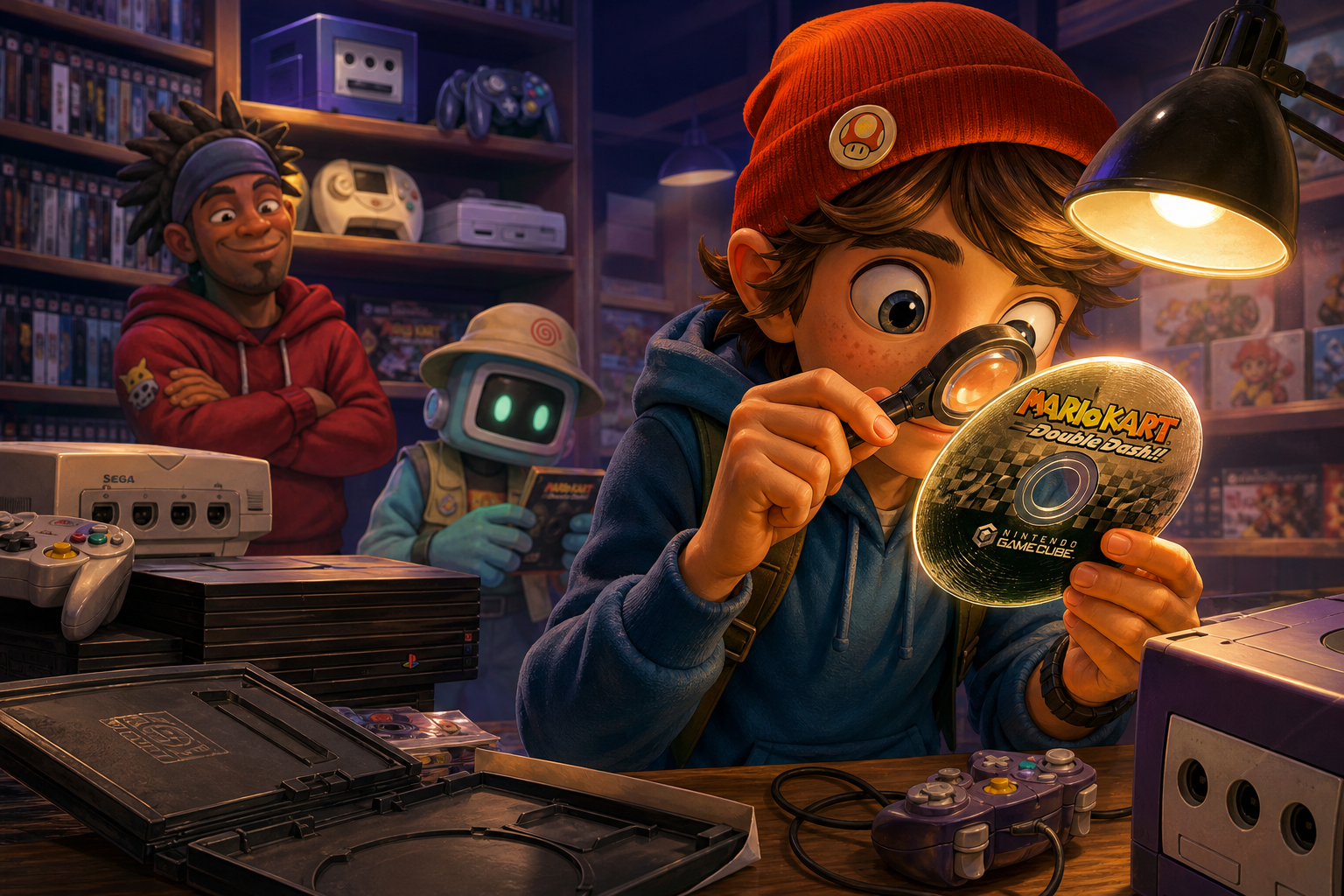
A scratch across the readable surface may cause loading trouble, but a fracture in the disc’s center ring creates a different kind of concern. The hub area is handled whenever a disc is removed from its case and secured in a console. It also experiences the forces associated with rotation. That makes a crack reaching the center hole a structural defect, not a minor mark to discount casually.
This matters across the three formats represented by Mario Kart: Double Dash!! and Metroid Prime on GameCube, Shadow of the Colossus and God of War on PlayStation 2, and Sonic Adventure and Shenmue on Dreamcast. The consoles and disc formats differ, but the buying decision is similar: document the defect, do not use a visibly unsafe disc as a test subject, and compare the complete cost with an undamaged copy.
The stop-sign rule: a disc crack changes the purchase
Treat a crack that begins at or reaches the center hole as damaged media. Do not let an attractive label, clean data surface or complete-looking case turn it into a normal-condition purchase. A disc may still be readable because optical formats include error-correction systems, but successful reading does not demonstrate that the plastic will remain stable during later handling or spinning.
Nintendo’s GameCube safety guidance says not to use cracked, deformed or repaired discs and warns against bending or applying excessive pressure while loading one. Sega’s Dreamcast software warnings likewise caution against cracked, modified or repaired GD-ROMs, including discs altered with adhesive tape. Those instructions support a conservative buying rule for all three platforms: visible disc damage is a reason to pause, not an invitation to test your console.
A crack does not necessarily mean immediate shattering, and no photograph can predict exactly when it will spread. The defensible conclusion is narrower and more useful: the disc has an unpredictable structural risk, and the buyer should value it as damaged unless a qualified specialist provides a different assessment. A seller’s statement that it worked once cannot remove that uncertainty.
- Separate ordinary surface wear from structural damage before discussing condition.
- Do not insert a visibly cracked disc into a valuable or hard-to-replace console.
- Treat tape, glue, an enlarged center hole or another modification as a stop condition for a usable original.

What counts as a center-ring crack?
The center hole is the opening that fits over the console’s spindle or hub. Around it is the inner ring, which may be clear, partly printed or visibly different from the main data area. Look for a thin line that travels outward from the hole, branching lines in the clear plastic, a missing chip, a lifted section or a fracture visible when the disc is tilted under a bright light.
Do not confuse a cracked case hub with a cracked disc. A case’s retaining fingers can break while the disc remains intact. Conversely, a disc can have a damaged center ring even when the case looks perfect. Ask the seller to remove the disc from the case and photograph the actual disc, rather than relying on a picture of the closed jewel case or an image of the disc resting on its holder.
Reflections, printing seams and small marks on the label can be difficult to interpret from a marketplace photograph. A single image cannot establish that a line is harmless. Ask for close photographs of both sides, with the disc held by its edge and not bent. The center hole, inner ring and outer edge should all be visible. If the seller cannot provide that evidence, the condition remains unverified.
- Ask whether the fracture is in the disc or only in the case hub.
- Request a close-up of the center hole and inner ring on both sides.
- Look for branching lines, missing plastic, adhesive residue and an enlarged hole.
- Treat an unclear photograph as missing evidence, not as proof of a clean disc.
Why hub damage deserves more caution than a scratch
A disc is not a flexible sheet that can be safely bent to make inspection easier. Removing it from a tight case hub, pressing it onto a console spindle or forcing it off at an angle can add stress around the center ring. Once a crack exists, repeated handling can extend it. Rotation creates another risk because a weakened disc is being held and spun at speed.
The reflective layer also matters. Physical force can damage or separate disc layers, and damage to the printed side may affect the information beneath it. A clean-looking playing surface therefore cannot cancel out a fracture in the hub. Structural condition and optical readability are separate categories that should be recorded separately in a listing or collection inventory.
Cleaning is not a repair. Nintendo recommends a soft cotton cloth and water for GameCube disc cleaning, with straight strokes from the inner rim toward the outer edge. That guidance addresses dirt; it does not make a cracked disc safe. Resurfacing may address certain surface defects, but it should not be treated as a solution for a fractured center ring.
- Do not flex a disc to see whether a crack opens.
- Do not assume resurfacing resolves hub damage.
- Record data-side wear and structural damage as separate findings.
- Remember that readable today does not mean safe to spin tomorrow.
A repeatable photo inspection for online listings
Start by identifying the exact item: platform, region, edition, title and disc count. Then request photographs with the disc outside its case. Inspect the label side first for cracks, chips, lifting or distortion around the hub. Turn it over and inspect the clear inner ring, the data surface and the outer edge. Finally, compare the disc with the case, manual and listing description so that a replacement or mismatched disc is not being passed off as the pictured copy.
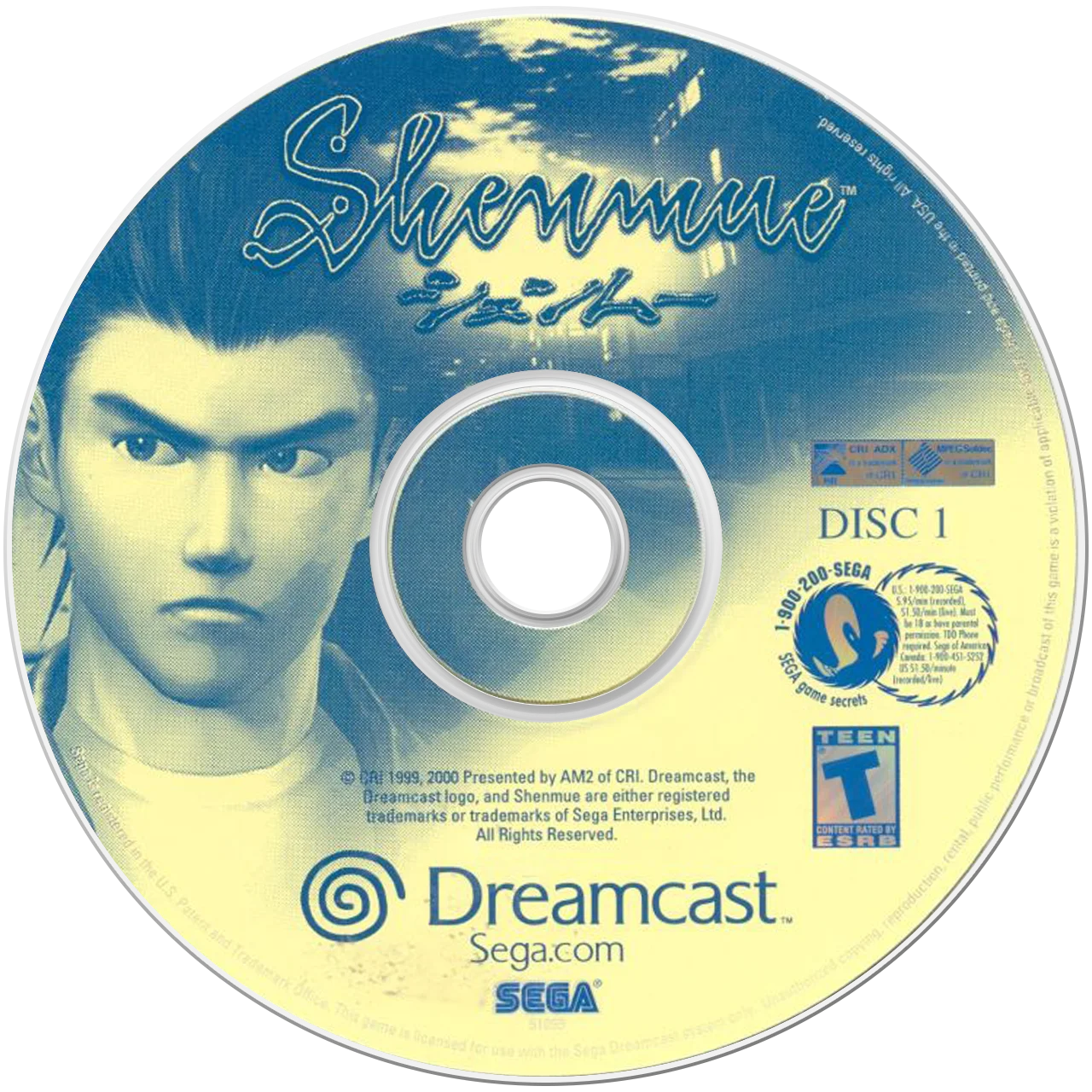
For a multi-disc release, repeat the process for every disc. Shenmue is an important example because a complete physical set contains multiple discs, and one damaged or missing disc changes the usefulness and completeness of the purchase. A photograph of one disc, even a sharp one, says nothing about the condition of the others.
Ask for an angled, well-lit close-up rather than a distant flat-lay. The image should show the complete center hole and enough surrounding plastic to reveal a fracture’s direction. Do not ask the seller to spin the disc, bend it or press on the damaged area for a demonstration. A safe inspection photo is better evidence than a risky test.
- Confirm the title, region, edition and number of discs.
- Inspect the label side, data side, inner ring and outer edge.
- Request separate photographs for every disc in a multi-disc set.
- Compare the disc’s markings with the case and listing description.
- Save the listing photographs before purchasing.
Platform-specific checks for GameCube, PS2 and Dreamcast
GameCube uses small optical discs, so a listing should clearly identify an original GameCube disc rather than a case-only item, replacement media or promotional disc. For Mario Kart: Double Dash!! and Metroid Prime, confirm that the disc markings and regional release match the case. Do not infer authenticity or condition from the front cover alone. Nintendo’s handling guidance makes a visible crack especially important because the disc should not be loaded or subjected to excessive pressure.
PlayStation 2 software was released on CD-ROM or DVD-ROM depending on the title and edition. For Shadow of the Colossus and God of War, confirm the exact regional release, disc count and whether the listing contains the original game disc rather than a replacement. The supplied platform-specific cracked-disc warnings are stronger for GameCube and Dreamcast than for PS2, so avoid inventing a Sony rule that is not documented. General optical-media handling principles still make a hub fracture a serious condition defect.
Dreamcast uses GD-ROM software. For Sonic Adventure, check that the disc is an original Dreamcast release and inspect the inner ring closely. For Shenmue, check every disc individually and confirm that the set’s contents match the edition. Sega’s warnings specifically caution against cracked, repaired or modified GD-ROMs and against enlarging or modifying the center hole.
- Match the disc to the stated platform and regional edition.
- Confirm whether the listing is for original media, a replacement or a case only.
- For PS2, verify the correct number and type of discs for the edition.
- For Dreamcast multi-disc sets, inspect every disc.
- Do not treat one platform’s documentation as proof of another platform’s exact policy.

Why a boot test is not worth the risk
A test video can show that a console recognized a disc at one moment. It cannot show that the disc is structurally safe, that it will survive future removal, that every disc in a multi-disc set was tested or that the item is authentic and correctly matched to its case. A boot screen is evidence about a momentary reading event, not a safety certificate.
Do not ask a seller to test a visibly cracked disc in a console, and do not perform that test yourself after purchase. Nintendo and Sega’s precautions support refusing to use cracked media. Testing can also make a return dispute harder if the disc arrives in worse condition or breaks after you chose to spin it.
Safer evidence includes close-up photographs, a short inspection video that shows both sides without flexing, and clear answers about when the damage was first noticed. If a seller has an undamaged replacement copy, that copy may be tested separately, but its result does not prove anything about the cracked disc. Keep the distinction explicit.
- Do not use a boot screen to override a visible fracture.
- Do not request bending, spinning or pressing demonstrations.
- Use inspection evidence instead of risky playback.
- Treat a seller’s successful test as limited evidence even when the disc is undamaged.
Seller questions that produce useful answers
Questions should force the listing’s uncertainty into specific, documented answers. Ask: “Is the crack in the disc or only in the case hub?” Ask: “Does the line reach the center hole?” Ask: “Is there any tape, glue, adhesive residue, drilled area or enlarged hole?” Ask: “Which disc is affected, and how many discs are included?” These questions are more useful than asking whether the item is in good condition.
Also ask whether the seller noticed the damage before listing, whether the disc was tested after the damage appeared, and whether the photographs show the exact item rather than a stock image. If the item is sold as complete, request confirmation of the manual, inserts, case and every disc. For a regional or special edition, ask the seller to identify the release rather than relying on a generic title.
Keep communication on the marketplace. A seller who refuses a close-up, changes the answer, insists that a cracked disc is “tested and fine,” or asks you to complete payment outside the protected checkout route has not reduced the risk. Do not proceed simply because the listing is scarce or the seller says another buyer is waiting.
- Ask which component is cracked.
- Ask whether the crack reaches the center hole.
- Ask about tape, glue, drilling or modification.
- Ask whether every disc is present and individually inspected.
- Keep questions and answers in the marketplace record.
- Walk away if the seller will not answer clearly.
What condition evidence cannot prove
A seal, label, screw, board photograph or clean cover can support an identification process, but none proves that the disc is authentic, complete or playable by itself. A sealed case can contain the wrong item, and a sharp label photograph can conceal damage on the opposite side. A screenshot of the game running proves only that some copy produced that screen at some time.
A visible crack does establish one useful fact: the photographed disc has structural damage. The absence of a crack in one distant image establishes much less. It does not prove that the center ring is intact, that another disc in the set is undamaged or that the delivered item will match the listing.
Treat “original,” “complete,” “tested” and “mint” as claims that require supporting evidence. For valuable editions, compare multiple photographs of the disc, case, artwork and identifying marks, but do not attempt invasive authentication or internal repair. If the evidence remains contradictory, pay only what the item is worth as an uncertain damaged or incomplete lot—or do not buy it.
- Do not authenticate from one label, seal, screw or screenshot.
- Do not infer completeness from cover art.
- Distinguish evidence of identity from evidence of function.
- Price uncertainty as risk, not as a discount from an assumed perfect copy.
Calculate the total cost before checkout
The purchase price is only one category. Add shipping, tax, import charges where applicable, a replacement case or manual, the cost of finding an undamaged replacement disc, professional inspection and possible return shipping. Also account for time spent documenting a dispute and the possibility that a damaged original will not fit the collection’s condition standard.
Do not invent a current fair price for any of these games. Instead, compare several recent completed transactions for the same platform, region, edition, disc count and condition. Separate listings with clean, verified discs from damaged, incomplete or untested copies. The comparison is useful only when the copies are genuinely comparable.
A damaged center ring should not be valued as a normal playable copy merely because the seller says it boots. If the combined cost approaches that of a clearly photographed, undamaged copy, the safer option is usually to keep searching. If you are buying for parts or display, state that purpose explicitly and set a lower ceiling based on what you can actually use.
- Add item cost, shipping, tax and any import charges.
- Include replacement media, case, manual and inspection costs.
- Compare the same edition, region and disc count.
- Separate verified undamaged copies from damaged or untested listings.
- Set a maximum before bidding or submitting an offer.
Shipping, arrival inspection and buyer protection
Before payment, read the marketplace’s current return and buyer-protection terms for that transaction. Eligibility can depend on the checkout method, item category, stated return window and reporting deadlines. A seller’s return policy is not a substitute for documenting the item, and platform rules can change.
When the package arrives, photograph the unopened parcel, then photograph the disc and case before manipulating the hub. Retain the packaging. Compare the delivered item with the saved listing images and messages. If a crack was undisclosed, expanded during shipping or affects a different disc than described, report the problem through the platform’s required process rather than negotiating privately or paying for an off-platform solution.
Handle the disc by its edge and avoid bending it. If a visible fracture is present, do not put it into a console to gather more evidence. Keep the listing, photographs, package images and seller communication until the return or claim is resolved. Follow the platform’s instructions for return shipping and do not assume a refund is guaranteed until the policy confirms that the transaction qualifies.
- Check the current protection and return deadline before buying.
- Photograph the package and item on arrival.
- Retain packaging and saved listing evidence.
- Do not test a visibly cracked disc.
- Use the marketplace’s formal claim or return process.
- Never move payment or dispute handling off-platform.
Clear stop conditions for the buyer
Walk away when the crack reaches the center hole, branches into the inner ring, has missing plastic or shows adhesive or other repair material. Those signs make the disc unsuitable for a buyer seeking safe use or an undamaged collectible. The same decision applies when the seller has enlarged or modified the hole, refuses to identify the damaged component or will not provide a close-up of the exact disc.
Stop when a multi-disc set contains an unverified disc, when the listing uses only stock or distant photographs, or when the platform’s return route is unclear. Scarcity does not compensate for missing evidence. Neither does a seller’s rating, because a good transaction history cannot reveal the condition of this particular disc.
If you already own a visibly cracked disc, isolate it in a protective case and do not load it. Document the condition and consult a qualified preservation or repair professional if the media contains rare data. Avoid tape, glue, drilling, hub enlargement and other improvised fixes. For a purchase, the simplest safe decision is usually to reject the damaged copy and continue looking for one whose disc condition can be verified.
- Reject a disc with a center-hole fracture or repair evidence.
- Reject unclear multi-disc completeness.
- Reject listings without useful disc photographs.
- Reject sellers who will not preserve a protected return path.
- Do not let rarity replace condition evidence.
- Do not attempt an improvised disc repair.
A center-ring crack is small in area but large in consequence. It affects the part of the disc that is repeatedly handled and secured, and it can worsen without offering a reliable warning. The cleanest data surface, successful boot or attractive case cannot turn structural damage into normal condition.
For GameCube, PlayStation 2 and Dreamcast purchases, inspect the exact disc, ask focused questions, calculate the complete replacement risk and preserve buyer-protection evidence. When the seller cannot prove that the hub is sound—or when the crack is plainly visible—the safest buying decision is to stop rather than sacrifice valued hardware for a momentary test.