Spoilers for Superman Unlimited #19 follow.
Superman Unlimited #19 takes one of DC’s most elastic high concepts and applies it to its most recognisable hero: Superman is transformed into a bizarre alien life-form while an alien elsewhere takes on Superman’s body. The issue, credited to Dan Slott, Lucas Meyer and Vasco Georgiev, frames that upheaval around an alien attack, a cipher-like language evocative of Interlac, and a device whose operation recalls the rotary mechanism of the H-Dial from Dial H for Hero.
That combination matters because the H-Dial has rarely been a straightforward power-up device. Across its many incarnations, it has been a story engine for instability: the person using it may become a wholly unexpected hero, with a new look, new abilities and often a new problem to solve. In this case, the premise is more alarming than a simple transformation. Superman remains on Earth in another being’s body, speaking Interlac, while the other being is changed into Superman on its own planet.
The result is an especially strange use of a concept built on strangeness. It leaves Clark with an immediate practical challenge—how to act heroically with an alien physiology and language barrier—while raising a larger question over the nature of the device and the alien group employing it.
A dial, an attack and a very un-Superman-like Superman
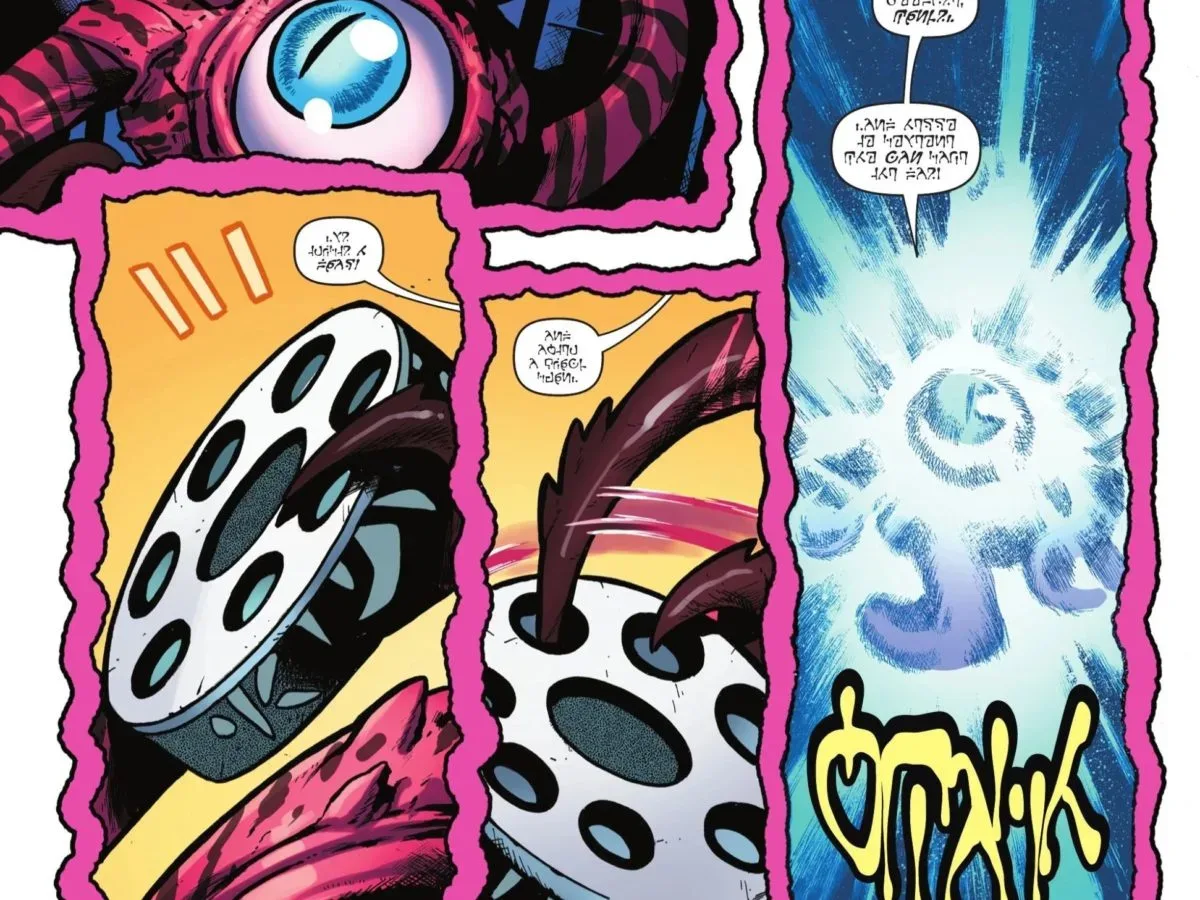
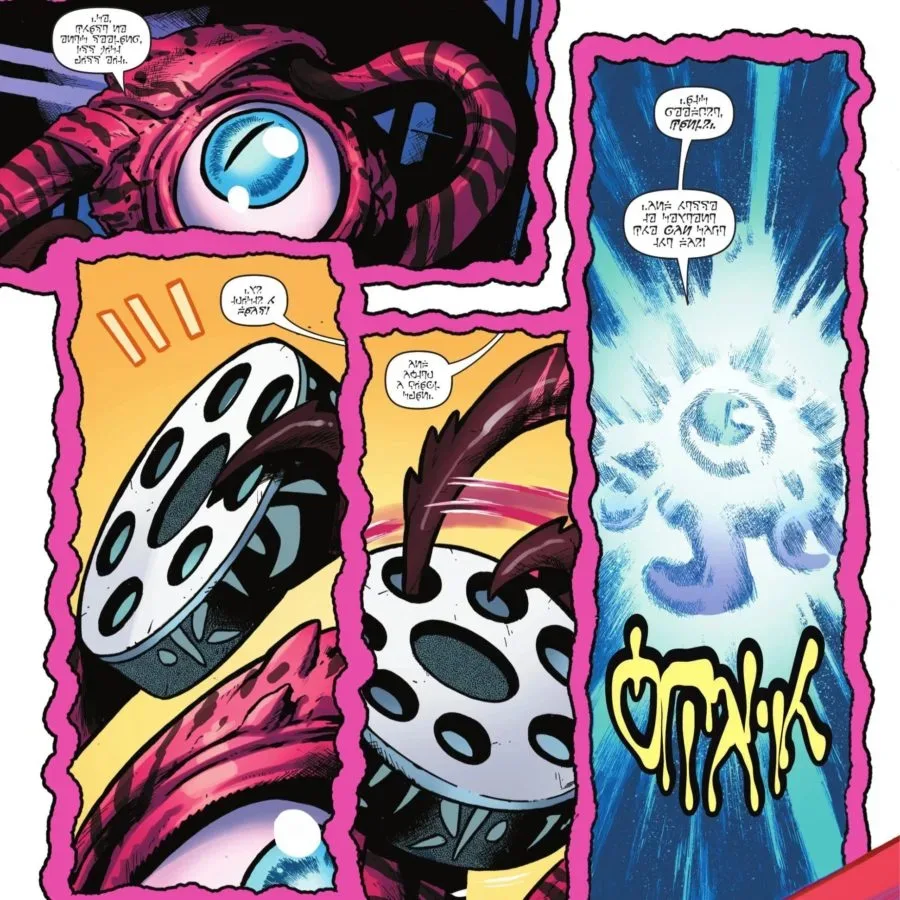
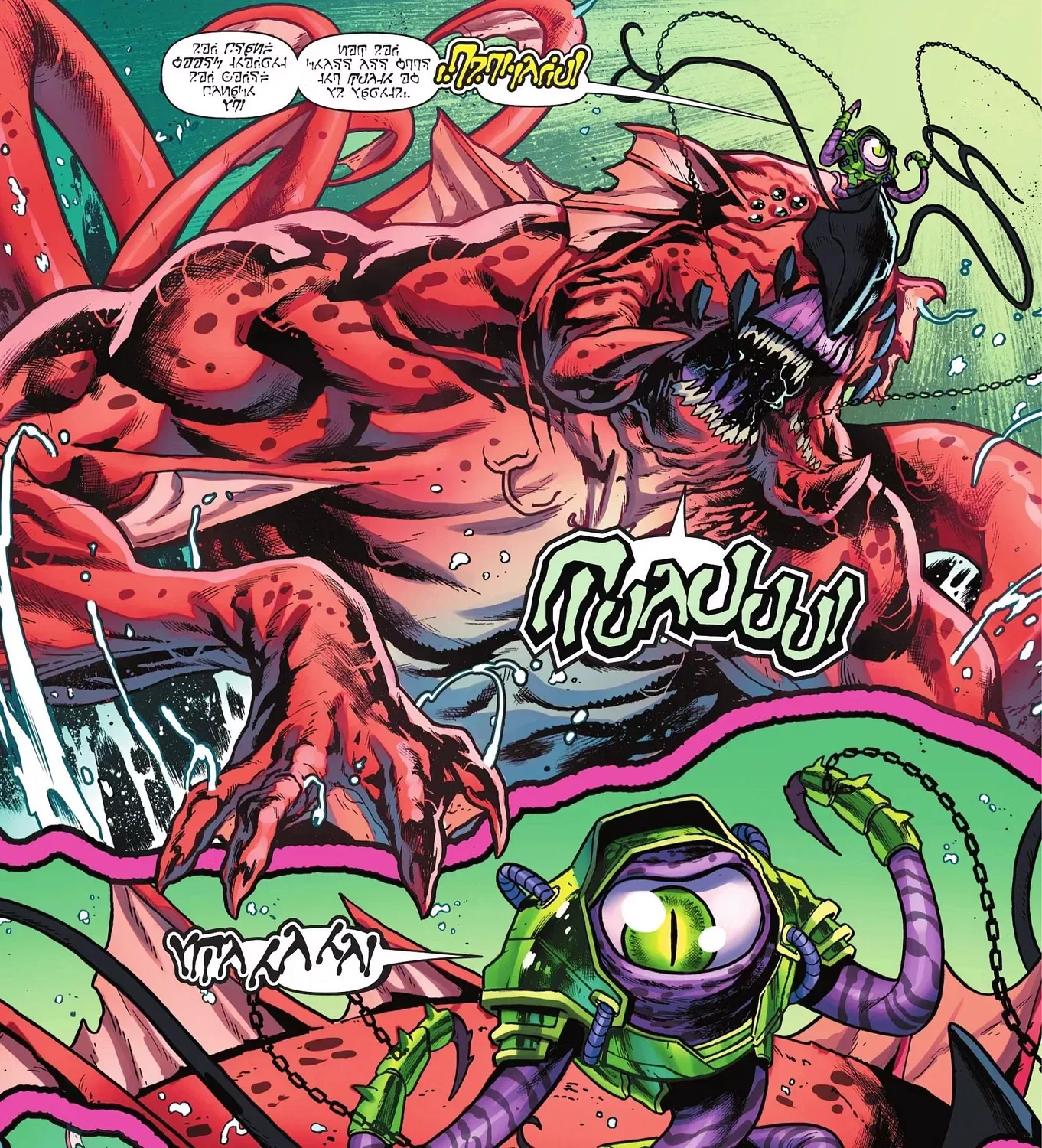
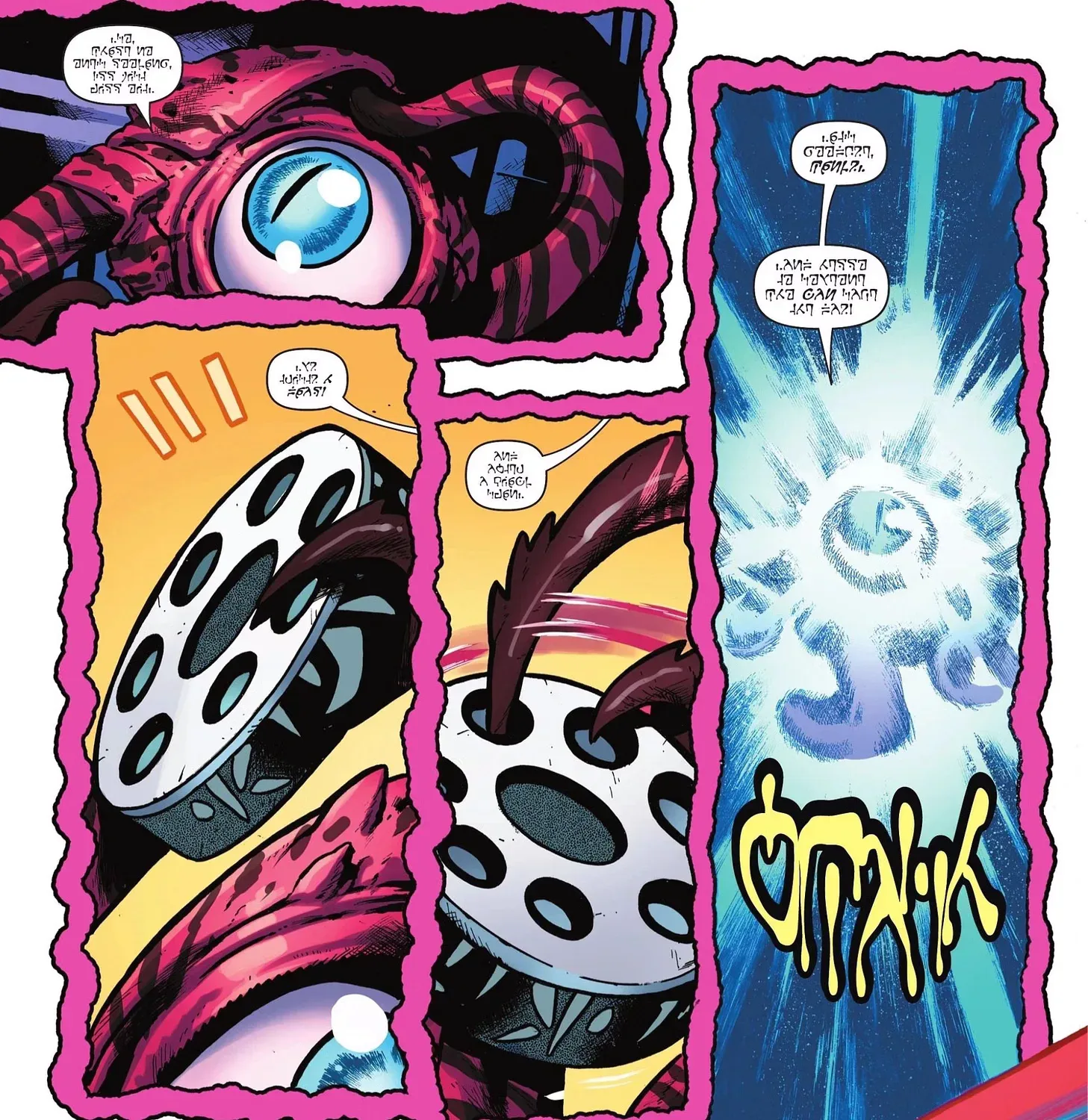
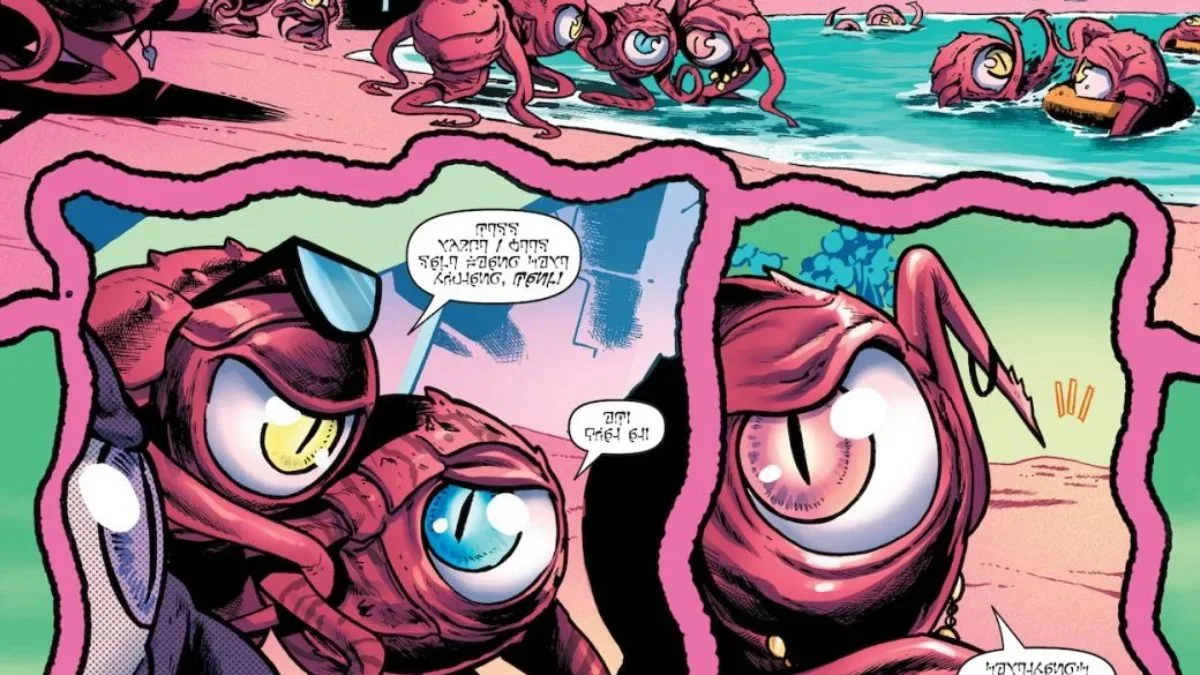
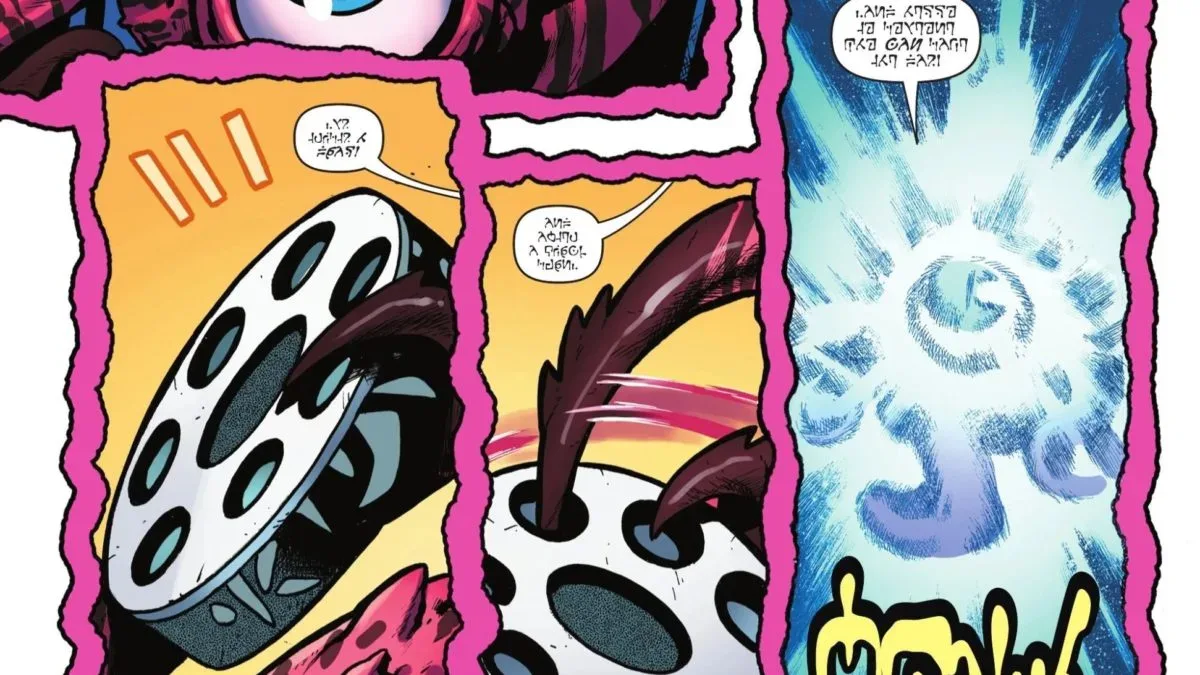
The chain of events begins with an alien beach gathering interrupted by another alien attacker, whose colours evoke Lex Luthor’s familiar palette. The dialogue is presented in an encoded language comparable to Interlac. The endangered aliens conclude that the attacker is too powerful and that they need more power to break its chains.
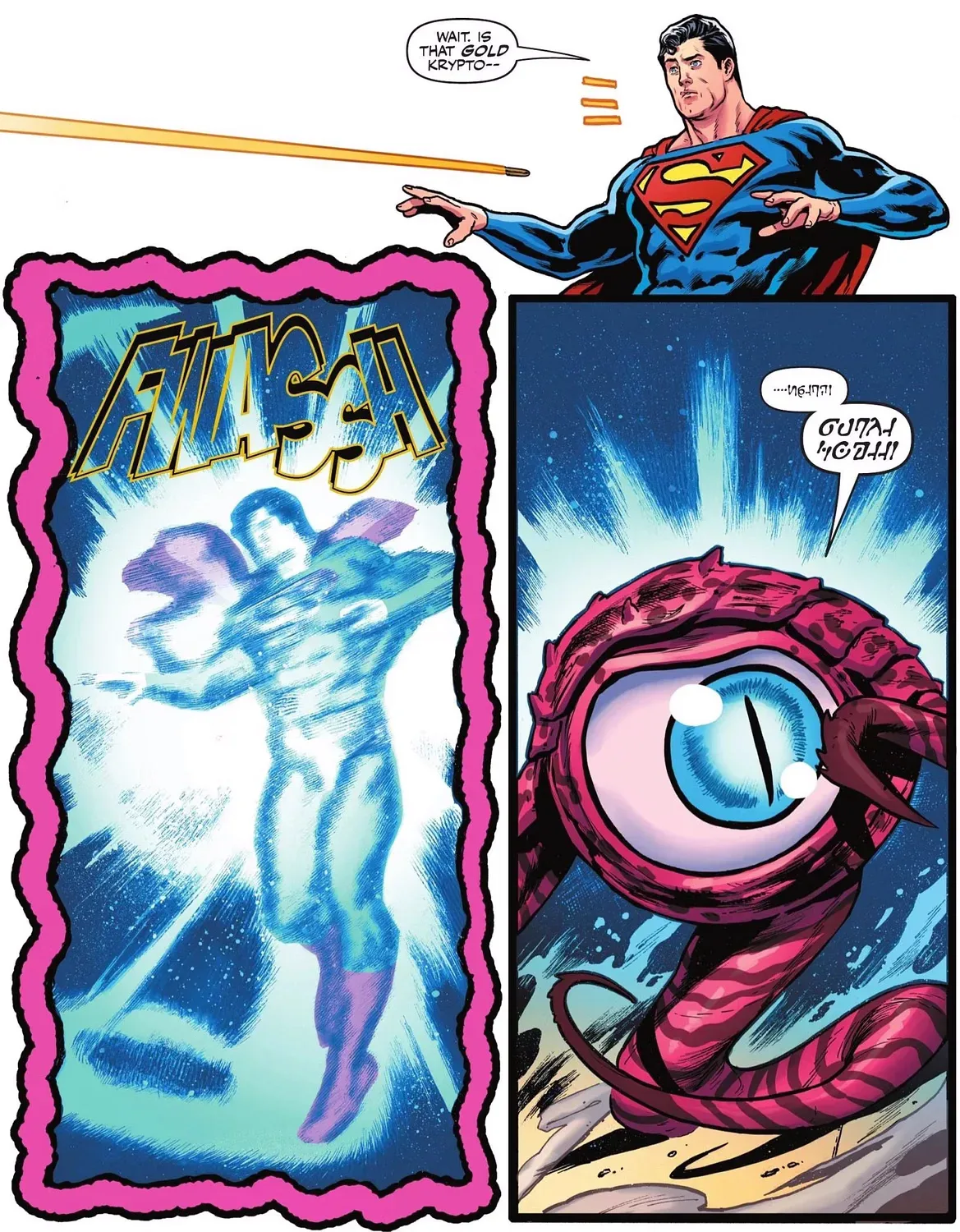
Their solution involves tentacles operating a circular dial that visually resembles an old telephone rotary dial. What follows is not merely an energy boost. The device produces a swap: Superman becomes an alien on Earth, and the alien becomes Superman on its home world.
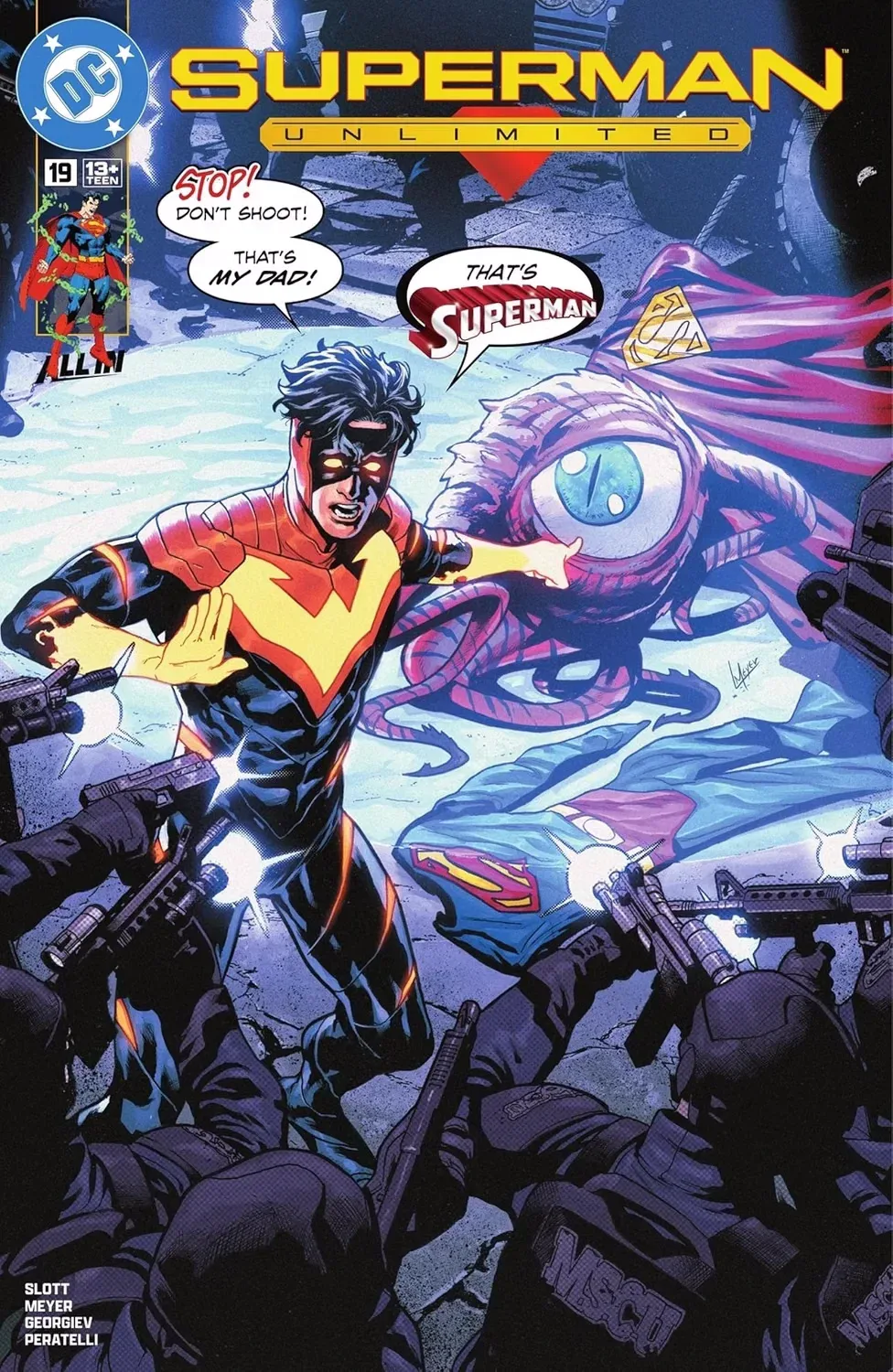
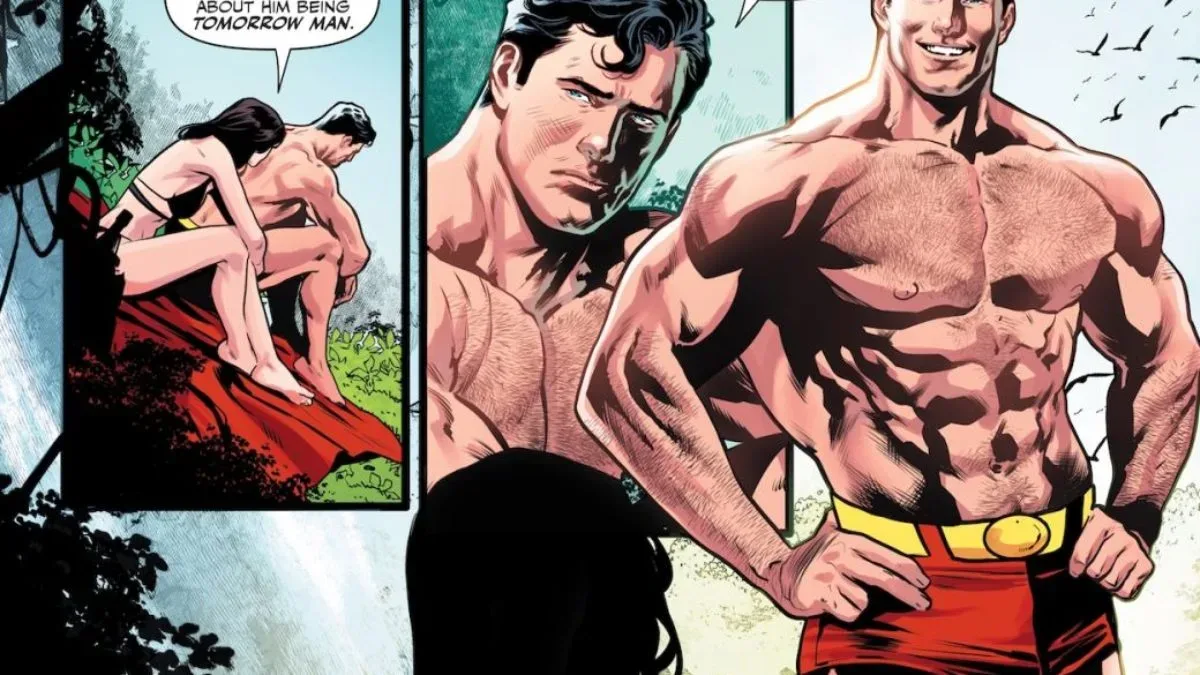
Promotional material describes the transformed Superman as a one-eyed, three-tentacled creature. The cover copy also places the event during an adventure involving Superman’s son, Tomorrow Man. Those details establish the issue’s deliberately absurd visual pitch, but the body-swap setup gives the absurdity narrative weight. A Superman story normally depends on Clark’s recognisable capabilities, communication skills and public identity. Taking all three away at once changes the nature of the crisis.
There is also a difference between being disguised and being displaced. Clark is not apparently choosing an alien guise, nor is he simply depowered. He is dealing with the consequences of another individual inhabiting his own iconic form in another location. That is a useful escalation of the central Dial H idea: identity is not just a costume or a powerset, but a situation that can be reassigned.
Why Interlac is an important clue
Interlac is an interstellar language associated with the far-future setting of the Legion of Super-Heroes. In the history of Dial H for Hero, later stories, including Mark Waid’s Silver Age miniseries, identified the glyphs on Robby Reed’s original dial as Interlac. That link suggested an alien or far-future connection, although it did not settle who built the dial or for what purpose.
Its use in Superman Unlimited #19 therefore does more than create an alien-looking page. It deliberately places the story in the same conceptual neighbourhood as the H-Dial’s oldest unresolved mystery. The alien character that Superman becomes speaks Interlac on Earth, and the aliens at the scene are also communicating in a cipher-like language. The imagery of a dial and the language connection together make the allusion considerably more specific than a generic transformation plot.
That does not yet establish that the device in the issue is the original H-Dial, or that it supersedes earlier explanations of its origin. The story instead presents material that can be read as opening that possibility. The aliens’ apparent ability to draw upon superhero identities—including Superman’s—could point to a new variation on the premise: a technology used by an alien society for emergencies, convenience or even entertainment.
For readers, the key distinction is between reference and retcon. A reference borrows familiar imagery or vocabulary. A retcon, shorthand for retroactive continuity, changes or redefines established fictional history. The issue’s dial imagery, Interlac and swap mechanics are strong references to Dial H for Hero; whether they become a new origin account depends on what future issues explicitly establish.
The original Dial H for Hero was built for surprise
Dial H for Hero began in House of Mystery #156 in January 1966. Dave Wood wrote the feature and Jim Mooney drew it. Its original lead was Robert “Robby” Reed, a teenager from Littleville, Colorado, who found a rotary-style dial covered in alien symbols after falling into a cavern.
By dialing H-E-R-O, Robby could become a different superhero every time, gaining that character’s name, costume and powers. Dialing in reverse restored him to normal. The basic format gave the series unusual freedom: rather than centring on one permanent hero with a fixed suite of abilities, every use of the device could introduce a fresh design and power set. Robby’s signature cry, “Sockamagee!”, matched the feature’s playful, exuberant identity.
The original run lasted through issue #173 in 1968. Yet the broadness of its premise made it unusually reusable. The H-Dial can support comedy, cosmic science fiction, horror-tinged identity stories, superhero pastiche and stories about the responsibility of borrowing power. It is an ideal mechanism for creators who want a superhero narrative that can radically alter its visual rules from page to page.
Superman Unlimited #19 applies that versatility to a figure normally defined by consistency. The visual joke is immediate: Superman is suddenly a creature with one large eye and three tentacles. But the deeper connection is that both the old feature and this new scenario ask readers to recognise heroism beneath a constantly changing exterior.
Every revival has changed what the dial means
The H-Dial’s subsequent history has not settled on one single explanation. Instead, different eras have approached the device from distinct angles.
- The early-1980s revival: Marv Wolfman and Carmine Infantino introduced Christopher “Chris” King and Victoria “Vicky” Grant. Their dials were concealed as a watch and pendant, and their transformations lasted only one hour. The series also used hero and villain designs submitted by readers. Within that continuity, the pair’s devices were made by the Wizard, the benevolent half of Robby Reed after a prior use of a dial split him into the good Wizard and the evil Maste.
- The New 52-era interpretation: China Miéville’s more adult-oriented version followed Nelson Jent and embraced deliberately odd transformations. It explained the dials as creations of a civilisation from another dimension. The devices copied concepts, identities and technology from across the multiverse for social and technological advancement. Other cultures, angered by that intellectual-property theft, destroyed the civilisation and scattered the dials.
- The 2019 Wonder Comics series: Sam Humphries and Joe Quinones introduced the Heroverse, a metaphysical realm from which hero identities originate. An older Robby Reed, known as the Operator, opposed Mister Thunderbolt, his evil counterpart created when Robby used a Y-Dial to split himself. The Operator said the dial had been fashioned from a fragment of the Forge of Creation, the birthplace of new worlds previously seen in Dark Nights: Metal.
These explanations are not simply trivia. They show why a Superman-linked version of the concept has so much room to develop. Depending on the interpretation, the dial can be alien technology, a multiversal copying machine, an artifact tied to the creation of worlds, or a route into a metaphysical reservoir of heroic identities. Each model changes the stakes of someone turning Superman into an alien and giving Superman’s form to somebody else.
If the device is only a local alien tool, then the story may be a contained body-swap adventure. If it is connected to the larger H-Dial mythology, however, the incident may be a doorway into questions about where heroic forms come from, who can access them and what it means for a character as culturally fixed as Superman to become transferable.
What the Superman swap does to the Dial H formula
Classic Dial H for Hero stories are usually concerned with a person becoming an original or unfamiliar hero. The transformation is unpredictable, often inconvenient, but ultimately gives the user some means of confronting a threat. In Superman Unlimited #19, the framework is inverted. Superman is not selecting an identity to gain useful powers; he is apparently caught in a mechanism initiated by aliens under pressure.
That removes the control normally implied by the word “dial.” The alien group may be operating the machine deliberately, but Clark is its consequence rather than its user. And because another being becomes Superman, the issue turns the question outward: what happens when the most famous superhero identity is worn by someone who has not necessarily earned, understood or chosen it?
It is a body-swap premise, but one with a classic comic-book scale. Superman’s power is formidable enough that its temporary transfer can have consequences far beyond the affected people. Conversely, putting Clark in an alien body tests the part of Superman that cannot be measured through flight, strength or heat vision. His capacity to help depends on judgement, empathy and improvisation when his usual tools are unavailable.
The creature’s ability to speak Interlac further makes language part of the obstacle. Communication is frequently treated as background texture in superhero comics; here it appears to be central to Clark’s displacement. If he cannot readily make himself understood on Earth, he has to solve an immediate crisis while looking and sounding like an alien.
A flexible piece of DC’s superhero mythology
The value of this apparent Dial H return is not that it finally gives the property one unquestionable origin. The collected history points in the opposite direction: the H-Dial is valuable precisely because creators can recast it. It has been a mysterious cavern find, wearable technology with a strict one-hour limit, a multiversal appropriation device and an artifact linked to the creation of worlds.
Superman Unlimited #19 adds another potentially useful perspective: a dial-like system that can pull Superman into an alien identity and place his identity elsewhere. That is not confirmed as a replacement for the prior accounts, but it is a fresh complication that uses the property’s visual language and Interlac connection effectively.
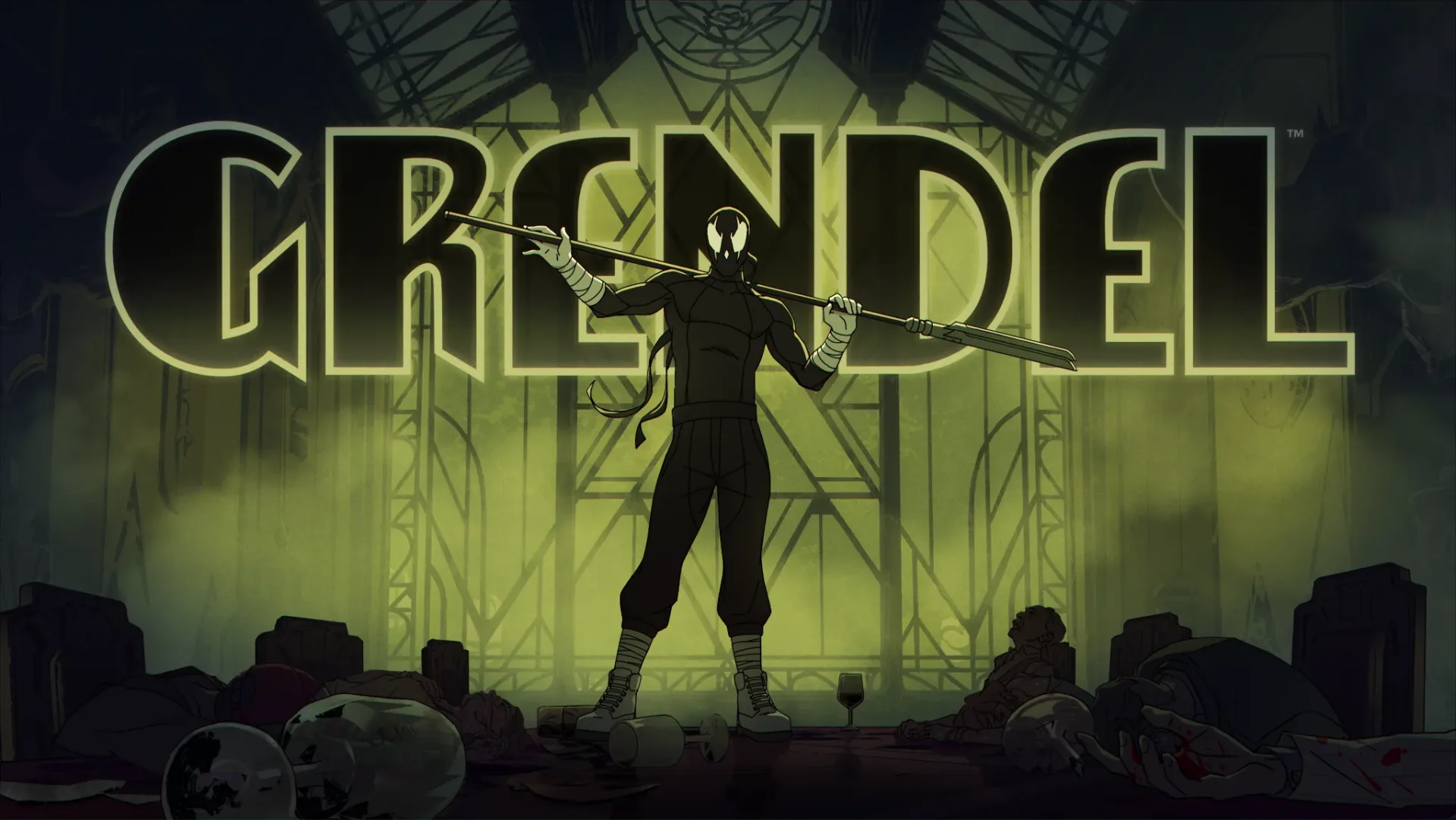
For comic readers following other contemporary adaptations and expansions of comics material, including the recently announced adult animated Grendel series, it is a reminder that deep-catalog ideas can remain creatively potent without being reduced to simple nostalgia. The H-Dial’s enduring hook is not one character or one origin: it is the chance to ask what heroism looks like after the hero has become someone—or something—else.
Superman Unlimited #19 is listed at $4.99 and dated November 18, 2026.