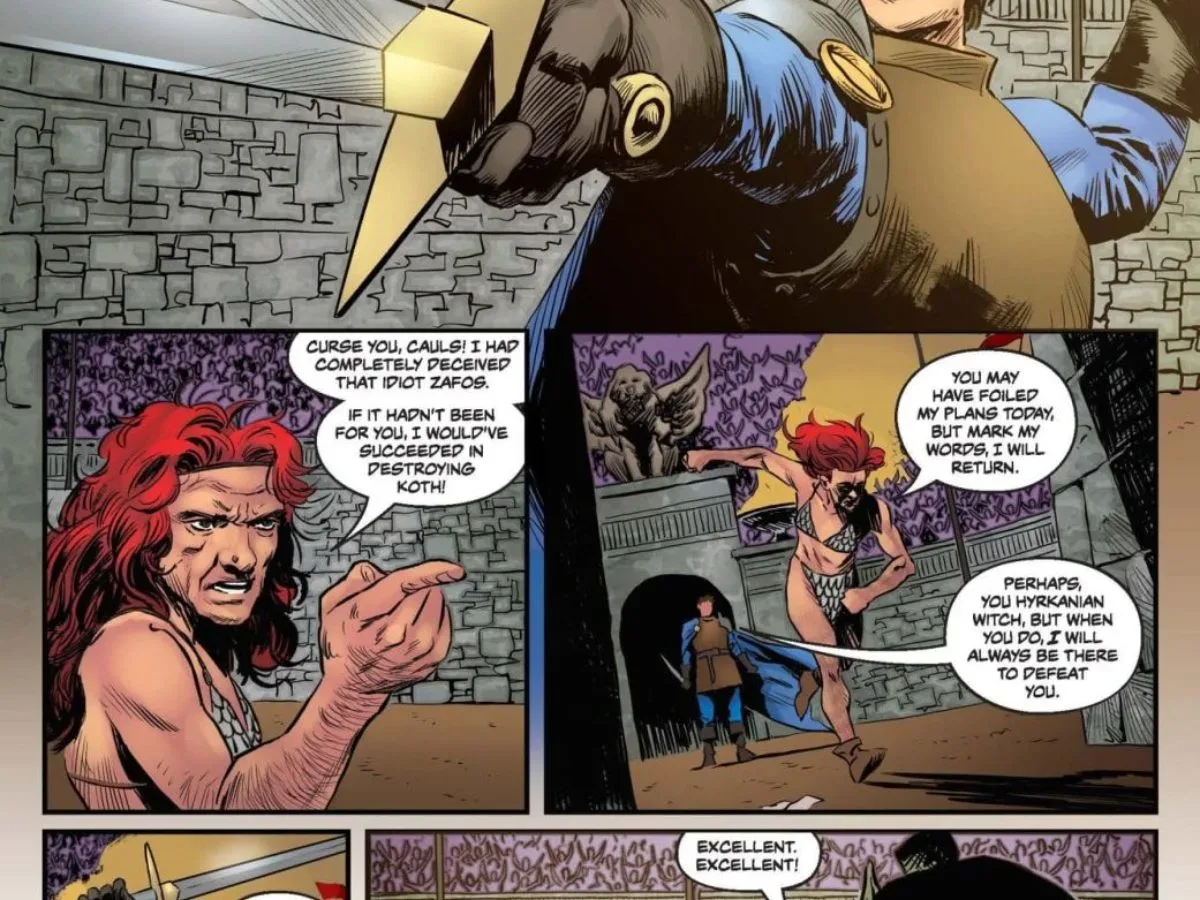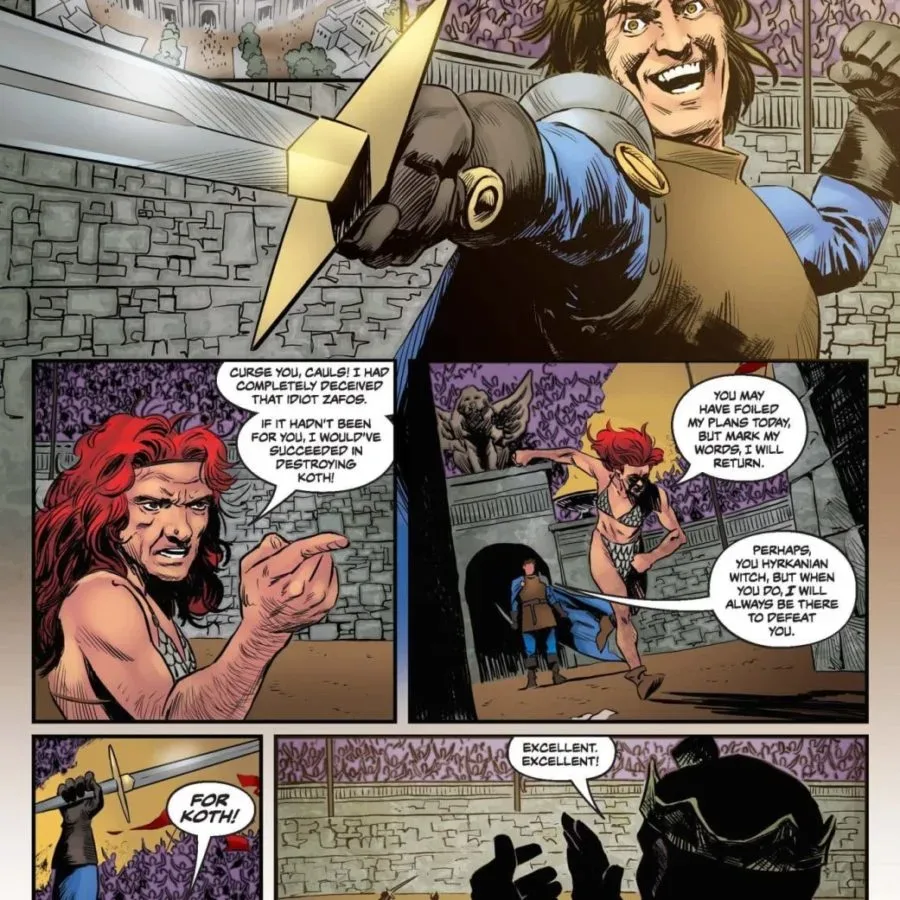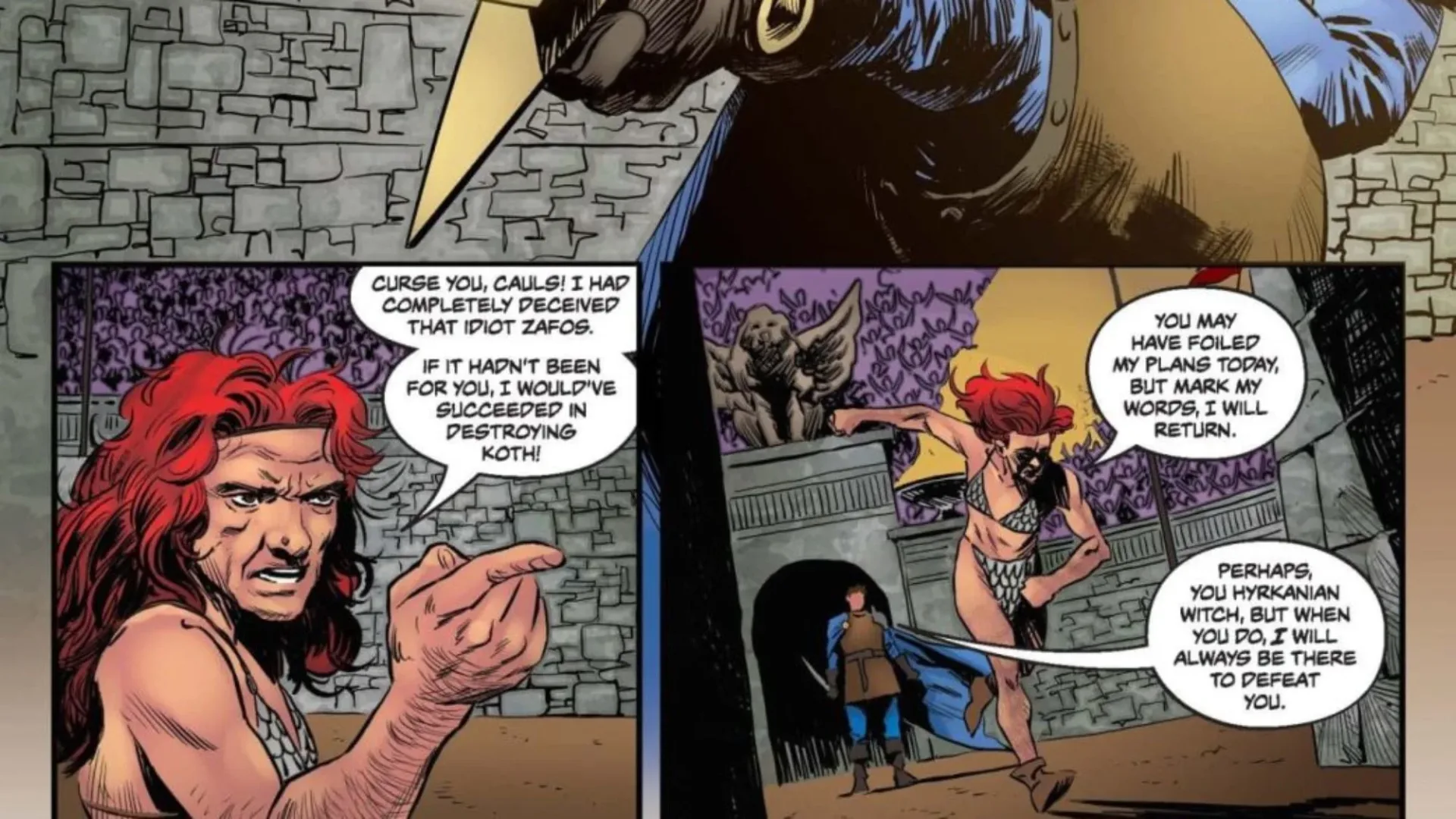
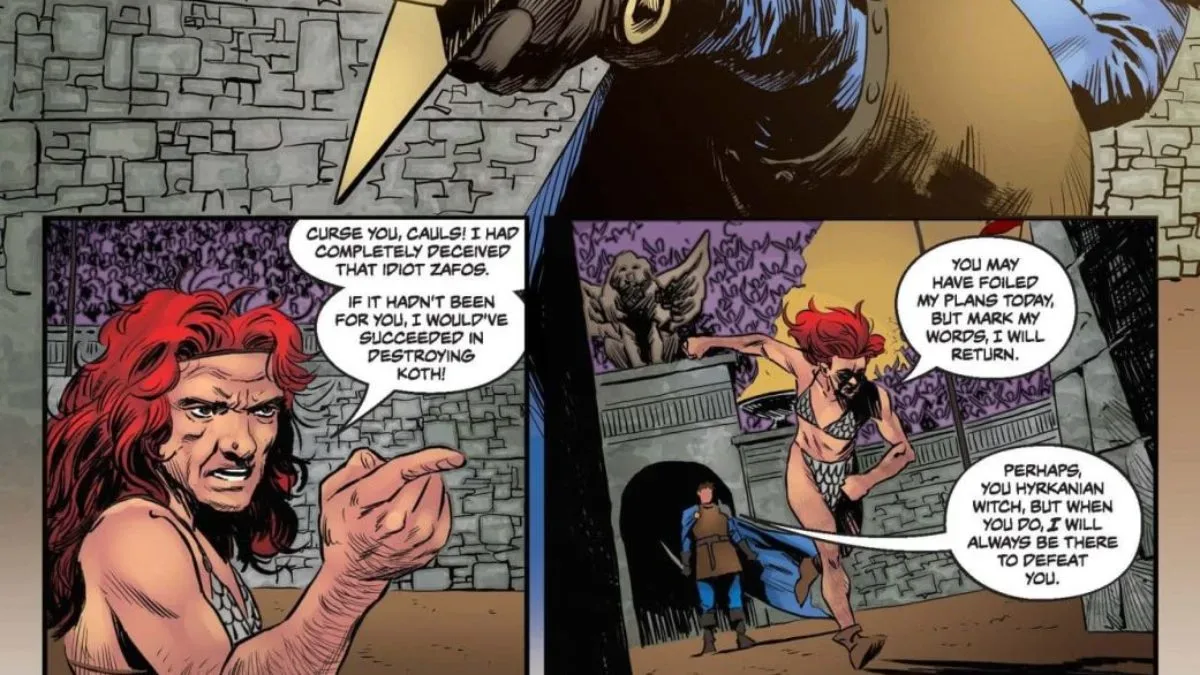
Red Sonja: She-Devil with a Sword #7 is scheduled to reach comic shops on November 11, 2026, with a premise that turns the spotlight away from a conventional battlefield and toward a Khorshemish theater. While Sonja remains on the run in the wake of the Rising Sun storyline, a performance inside the city is presenting a revised account of recent events.
That setup gives the sword-and-sorcery series an especially pointed conflict: Sonja is not only a warrior trying to stay ahead of those hunting her, but also a figure whose reputation can be reshaped in public while she is absent. The issue is written by Rory McConville, with interior art by Pablo de Bonis. Its listed cover artists are Stuart Sayger, Lucio Parrillo, Joseph Michael Linsner, Mike Rooth, and Megan Random for a cosplay cover.
A fugitive faces a story being told without her
The central image in the solicitation is simple but loaded: an account of events is being acted out on a stage while the person at the center of that account cannot easily answer it. Sonja’s physical escape and the play’s public narrative are two different fronts in the same struggle.
A propaganda play, in this context, is not merely entertainment with a political setting. It is a performance designed to frame events, assign heroes and villains, and influence what an audience accepts as truth. The reported setup identifies King Cauls as using the production to turn opinion against Sonja. The theater therefore becomes a tool of authority: a controlled place where costumes, dialogue, spectacle, and an official version of the past can all work together.
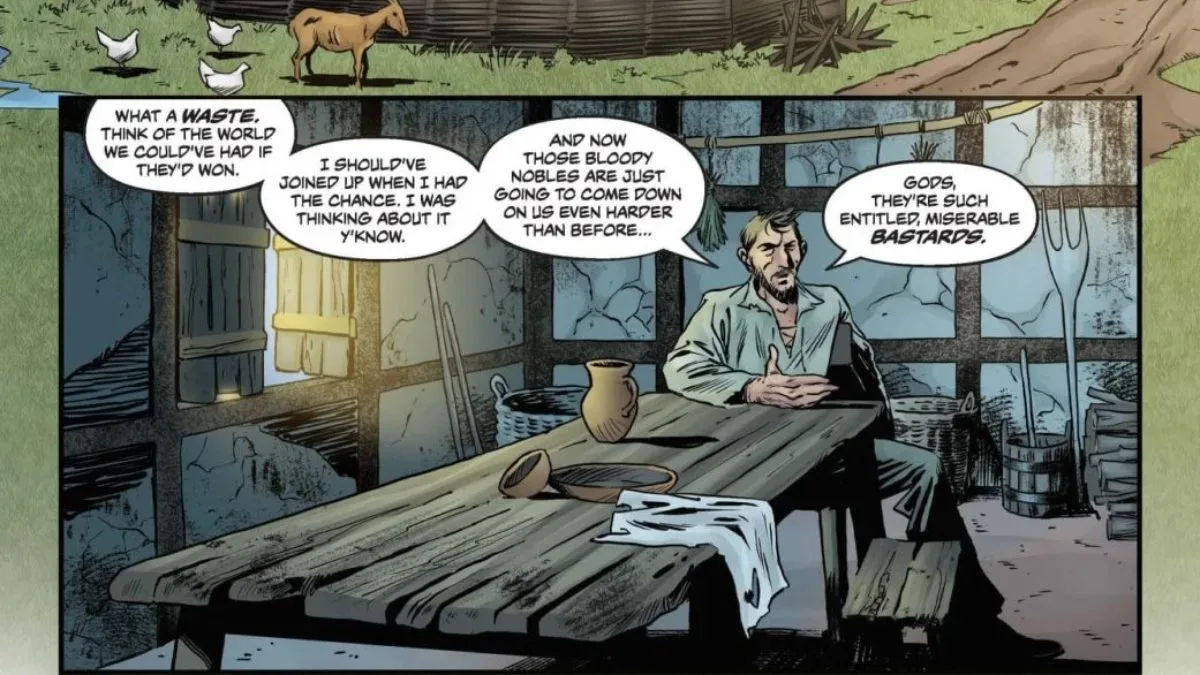
For a character as closely associated with direct action as Red Sonja, that is a compelling complication. A sword can settle an immediate threat, but it does not automatically undo a tale that has already reached a crowd. If the public has been taught to see Sonja as an outlaw, then every new encounter carries the risk that strangers, guards, or hired pursuers will approach her with that assumption already fixed.
The solicitation also places bounty hunters on Sonja’s trail. A bounty converts a political accusation into a practical incentive for others to join the pursuit. It means the danger need not come only from the ruler or a formal army; anyone who believes they can profit may become an obstacle. Coupled with the staged retelling in Khorshemish, that pressure suggests an issue concerned with both survival and the consequences of being publicly defined by an enemy.
Theatricality fits the issue’s conflict
Theater is an apt device for this kind of story because it makes storytelling visibly artificial while still allowing it to feel persuasive. Audiences know they are watching actors, yet performance can establish emotion, create sympathy, and leave a memorable impression. In a fantasy setting, a ruler who commands the stage can potentially make authority look inevitable, righteous, or secure—even when the truth is more complicated.
That does not mean the comic’s solicitation confirms exactly how the play unfolds, how much of it Sonja sees, or what response it receives. Those are questions for the issue itself. What is established is the basic dramatic contrast: a public, choreographed account of the past is underway, while Sonja is moving through the world as a hunted figure.
The premise also creates room for irony. Red Sonja’s legend is usually carried by the image of a capable fighter confronting danger face-to-face. Here, the opposition is using a form of combat that operates through an audience. The conflict is no longer limited to who wins a clash; it includes who gets to explain that clash afterward.
What readers can expect from the creative lineup
McConville is credited as writer and de Bonis as artist for the continuing issue. The solicitation identifies the book as a sword-and-sorcery epic, a genre label that generally points to adventures driven by individual heroes, dangerous journeys, weapons, rival powers, and heightened fantasy stakes. In this installment, those familiar ingredients are paired with a more civic pressure point: the way a city can be encouraged to treat a fugitive as an enemy.
Multiple cover options give readers different ways to pick up the issue. Stuart Sayger is listed on the main cover credit, with additional covers by Parrillo, Linsner, and Rooth, plus the Megan Random cosplay variant. All of the listed editions carry a $4.99 suggested retail price. As with any comic shop release, readers looking for a particular cover may want to check with their local retailer rather than assume every option will be on the shelf.
- Title: Red Sonja: She-Devil with a Sword #7
- Publisher: Dynamite Entertainment
- Writer: Rory McConville
- Artist: Pablo de Bonis
- In shops: November 11, 2026
- Suggested retail price: $4.99
Why the setup matters for Sonja’s next chapter
The key practical implication of the issue’s premise is that Sonja’s flight has consequences beyond distance and immediate safety. Staying ahead of bounty hunters may keep her alive, but it leaves a vacuum that the Khorshemish production can fill with a sanctioned version of events. That makes the theater more than background color. It is part of the machinery making her escape harder.
It also establishes a potentially useful tension for continuing readers: even if Sonja can outfight a pursuer, she may still have to contend with suspicion that has been cultivated far from the road. The issue’s drama can work on two levels at once—an active hunt for Sonja and a public effort to make that hunt appear justified.
For readers interested in the broader appeal of physical pop-culture releases, there is a related preservation question beyond any one comic: how people keep media accessible over time. Our look at why game archives need more than one copy explores that larger concern from the game-media side. A single issue is, of course, a different kind of object, but the underlying value of having a deliberate approach to physical media remains familiar.
Release details and cover choices
The listed product codes include 0926DE0723 for the primary issue and separate listings for the Parrillo, Linsner, Rooth, and Megan Random covers, as well as another Parrillo listing. The presence of several covers does not change the credited story or interior art; it gives buyers a selection of exterior artwork for the same numbered installment.
For newcomers, the solicitation’s reference to the Rising Sun events is a clear sign that #7 continues ongoing circumstances rather than presenting a wholly detached adventure. Readers wanting the fullest immediate context may wish to catch up on the preceding material before jumping in. At the same time, the core situation is readily understandable from the setup alone: Red Sonja is being pursued, and powerful figures in Khorshemish are working to control the version of her story that reaches the public.
With a theater staging political mythmaking, bounty hunters pursuing the woman being mythologized, and a fugitive heroine unable to simply step onto the stage and correct the record, Red Sonja: She-Devil with a Sword #7 has a premise built around the difference between what happened and what a crowd is persuaded to believe happened.