Marvel’s Punisher vs. Spider-Man #3 is positioned around a fundamental superhero argument: what happens when two people who both want crime stopped cannot agree on what stopping it is allowed to look like? The issue, due September 23, 2026, brings Frank Castle and Spider-Man together during an earlier period of the Marvel Universe. Castle is pursuing his war on crime with the uncompromising tactics that define the Punisher, while Spider-Man’s idea of responsibility collides head-on with those methods.
The immediate physical problem is Rhino, with a warehouse confrontation setting the scene for a notably rough meeting. Yet the premise is less about whether Spider-Man and the Punisher can overcome one imposing opponent than it is about the line between them. Spider-Man aims to protect people and bring criminals in alive. The Punisher treats lethal force as a necessary answer to threats he believes cannot be handled any other way. That disagreement is the real engine of the issue.
Punisher vs. Spider-Man #3 is written by Dan Abnett, drawn by Alvaro Lopez, and features a cover by Jonas Scharf. Marvel lists the 32-page comic at $4.99 in the US, rated T+ / Parental Advisory.
An early-days collision, not a conventional team-up
The setup explicitly returns Frank Castle and Spider-Man to earlier points in their crimefighting careers, when their relationship—and the battle lines around their competing ethics—were still being established. That distinction matters. The story is not simply presenting a familiar crossover pair in their settled roles; it is framing an encounter meant to help define why their connection remains inherently uneasy.
Frank is described as younger, leaner, and meaner, pursuing the criminal element in the city with the same core mission associated with the Punisher. Spider-Man enters with a very different mandate. His sense of responsibility is not merely a personality trait or an obstacle designed to prolong an action sequence. It is the moral rule that informs his decisions: power must be used to protect, and that responsibility includes refusing to become an executioner.
That difference makes the pair unusually durable foils. They can identify the same threat, reach the same warehouse, and want civilians protected from the same villain—but their choices at the decisive moment can still be incompatible. A team-up can therefore become a confrontation without either character needing to misunderstand the danger in front of them.
Rhino raises the stakes—and the ethical pressure
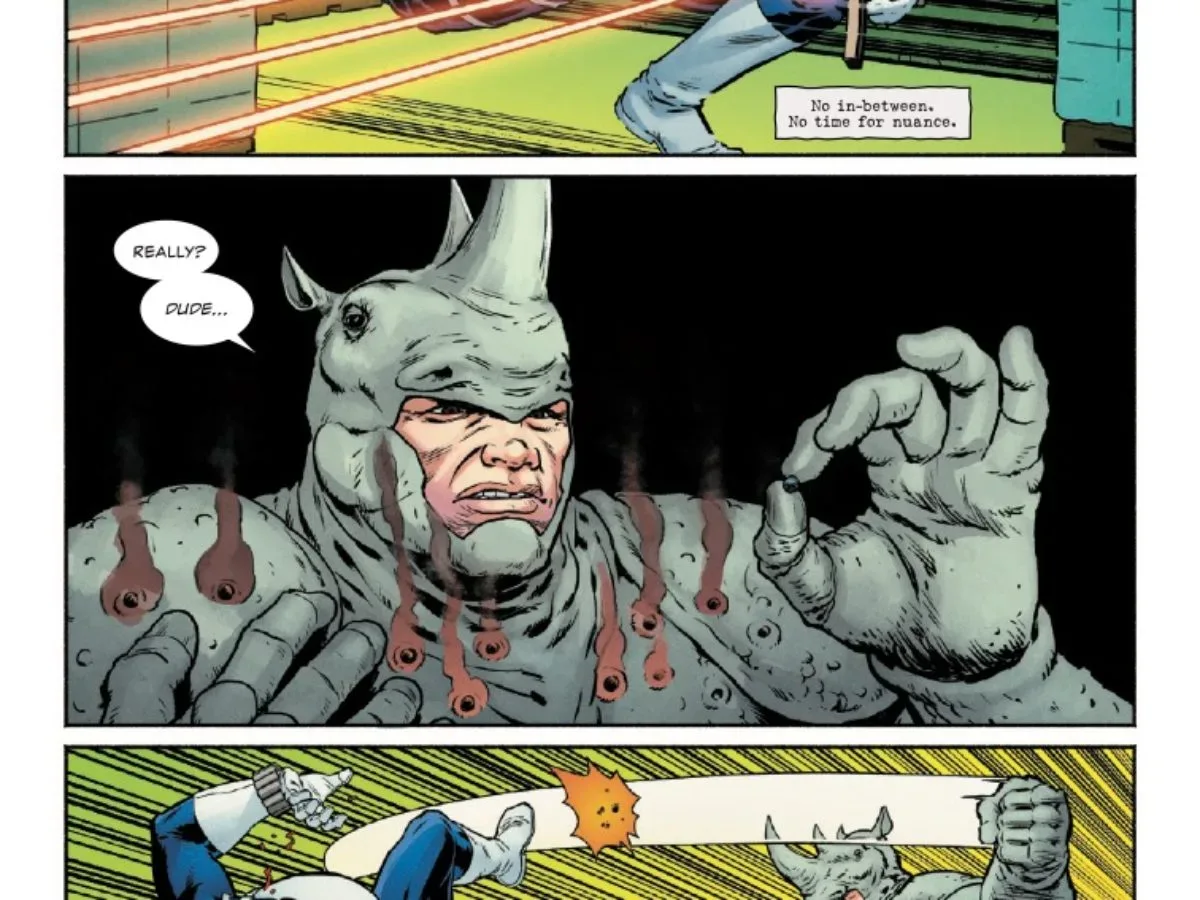
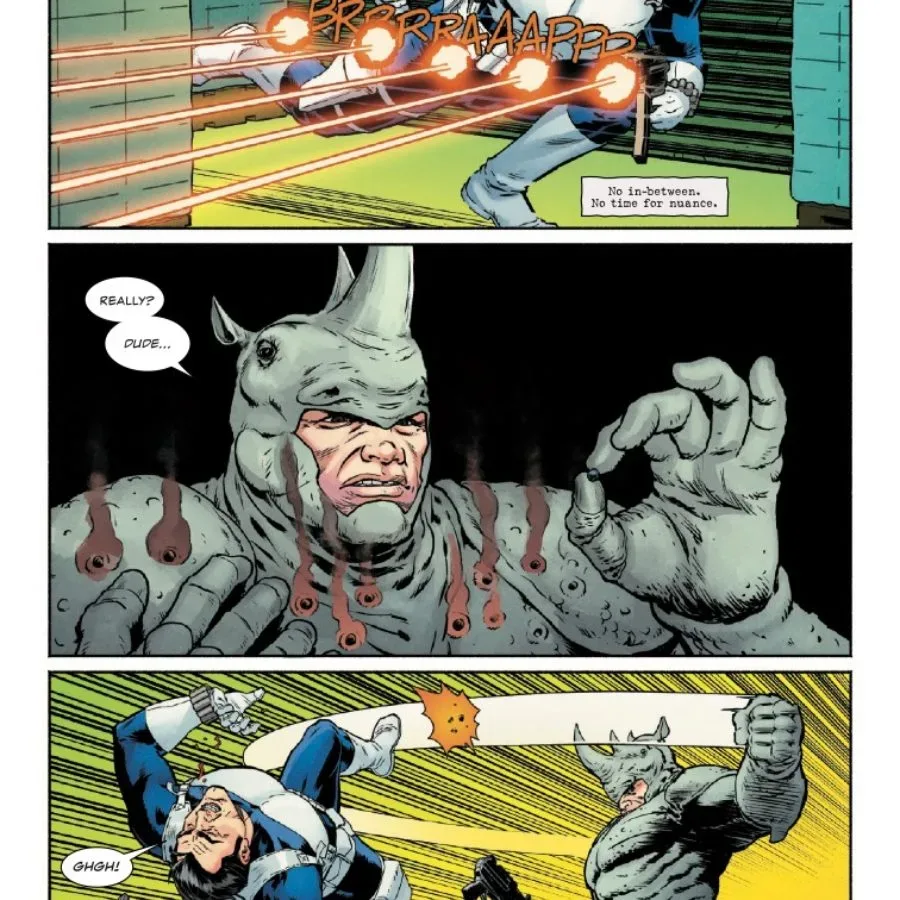
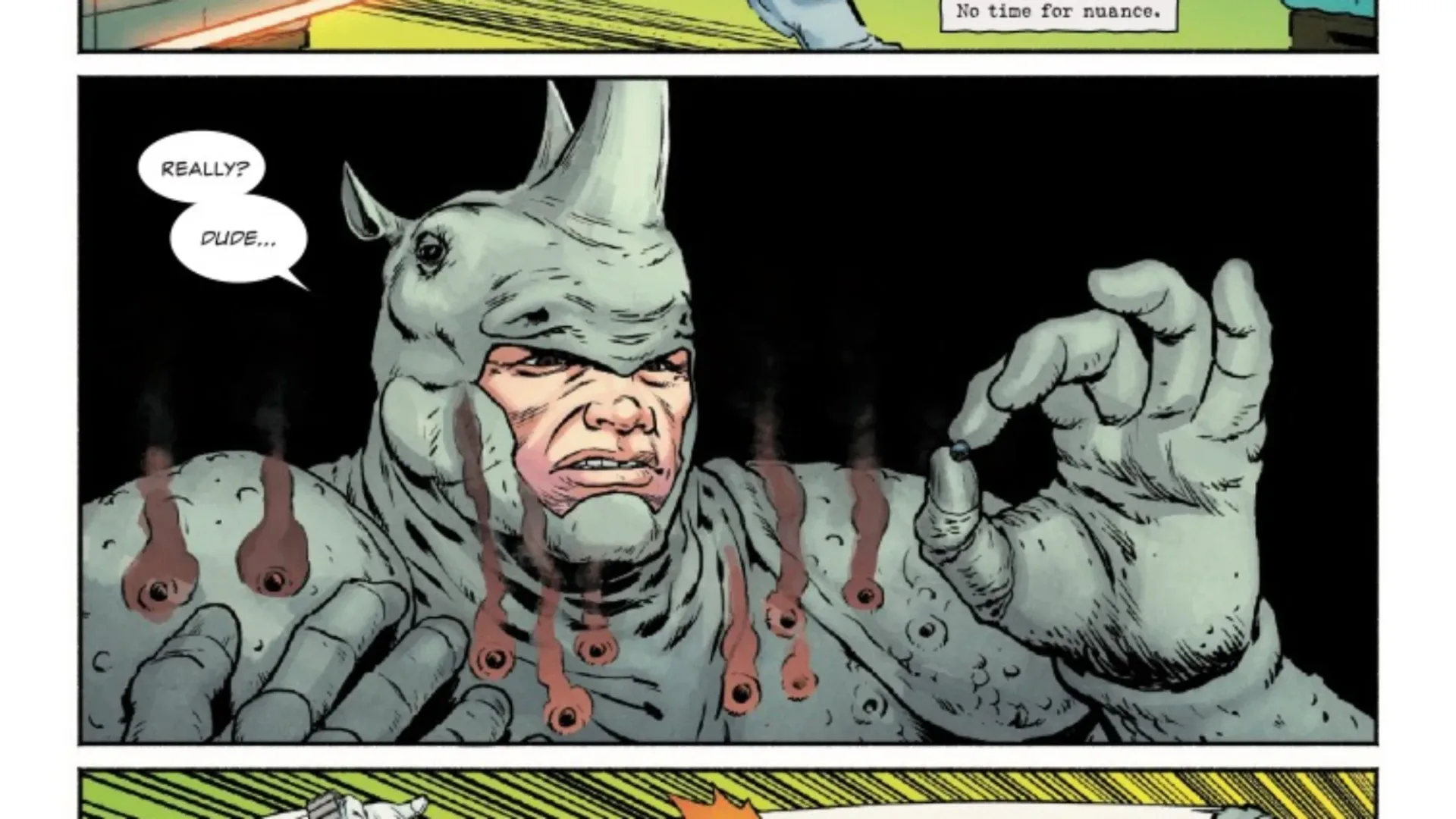
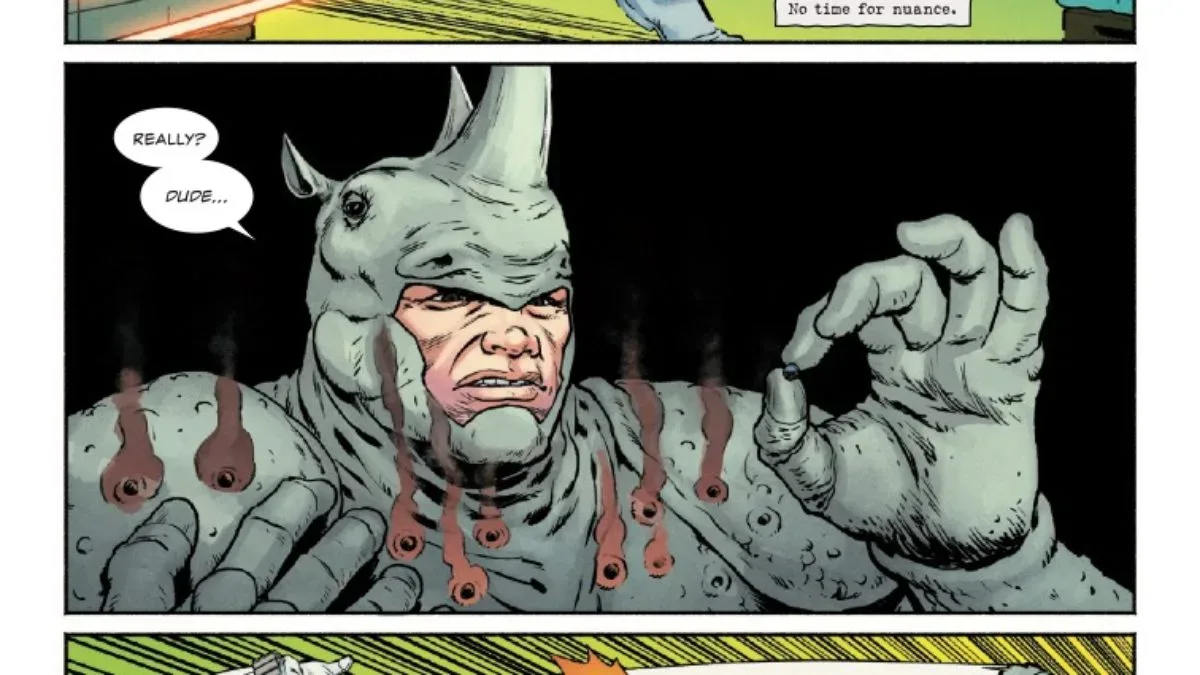
Rhino is a fitting presence for this dispute because he is presented as bulk-armored and physically formidable. A heavily protected opponent creates an action problem for Spider-Man and the Punisher alike, but it also raises the temptation to treat overwhelming violence as the fastest solution.
Preview material points to Frank abandoning nonlethal rounds for 240-grain jacketed hollow points during the fight. In simple terms, a hollow-point round is ammunition designed to expand after impact; the “grain” measurement refers to projectile weight. The story uses that weapon detail to clarify Frank’s outlook rather than to turn it into empty technical spectacle. In a crisis, he sees restraint as theatrical and dangerous. He identifies an exposed vulnerability on Rhino and is prepared to use it lethally.
That is precisely where Spider-Man’s opposition becomes consequential. Spider-Man’s webs and agility are traditionally tools for disarming, containing, redirecting, and rescuing. Against an armored foe, those tools may be insufficient by themselves—but insufficiency does not automatically erase the question of what should be done next. The issue’s conflict asks whether a difficult situation validates Castle’s approach, or whether holding the line on lethal force is most important when that line is hardest to hold.
Why the warehouse matters
A warehouse is more than a convenient enclosed arena for superhero action. It is an environment that can intensify uncertainty: limited exits, blind corners, industrial obstacles, possible bystanders, and the potential for damage to spread quickly. In that setting, Spider-Man’s impulse to restrain and protect clashes even more sharply with Frank’s emphasis on immediate, permanent neutralization of a threat.
The available material also identifies a figure called Morgue, whom Spider-Man is seen webbing up amid the chaos. That detail reinforces that Rhino is not necessarily the only problem in the space. Spider-Man’s attention is divided between a major powerhouse and a live criminal situation, while Frank’s focus is on ending the most dangerous threat in the most direct way he can.
Stories like this work best when neither character’s problem is trivialized. If Rhino can be easily contained, then Frank’s lethal escalation has less dramatic force. If every alternative has already failed beyond question, then Spider-Man’s refusal risks being reduced to a formality. The stated setup appears built to keep both pressures alive: a serious threat, insufficiently simple answers, and two heroes who read duty in incompatible ways.
What “responsibility” means in this matchup
Spider-Man’s responsibility is often condensed into a famous principle, but its practical meaning is broader than a slogan. It includes accepting accountability for the outcomes of his strength, recognizing that fear and anger can distort judgment, and declining shortcuts that put personal certainty above due process and life. In a fight with the Punisher, that philosophy does not remain abstract. It becomes a direct challenge to someone who believes his certainty is justified by the crimes he is confronting.
For Castle, the argument is about efficacy. He believes criminals who inflict devastating harm cannot always be managed through capture and restraint. Spider-Man, conversely, sees no-kill boundaries as part of what prevents a hero from taking on the role of judge, jury, and executioner. Their disagreement is therefore not about whether violence is already present—both operate in violent situations—but about control, limits, and the authority to decide that another person cannot be allowed to live.
That is the useful distinction at the center of the issue. Spider-Man’s objection is not that Rhino is harmless or that Frank is imagining a threat. He contests Frank’s chosen answer. The argument becomes more difficult, rather than less, because Rhino’s armor and aggression make Castle’s solution feel immediately practical.
A relationship defined by friction
Marvel describes the confrontation as one that sets the tone for Spider-Man and the Punisher’s relationship for years to come. That is a substantial promise, but the available premise supports it. The two characters are close enough in purpose to keep crossing paths and far enough apart in method to make those crossings combustible.
They are not opposites in the simplistic sense. Both target criminal harm. Both move quickly when people are in danger. Both possess a strong internal code. The difference is that Spider-Man’s code restricts the force he will use, while Castle’s code can demand that he use fatal force when he believes it will prevent future harm. Their shared urgency is what makes their ethical divide so pointed.
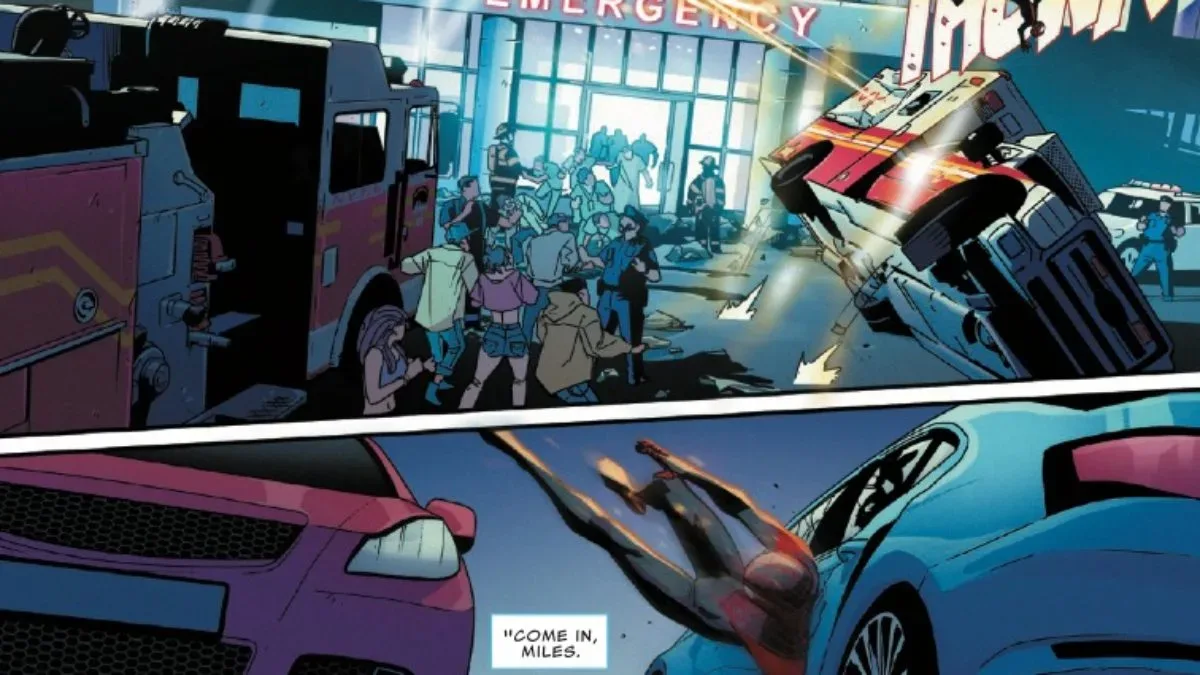
Readers following current Marvel comic coverage may also want to see how another Spider-Man title uses its hero’s past as a source of tension in Miles Morales: Spider-Man #2. The stories involve different Spider-Men and different circumstances, but both premises underline how much Marvel’s street-level conflicts can turn on history, identity, and the choices heroes make under pressure.
Release details and variant covers
Punisher vs. Spider-Man #3 goes on sale September 23, 2026. The standard edition is priced at $4.99 in the US and runs 32 pages. Marvel has also listed three variants at the same US price: a Luciano Vecchio variant, a Mark Bagley variant, and an Erik Larsen variant.
- Title: Punisher vs. Spider-Man #3
- Writer: Dan Abnett
- Artist: Alvaro Lopez
- Cover artist: Jonas Scharf
- On sale: September 23, 2026
- Format: 32 pages
- US price: $4.99
- Rating: T+ / Parental Advisory
The issue’s central appeal is clear: it places a younger Castle’s hard-edged campaign against the hero whose responsibility is most visibly tested by that campaign. Rhino supplies the physical danger, the warehouse supplies the pressure-cooker setting, and Spider-Man supplies the moral resistance. Whether the confrontation ends in cooperation, condemnation, or an uneasy combination of both, the underlying conflict is not likely to be resolved by simply defeating the villain in the room.