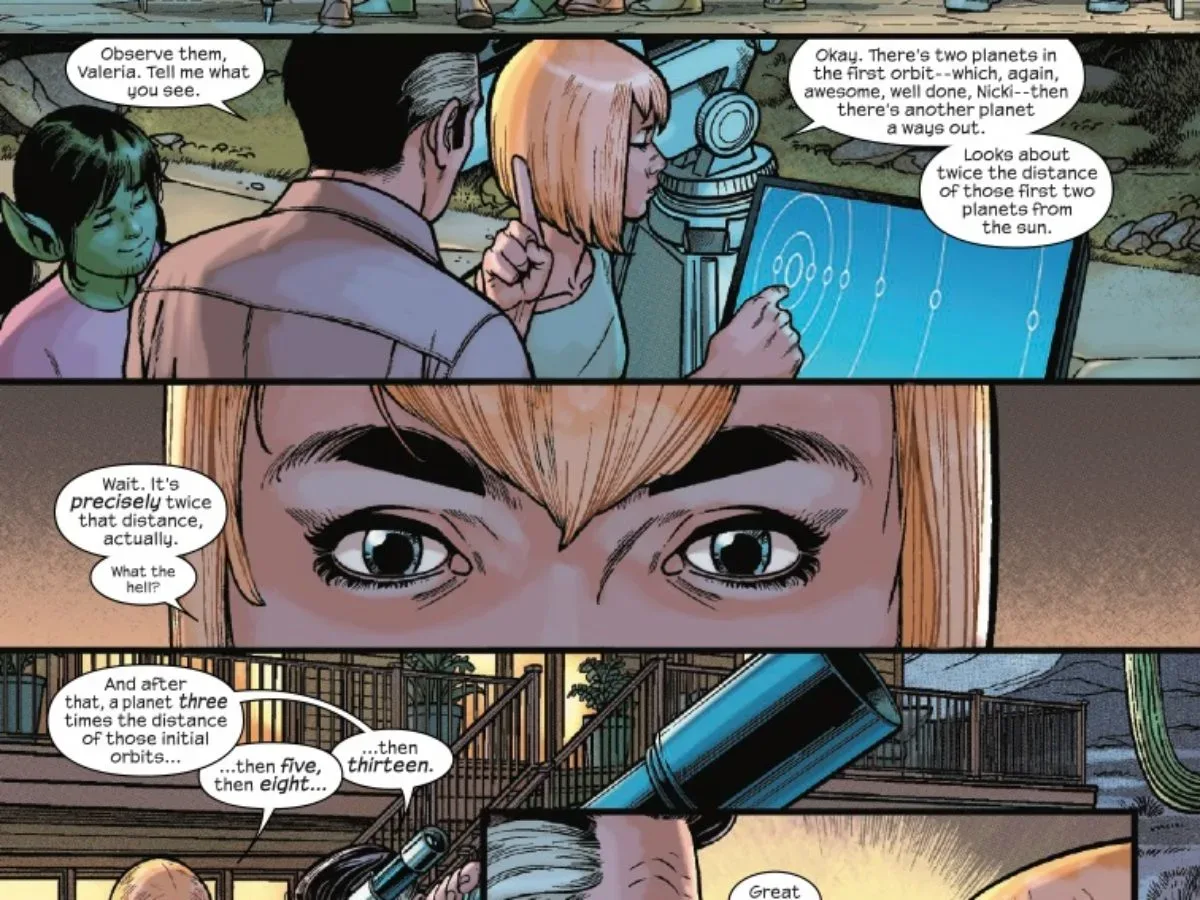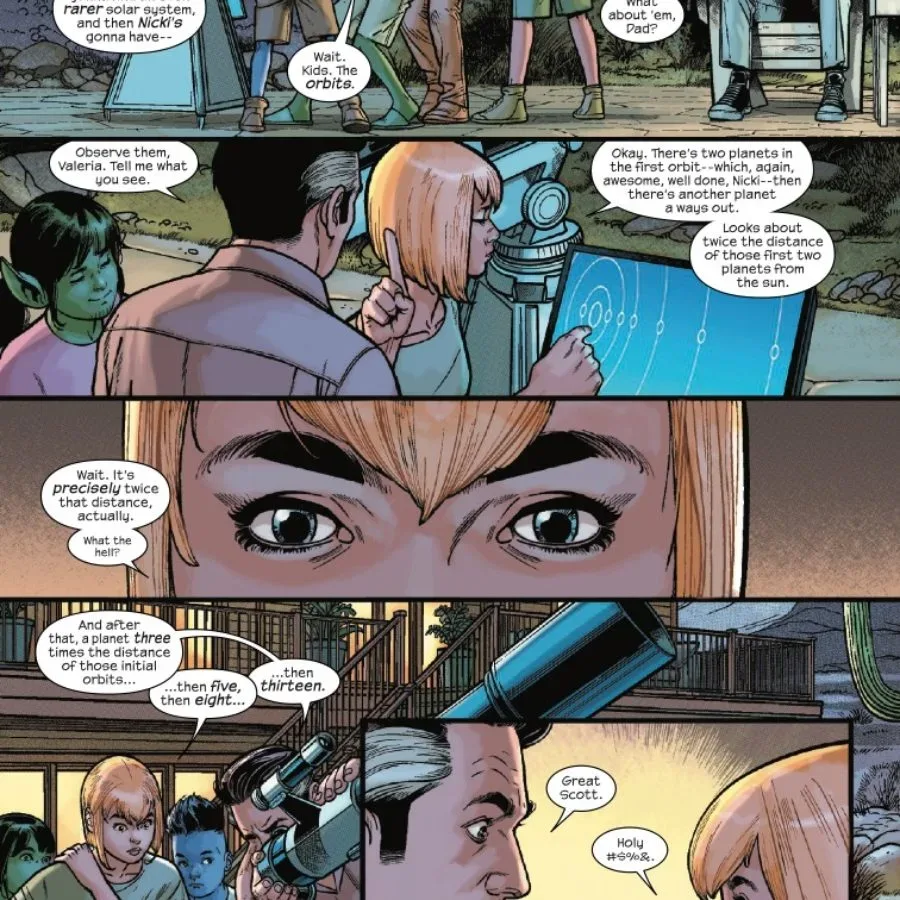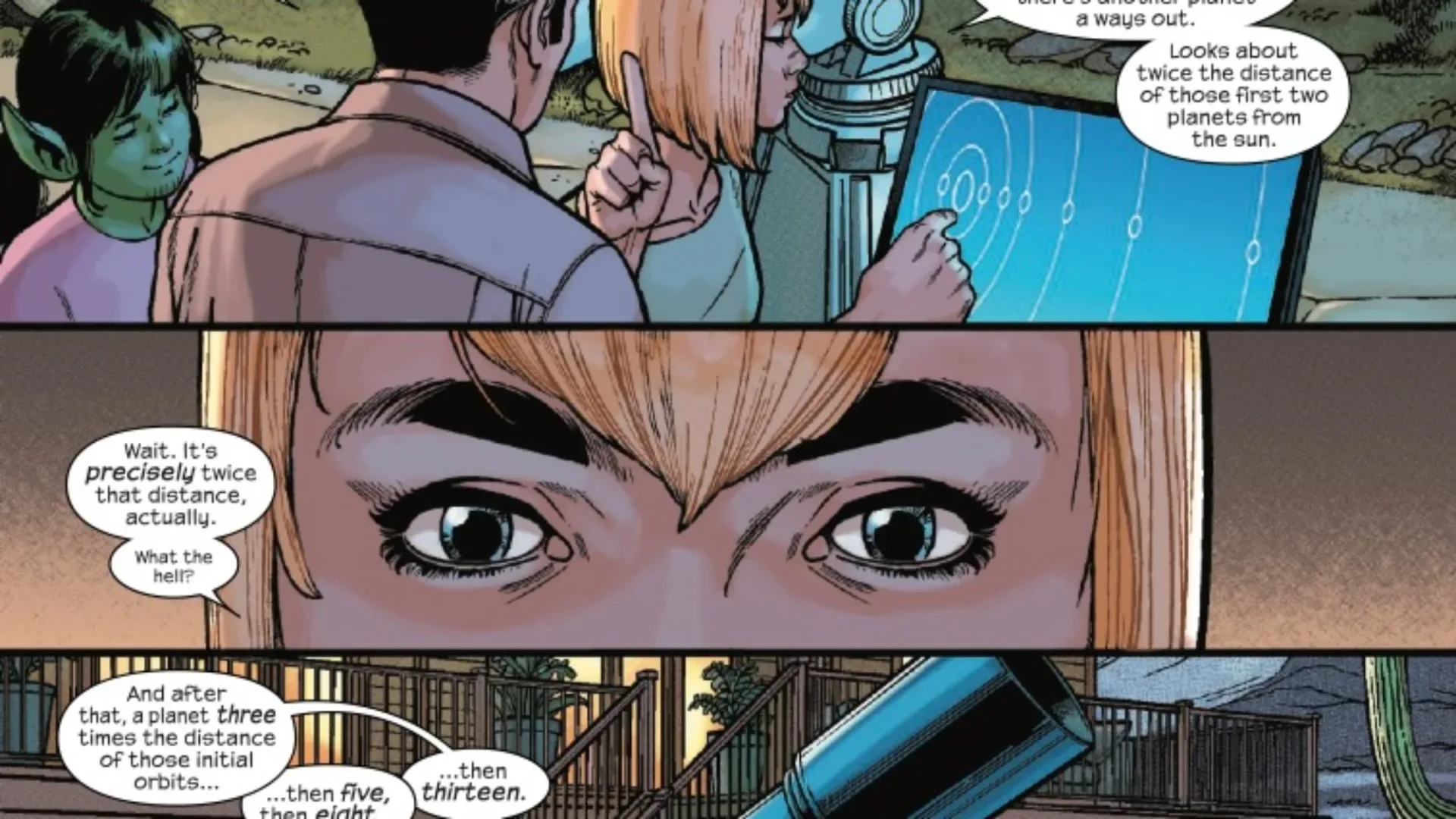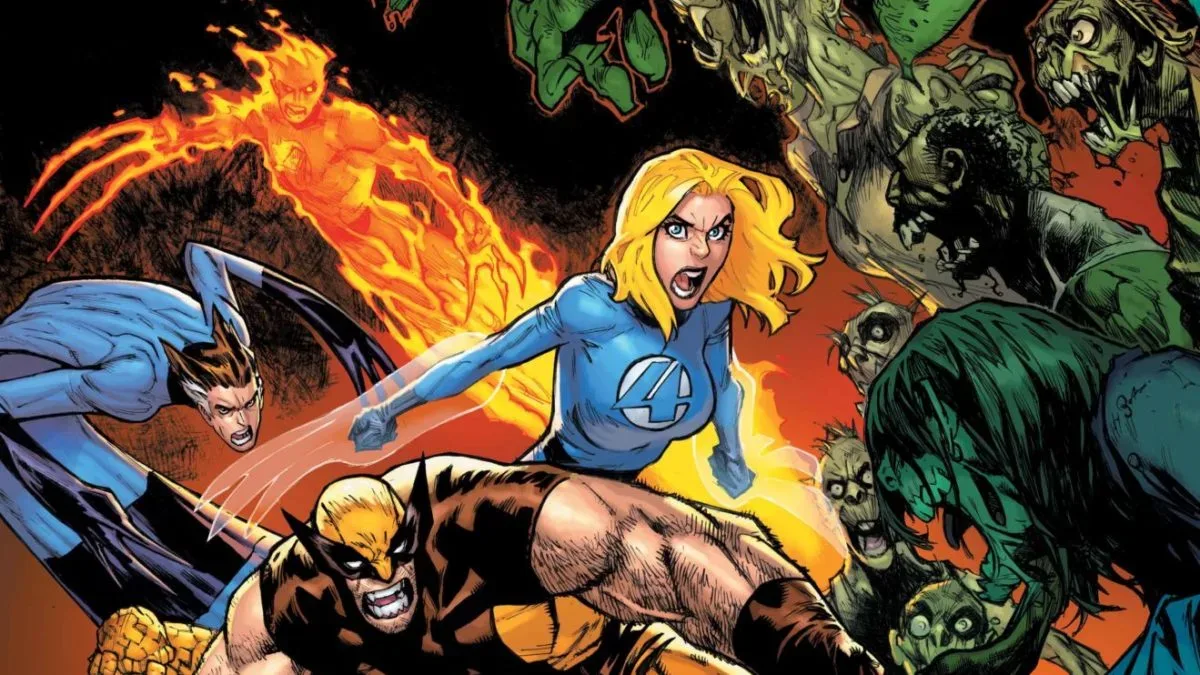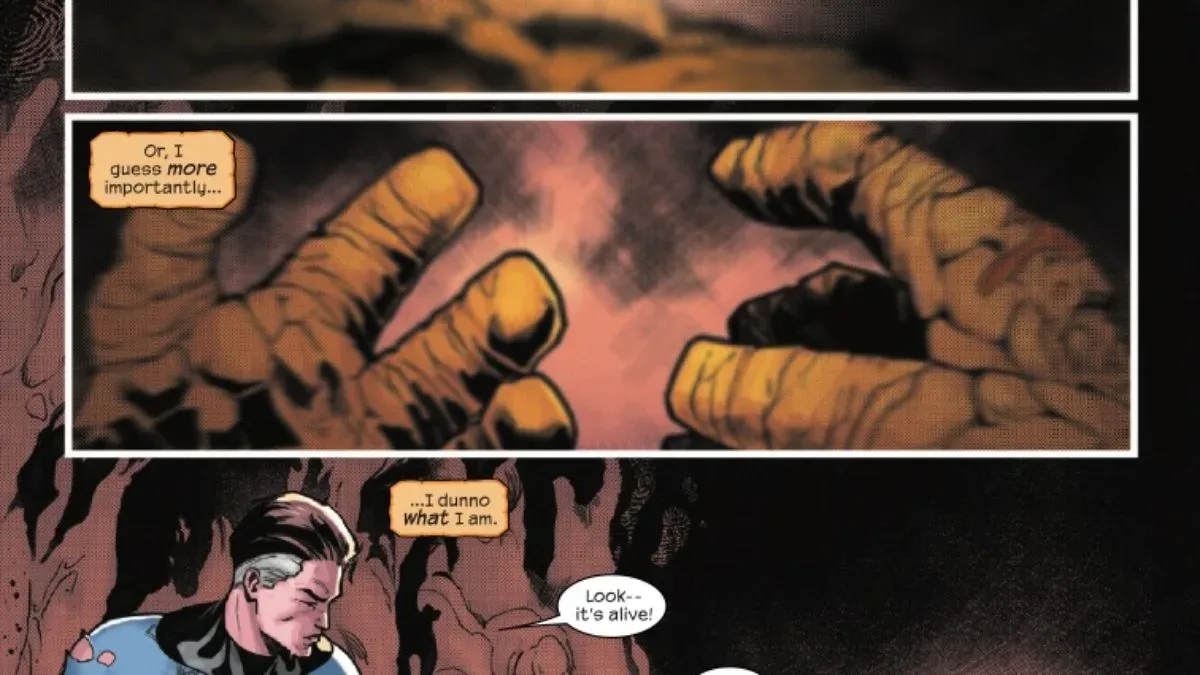
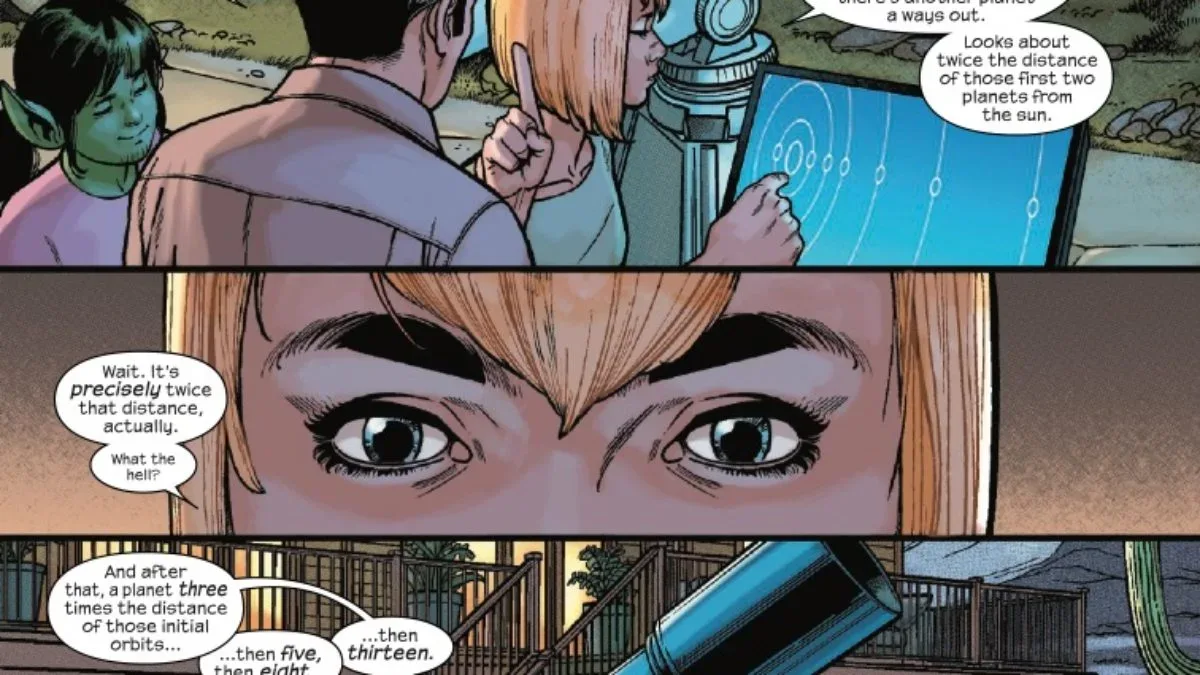
The Fantastic Four are turning a family science project into a full-scale cosmic mystery in Fantastic Four #19. The issue, which begins the new storyline “The Dark Forest”, centers on a telescope built for the Richards children—one capable of looking farther into unexplored space than ordinary observation would allow. What it finds is not evidence of alien life in the conventional sense, but evidence of alien technology on an extraordinary scale.
That distinction drives the premise. The family identifies a technosignature, described here as solar engineering that could only have been created by an immensely advanced civilization. In plain terms, a technosignature is a detectable sign of technology rather than a direct biological sign of living organisms. A biosignature would point toward the possible presence of life itself; this signal instead points toward what intelligent beings built. For a team led by Reed Richards, a cosmic engineering project is naturally difficult to ignore.
The signal also appears to function as an invitation. The Fantastic Four and their children follow it across the universe, only to learn the civilization responsible for it is extinct. That makes the invitation less like a welcome message and more like a warning preserved in the ruins. Worse, the description indicates that whatever destroyed the society may still be nearby.
A family discovery becomes an isolation story
Fantastic Four stories have long had room for both impossible science and domestic stakes, and #19 places those elements directly together. The telescope was built for the children, so the family is involved in the discovery from the start rather than arriving after Reed has solved the central puzzle. The comic’s setup then removes that family unit from familiar territory and places it on the other side of the universe, where cryptic messages and an unknown threat await.
That is an effective pressure point for the premise. An invitation from an advanced culture could promise first contact, discovery, or access to a remarkable scientific achievement. Instead, the heroes find the aftermath of catastrophe. The question is no longer simply what the creators of the solar engineering wanted to communicate. It is also whether the invitation was sent before their destruction, whether it was intended as a warning, and whether responding to it has exposed the Richards family to the same danger.
The solicitation’s most consequential phrase is that the team will be “all alone” against a force they cannot defeat. That should be read as the issue’s stated dramatic situation, not a guarantee that every apparent advantage or setback will remain unchanged throughout the storyline. Still, it establishes a deliberate imbalance: Marvel’s first family is entering the arc with their usual scientific curiosity, but the opposition is framed as something beyond their ability to overpower directly.
What “The Dark Forest” is setting up
As Part One, Fantastic Four #19 has several jobs to do. It needs to introduce the telescope and its extraordinary result, establish why the signal is compelling enough to pursue, and turn an apparent breakthrough into a threat. It also needs to make the alien civilization matter even though the society is no longer there to meet. The remnants—its solar engineering, its messages, and the evidence of its fate—become the active pieces of the mystery.
The title The Dark Forest suggests an environment where exposure can be dangerous, but the supplied details do not define the title’s in-story meaning. What is clear is the arc’s emphasis on uncertainty. The family has detected something deliberately made and apparently directed at an observer. Yet its makers are gone, and the entity or force responsible may not be. The difference between a discovery and a trap may be the story’s central tension.
This also puts scientific interpretation at the heart of the conflict. A technosignature is evidence, but evidence requires context. Solar engineering may reveal the scale and sophistication of a vanished culture, without immediately explaining its intentions, its history, or the nature of the danger that destroyed it. The Richards family is therefore not merely traveling to a location; they are attempting to interpret a message from people who cannot clarify it.
For readers following Marvel’s wider comic output, Joking Joystick has also covered another mutant-facing collision course in DNX #5. Fantastic Four #19, however, is specifically positioned as a new cosmic-family mystery rather than a crossover event in the information currently available.
Creative team and issue details
Ryan North is credited as writer and Ramon Rosanas as artist for Fantastic Four #19. The main cover is by Humberto Ramos. The issue is listed as a 32-page, Rated T release from Marvel, with an on-sale date of November 18, 2026 and a US cover price of $4.99.
Readers who choose covers beyond the main edition will have several listed options, all priced at $4.99 in the US and $6.25 in Canada:
- Paco Medina 1:25 variant
- Peach Momoko Momo-Tone variant
- Marco Checchetto Indiana Jones Marvel Artifact variant
- Ramon Rosanas variant
- Leonel Castellani Marvel Studios Doomsday variant
The “1:25” label on the Paco Medina edition identifies it as an incentive variant. In comic-shop ordering, that generally denotes a copy tied to a retailer’s ordering quantity for the standard edition; the supplied listing names it as a 1:25 variant but does not provide further ordering or availability details. The other variant names identify distinct cover editions, not different story contents.
Why the setup fits the Fantastic Four
The Fantastic Four’s strongest premises often begin with a discovery that is exciting precisely because it is dangerous. Here, a new telescope represents the optimistic side of exploration: a family-built instrument enabling young minds to look beyond known space. The immediate reversal is that deeper sight uncovers the trace of a civilization whose technological achievement survived while the civilization itself did not.
That is a particularly sharp form of cosmic horror for a science-forward superhero book. The solar engineering is proof that somebody once had the knowledge and resources to reshape a star-scale environment. Their absence is proof that technological power did not make them safe. The danger becomes more immediate when the story suggests that the destructive force has not necessarily disappeared with its victims.
The family angle prevents the concept from being only an abstract space puzzle. The children are connected to the telescope that opens the door to this encounter, while the adult heroes must face the consequences of taking that invitation seriously. Whether the issue presents the journey as a lesson in wonder, caution, or both, its launch point is clear: curiosity reaches out into the dark and something answers—just not the civilization the Richards family hoped to find.
Fantastic Four #19 arrives November 18, 2026. It begins “The Dark Forest” with a vanished society, a surviving signal, and a threat framed as too powerful for the team to defeat head-on.