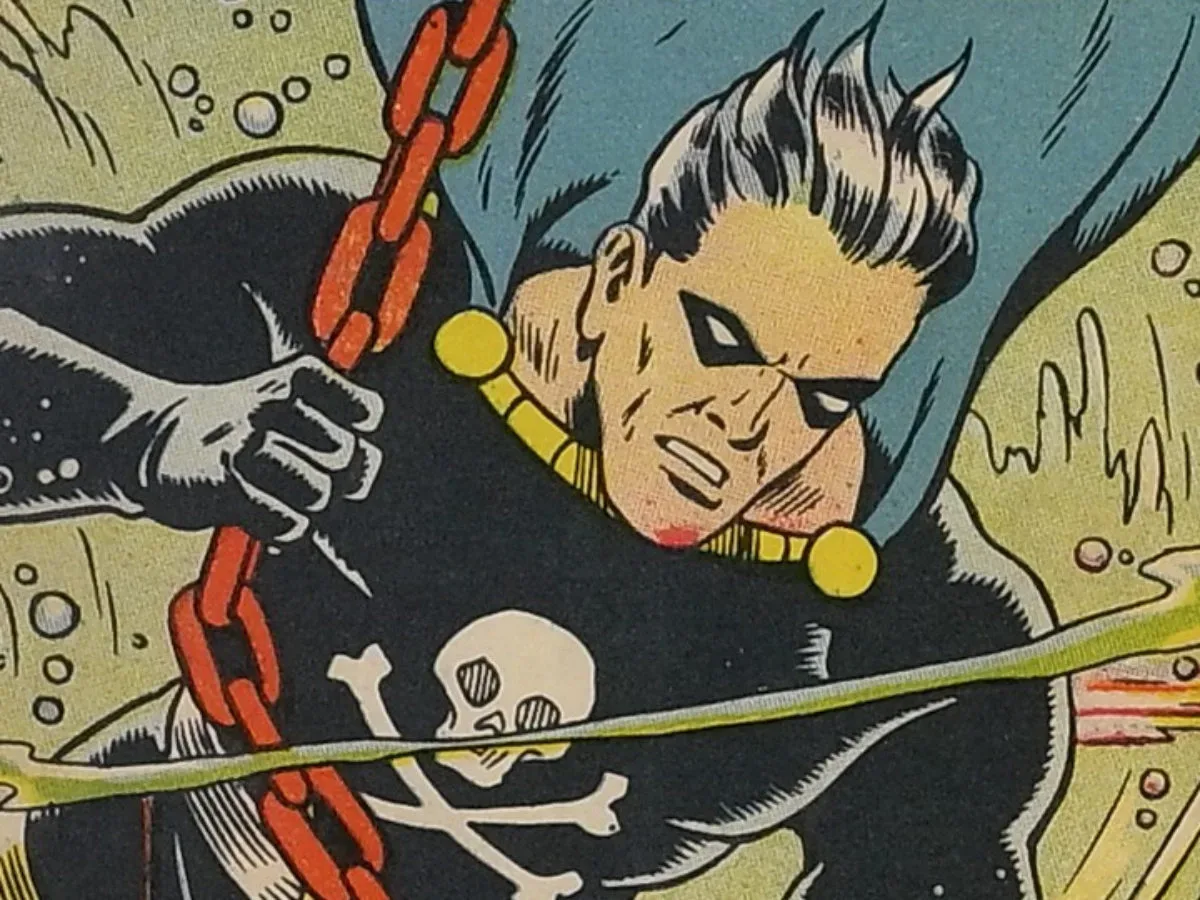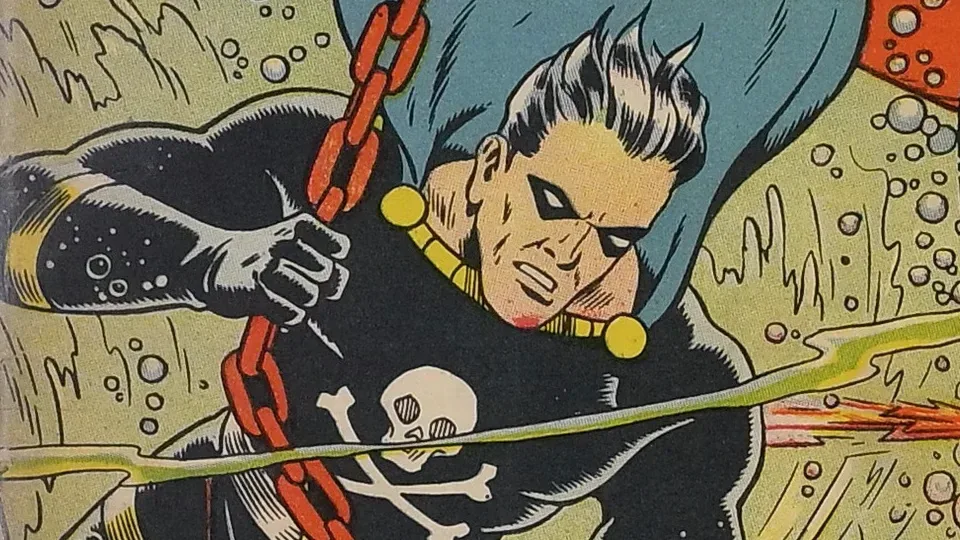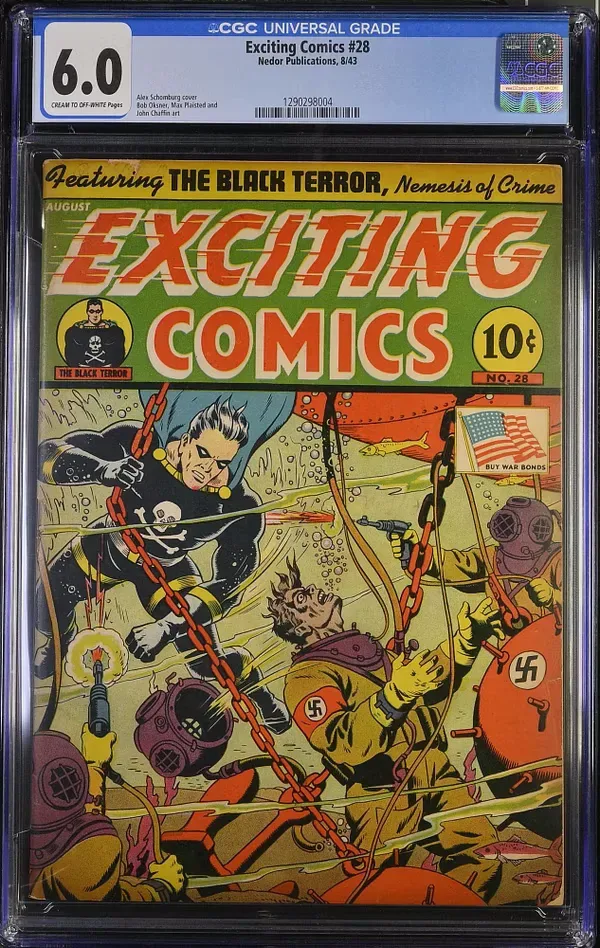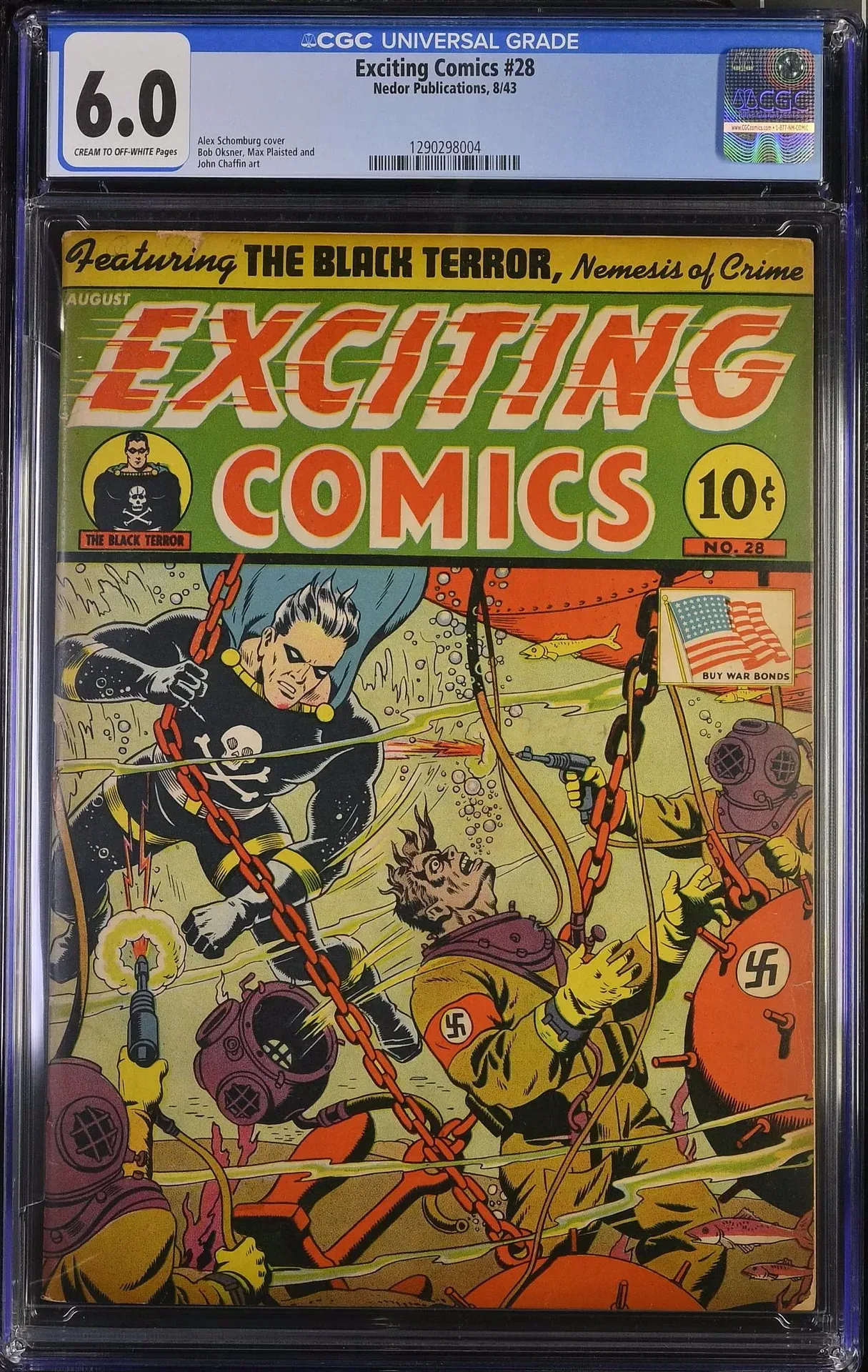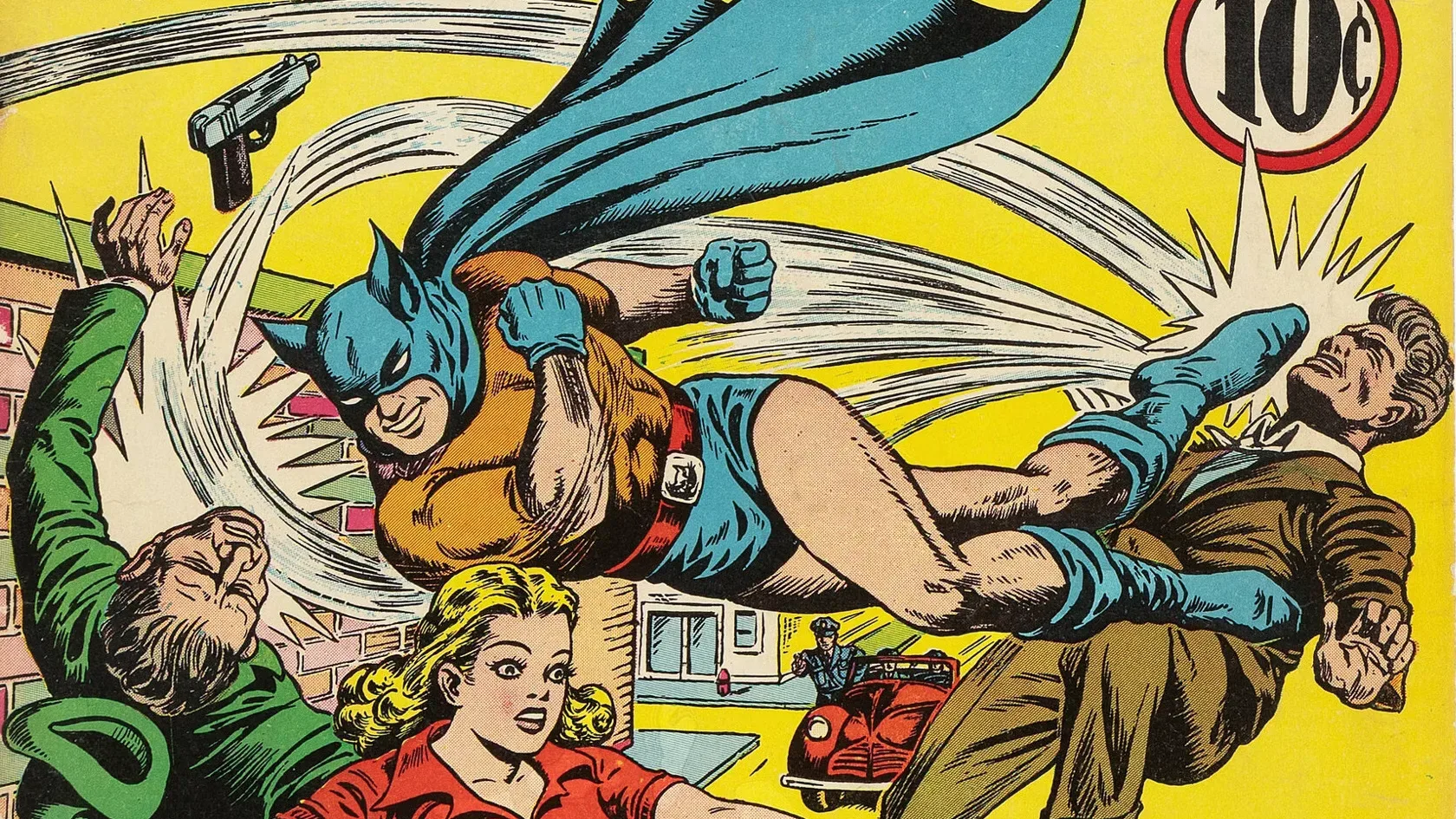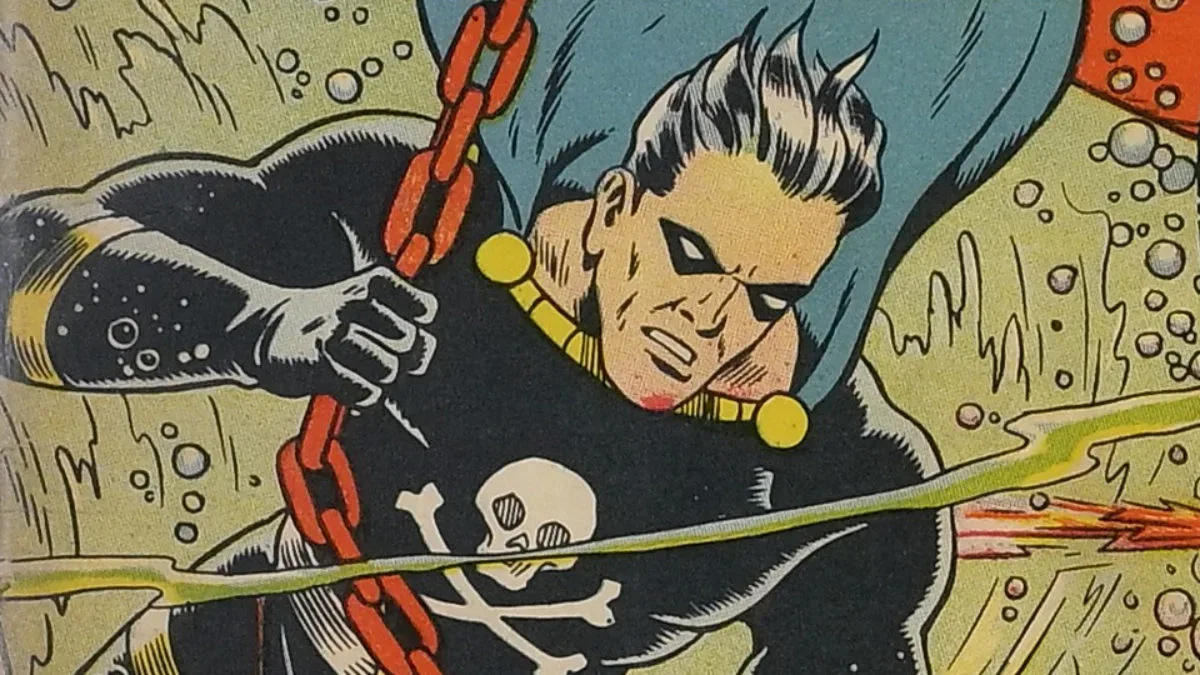
A copy of Exciting Comics #28, published by Nedor in 1943, is scheduled for the November 5, 2026 Golden Age Century Comics Showcase Auction VI #40378. The offered book is a CGC Universal FN 6.0 with cream-to-off-white pages, but its appeal extends beyond a single numerical grade. This is an issue where Golden Age superhero imagery, wartime popular culture, aviation-fiction drama and comics-collecting lore all meet on one cover.
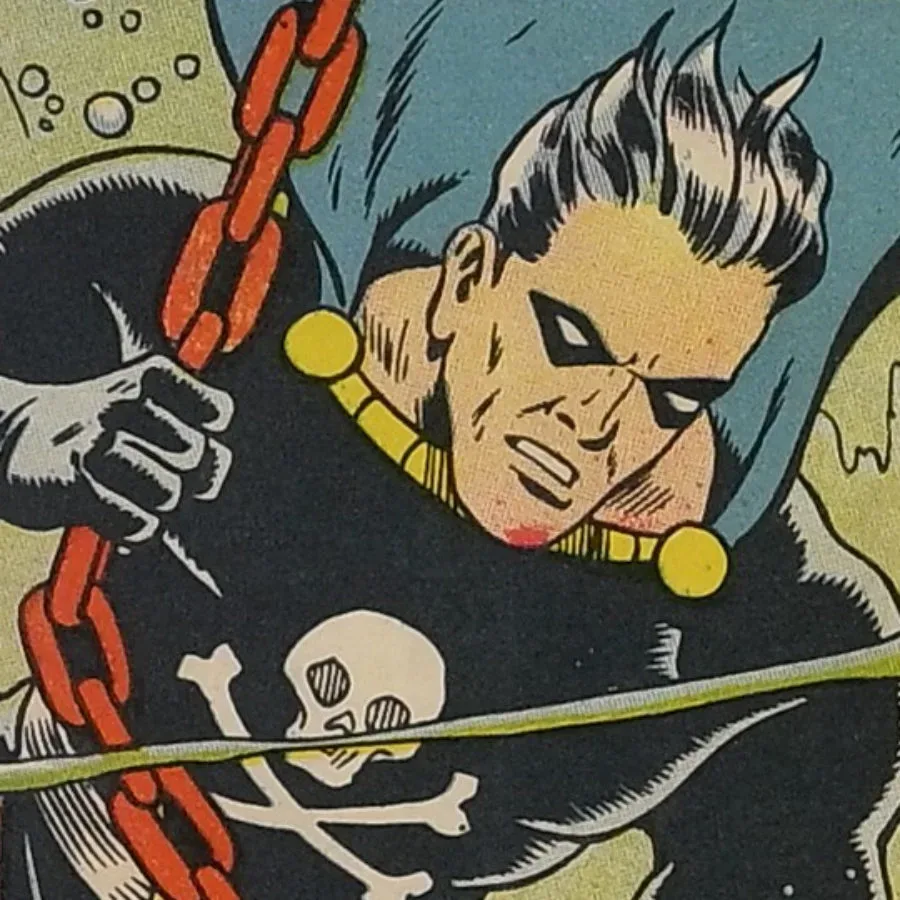
Its Alex Schomburg cover presents the Black Terror in an underwater scene, while the interior includes a Larry North adventure that borrows the emotional and political climate surrounding the Doolittle Raid. The issue is also one of the 44 so-called “white space” books in Ernie Gerber’s landmark photo guide—a distinction that has made particular Golden Age issues fascinating to collectors for decades.
A 1943 comic built around wartime urgency
Exciting Comics #28 is cover-dated August 1943 and reportedly reached newsstands around June 8 that year. Its contents reflect a period when American comic books did not simply use war as background decoration. Stories frequently presented heroes as participants in the war effort, and the books encouraged readers at home to participate through messages promoting War Bonds and Stamps.
That framing is central to this issue. The fictional adventure follows Larry North of the U.S. Navy on a mission linked to intelligence gathered during the Doolittle Raid. A photograph obtained during that raid reveals three enormous Japanese aircraft carriers being built. Within the story, each carrier is described as capable of carrying 100 aircraft and as a potential threat to Hawaii, the Panama Canal and the U.S. West Coast.
North leaves Betty Harmon in Hawaii and departs with a three-bomber force to eliminate the ships. The planned target is gone when the group reaches the shipyard: the carrier slips are empty. The airmen receive alternate targets and orders directing them toward China or Russia after the operation. The story eventually has North destroy all three carriers, delivering a compact six-page fantasy of intelligence, long-range aviation and decisive retaliation.
The adventure’s art is attributed to Max Plaisted. Plaisted’s work for the Pines organization ran from 1940 through 1944, alongside his work teaching modern and commercial art at Keuka College. The issue also contains artwork associated with Al Camy and Bob Oskner, as well as scripts by Richard Hughes.
Why the Doolittle connection matters
The Doolittle Raid was more than a convenient name for an aviation story in 1943. News surrounding captured raiders had returned to public attention under grim circumstances that spring. On April 12, the United States issued a diplomatic protest over the execution of captured Tokyo raiders and rejected accusations that the airmen had intentionally attacked civilian targets. President Roosevelt’s statement was publicly released on April 21.
That recent news context appears to have informed the Larry North story’s use of propaganda. A Japanese broadcast in the comic falsely claims that 100 American aircraft have been destroyed and says that five captured airmen will be executed for bombing schools and hospitals. The resemblance to real-world wartime allegations and the fate of captured raiders is difficult to miss, although the comic’s carrier mission itself is fictional.
For modern readers, that mixture requires some care. The issue is a work of entertainment and wartime persuasion, not a historical document or a literal continuation of the Doolittle mission. Still, it preserves how quickly comic-book storytelling could absorb immediate headlines. A six-page adventure turned a contemporary national trauma into a high-stakes narrative in which a hero receives secret intelligence, faces a changing battlefield and prevails against overwhelming enemy hardware.
It also illustrates the role comics could play in reinforcing home-front messaging. The book’s repeated bond and stamp appeals connected on-page military heroics with a civilian action readers were asked to take. In that sense, the issue was selling more than action: it was joining a larger wartime culture built around participation, morale and patriotic obligation.
Schomburg’s cover and the appeal of a “white space” comic
Alex Schomburg’s contribution is a major reason the issue stands out. Schomburg did substantial work for Pines, and his Black Terror cover gives this particular issue a striking visual identity separate from the Larry North feature inside. For collectors, though, its reputation is bound especially tightly to Ernie Gerber’s The Photo-Journal Guide To Comic Books.
Published in two volumes in 1989, Gerber’s guide attempted an enormous photographic record of Golden Age comics. It included images of roughly 21,000 books and Gerber’s scarcity assessments, informed by his long involvement in comic-book collecting. He was also the inventor of the Mylar Snug.
The guide used an 11-point scarcity index. At its extreme, a Gerber 11 meant a comic was known to have been published but no copy was known to exist. A Gerber 10 referred to fewer than five known copies, Gerber 9 indicated six to 10, and Gerber 8 indicated fewer than 20. These figures should be understood as Gerber’s period assessment rather than a permanent, exact population count; surviving copies can surface, be identified differently, or later enter third-party grading records.
Gerber could not obtain cover photographs for 44 of the 21,000 books in time to include them in the guide. Rather than omit the entries, the book printed blank areas where the covers would have appeared. Those omissions became known among collectors as “white space” comics. The term does not describe a variant, an alternate printing or a defect in the comic itself. It refers to the empty placeholder in the 1989 reference work.
Exciting Comics #28 was both a Gerber 8 and one of those 44 white-space entries. That dual status gives it a very particular kind of cachet. A collector may value the book for Schomburg’s cover, its wartime subject matter, the Black Terror, its scarcity reputation, or the fun of owning a comic that once appeared in a famous guide without its cover shown. Here, those narratives overlap rather than compete.
What the current grading census does—and does not—say
The current CGC census lists 29 Universal entries for Exciting Comics #28, along with one Conserved entry and three Restored entries. Three Universal copies are graded 6.0, and three grade higher.
Those labels are useful for interpreting the auction copy. “Universal” is CGC’s standard label designation for a comic without restoration that affects its grade designation. “Restored” identifies work performed to improve or replace aspects of the book, while “Conserved” refers to preservation-oriented intervention. Collectors can have different preferences between these designations, so they are material details rather than interchangeable census totals.
The census also should not be read as a full inventory of every surviving copy. It records comics submitted to CGC, not every issue that may exist in private collections, dealer inventories or ungraded holdings. Likewise, a Gerber 8 rating and a modern grading census answer different questions. Gerber’s index captured an estimate of observed scarcity during the guide’s creation; the census tracks a subset of copies that have been certified by one grading service.
In practical terms, the offered 6.0 sits at a grade shared by three Universal census entries, with only three Universal copies recorded higher. That does not create a guaranteed valuation outcome, but it provides useful context for anyone weighing the book’s place among slabbed copies. The cream-to-off-white page designation is another preservation detail potential bidders will likely consider alongside the grade and label type.
An issue with more than one literary footnote
There is another unusual attribution attached to the book: a tentative script credit for Patricia Highsmith on the Crime Crushers story. Highsmith would later become a celebrated novelist, and her name is also referenced in that story’s dialogue. The credit remains tentative, an important qualification when discussing work from an era where comics documentation can be incomplete and credits were not always presented with modern precision.
That uncertainty does not erase the point of interest. It adds another layer to an issue already notable for its assembled talent: Plaisted, Camy, Oskner, Hughes and Schomburg are all connected to its contents, while the Highsmith association offers a possible early-career link to a writer who later became widely known for prose fiction.
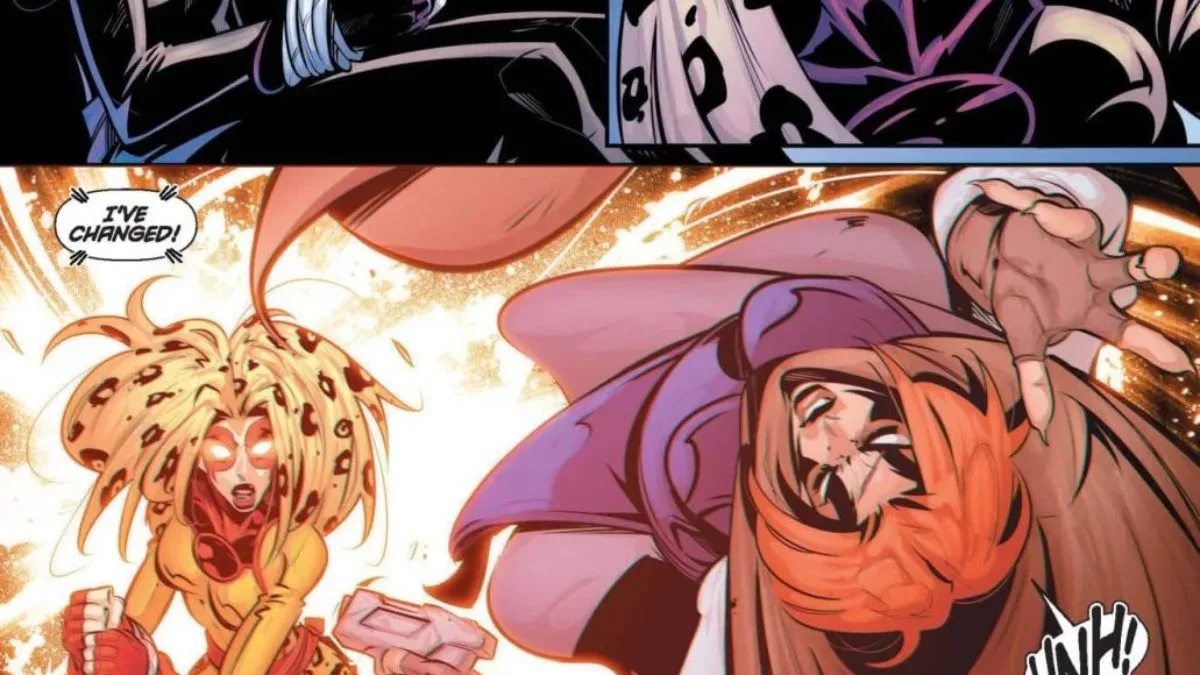
For readers who enjoy comics as a cross-section of visual culture, this is the attraction of books such as Exciting Comics #28. They are not reducible to their front cover or a headline-grade scarcity tag. They carry traces of the production system that made them, the immediate events that shaped their stories, and the changing ways collectors have catalogued and valued them. That same broad interest in comic-book worlds continues across newer fiction too, including a recent look at Cheetara’s hunt for the Book of Omens.
What makes this auction copy notable
Potential bidders are looking at a 1943 Nedor comic with several distinct, source-supported points of significance:
- Schomburg cover art: the underwater Black Terror image comes from one of the era’s best-known comic-book cover artists.
- Wartime context: the Larry North feature echoes the public aftermath of the Doolittle Raid and was published only weeks after Roosevelt’s April 21 statement became public.
- Gerber white-space status: it belongs to the limited group of 44 covers missing from the original 1989 photo guide.
- Gerber 8 designation: Gerber’s historical estimate placed the issue below 20 known copies at the time of his assessment.
- Certified-condition context: the auctioned copy is CGC Universal 6.0, while the census lists three higher Universal entries.
- Creator associations: the book links Schomburg and several interior contributors, with a tentative Highsmith script attribution adding further intrigue.
There is no need to force a single reason for this issue’s appeal. The historical resonance may be the main draw for one bidder; the Schomburg cover for another; the Gerber-guide story for a third. The November 5 sale puts all of those elements in play at once, attached to a certified copy of a comic whose reputation has grown from the unusual intersection of art, war-era storytelling and collector memory.