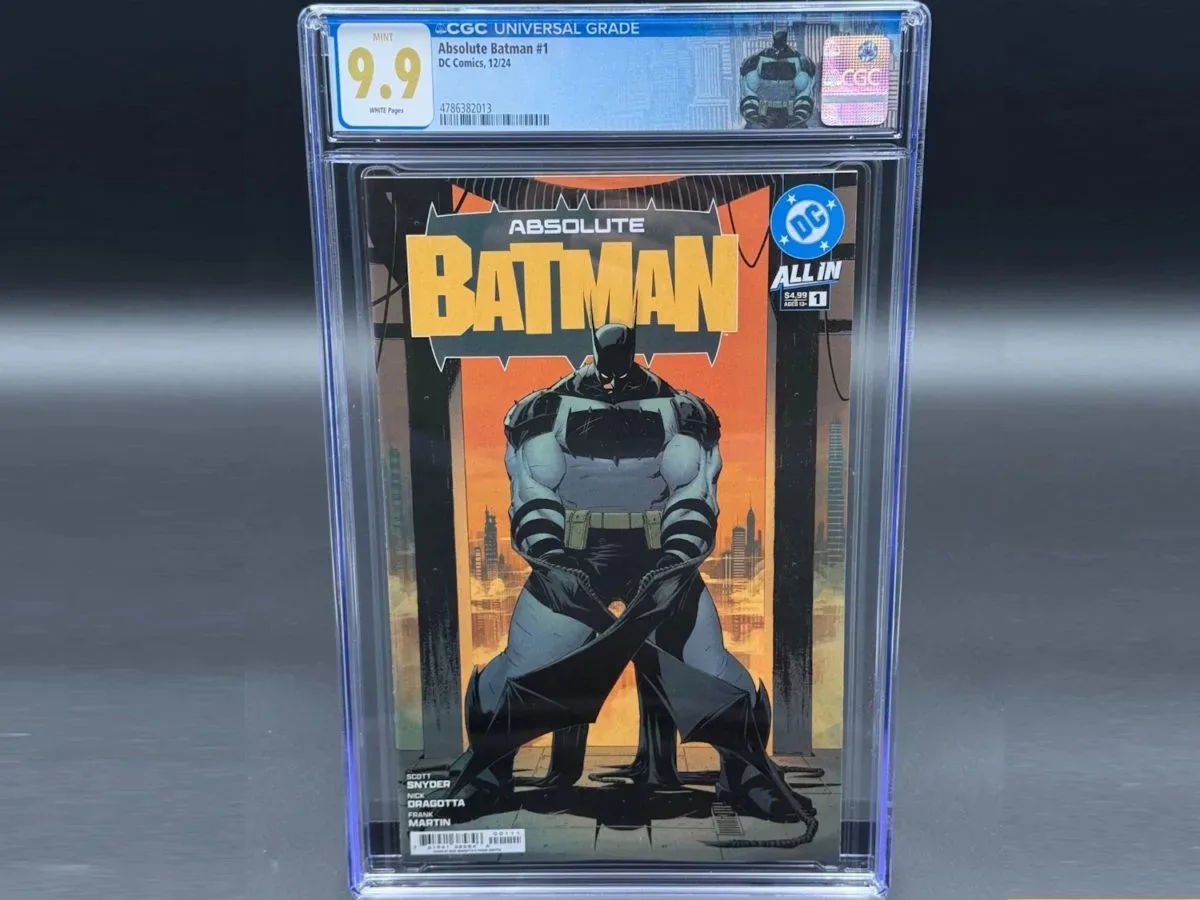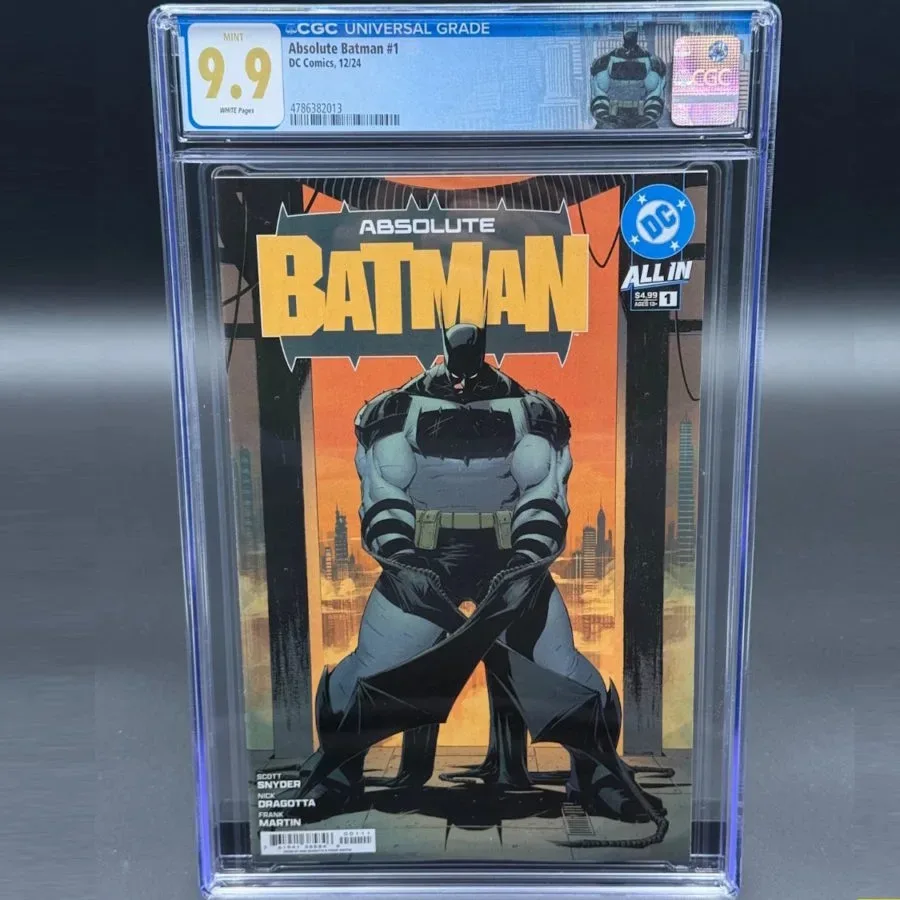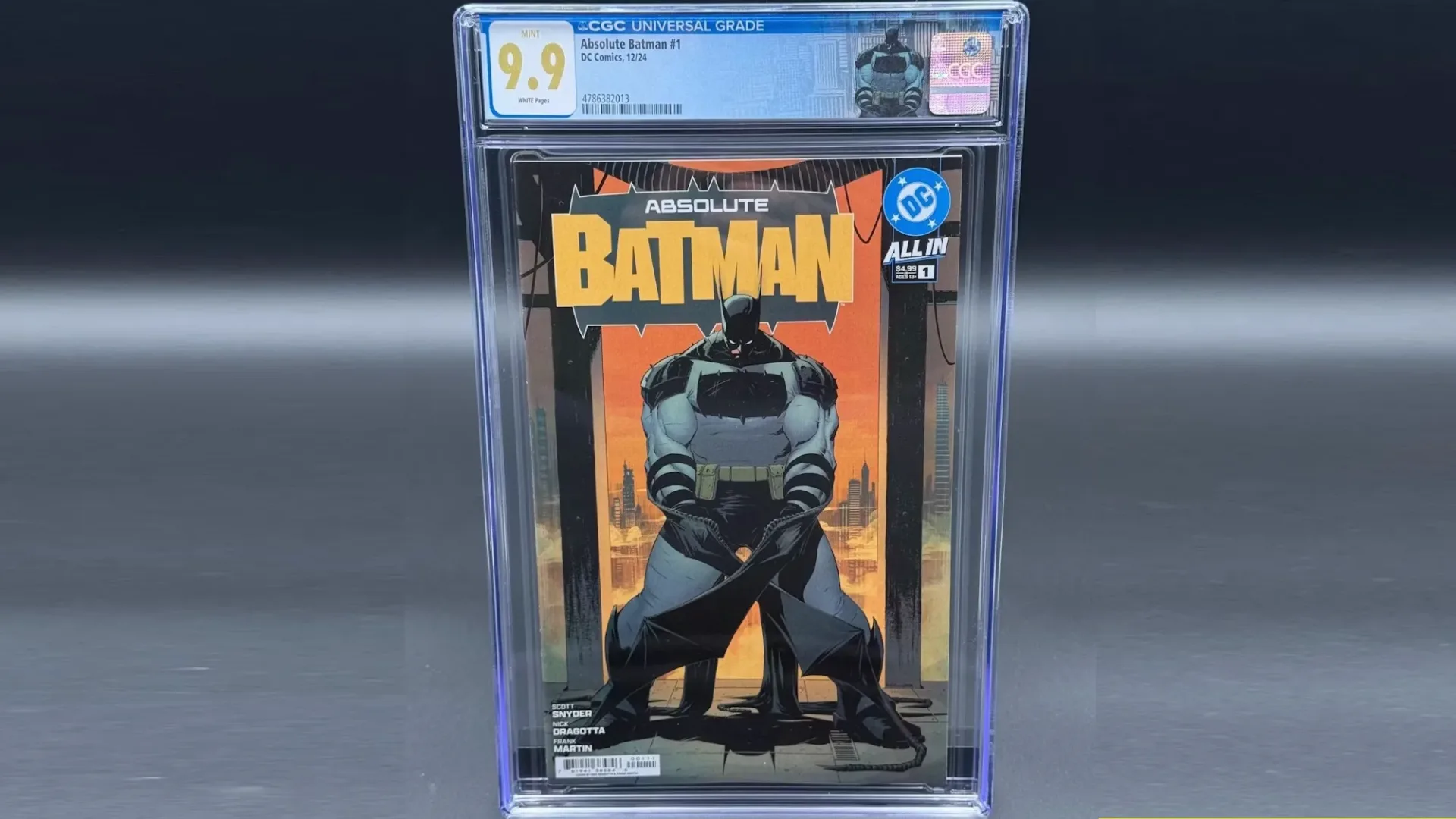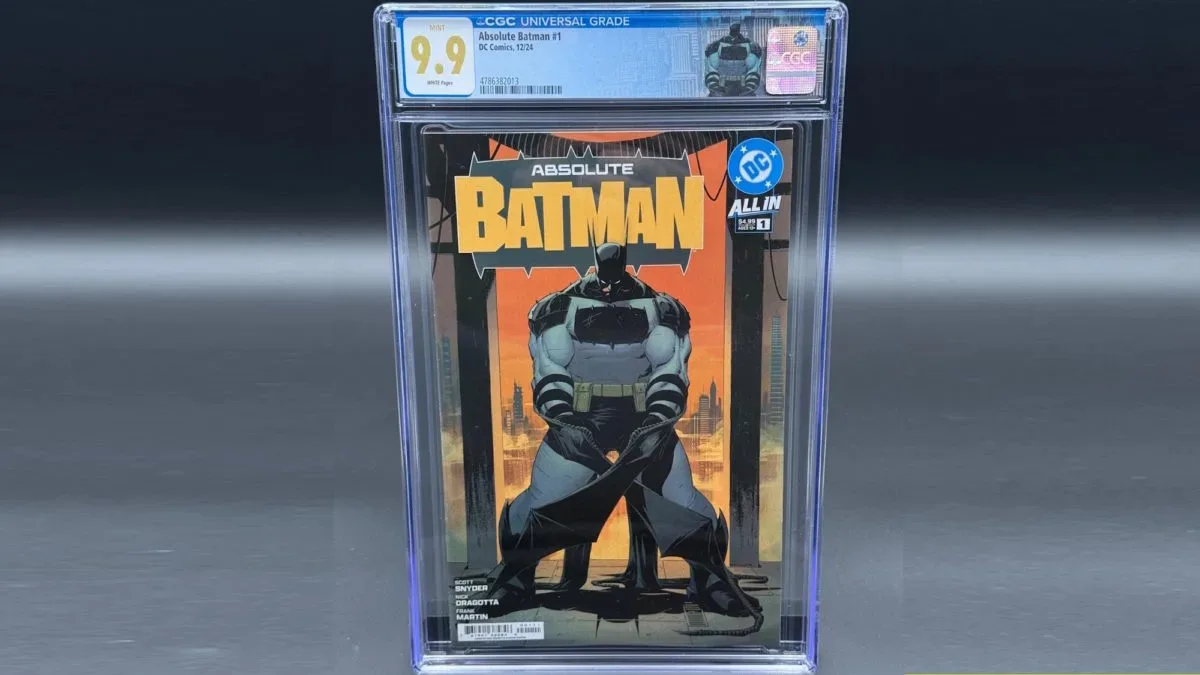
A copy of Absolute Batman #1 graded 9.9 by CGC has reportedly sold for $18,000, marking a remarkable escalation from a separate $10,000 sale of the same issue and grade roughly one month earlier. The two results are a sharp illustration of how quickly a modern comic can become expensive when a heavily collected series meets a very small pool of copies at an elite certified grade.
The $18,000 transaction is not merely a large number for a recent release. It also reportedly matches the highest amount paid for any Absolute Batman comic so far. The other book at that price was a very different collectible: a blank-sketch edition of Absolute Batman #18 with one-of-one painted cover art by Dan Quinatana. That comparison matters. A unique piece of original cover art is inherently singular, while Absolute Batman #1 began as a standard comic available at a $4.99 cover price in 2024. Its value at this level is therefore tied less to uniqueness of content and more to the unusually difficult task of locating a copy that earns a 9.9 grade.
What the two sales actually show
On simple arithmetic, moving from $10,000 to $18,000 is an 80% increase in the recorded sale price. That is an attention-grabbing change, but it should not be read as a guaranteed return for every copy of the issue—or even every 9.9. The results concern two individual sales, not a broad average from dozens of comparable transactions. Marketplace fees, grading fees, shipping, taxes and the price originally paid for a book all affect a seller’s real outcome.
More importantly, markets for condition-sensitive collectibles can be especially volatile when the population is tiny. If only a handful of qualifying books can be bought at a given moment, one motivated buyer can establish a new headline number. Another sale may reinforce it, fall short of it, or exceed it. A single result is evidence of what one buyer paid for one specific certified item at one point in time. It is not a price guide for every raw copy tucked into a long box.
For more context, explore Only Raw Records in GTA VI: Artists, Ambitions and Confirmed Connections.
That distinction is the central practical takeaway from the $18,000 sale. The story is not that every first printing of Absolute Batman #1 suddenly became an $18,000 comic. It is that a very small top-tier segment of the issue’s certified population has attracted extraordinarily aggressive demand.
Why the CGC 9.9 label changes the conversation
CGC is a third-party grading company. In comic collecting, a book submitted for grading is evaluated for condition and, when encapsulated in a sealed holder, is commonly described as “slabbed.” The grade on that holder gives buyers a standardized assessment they can use when comparing copies sold across distance, particularly in online auctions and fixed-price listings.
A 9.9 is near the top of CGC’s scale. The cited CGC registration figures list no Absolute Batman #1 copies at 10.0 and just 10 at 9.9: three signed and seven unsigned. The $18,000 copy was reportedly one of the unsigned examples. The supplied registration figure for lower-graded copies is rendered ambiguously, so it is not useful to extrapolate a precise overall census from it. The important confirmed point is much narrower: 9.9 copies are presented as exceptionally scarce compared with the issue’s wider graded population.
That scarcity is why the absence of a 10.0 also has emotional weight in the market, even if it does not mathematically dictate a 9.9’s price. With no 10.0 registered in the cited data, the 9.9 occupies the highest currently recorded tier for the issue. Some collectors pursue that “best available” status, while others may see it as an opportunity to own a book near the top of the grading scale without waiting for a theoretically higher-grade example to appear.
Certified grade is not the same thing as rarity of the comic
Collectors should separate two ideas that can sound alike but are not interchangeable. A comic can be widely printed and still be rare at 9.9. That is a condition rarity. A book can also be scarce in all conditions because few copies exist at all. That is issue rarity.
Absolute Batman #1 falls into the first conversation based on the available information. More than 100,000 copies were said to be in circulation, yet only 10 CGC 9.9 examples were cited. Modern comics can be damaged at multiple points: in production, distribution, retail handling, bagging and boarding, transport, storage, or grading preparation. A book that looked excellent on a shop shelf may not ultimately meet the standards needed for an ultra-high grade.
None of that makes every unslabbed copy a hidden fortune. A raw, or uncertified, issue has no confirmed numerical grade until it is submitted. Submission itself also carries costs and risk, and the final grade may be lower than the owner expects. The large gap between cover price and the reported 9.9 sale therefore reflects certified condition, limited supply at that exact grade, and collector demand—not simply possession of the issue.
A breakout series with a growing collector ecosystem
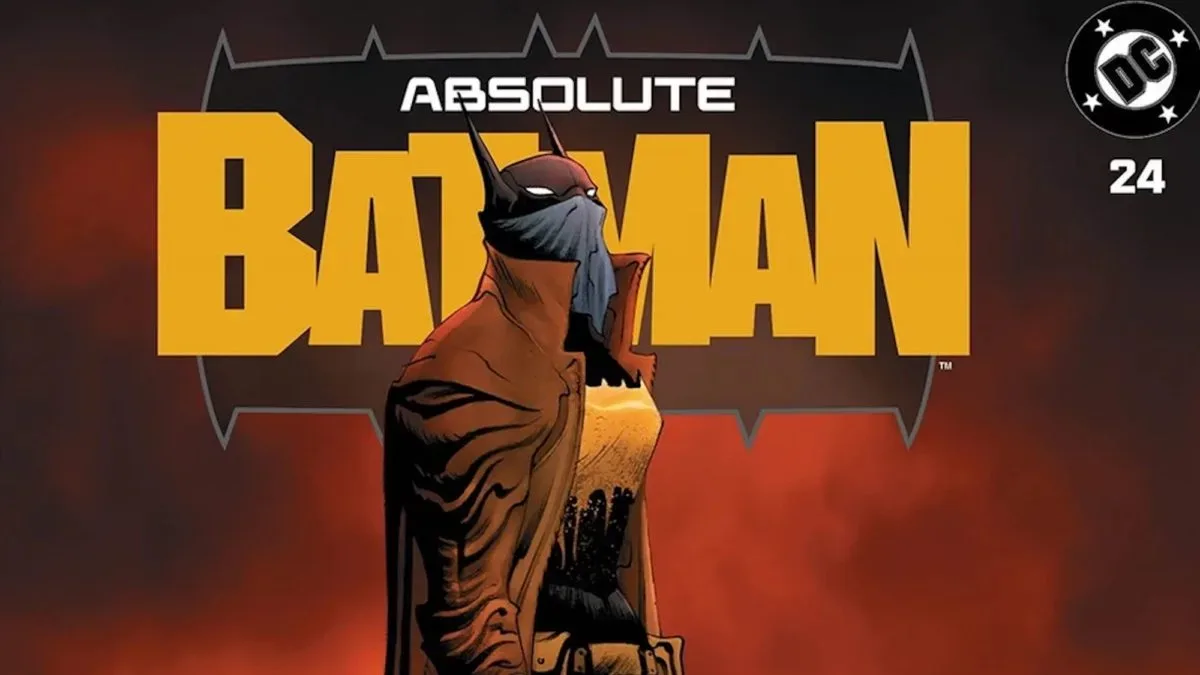
Created by Scott Snyder and Nick Dragotta, Absolute Batman launched in 2024 as the title that opened DC’s Absolute Universe line. It became an immediate hit and, by the information available here, continued expanding rather than fading after its debut. Its success has helped fuel demand for variant editions, including retailer-exclusive covers.
A variant cover is an alternate version of a comic’s cover art, often produced in different quantities or distributed through particular retailers. Variants can give collectors another way to focus their search, but they also complicate the market. A sale for the standard edition in a 9.9 should not automatically be treated as a value benchmark for every retailer exclusive, signed copy, or sketch cover. Print availability, signing, artwork, grade and buyer preference can all produce very different outcomes.
The demand has reportedly grown large enough that DC has capped distribution of retailer-exclusive variants. That is a meaningful detail for collectors because it shows that variants are not operating at the margins of the title’s success. They are part of a major retail ecosystem around the book. It also helps explain why condition and edition details need to be read closely whenever an eye-catching sale is shared online.
The series’ commercial impact has reportedly been substantial enough that, if treated as its own comic publisher, it would rank fourth in comic shops. Some shops have reportedly opened with selling Absolute Batman as their focus. Those claims speak to exceptional demand, but they should not be confused with proof that every related comic, cover, or later issue will perform identically in the secondary market. A powerful brand can create many desirable products without making all of them equally scarce or equally collectible.
What collectors can take from the $18,000 result
For owners of Absolute Batman #1, the first move is documentation rather than assumption. Identify the exact edition, verify whether it is standard or a variant, and inspect its condition conservatively. Corner wear, spine ticks, surface impressions and printing flaws can matter greatly when a potential value discussion revolves around the top fractions of a grading scale.
For prospective buyers, the useful question is not “Did a copy sell for $18,000?” but “What exactly sold for $18,000?” That means checking the edition, the CGC grade, whether it was signed, the timing of the sale, and whether the transaction was a completed sale rather than an unsold asking price. The reported $18,000 copy was unsigned, which makes the population split especially relevant: it is one of seven cited unsigned 9.9s, rather than one of the three signed examples.
It is also sensible to distinguish enthusiasm for the series from a willingness to chase a headline-grade investment. The issue remains a landmark first release for a popular modern Batman line regardless of whether a collector owns a raw reading copy, a mid-grade certified example, a variant, or no copy at all. The record-level market is one part of the hobby, not the only valid way to enjoy the book.
A note on the $2 billion thought experiment
The comparison between a massive initial print run and a hypothetical multi-billion-dollar value at 9.9 is useful as a way of showing why top-grade scarcity matters—but only as a thought experiment. It assumes that every copy could receive a 9.9 and that all could sell at the same $18,000 level. Neither premise follows from the reported sales. In practice, condition populations are limited, grading is selective, and selling a large quantity of identical high-end items would change supply conditions.
That is not a knock on the $18,000 transaction. Rather, it helps put the result in the right frame: an exceptional price paid for an exceptional certified copy within a tiny reported population. The reason the figure is so striking is precisely that there are not thousands of comparable 9.9 books ready to appear at once.
The significance of the new benchmark
The reported $18,000 sale is a milestone for Absolute Batman and a conspicuous signal of collector confidence in the series’ premium condition market. It ties the line’s existing price record while doing so with a copy of the foundational first issue rather than a one-of-one painted sketch cover.
At the same time, the one-month jump from $10,000 should encourage care as much as excitement. The available evidence supports a conclusion that demand for CGC 9.9 copies is intense and supply at that grade is very limited. It does not establish a stable floor price, a universal value for raw copies, or an outcome that other modern comics can automatically replicate. For now, the clearest fact is also the simplest: one unsigned CGC 9.9 copy of Absolute Batman #1 has changed hands for $18,000, making the condition census around this recent comic impossible for collectors to ignore.
Shop the products
Check current price, model and availability at the retailer.