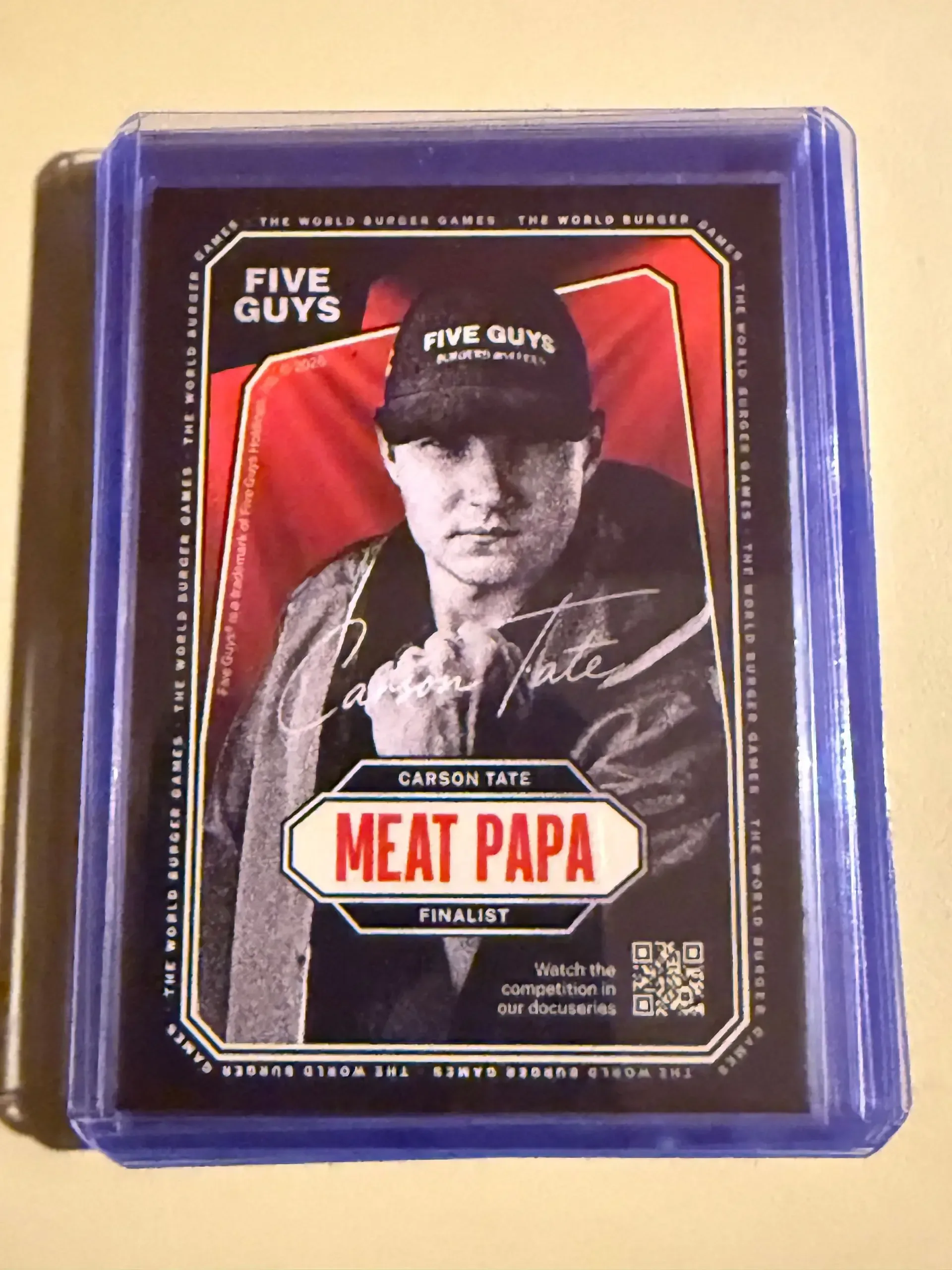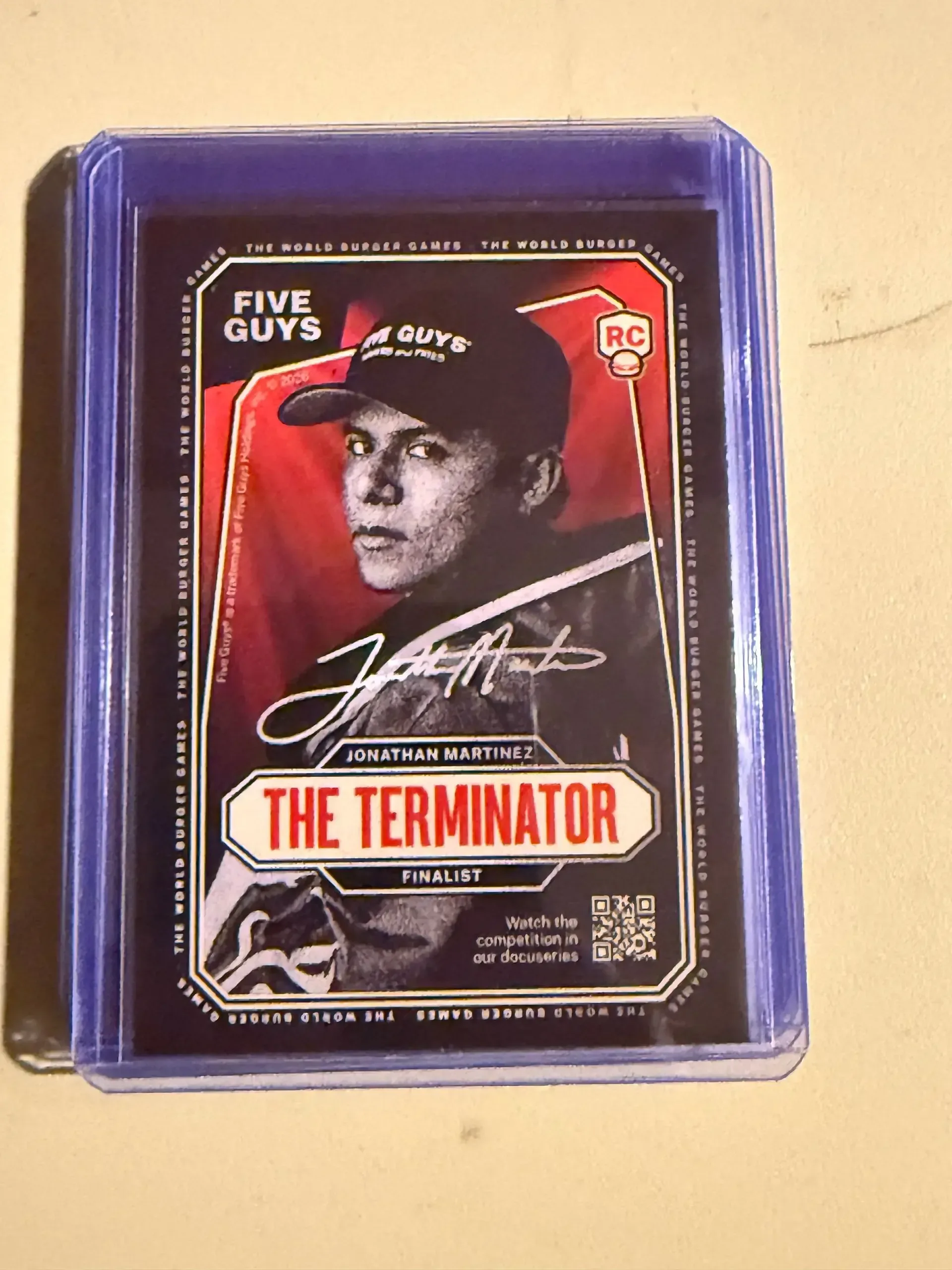
Five Guys has entered the trading-card conversation with an unusually human subject for a restaurant promotion: its own employees. The chain has issued a limited eight-card set centered on finalists from the Five Guys Games, a worldwide workplace competition that is also the subject of the five-episode Prime Video docuseries On the Line: The World Burger Games.
Instead of relying on a licensed cartoon, athlete, film franchise, or game character, the cards spotlight workers who compete in the food-preparation tasks associated with their jobs. The result is a small promotional set that sits in a curious space between restaurant memorabilia, employee-recognition material, and conventional trading cards.
The cards were released alongside the series in mid-October and may still be available at participating Five Guys locations with qualifying purchases. Availability is not guaranteed, so anyone interested in completing the set should ask at the restaurant before assuming a promotion is active or that a particular card remains in stock.
An eight-card set built around Five Guys Games finalists
The complete checklist consists of eight Five Guys Games finalists. Five are identified with nicknames that give the set a sports-card-style personality:
For more context, explore Lil Baby Leaves Door Open to a Playboi Carti Collab Album, but Nothing Is Confirmed.
- Carson Tate, “Meat Papa”
- Aurelien Favreau, “Mr. Patate”
- Jose Once, “La Máquina”
- Peter Le, “Anonymous 24-H”
- Joshua Harvey, “Jed”
- Jackson Chimbay
- Enock Akuwure
- Jonathan Martinez, “The Terminator”
That nickname-forward presentation is important to the appeal. A promotional card is a card made chiefly to support another product, event, or campaign rather than a standard retail-card release. Here, the promotion gives each competitor a memorable on-card identity, turning names from an internal-style competition into characters a collector can recognize and chase.
The official Five Guys Games site shows the fronts and backs of all eight cards, which gives collectors a useful visual checklist before they start looking locally. With a set this small, knowing the full roster matters: a collector can quickly tell which names are missing without having to infer the checklist from restaurant handouts.
The competition itself is not a traditional sport, even though the cards borrow some of the visual and cultural language of sports collecting. Contestants are tested on timed tasks tied to day-to-day restaurant work, including stacking cheese, preparing and wrapping orders, and cutting potatoes. Speed and accuracy determine the results.
Related coverage includes Top 3 Things Collectors Should Know About the Five Guys Trading Card Promo.
That makes the cards more than a generic burger-chain giveaway. Their subject is a specific contest of operational skills, with the collectibility coming from the people who advanced to the final rather than from rarity tiers, fictional lore, or player statistics.
Jonathan “The Terminator” Martinez is the obvious centerpiece
Jonathan Martinez of Kingston, New York, won the Five Guys Games championship and its $100,000 grand prize. His “The Terminator” card therefore has the clearest narrative significance in the set: it represents the eventual winner of the competition depicted in the series.
That does not establish that Martinez’s card is scarcer than the others, more valuable, or distributed differently. No print runs, odds, parallel versions, or card-by-card production details have been provided here. But it does make the card the natural centerpiece for someone assembling the eight-card roster. In trading-card terms, a centerpiece is not automatically the rarest item; it is often the item with the strongest story, recognition, or connection to the event being commemorated.
The docuseries premiered on October 15 and follows participants from qualifying rounds through the championship. For collectors, that provides an extra layer of context that many food promotions do not have. The card is not merely a name and image attached to a burger purchase; it connects to a filmed competition with a known progression and a final result.
That narrative is also why the set has a different feel from character-driven restaurant cards. The competitors are real people, and the contest is rooted in practical service skills. It is an unusual premise for a collectible, but one that gives each card a direct link to the event it represents.
What collectors should know before hunting for cards
The central practical detail is that cards may be available only at participating restaurants and with qualifying purchases. Neither phrase should be read as a promise of universal availability. A nearby location may not be taking part, may have run out, or may have a different understanding of which purchases qualify.
A straightforward approach is best:
- Ask whether the location is participating before ordering.
- Ask whether cards are currently in stock.
- Confirm whether a qualifying purchase is required and what qualifies.
- Check which card was received against the eight-card checklist.
- Keep cards away from food, drinks, grease, and moisture after pickup.
The last point is particularly sensible for a restaurant-issued item. Condition is a basic collecting term referring to the physical state of a card: corners, edges, surface, centering, stains, bends, and other visible wear all affect how a card presents. Nothing in the promotion suggests these cards are intended as premium grading submissions, and there is no reason to assume they are. Still, a card carried beside fries and a drink faces obvious risks that a pack opened at home may not.
Collectors also should not assume a limited-edition label answers every scarcity question. “Limited edition” communicates that the release is promotional and finite, but it does not, by itself, reveal how many copies exist, whether each card was produced equally, or how long individual restaurants will have stock. Until production information is supplied, the clearest goal is simply a complete, clean eight-card set.
A different kind of fast-food card promotion
Restaurant card promotions have often leaned on established entertainment brands. McDonald’s most recent Pokémon Happy Meal promotion, launched November 10, includes 15 collectible Pokémon cards and 15 miniature Happy Meal box-shaped toys. Each Happy Meal includes two Pokémon Trading Card Game cards, while seven of the 15 cards are foil versions. The packaging features Pikachu, Umbreon, and Torchic, tying the release to Pokémon’s 30th anniversary.
That campaign follows prior McDonald’s Pokémon card releases, including a 2021 25th-anniversary promotion and a January 2025 offering with four-card booster packs. Pokémon is an especially familiar fit for fast-food collecting because the cards already belong to a long-running game and collector ecosystem, with recognizable characters and established expectations around sets, foil treatments, and promotions.
Burger King also has a notable place in Pokémon collecting history. Its 1999 tie-in for Pokémon: The First Movie included trading cards and six collectible 23-karat gold-plated Pokémon cards packaged in Poké Ball-shaped containers. The Five Guys promotion is very different from that model. It has no outside entertainment license at its center and no fictional mascot acting as the draw.
Instead, Five Guys is making an in-house competition its collectible hook. The cards celebrate workers who performed under time pressure in a global contest, while the streaming series supplies the wider story of their path to the final. That is a narrower premise than Pokémon, but also a more distinctive one.
Why the set may appeal beyond the usual card audience
Not every collectible needs a massive checklist, expensive chase card, or mature resale market to be interesting. Some releases are appealing precisely because they capture an unexpected cultural moment. These Five Guys cards document an unusual collision of restaurant work, competition television, promotional marketing, and the familiar ritual of completing a small set.
For Five Guys regulars, the cards offer a tangible companion to On the Line: The World Burger Games. For promotional-card collectors, they add an offbeat food-industry issue to a binder or display. And for people who enjoy the overlap between games and collectible culture, the timed competition format provides a recognizable competitive structure, even if the challenges involve wrapping orders and cutting potatoes rather than a controller or a field.
The important expectation is scale. This is an eight-card restaurant promotion, not evidence of a broad new card line or a major new collecting category. Its appeal rests on specificity: real finalists, memorable aliases, a documented competition, and a $100,000 champion whose card gives the checklist a clear focal point.
For anyone who enjoys the stranger corners of trading-card culture, that may be enough. Ask a participating Five Guys location about the promotion, consult the official checklist, and treat a clean complete run of all eight finalists as the practical collecting target.