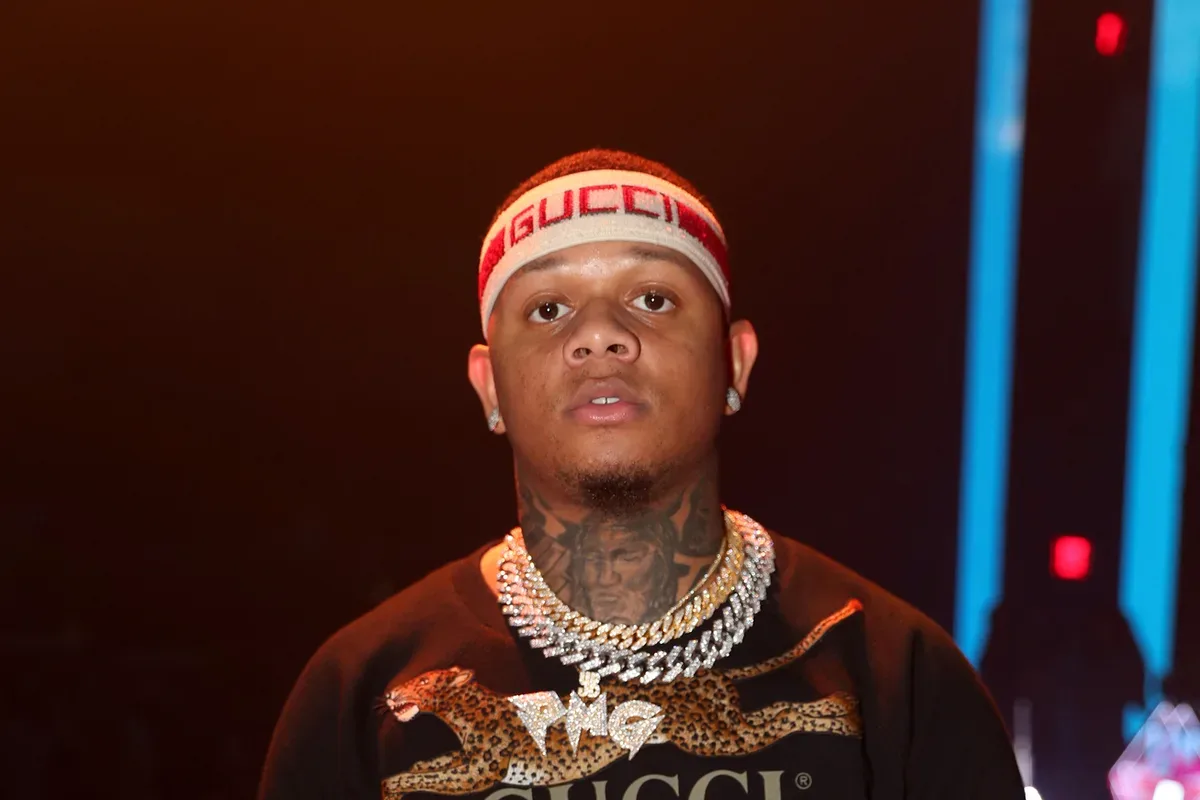
Markies Conway, the rapper known as Yella Beezy, has begun presenting his defense in the Dallas capital murder case connected to the 2020 death of Melvin Noble, known professionally as MO3. The shift came after Judge Chika Anyiam declined a defense request to dismiss the case for insufficient evidence following the close of the prosecution’s presentation.
Conway has pleaded not guilty to capital murder and denies involvement in Noble’s death. Prosecutors allege that Conway paid Kewon White to carry out the killing. That is an allegation being contested at trial, not a finding of guilt against Conway.
Noble was killed on Interstate 35E in Dallas on November 11, 2020. White was convicted on September 4, 2026, and received a life-without-parole sentence. The present trial concerns the separate allegations against Conway and the prosecution’s contention that he played a role in arranging the killing.
What the denied dismissal request means
A request to dismiss for lack of evidence is, in practical terms, an argument that the prosecution has not presented enough for the case to continue. Judge Anyiam’s refusal to grant that request means the trial proceeds; it does not decide whether Conway is guilty. The defense now has its opportunity to call witnesses, challenge the reliability and significance of the state’s evidence, and offer its own account to the jury.
The prosecution rested after Detective Eric Barnes completed his testimony. The defense’s first witness was Lynn Scott, an employee of Hitco Entertainment. The supplied court account does not detail Scott’s testimony, so its significance is not yet clear from the record available here.
The defense phase is especially important because much of the dispute has centered on witness Jose Bodega, whose accounts have sharply diverged. Bodega, whose birth name is Theodore Thomas, is described as Conway’s childhood friend. He previously gave grand-jury testimony concerning an alleged plan to kill Noble, then later withdrew those claims while testifying before the trial jury.
The central dispute over Jose Bodega’s testimony
On November 2, Bodega testified under immunity and told jurors that he had invented the account he gave a grand jury on February 13, 2025. In that earlier account, he had alleged that Conway and Trapboy Freddy wanted MO3 dead. At trial, Bodega said that assertion was false.
That kind of reversal creates two distinct issues for a jury. One is credibility: whether Bodega should be believed now, whether he should have been believed earlier, or whether neither version is dependable. The other is the evidentiary use of the earlier statement itself. Judge Anyiam limited how jurors could use Bodega’s prior grand-jury account. They could weigh it in assessing his credibility, but they could not treat it as proof that the events described in the statement occurred.
Related coverage includes Yella Beezy Defense Opens in Dallas MO3 Capital Murder Trial After Dismissal Request Is Denied.
That distinction matters. A witness’s previous inconsistent statement can help a jury evaluate whether the witness is changing accounts, but the judge’s limitation means the prior statement does not automatically become substantive proof of the allegation it contains. In this case, jurors may consider the conflict between Bodega’s versions when judging his trustworthiness, while remaining barred from using the earlier account alone as evidence that Conway paid for Noble’s killing.
Bodega had previously invoked his Fifth Amendment rights outside the presence of jurors on October 29. He had also agreed to cooperate in connection with a separate federal drug case, an arrangement the defense examined before the murder trial started. Prosecutors were permitted to question him as a hostile witness.
A hostile witness is not necessarily someone acting with personal hostility. In courtroom practice, the designation permits the party that called the witness to use more pointed questioning because the witness is adverse, unwilling, or giving testimony that conflicts with that party’s position. Here, that status reflected the gap between Bodega’s previous grand-jury account and his trial testimony.
Defense scrutiny of detective’s calls with Bodega
Attorney Toby Shook pressed Detective Barnes about his contact with Bodega during 2025 and 2026. The questioning included calls that lasted 82 minutes and 70 minutes, as well as a 4:48 a.m. call. Barnes acknowledged that he did not keep written notes of those conversations.
The defense suggested that Bodega received improper guidance or support. Barnes denied being personally friendly with Bodega. He testified that Bodega felt isolated and threatened after his identity was circulated online, and he said he had never spent so much time speaking with a witness.
The issue for jurors is not simply the length of the calls. It is what, if anything, was said during them; whether the communication affected Bodega’s account; and whether the lack of notes leaves important gaps in the record. The available account establishes that the defense raised those concerns and that Barnes rejected the claim of a personal relationship. It does not establish that the detective improperly coached Bodega.
This is a familiar kind of credibility contest in a criminal trial: one side may argue that extensive contact compromises a witness’s independence, while the other may contend that the contact was a response to a witness’s safety concerns and isolation. The jury is expected to assess testimony and the reasonable inferences arising from it, under the court’s instructions.
Excluded jail call narrows the material before jurors
Judge Anyiam also excluded a jailhouse call involving White that prosecutors wanted to introduce. The available account does not specify the content of the recording or the legal basis for the ruling. What is clear is that the jury will not hear that particular call as part of the evidence in this trial.
Evidence exclusions are consequential because they define the factual record the jury is permitted to consider. They should not be read as findings about everything discussed outside the jury’s presence. Rather, they set boundaries on what evidence reaches deliberations. In this case, the exclusion of the White call and the restricted use of Bodega’s earlier grand-jury statement mean that the jury’s verdict must rest on the admissible evidence ultimately presented in court.
Why the trial’s witness questions carry unusual weight
The proceedings place a heavy focus on the stability of witness accounts, police-witness communication and the careful difference between an allegation and admissible proof. Conway’s not-guilty plea remains the starting point for the defense, while prosecutors continue to pursue their allegation that he paid White to kill Noble.
For audiences following rap and entertainment news, the case also sits within a community still affected by Noble’s death. But public discussion, online attention and the status of the artists involved do not replace the rules governing the courtroom. Barnes testified that Bodega felt threatened after being identified online, a reminder that attention outside the courthouse can affect the circumstances around a witness without deciding the facts at issue.
Music-world stories often draw broad public reaction, whether focused on legal proceedings, performances or culture figures such as the account of Nelly’s Allen Iverson HORSE story. This proceeding, however, turns on a narrower and more serious question: what the properly admitted evidence proves beyond the competing accounts presented to the jury.
What comes next
With the dismissal request denied and the prosecution’s case closed, the defense has entered the stage where it can directly develop its challenge to the state’s theory. Scott’s appearance as the first defense witness marks that transition, though no further detail about her evidence was provided.
The key factual tensions already visible are clear: Bodega’s recantation of his grand-jury allegations; the permitted but limited use of those prior statements to evaluate credibility; the detective’s unrecorded or undocumented lengthy calls with Bodega; and the exclusion of the jailhouse call prosecutors sought to play.
None of those elements independently resolves the case. The jury will have to evaluate the testimony it heard, apply the judge’s evidentiary instructions, and determine whether the prosecution has met its burden. Conway remains presumed innocent unless and until a verdict establishes otherwise.