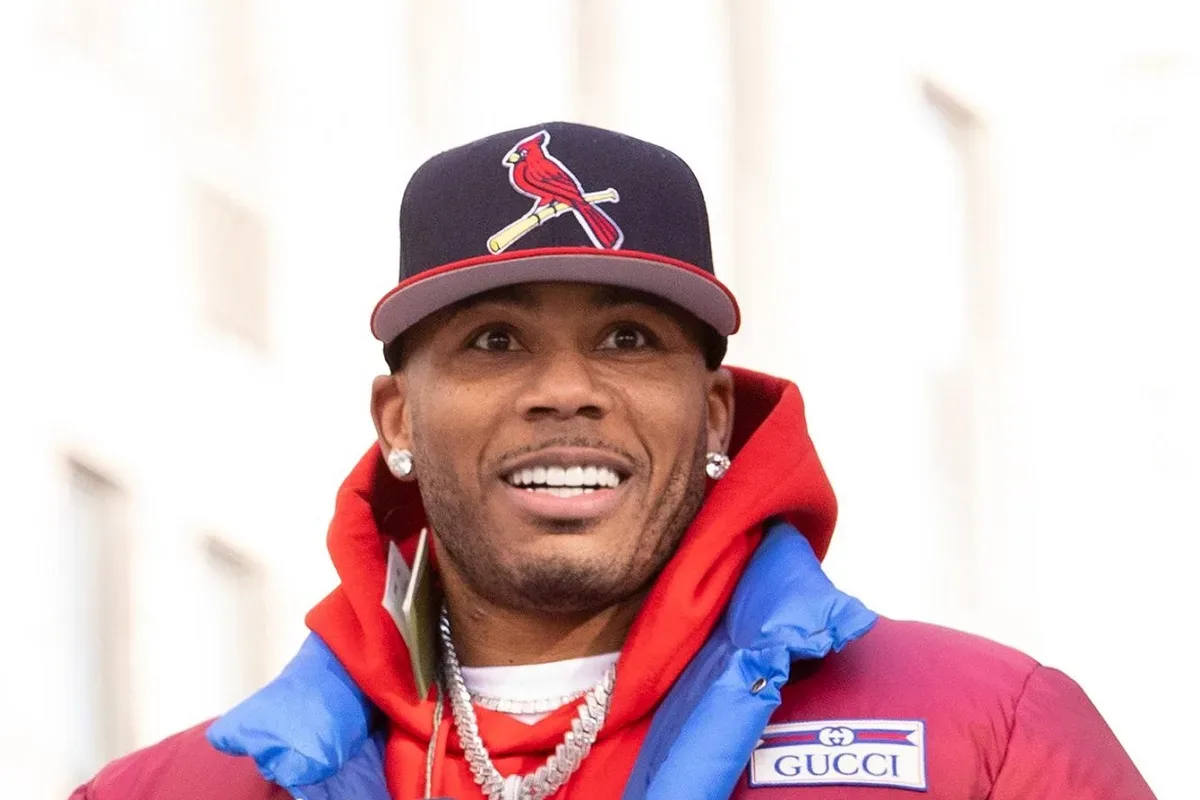
Nelly has supplied a much more entertaining—and considerably more qualified—version of his old HORSE victory over Allen Iverson. Yes, the rapper says he beat one of basketball’s most feared scorers in a shooting game. But no, he is not presenting it as proof that he could take Iverson in a normal run.
Revisiting the matchup on 7PM in Brooklyn with Carmelo Anthony, Nelly explained that the contest took place during the NBA offseason at Jermaine Dupri’s home gym in Atlanta after both players had been out the night before. The conditions mattered. Both men had been drinking, Nelly knew the court intimately, and the gym’s low ceiling created a particularly awkward problem for a player accustomed to launching shots in NBA arenas.
“We was playing HORSE, but in fairness, did I beat him? Yes, I beat him playing HORSE. But we was both hammered, he was just hammered,” Nelly said.
It is an unusually candid clarification of a celebrity-sports story that could easily survive as a one-line boast. Nelly still gets to keep the win. At the same time, he identifies precisely why a game against Iverson became possible in that particular building, in that particular format, on that particular night.
HORSE is not one-on-one basketball
The central distinction is simple: HORSE tests shot replication, not the complete set of skills that makes someone great at basketball.
In the traditional game, one player calls and makes a shot. The other player must duplicate it; a miss earns a letter. The first player to spell HORSE loses. There is no need to beat a defender off the dribble, navigate help defense, run an offense, or stop anybody at the other end. Those omissions are substantial when one participant is Allen Iverson.
Nelly did not dodge that point. He said he could not guard Iverson. That is less a knock on Nelly than an acknowledgement of the obvious: Iverson’s speed and scoring ability made him one of the most difficult players to contain. A shooting contest removed the part of the matchup where Iverson’s quickness would be most punishing.
That does not make the result meaningless. It explains the kind of result it was. HORSE can reward repeatable mechanics, imagination, touch and the ability to handle pressure after watching an opponent convert a difficult look. Nelly described himself as someone who could stand in one place and reliably make shots. In a contest built around making and matching baskets, that is a real asset.
The ceiling became part of the game
The more revealing detail is the gym itself. Nelly was familiar with Dupri’s court and had practiced there. He understood the room’s constraints and adjusted accordingly. Iverson, meanwhile, kept using a high-arching shot that might have been perfectly natural in a professional arena, only for the ceiling to interfere.
Shot arc is exactly what it sounds like: the upward and downward curve of a basketball’s flight. A higher arc can help a shot enter the hoop more softly and can make the basket effectively easier to approach from above. But an indoor court with limited overhead room turns that strength into a liability. A ball that rises too high cannot reach the rim cleanly if it meets the roof first.
Nelly’s answer was practical rather than flashy. He leaned on a set shot he had worked on in that gym. A set shot generally refers to a shot released from a stable, planted position rather than a jumper taken while rising. The account does not establish any technical blueprint beyond that, but the key advantage is clear: Nelly had a shot calibrated for that space.
That is the part of the story that makes the upset believable without requiring anyone to pretend the two men were comparable players in an open gym. Court knowledge matters. Even casual players know that a familiar rim, backdrop, lighting arrangement or roofline can affect comfort and shot selection. Here, familiarity did more than settle nerves. It apparently shaped which shots were usable at all.
A small contest with very specific conditions
There is a temptation to flatten every basketball story into a universal ranking: one person beat another, therefore that person is better. Nelly’s account argues against that instinct. Conditions can define a contest more strongly than its headline.
- Format: HORSE emphasizes matching shots instead of defending or creating separation.
- Venue: The low ceiling penalized Iverson’s normal high-arc approach.
- Familiarity: Nelly knew the court and had a practiced response to its limits.
- Preparation: Both participants had spent the prior night out, which Nelly said affected the game.
None of those points erases a made basket. They do, however, make it a mistake to frame the episode as a conventional athlete-versus-entertainer showdown. The game was closer to a specialized challenge staged in a room one player knew well. Nelly’s greatest edge was not a secret crossover or a claim to NBA-level athleticism; it was situational adaptation.
There is also something refreshing about the lack of mythology in his retelling. Celebrity competition stories often get bigger with every repetition. This one gets more specific. Nelly acknowledges the favorable environment, admits the defensive mismatch, and lets the win remain a strange, memorable footnote rather than an impossible sporting miracle.
Iverson’s rematch changed the scorecard
The cleanest rebuttal came from Iverson himself. Nelly said Iverson later returned sober for a rematch and won decisively. That result did not undo the first game, because it was a different game under different circumstances. It did settle the broader question that can hang over an anecdote like this: the first result was never evidence that Nelly had solved Allen Iverson as a basketball player.
Instead, the two outcomes make a better story together. The first was a perfect-storm HORSE win: a familiar court, an opponent whose usual arc was compromised, and two players dealing with the effects of a night out. The second was a sharp correction from a Hall of Famer, with Nelly himself making no serious attempt to dispute what it meant.
The episode also sits naturally within the long overlap between hip-hop and basketball, where gym runs, friendly wagers and stories of famous players sharing a court with artists can become part of the culture’s folklore. That wider connection continues to be preserved in different ways, including pieces of hip-hop history such as MC Lyte’s 2006 VH1 Hip Hop Honors jacket.
For Nelly, though, the appeal of this tale is its narrowness. He beat Iverson at HORSE. He says so plainly. He also supplies the caveats before anyone else can: the booze, the ceiling, the court familiarity, the fact that defending Iverson was never on the menu, and the sober rematch that went firmly in Iverson’s favor.
That leaves a much better punchline than an inflated claim ever could. In the right gym, with the roof low enough and the rules peculiar enough, a reliable set shot can briefly put a rapper ahead of an NBA legend. Just do not mistake it for a scouting report.