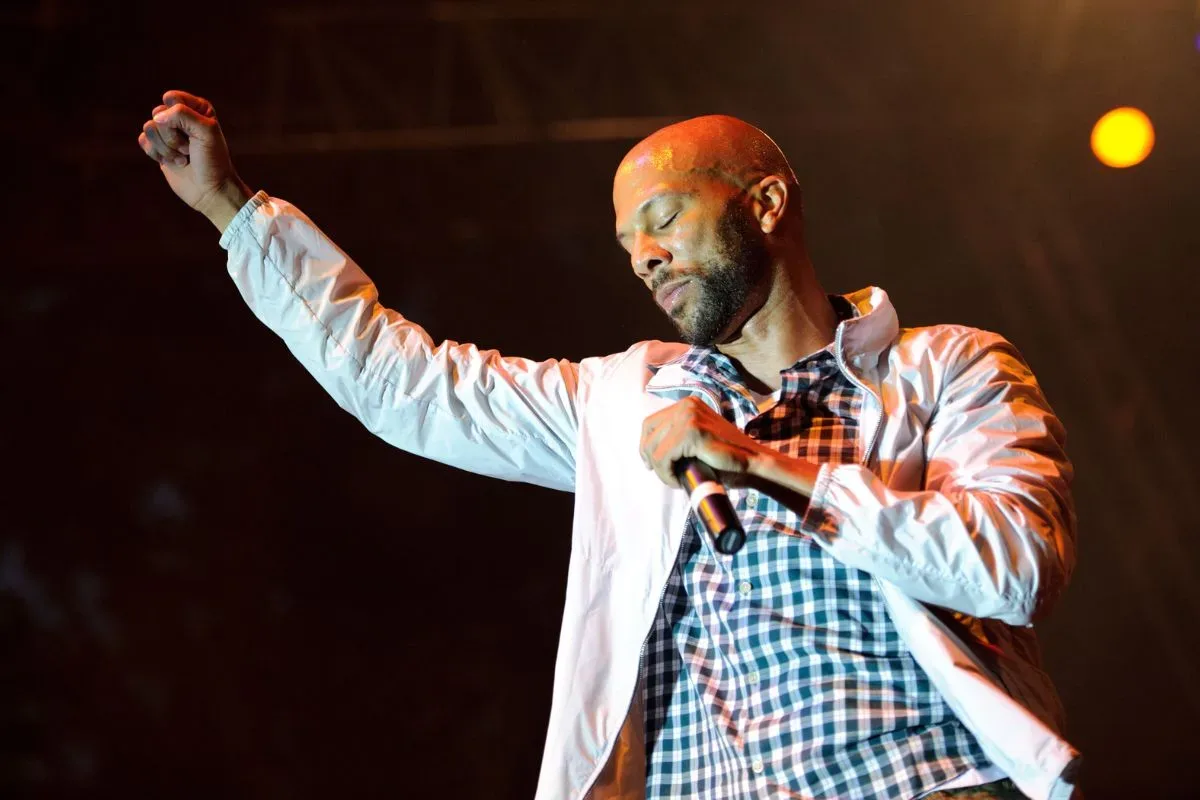
Common’s music is headed for a different kind of live setting in Miami. On Thursday, November 12, the artist will perform with Nu Deco Ensemble at the Adrienne Arsht Center’s Knight Concert Hall, where the group’s co-founder and artistic director Sam Hyken will conduct a one-night orchestral collaboration.
The program begins at 8 p.m. and is expected to run approximately 90 to 100 minutes. Rather than presenting a conventional tour-stop format built around a traveling backing band or a fixed festival set, the performance is centered on Nu Deco’s approach to reworking a guest artist’s existing catalog for its own musicians and sound.
That distinction is the heart of the event. An orchestra appearing alongside a rapper can suggest a simple layer of strings and brass added to familiar recordings. Nu Deco’s stated identity, however, is built around fresh arrangements: music is adapted for the ensemble instead of being treated as a song with orchestral decoration placed on top. In practical terms, that means the concert’s character will depend on how the ensemble reshapes songs from Common’s career, not merely on how closely it recreates studio versions.
A catalog built for reinterpretation
The Miami set draws from more than three decades of Common’s work across hip-hop, film and theater. Expected selections include Love of My Life and Glory, the Oscar-winning song Common recorded with John Legend for Selma.
The breadth of that material matters when the accompaniment changes. A live orchestral arrangement can redistribute a song’s musical roles among different sections of an ensemble. A melodic line that listeners associate with a sampled phrase, keyboard part or vocal response can be assigned elsewhere; rhythm can be articulated differently; and transitions can be made more expansive to fit an ensemble performance. Those are general features of arranging, not a promise of specific changes to any individual song on this program. The details of Nu Deco’s arrangements have not been specified.
What is known is that Hyken has a deep connection to the catalog being explored. He has identified Like Water for Chocolate, Be and Electric Circus among his favorite hip-hop albums. That personal familiarity gives the collaboration a clear artistic foundation: the conductor leading the orchestra is engaging with albums he has singled out, rather than approaching the music as an anonymous collection of hits.
For an audience, that makes this an event where recognition and reinterpretation are likely to exist side by side. The songs remain Common’s songs, but the setting invites attention to composition, pacing and instrumental color as much as to the verses themselves. Hip-hop has long supported live-band performance, but an orchestra changes the available palette and requires deliberate choices about what should stay foregrounded.
What “new arrangements” means here
An arrangement is a version of an existing piece of music designed for particular performers or instruments. It is not necessarily a new composition. In this case, Nu Deco’s role is to translate and organize material from Common’s catalog for its ensemble, finding ways for orchestral players to contribute actively to the performance.
Related coverage includes Common and Nu Deco Ensemble Set Miami Orchestra Collaboration.
That work can involve decisions about structure, harmony, rhythm and instrumental texture. Texture refers to how musical elements sit together: a sparse passage may leave substantial room around a vocal, while a dense passage uses multiple lines and timbres at once. The meaningful question in a collaboration like this is not simply whether an orchestra is present, but how it is used. Will the musicians provide a broad backdrop, take on featured lines, create contrast between sections, or establish new transitions? The Miami concert’s premise is that those choices are central rather than incidental.
That approach suits a catalog that has moved between intimate, reflective material and larger cinematic work. It also leaves room for a performance to feel connected to familiar recordings without trying to duplicate them note for note. The concert is scheduled as a live collaboration, so it should be understood as its own presentation rather than a replacement for the albums from which the material originates.
Recent work remains part of the picture
Common’s latest full-length collaboration, The Auditorium: Vol. 1, arrived in 2024 with Pete Rock. The album received Grammy nominations for Best Rap Album and Best Rap Performance, adding a current chapter to the much longer span of work represented by the Miami program.
Including music from a career that reaches from established albums to recent releases gives the concert a broader frame than a nostalgia showcase. It places the orchestral treatment alongside a body of work that continues to grow. No complete song list has been provided, so attendees should not assume that any specific album or track beyond the expected selections will appear.
That uncertainty is worth preserving. A collaboration concert can be especially appealing because it is tailored to a particular set of players and a particular venue, but its one-off character also means the exact balance of songs is part of the performance itself. The confirmed expectation is a career-spanning program, not a publicly detailed setlist.
Why Miami is more than a convenient venue
Nu Deco was founded in Miami in 2015. Its work has moved across classical music, hip-hop, soul, jazz and pop, with past guest collaborators including Wyclef Jean, Macy Gray, Stephen Marley, Bilal, Masego and Emily King. Common’s appearance extends that cross-genre model on the ensemble’s home stage.
The group reports that its concerts and recordings have reached more than 100,000 audience members and generated 15 million streams. Its educational programs have served more than 174,000 students, while Nu Deco Access has distributed thousands of free tickets in Miami-Dade County. Those figures describe an organization whose activity reaches beyond its ticketed concerts, with live performance, recordings, educational work and local access efforts all forming part of its presence in the city.
That local context helps explain why the Knight Concert Hall date carries a different weight from an ordinary stop on a multi-city run. Miami is the ensemble’s base, its musicians are performing in their home environment, and its artistic leadership is directly guiding the program. Common is the featured artist, but the event’s identity is inseparable from Nu Deco’s method and community footprint.
There is also value in keeping the terms clear. This is not described as a permanent Common tour format, nor is it presented as a traditional Common concert with a standard orchestra package attached. It is a collaboration with a Miami-founded ensemble that has made contemporary artist partnerships a defining part of its programming.
The next night moves to Orlando
After the Miami performance, Common and Nu Deco will bring the collaboration to Orlando’s Walt Disney Theater the following night. Miami nevertheless receives the first performance, as well as the date at Nu Deco’s home stage.
For people considering the Knight Concert Hall show, the concrete details are straightforward: Thursday, November 12; 8 p.m.; an estimated 90-to-100-minute running time; and a program involving Common with Nu Deco Ensemble under Hyken’s direction. The available information does not establish ticket availability, pricing, an opening performer or the full sequence of music, so those details should not be assumed.
The larger appeal is the meeting of a major hip-hop catalog with an ensemble that has built its profile on recasting contemporary music in a live orchestral context. Like other communal arts events, the experience is shaped as much by a specific room and shared audience as by the work being revisited—an idea also visible in recent conversations about fans turning a theatrical return into a communal celebration.
For Common listeners, the Miami date offers an opportunity to hear material from across his career framed by a new set of instrumental possibilities. For Nu Deco, it is another high-profile example of the organization’s core proposition: classical ensemble forces can engage directly with contemporary music, with arrangement and interpretation doing the real creative work.