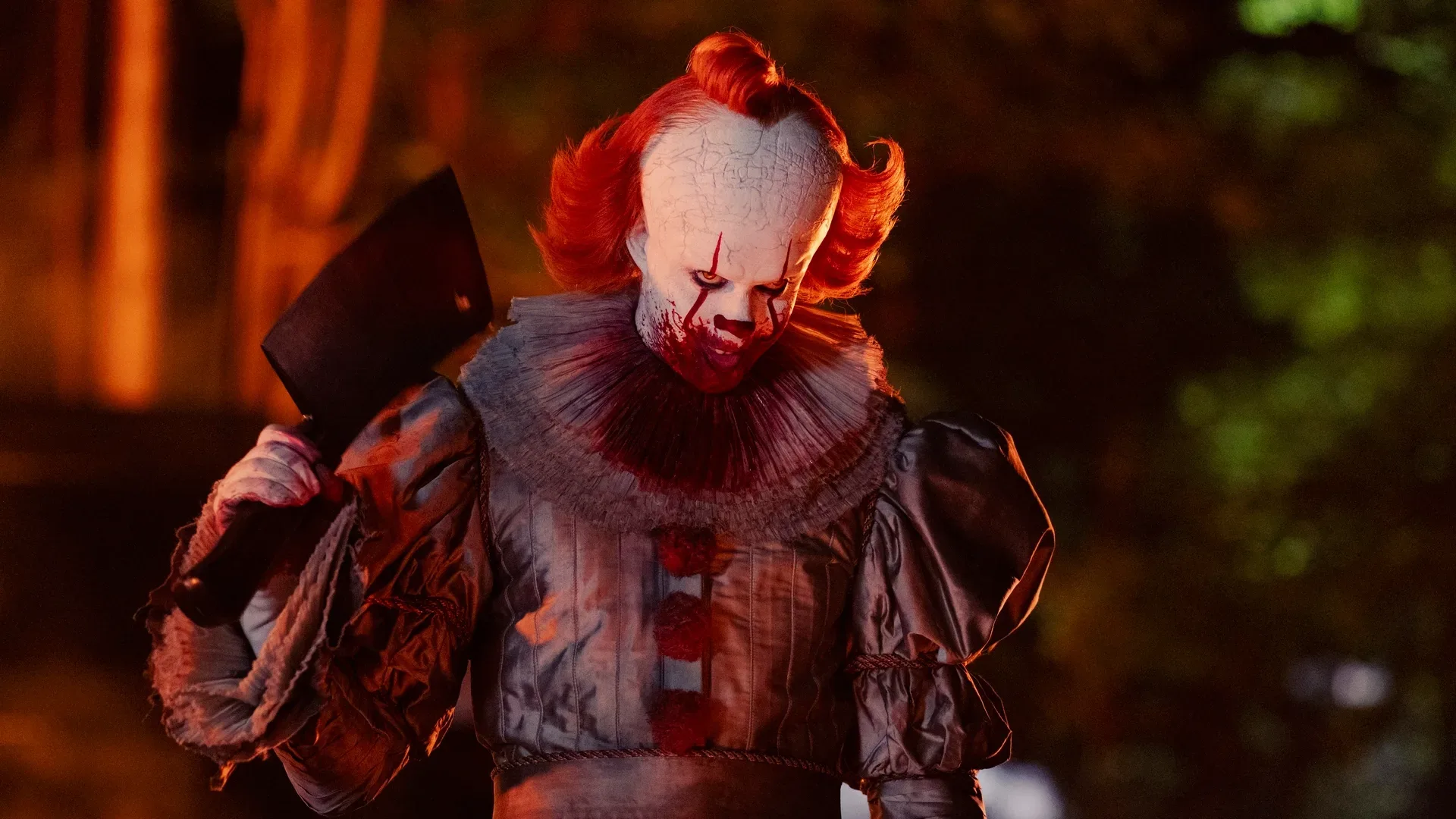
Tim Curry’s Pennywise remains one of horror’s most durable nightmares: a clown who could be funny, theatrical, inviting and deeply wrong, often within the same breath. More than 30 years after Curry first played the character in the 1990 television adaptation of Stephen King’s It, the role is still a major point of reference for every return trip to Derry.
That influence was on the minds of Andy and Barbara Muschietti, the sibling filmmakers behind the modern It film series and the television prequel It: Welcome to Derry. The pair reflected on Curry’s importance following his death on Aug. 25 from coronary artery disease. He was 80.
Barbara Muschietti described Curry’s legacy as extraordinary and spoke warmly about the connection between his work and the later creators who have continued exploring King’s fictional Maine town. Andy Muschietti likewise emphasized that Pennywise is only one part of a career that reached across cult musical cinema, studio comedy, animation, voice work and music.
For genre fans, that distinction matters. Curry’s Pennywise is inseparable from the childhood-TV terror attached to the 1990 adaptation, but his larger body of work is remarkably eclectic. His credits include The Rocky Horror Picture Show and Annie, alongside a substantial musical career. The legacy is not merely one frightening clown performance; it is the work of an actor whose boldness made outsized characters feel alive, unpredictable and specific.
Pennywise changes, Derry remains
The Muschiettis took on the formidable task of revisiting Pennywise in 2017, when their feature adaptation of It introduced Bill Skarsgård as the shape-shifting entity. Rather than attempting a replica of Curry’s interpretation, the new films established a different version of the character and a different cinematic texture for Derry. It Chapter Two followed in 2019, completing the film adaptation’s central story across two entries.
It: Welcome to Derry widens that framework by moving away from the familiar Losers’ Club timeline and into the town’s long, recurring history of catastrophe. It was developed for television by Andy and Barbara Muschietti with Jason Fuchs, who also worked on the recent It movies. The series is built around the grim premise that Derry’s horror did not begin with one group of children, nor does it end with them.
The first season debuted on HBO Max on Oct. 26, 2025. Set in 1962, it explored Derry’s prior encounter with Pennywise before the events depicted in the 2017 film. That setting provided an opportunity to examine a separate generation living under the town’s peculiar, dangerous cycle—a cycle whose terror is both supernatural and rooted in the community’s failures to acknowledge what is happening around it.
That long-view structure is especially appropriate for King’s mythology. In the novel, Derry’s history is layered with episodes of violence and disaster, with the town repeatedly seeming unable or unwilling to retain the full memory of its own wounds. Pennywise is a monster, certainly, but Derry’s recurring denial is part of the horror engine. A prequel can therefore function as more than lore delivery: it can show how the same malign force finds new eras, new social conditions and new ways to hide in plain sight.
Season 2 moves to the Bradley Gang Massacre
Season 2 has been renewed and will travel further back, to 1935. Its story will center on the Bradley Gang Massacre, involving a group of bank robbers who stop in Derry to purchase ammunition and instead encounter unimaginable horror. The event is drawn from one of the interludes in King’s novel, material that expands the book’s wider history beyond the main childhood-and-adulthood narrative.
Production on the second season had not yet begun when the Muschiettis discussed the project, and casting work was underway. That is an important boundary for fans parsing every bit of pre-production news: 1935 is the confirmed destination and the Bradley Gang event is the stated focus, but further casting or production particulars were not yet established.
Andy Muschietti has characterized the new season as a distinctly different world, one designed with surprises in store. He also suggested that viewers who connected with the first season should find even more to enjoy in Season 2. The leap from 1962 to 1935 is not just a change in wardrobe, vehicles and period detail. It places the story in a different cultural moment and makes room for the show to tackle Derry through another set of characters who have no idea what waits beneath their town.
The long-range plan previously described by the creative team calls for three seasons corresponding to Pennywise cycles in 1962, 1935 and 1908. If that plan continues as outlined, the series is essentially constructing a reverse excavation of Derry’s nightmares. Each season moves the audience farther from the 2017 movie’s immediate past while getting closer to older scars in the town’s history.
That approach also separates Welcome to Derry from a conventional continuation. The question is not simply what happened next after the films. It is what happened before, and how many times the town has been confronted with terror only for the truth to dissolve into local silence. A period-by-period design gives that idea narrative shape.
A shared-reality return for the 2017 film
The Muschiettis’ current Derry work also intersects with a new exhibition-style presentation of the 2017 It. They attended the opening night of It at Cosm in Los Angeles, where the film has been transformed into an immersive shared-reality experience.
For filmmakers, a new large-audience showing is an unusual second life for a completed film. Andy Muschietti praised the opportunity to put the movie in front of a crowd again and noted that the presentation itself offered something special. Barbara Muschietti said she would like to see the experience reach more cities around the United States, framing theatrical gathering as central to why movies are made.
The Cosm run is available at select locations and is scheduled to continue through Oct. 18. The presentation is another example of how established movies are increasingly being reintroduced as events rather than simply returned to a standard screen. In that respect, it shares a broad theatrical impulse with projects such as the return of Avengers: Endgame to theaters, even though the formats and franchises are entirely different.
For It, the setting has obvious potential in an immersive environment. Derry is not merely a backdrop; it is an active pressure system, a place whose streets, sewers, homes and public spaces can all feel subtly compromised. A shared-reality format may heighten the communal tension that horror audiences already bring to a packed screening: someone gasps, someone laughs nervously, and suddenly every viewer is aware that the room has collectively spotted the balloon.
A legacy that is bigger than one balloon
It is tempting to reduce a performer’s legacy to the role most closely attached to them, especially when that role has entered the permanent vocabulary of horror culture. But the Muschiettis’ remembrance points in a broader and more fitting direction. Curry’s work was flexible, musical, extravagant and memorable across genres. Pennywise endures because Curry committed to the character’s unsettling contradictions, not because he was confined to horror.
That history also provides useful context for the newer It era. Skarsgård’s Pennywise, the 2017 and 2019 films, and Welcome to Derry are not attempts to erase what came before. They are later movements in a property that has repeatedly found new forms: novel, miniseries, theatrical films, streaming prequel and now an immersive presentation.
Season 2’s shift to 1935 should offer the next substantial test of that adaptability. The Bradley Gang Massacre is a piece of King’s larger Derry mythology, and the series has a chance to turn that embedded history into a complete period horror story. With production still ahead and casting in progress, much remains unknown. What is clear is the direction: farther back in time, deeper into Derry’s cycles, and still under the long shadow of a clown performance horror audiences have never forgotten.